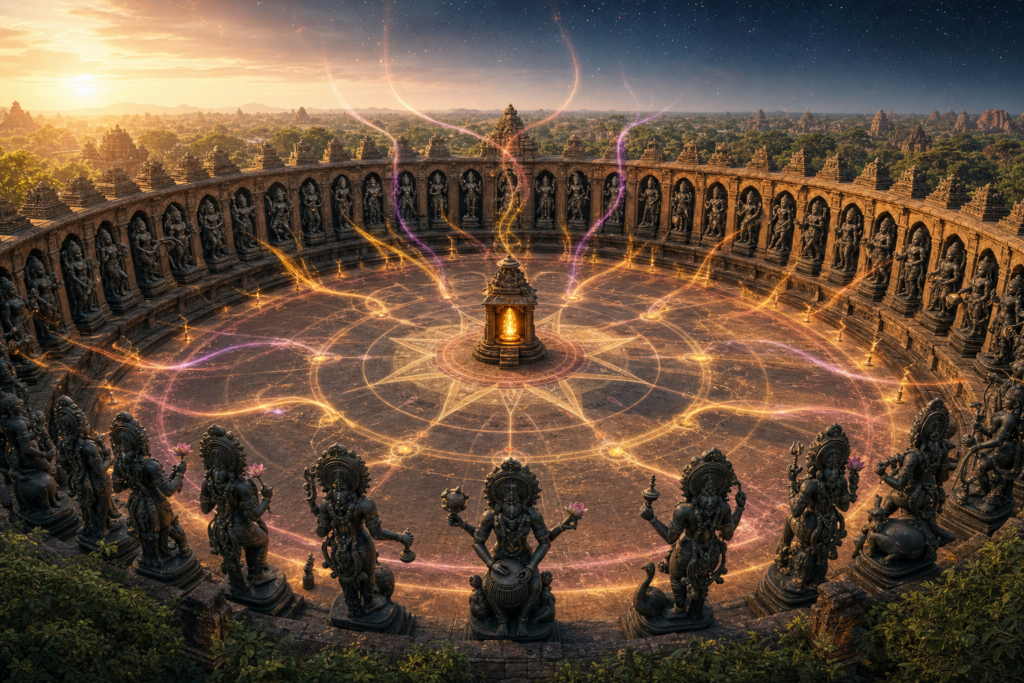
Within the classical Sankhya philosophy, the dynamic reciprocity of Purusha (consciousness) and Prakriti (primordial nature) articulates a foundational vision of reality. This vision, which regards existence as a harmonized interplay rather than a conflict of opposites, finds luminous expression in the sacred unions of Rama–Sita and Shiva–Shakti. These pairs function not merely as mythic figures, but as living symbols of cosmic completenessa template for inner integration, ethical balance, and social harmony across dharmic traditions.
Sankhya’s metaphysics explains that Purusha is pure witnessing awareness, while Prakriti is the creative matrix of all manifestation. Neither principle is complete in isolation; their creative tension underlies the emergence of mind, matter, and meaning. Through this lens, divine couples in Hindu narratives serve as pedagogical mirrors: they illuminate how consciousness and nature, insight and energy, presence and process, conjoin to form a coherent whole.
In the Shiva–Shakti paradigm, the inseparability of stillness and power is paramount. The icon of Ardhanārīśvara communicates a single reality expressed through complementary aspects, while the dictum often rendered as “Shiva without Shakti is shava” underscores the necessity of generative energy for conscious presence to become transformative. Here, ontology becomes ethics: wholeness entails recognizing, honoring, and integrating the full spectrum of being.
The Rama–Sita synthesis teaches a parallel lesson through the idiom of dharma. Rama, as Maryāda-Puruṣottama, embodies principled consciousness guided by ethical clarity, while Sita manifests resilient, life-affirming Shaktisteadfastness, moral insight, and compassionate strength. Their journey through exile and return illustrates how devotion, duty, and discernment interlace to uphold social order and personal integrity. As a symbol, their union presents dharma not as rigid rule, but as the art of balanced responsiveness rooted in inner alignment.
Comparable motifs surface across dharmic traditions. In Buddhist thought, particularly Vajrayāna, the union of prajñā (wisdom) and upāya (skillful means) parallels the Purusha–Prakriti synthesis as a method to realize non-dual awareness. Jain philosophy distinguishes jīva (sentient principle) from ajīva (non-sentient constituents), while guiding practice through the integrative triad of samyak darśana–jñāna–cāritra (right vision, knowledge, conduct). Sikh teachings emphasize Ik Onkar, the one undivided reality, and model a balanced integration through miri–piri (temporal and spiritual sovereignty). Collectively, these currents affirm a civilizational ethos: harmony arises from complementary unities, not uniformity.
These symbolic unions also map onto inner life. Psychologically, they invite the reconciliation of contemplation and creativity, clarity and compassion, resolve and receptivity. Ethically, they encourage individuals to cultivate discernment without hardness, and tenderness without indecision. Practically, they suggest a disciplined integration of understanding and actionmeditative steadiness guiding purposeful service.
Rituals and festivals deepen this integrative vision in lived practice. Mahāśivarātri contemplates stillness energized by devotion; Navarātri honors Shakti as the pulse of renewal; observances connected to Rama–Sita, such as Vivāha Pañcamī, celebrate relational harmony as a sacred discipline. Families and communities across regionsand within the diasporadraw on these observances to nurture unity, transmit values, and embody shared ethical aspirations.
In contemporary contexts, the symbolism is strikingly relevant. Leadership guided by wisdom (Purusha) must be animated by compassionate execution (Prakriti). Social policy that upholds principled order must also sustain the living fabric of community. Ecological stewardship benefits from seeing nature as sacred Shakti, calling for reverent, responsible action aligned with the wider web of life. In each sphere, completeness emerges when insight and energy converge.
Ultimately, Rama–Sita and Shiva–Shakti present a pedagogical grammar for wholenessan invitation to integrate inner awareness with outer action, and to recognize the dharmic kinship among Hindu, Buddhist, Jain, and Sikh traditions. By honoring these complementary unities, individuals and communities can cultivate inner balance, social concord, and a shared civilizational vision grounded in dignity, compassion, and wisdom.
Inspired by this post on Hindu Blog.