Month: June 2024

  • The Aryabhata Number System

    The Aryabhata Number System

    The **Aryabhata Number System** showcases the ingenuity of ancient Indian mathematicians, with Aryabhata inventing a unique method of numerical representation using Samskritam letters. His seminal work, the **Aryabhatiya**, composed in 499 CE, is divided into four sections covering astronomical constants, mathematics, time reckoning, and celestial geometry. Aryabhata’s notable contributions include the use of the decimal…

  • The Sprawling Heritage of the Hindu Legal System in Bali and Java

    The Sprawling Heritage of the Hindu Legal System in Bali and Java

    The Hindu cultural conquest of Southeast Asia remains unique in history. Ancient Indian colonists brought civilization, art, religion, and legal systems, profoundly influencing Bali and Java. This post explores how these regions voluntarily embraced and modeled their societies after Hindu culture, highlighting Nehru’s betrayal of these ancient ties.

  • Bharat: The Natural Home for Sanatanis (Hindus, Buddhists, Jains, and Sikhs)

    Bharat: The Natural Home for Sanatanis (Hindus, Buddhists, Jains, and Sikhs)

    “Bharat: The Natural Home for Sanatanis (Hindus, Buddhists, Jains, and Sikhs)” explores why India is the intrinsic homeland for these ancient religions. The post highlights India’s historical roots as the birthplace of these faiths, its rich cultural and spiritual heritage, and the preservation of ancient knowledge and texts. It emphasizes the socio-cultural practices and festivals…

  • The Poetry of Algebra: How India Contributed to the Logic of Indeterminate Equations

    The Poetry of Algebra: How India Contributed to the Logic of Indeterminate Equations

    This blog post explores the contributions of ancient Indian mathematicians Bhaskara, Brahmagupta, and Aryabhata to algebra, highlighting their work on indeterminate equations. It emphasizes the poetic beauty of algebra and its enduring legacy, connecting historical mathematical innovations to modern technology and the development of computers in India.

  • What is THE TRUTH?

    What is THE TRUTH?

    This blog post explores the concept of truth and its multifaceted nature. Using a story of students observing a tree differently, the post illustrates how each person’s understanding of truth is shaped by their unique perspective and experiences. It delves into the limitations of human abilities in comprehending the entirety of truth, drawing parallels with…

  • The Myth that Mohandas Gandhi Alone Delivered Freedom to India

    The Myth that Mohandas Gandhi Alone Delivered Freedom to India

    A hundred and fifty-four years after his birth, the legacy of Mohandas Karamchand Gandhi remains contested in India. Much of this uncertainty stems from extensive propaganda that has obscured vital truths about Gandhi as an activist, leader, politician, demagogue, and unlikely saint. One of the most enduring myths is encapsulated in the single word: Mahatma.…

  • From Sthula to Sukshma: The Journey of Spiritual Practice

    From Sthula to Sukshma: The Journey of Spiritual Practice

    This blog post explores the journey from gross to subtle in Sanatana Dharma through meditation and japa. It delves into the importance of increasing sattva, the role of chakras in Raja Yoga, and the progressive nature of spiritual practices, emphasizing focus and one-pointedness to achieve spiritual realization.

  • Meet Bahadur Yar Jung: A Hyderabadi Pioneer of Pakistan

    Meet Bahadur Yar Jung: A Hyderabadi Pioneer of Pakistan

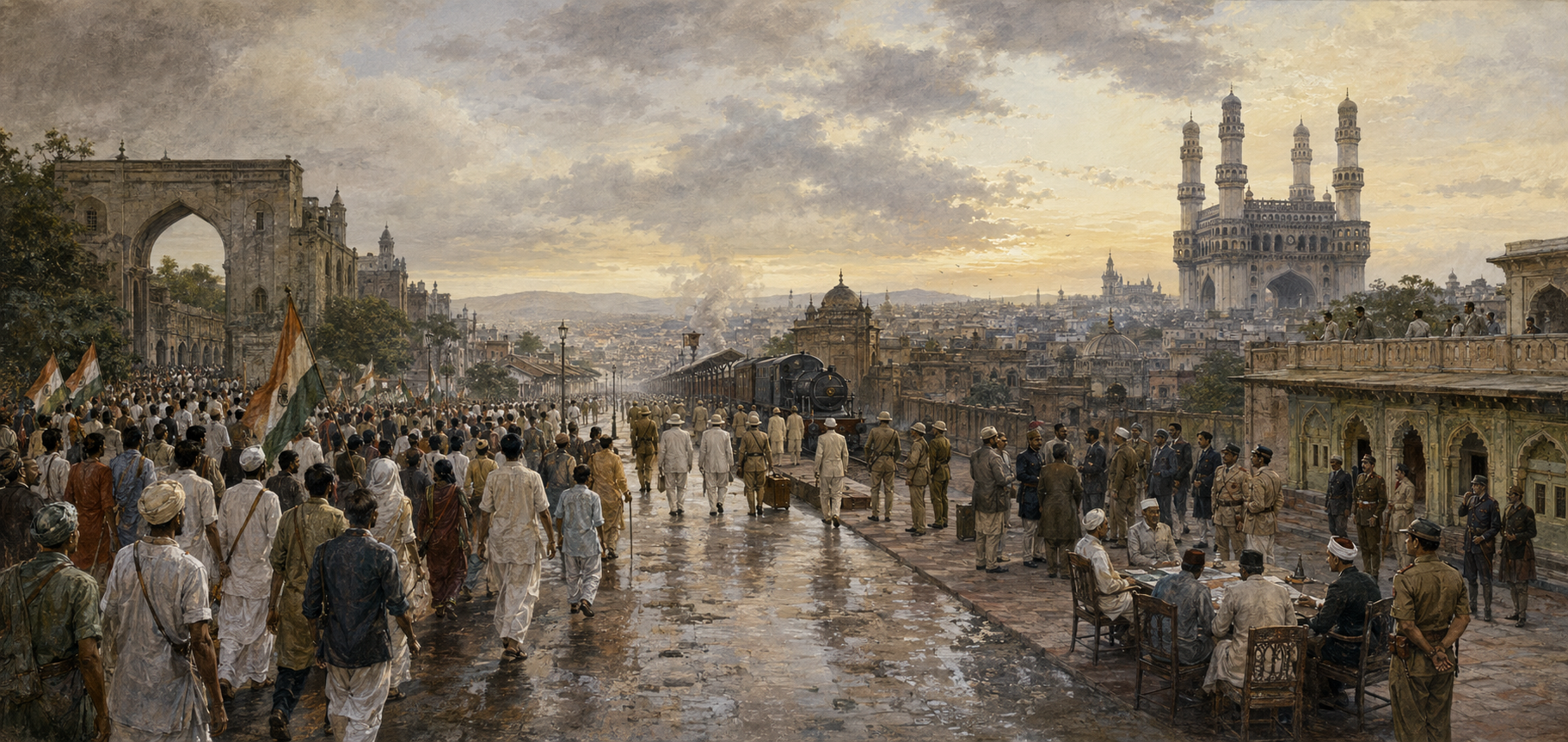
    Syed Muhammad Kasim Razvi, a fervent bigot, rose to power in Hyderabad under Nizam Mir Osman Ali. Razvi’s influence led to the persecution of Hindus and the establishment of an Islamic state. His rapid ascent and ruthless tactics dramatically reshaped the region’s political and religious landscape, leaving a lasting impact.

  • When Bakhtiyar Khalji Wiped out Gauda-Desa from Existence

    When Bakhtiyar Khalji Wiped out Gauda-Desa from Existence

    Bakhtiyar Khalji’s catastrophic devastation of the ancient city of Gaur marked a pinnacle in his career of plunder and genocide. Gaur, a historic center of Sanskrit learning and Hindu culture, was thoroughly obliterated, replaced by Islamic structures. This transformation permanently altered Bengal’s cultural and religious landscape, erasing its Sanatana past.