Category: History

  • Shivrajyabhishek 2026: Coronation of Chhatrapati Shivaji and the Dawn of Shivraj Shaka 353

    Shivrajyabhishek 2026: Coronation of Chhatrapati Shivaji and the Dawn of Shivraj Shaka 353

    Shivrajyabhishek 2026 commemorates the coronation of Chhatrapati Shivaji Maharaj on the lunar tithi of Shukla Paksha Trayodashi in Jyeshta Month. In 2026, the tithi falls on June 27 and begins Shivraj Shaka 353, while some public programs are scheduled for May 31 to broaden participation. The observance highlights how tithi-based dates differ from fixed Gregorian…

  • Inside Medieval Indo‑Islamic Chronicles: Rhetoric of Conquest, Bias, and Erased Lives

    Inside Medieval Indo‑Islamic Chronicles: Rhetoric of Conquest, Bias, and Erased Lives

    This long‑form analysis examines how medieval Indo‑Islamic court chroniclers crafted narratives of conquest, iconoclasm, and authority in India. Drawing on Al‑Utbi, Hasan Nizami, Ziauddin Barani, Amir Khusrau, and Minhaj‑us‑Siraj, it reproduces representative primary passages to show how panegyric and polemics shaped policy and public memory. It identifies two key traits: the elastic reframing of defeats…

  • Samiti and Sabha Unveiled: Vedic Roots of Democracy in Ancient Hindu Civilization

    Samiti and Sabha Unveiled: Vedic Roots of Democracy in Ancient Hindu Civilization

    Ancient India’s Vedic tradition preserved two hallmark assemblies—Samiti and Sabha—that balanced public participation with expert counsel. The Rigveda and Atharvaveda reference these bodies, which anchored governance to dharma and prioritized consensus, accountability, and communal welfare. Over time, their logic resonated through gana-sangha republics cited in Buddhist sources and through administrative codifications visible in medieval South…

  • Kalaram Mandir, Nashik: Sacred Origins, Peshwa-Era Grandeur, and the Legacy of Panchavati

    Kalaram Mandir, Nashik: Sacred Origins, Peshwa-Era Grandeur, and the Legacy of Panchavati

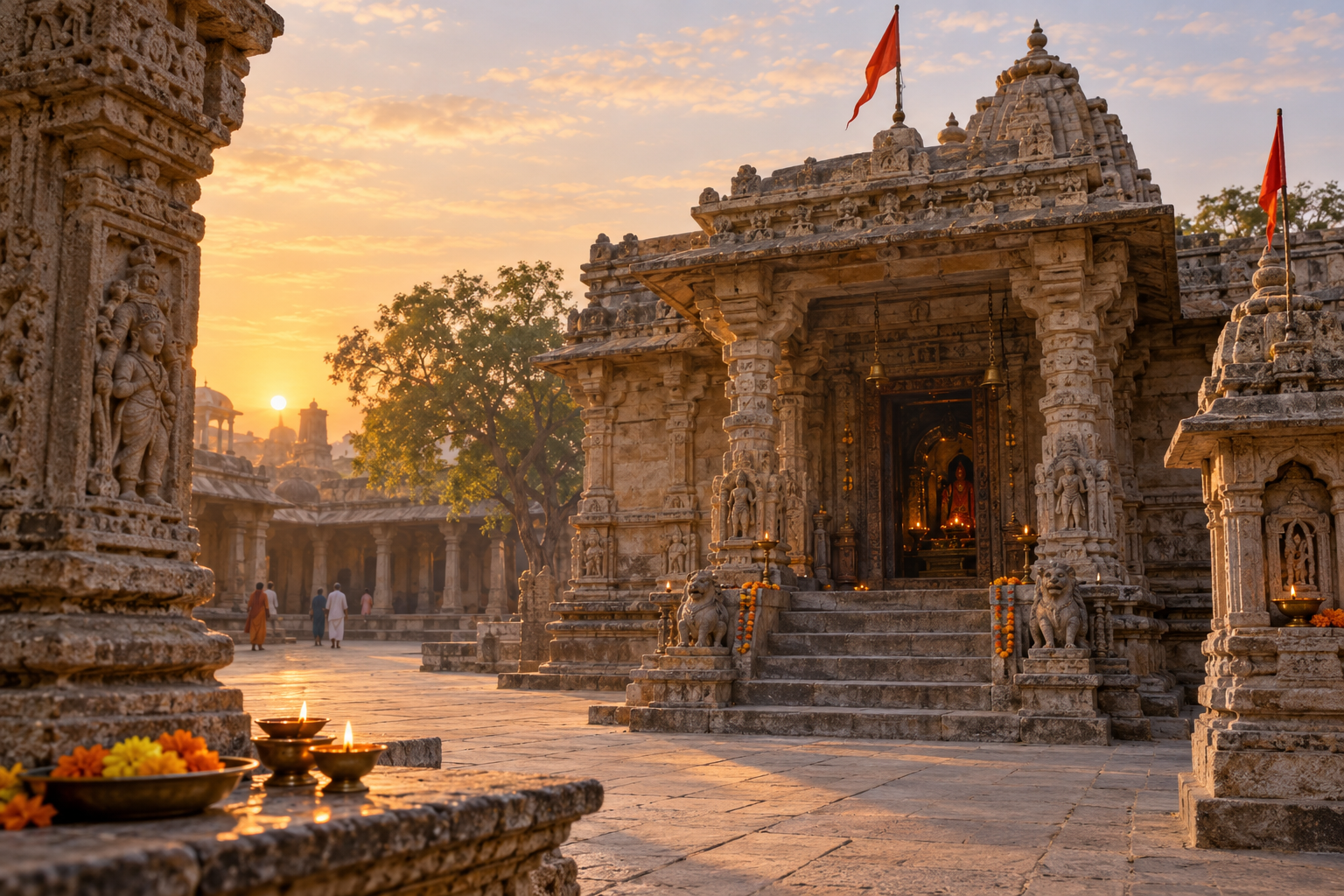
    Kalaram Mandir in Panchavati, Nashik, is a landmark of Rama-bhakti and Peshwa-era craftsmanship renowned for its black stone murti of Bhagavan Sri Rama with Mata Sita and Lakshmana. Local tradition venerates the deity as swayambhu, with the temple’s late-18th-century construction attributed to Sardar Rangarao Odhekar. Set within the Ramayana-rich landscape of Ramkund, Sita Gufa, and…

  • Bhai Kanhaiya Ji: Sevapanthi Saint Who Healed Friend and Foe, Inspiring Interfaith Unity

    Bhai Kanhaiya Ji: Sevapanthi Saint Who Healed Friend and Foe, Inspiring Interfaith Unity

    Bhai Kanhaiya Ji (1648–1718) is revered in Sikh history for serving water and aid to all the wounded—friend and foe—during the battles around Anandpur Sahib, earning explicit endorsement from Guru Gobind Singh. His example seeded the Sevapanthi tradition, which institutionalized non-sectarian seva through hospices, piyaus, and relief networks. This essay situates his life within the…

  • Smriti Chandrika: The Definitive 12th‑Century Dharmashastra Digest That Shaped Hindu Law

    Smriti Chandrika: The Definitive 12th‑Century Dharmashastra Digest That Shaped Hindu Law

    Smriti Chandrika (Smṛticandrikā), attributed to the 12th‑century South Indian scholar Devannabhatta, is a landmark Dharmashastra digest (nibandha) that shaped Hindu law in the Drāviḍa school. Distinguished by meticulous citations and minimal authorial intrusion, it consolidates earlier authorities on conduct (Achāra), life‑cycle rites (Saṃskāra), expiations (Prāyaścitta), ancestor rites and charity, and especially on legal procedure (Vyavahāra),…

  • Unmasking Medieval Indo-Persian Chronicles: How Propaganda and Piety Shaped India’s Memory

    Unmasking Medieval Indo-Persian Chronicles: How Propaganda and Piety Shaped India’s Memory

    Medieval Arabic and Persian court chronicles in India did more than list battles and dates—they engineered collective memory by merging piety, patronage, and propaganda. This analysis maps their genres (Sirah, Tabaqat, Tarikh, Malfuzat, Maghazi, Maktubat), clarifies how narratives framed Darul Harb and the Ghazi ideal, and explains why panegyric conventions celebrated conquest as sanctity. It…

  • Kon‑Tiki’s Daring Proof: 5,000 Miles on a Balsa Raft—and What It Revealed About Polynesia

    Kon‑Tiki’s Daring Proof: 5,000 Miles on a Balsa Raft—and What It Revealed About Polynesia

    Kon‑Tiki tested an audacious question in maritime history: could a prehistoric-style balsa raft ride Pacific currents from Peru to Eastern Polynesia? Built with period-faithful materials and steered by guara centerboards and a square sail, the raft launched in April 1947 and made landfall at Raroia after roughly 101 days, validating transport feasibility. The expedition proved…

  • Political Subjugation, Internal Faultlines, and Hindu Civilisation: An Evidence-Based Reappraisal

    Political Subjugation, Internal Faultlines, and Hindu Civilisation: An Evidence-Based Reappraisal

    UPSC Secretary Shashi Ranjan Kumar’s remarks—linking Hindu civilisation’s decline to political subjugation and internal shortcomings—have revived a vital debate. This evidence-based analysis distinguishes between transient state contraction and enduring civilisational continuity across Hinduism, Buddhism, Jainism, and Sikhism. It maps key turning points from the Delhi Sultanate and Mughal Empire to British Colonial Rule, while highlighting…

  • New Vrindaban’s Palace of Gold: A Living Testament to Devotion, Craft, and Dharmic Unity

    New Vrindaban’s Palace of Gold: A Living Testament to Devotion, Craft, and Dharmic Unity

    This long-form reflection examines New Vrindaban’s Palace of Gold in West Virginia, the focus of a second documentary by Vrsabhanu das. It traces the site’s evolution from a planned residence for Srila Prabhupada to a memorial shrine and cultural landmark within ISKCON. Readers gain a technical view of materials, methods, and process discipline—marble inlay, glass…

  • Sultan-ul-Qaum Jassa Singh Ahluwalia: Visionary Sikh Commander Who Forged Unity and Hope

    Sultan-ul-Qaum Jassa Singh Ahluwalia: Visionary Sikh Commander Who Forged Unity and Hope

    Sultan-ul-Qaum Jassa Singh Ahluwalia (1718–1783) led the Dal Khalsa through one of North India’s most turbulent centuries, transforming agile resistance into orderly governance. Elected at Sarbat Khalsa assemblies, he coordinated misl forces, protected trade and pilgrimage, and became renowned for rescuing abducted civilians during Afghan retreats. His Lahore coinage—Deg Tegh Fateh, Nusrat be-darang, yaft az…

  • Sikhs of Punjab: Khalsa Nationhood, Miri-Piri Sovereignty, and the Sacred Homeland

    Sikhs of Punjab: Khalsa Nationhood, Miri-Piri Sovereignty, and the Sacred Homeland

    This comprehensive essay examines the Sikhs of Punjab through three lenses: historical nationhood (qaum), religious sovereignty (miri-piri), and the homeland of the Khalsa. It traces the arc from Guru Nanak’s foundational institutions to the Khalsa discipline of 1699, through the Sikh misls and the inclusive statecraft of Maharaja Ranjit Singh, to modern constitutional arrangements and…

  • Inside the Impregnable: Golden Walls, Iron Gates, and Hanuman’s Reconnaissance of Lanka

    Inside the Impregnable: Golden Walls, Iron Gates, and Hanuman’s Reconnaissance of Lanka

    This long-form analysis situates Hanuman’s reconnaissance in the Yuddha Kāṇḍa of the Valmiki Ramayana as a precise military assessment of Lanka’s defenses. It explains Lanka as a classic jala-durga (water fort), where golden walls and iron gates combine spectacle with deterrence. Readers gain a technical view of fortification-in-depth, early-warning systems, ordnance such as śataghnī, and…

  • Unveiling Bhaujya: Aindra Mahabhisheka, Aitareya Brahmana, and the Power of Vedic Statecraft

    Unveiling Bhaujya: Aindra Mahabhisheka, Aitareya Brahmana, and the Power of Vedic Statecraft

    Bhaujya in the Aitareya Brahmana names both a system of governance and the oath-taking moment of the Aindra Mahabhisheka, where sovereignty is publicly bound to dharma. The celebrated sequence “samrajyam”, “bhaujyam”, “svarajyam”, “vairajya”, and “paramestya” maps layered forms of power—from self-rule to apex sovereignty—while insisting on ethical constraint. Read with Arthasastra and Dharmasastra, bhaujya emerges…

  • Decoding Medieval Islamicate Court Chronicles: Skills, Hijri Timekeeping, and How to Read Them Critically

    Decoding Medieval Islamicate Court Chronicles: Skills, Hijri Timekeeping, and How to Read Them Critically

    This essay decodes how medieval Islamicate court chronicles in India were made, why they date events from the Hijri era, and how their theological vocabulary shaped historical writing. It details the rigorous training of chroniclers in Quran, Hadis, Fiqh, Persian adab, and calligraphy, and explains their overlapping roles as jurists, advisers, and scribes. Through examples—Amir…

  • Unraveling the Indo-European Homeland: Evidence, Myths, and South Asia’s Living Heritage

    Unraveling the Indo-European Homeland: Evidence, Myths, and South Asia’s Living Heritage

    The search for the Indo-European homeland remains unsettled, but today it is informed by a stronger synthesis of comparative linguistics, archaeology, and ancient DNA. This article surveys the three leading proposals—Anatolian-Neolithic, South Caucasus, and Pontic-Caspian steppe—and distills J. P. Mallory’s critiques, including the problem of massive language shifts without clear archaeological correlates. It explains how…

  • Decoding the Dashagvas: Swift Angirasa Sages of the Rigveda and Their Living Legacy

    Decoding the Dashagvas: Swift Angirasa Sages of the Rigveda and Their Living Legacy

    The Dashagvas, remembered in the Rigveda as Angirasa-aligned priests, exemplify the Vedic fusion of disciplined speech, precise timing, and communal practice. Tradition pairs them with the Navagvas and links their names to nine- and ten-month sacrificial cycles that culminate in the release of light symbolized as cows and dawns. Rather than celebrating haste, their famed…

  • The War They Could Not Win: Dharmic Unity vs. Empire’s Cultural Offensive (Part 1)

    The War They Could Not Win: Dharmic Unity vs. Empire’s Cultural Offensive (Part 1)

    This long-form analysis reframes the nineteenth century as a hybrid struggle—military, legal, economic, educational, and narrative—between an expanding empire and a resilient, plural civilization. It situates the 1857 War of Independence within deeper structural transformations led by the British East India Company and subsequent Crown rule. The discussion explains how revenue settlements, legal codification, and…

  • The War They Could Not Win, Part 2: Strategy, Memory, and Dharmic Civilizational Resilience

    The War They Could Not Win, Part 2: Strategy, Memory, and Dharmic Civilizational Resilience

    This long-form analysis explains why certain campaigns in Indian history became unwinnable at the level of legitimacy, memory, and cultural continuity. Drawing on Clausewitz and Kautilya, it shows how consent—not mere control—determines durable victory. The piece outlines how dharmic traditions—Hinduism, Buddhism, Jainism, and Sikhism—created resilient social architectures through values like dharma, ahimsa, seva, and anekantavada.…

  • The War They Could Not Win, Part 3: How Dharmic Pluralism Defied Empire and Ideology

    The War They Could Not Win, Part 3: How Dharmic Pluralism Defied Empire and Ideology

    This installment analyzes why attempts to homogenize the subcontinent’s diverse religious and cultural life repeatedly failed. It shows how dharmic pluralism—Ishta in Hindu Dharma, Anekantavada in Jainism, upāya in Buddhism, and seva in Sikhism—functioned as a civilizational architecture of resilience. The discussion traces colonial knowledge projects, legal codification, and endowment management, and explains how communities…