Tag: Unity in Diversity

  • Panchajana Explained: The Powerful Fivefold Vision Across Hindu Scriptures

    Panchajana Explained: The Powerful Fivefold Vision Across Hindu Scriptures

    Panchajana is commonly translated as the five peoples or five classes of beings, but Hindu scriptures do not preserve only one universal list. This study traces the term from its Rigvedic ritual and social setting through Brāhmaṇa literature, the Nirukta, the Upanishads, and Vedānta commentary. It carefully examines the popular model of devas, humans, ancestors,…

  • The Liberating Power of Hare Krishna Chanting Across London’s Diverse Streets

    The Liberating Power of Hare Krishna Chanting Across London’s Diverse Streets

    Public Hare Krishna chanting in London is examined as a devotional practice, an attentional discipline and a form of collective music-making. The article explains the mantra’s Gaudiya Vaishnava meaning while carefully distinguishing spiritual liberation from measurable psychological effects. It traces the movement’s London history from the arrival of devotees in 1968 to its chart success,…

  • Vedic Varna Exposed: A Powerful Dharmic Case Against Caste by Birth

    Vedic Varna Exposed: A Powerful Dharmic Case Against Caste by Birth

    This article examines the Vedic and Dharmic argument that caste by birth is unjust and spiritually misleading. It explains the difference between jati as birth-community and varna as a framework based on guna, karma, qualities, duties, and conduct. Drawing from the Bhagavad Gita, Bhavishya Purana, Shri Ramcharitmanas, and broader Dharmic principles, it shows that character…

  • Equality of the Soul: A Powerful Interfaith Reading of Vedas and Jewish Wisdom

    Equality of the Soul: A Powerful Interfaith Reading of Vedas and Jewish Wisdom

    This rewritten study presents a rigorous, accessible exploration of the spiritual parallels between Vedic philosophy and Jewish mystical tradition. It focuses on equality based on the soul, showing how the Bhagavad-gita, Srimad-Bhagavatam, Torah, Zohar, Bahir, Talmud, and Sefer Yetzirah can be read in dialogue without erasing their differences. The article explains dharma, karma, reincarnation, guru-parampara,…

  • In the Loop with Aniruddha Dasa: Powerful Lessons from Folk Culture and Festivals

    In the Loop with Aniruddha Dasa: Powerful Lessons from Folk Culture and Festivals

    This article develops the theme of “In The Loop, Education, Folk News, Festivals – Aniruddha Dasa” into a detailed academic reflection on dharmic cultural education. It explains how festivals, folk traditions, temple practices, oral storytelling, kirtan, seva, and community news function as living classrooms. The discussion highlights the shared civilizational values of Hinduism, Buddhism, Jainism,…

  • The Transformative Birthday Gift Guru Nanak Would Ask From Every Seeker Today

    The Transformative Birthday Gift Guru Nanak Would Ask From Every Seeker Today

    Guru Nanak’s birthday is best understood not as a call for external offerings, but as an invitation to inner transformation. His teachings ask society to offer truthfulness, honest labor, sharing, humility, and selfless service as the most meaningful gifts. The article explains the ethical force of Naam Japna, Kirat Karni, Vand Chakna, seva, sangat, pangat,…

  • Prasthānas, Advaita, and the Powerful Unifying Vision of Bhāratīya Wisdom

    Prasthānas, Advaita, and the Powerful Unifying Vision of Bhāratīya Wisdom

    Śrī Madhusūdana Sarasvatī’s Prasthānabheda offers a powerful way to understand the diversity of Bhāratīya philosophical traditions without reducing them to contradiction. Its closing vision argues that the various prasthānas were composed by wise munis who taught according to the readiness of different seekers. The article explains how this framework culminates in Advaita Vedānta and the…

  • Powerful Hindu Wisdom: Different Cows, One Milk, and the Unity Beneath Diversity

    Powerful Hindu Wisdom: Different Cows, One Milk, and the Unity Beneath Diversity

    The teaching “Cows come in different colors but milk of all cows is one color” offers a powerful Hindu reflection on unity in diversity. It explains that outward differences in appearance, culture, sect, language, and spiritual practice need not obscure a deeper shared reality. The metaphor is rooted in everyday life, making complex ideas such…

  • Why Preserving Dharmic Culture Is Essential for Knowledge, Identity, and Unity

    Why Preserving Dharmic Culture Is Essential for Knowledge, Identity, and Unity

    Preserving culture is essential because it protects the memory, wisdom, ethics, and spiritual depth of a civilization. Vedic culture and the wider Dharmic traditions of Hinduism, Buddhism, Jainism, and Sikhism offer enduring frameworks for duty, self-discipline, compassion, knowledge, and liberation. Cultural preservation does not mean rejecting modernity; it means engaging the modern world with rooted…

  • Respect as Sacred Discipline: A Powerful Dharmic Framework for Unity and Dialogue

    Respect as Sacred Discipline: A Powerful Dharmic Framework for Unity and Dialogue

    This rewritten article develops the theme of “Respect Seminar, Part 1” into a comprehensive academic reflection on respect as a Dharmic discipline. It explains how Hinduism, Buddhism, Jainism, and Sikhism each offer powerful ethical frameworks for dignity, dialogue, humility, and social harmony. The piece distinguishes respect from mere politeness and shows how it functions cognitively,…

  • Awakening Unity Through the Bhagavad Gita: Divine Love, Bhakti, and Truth

    Awakening Unity Through the Bhagavad Gita: Divine Love, Bhakti, and Truth

    The Bhagavad-gita presents human life as a rare opportunity for self-inquiry, spiritual discipline, and God-realisation. Its vision of unity teaches that all beings are eternal souls connected to the Supreme and deserving of dignity, compassion, and responsibility. Through “sastra-caksu,” the trained vision of scripture, the seeker learns to see beyond fragmented sensory perception and recognize…

  • India, Hinduism, and the Powerful Freedom of Dharmic Pluralism and Insight

    India, Hinduism, and the Powerful Freedom of Dharmic Pluralism and Insight

    This reflection presents India and Hinduism as living civilizational realities rather than fixed systems that can be reduced to ritual, geography, or linear history. It explains why Indian traditions often preserve memory through symbols, narratives, philosophy, sacred geography, and direct experience as much as through dates and documents. The essay explores Hinduism’s decentralized structure, its…

  • Evolving Consciousness and Dharmic Unity: Powerful Lessons from Living Systems

    Evolving Consciousness and Dharmic Unity: Powerful Lessons from Living Systems

    This long-form reflection examines consciousness, evolution, and Dharmic unity through the metaphor of human beings as conscious cells in a larger living body. It connects biological evolution, LUCA, multicellularity, ecological crisis, and social transformation with the shared wisdom of Hinduism, Buddhism, Jainism, and Sikhism. The piece explains that unity does not require sameness; healthy systems…

  • America at 250: The Powerful Dharmic Roots Hidden in Its Founding Vision

    America at 250: The Powerful Dharmic Roots Hidden in Its Founding Vision

    America’s 250th anniversary offers an opportunity to revisit the deeper roots of its founding vision of religious freedom and pluralism. Hinduism is often treated as a recent immigrant tradition in the United States, but Hindu thought and Indian civilizational models were already visible to eighteenth-century intellectuals. Texts such as A Code of Gentoo Laws and…

  • London Joins the Hare Krishna Mantra: Powerful Lessons in Bhakti and Unity

    London Joins the Hare Krishna Mantra: Powerful Lessons in Bhakti and Unity

    London’s public chanting of the Hare Krishna mantra on 20 June 2026 reflects a powerful meeting of bhakti, diaspora identity, and urban spiritual culture. The event highlights how sacred sound can transform public space into a shared field of devotion, reflection, and community. The Hare Krishna Mahamantra is rooted in Gaudiya Vaishnava theology, yet its…

  • Why Hinduism Offers Many Powerful Spiritual Paths for Every Kind of Seeker

    Why Hinduism Offers Many Powerful Spiritual Paths for Every Kind of Seeker

    Hinduism recognizes that spiritual growth cannot be identical for every person because human beings differ in temperament, capacity, duty, and life situation. This article explains how concepts such as adhikara, svadharma, the three gunas, Ishta Devata, Karma Yoga, Bhakti Yoga, Jnana Yoga, and Raja Yoga support a plural yet disciplined spiritual vision. It shows that…

  • Panchopakas in Hinduism: Powerful Unity Behind Five Sacred Paths of Devotion

    Panchopakas in Hinduism: Powerful Unity Behind Five Sacred Paths of Devotion

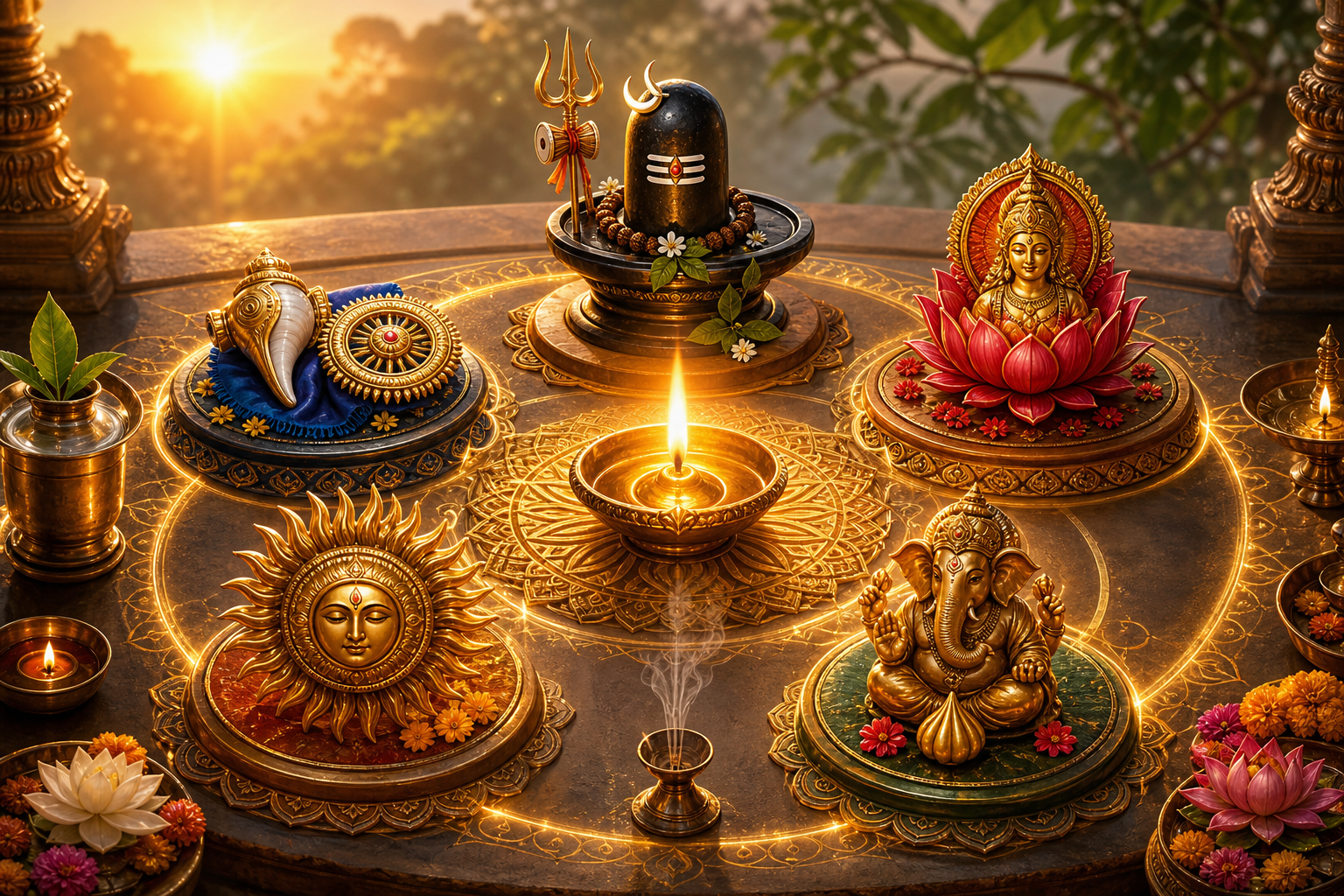
    Panchopakas, also understood through Panchopasana and Panchayatana Puja, presents a powerful Hindu model of unity through five sacred paths. It honors Shiva, Vishnu, Devi, Surya, and Ganesha as distinct yet harmonious approaches to the Divine. The concept explains how Hinduism can sustain deep devotional diversity without losing philosophical coherence. It also clarifies the role of…

  • 6-Hour Kirtan in London: Commemorating 60 Years of ISKCON with Soul-Stirring Sankirtan (21 June 2026)

    6-Hour Kirtan in London: Commemorating 60 Years of ISKCON with Soul-Stirring Sankirtan (21 June 2026)

    On Sunday, 21 June 2026, ISKCON London Radha-Krishna Temple hosts a 6-Hour Kirtan to commemorate 60 years of ISKCON (1966–2026). The event aligns with International Yoga Day, underscoring the shared aims of yoga and kirtan: inner clarity, compassion, and collective well-being. Rooted in Gaudiya Vaishnavism and praised in the Bhagavata Purana, sankirtana leverages the maha-mantra…

  • Terrace Tales: A Liminal Space Where Stories, Memory, and Dharma Transcend Language

    Terrace Tales: A Liminal Space Where Stories, Memory, and Dharma Transcend Language

    Terrace Tales is examined as a book where the everyday South Asian terrace becomes a liminal space that enables stories to transcend language through gesture, sound, memory, and ritual. The analysis emphasizes how multimodal narrative strategiesvisual cues, translanguaging, and soundscapessupport comprehension across linguistic communities. It highlights Dharmic unity by drawing ethical through-lines from Hinduism, Buddhism,…

  • In Kali Yuga’s Shadow, Karuṇā Shines: The Dharma of Empathy for Collective Survival

    In Kali Yuga’s Shadow, Karuṇā Shines: The Dharma of Empathy for Collective Survival

    Kali Yuga accentuates speed, scarcity, and social fragmentation, making empathy not just virtuous but vital. Drawing on Hinduism, Buddhism, Jainism, and Sikhism, this essay frames karuṇā as strategic dharmaethically right and instrumentally wise. It grounds empathy in the Bhagavad Gita, Anekantavada, Brahmavihāra practice, and Sikh seva, aligning with the civilizational ideal of Vasudhaiva Kutumbakam. Contemporary…