The complete body of films documenting Srila Prabhupada and ISKCON from 1965 to 1977 has been meticulously transferred and restored in 4K. This preservation initiative follows archival best practices—wet-gate scanning, high bit-depth log masters, audio restoration, and OAIS-aligned storage—to protect authenticity while improving clarity. Scholars gain reliable primary sources with rich metadata, time-coded transcripts, and…

The Sri Caitanya Mahaprabhu Tree is a precise Gaudiya Vaishnava metaphor for how divine love becomes a living tradition. Rooted in scripture and embodied by saintly exemplars, it unfolds through three great trunks—Nityānanda, Advaita, and Gadādhara—into innumerable branches that nourish communities via kīrtana, study, and service. Śrīla Prabhupāda’s emphasis on remembering the names of Vaiṣṇavas…

Triranga Darshanam links three celebrated Ranganatha temples—Srirangapatna, Shivanasamudra, and Srirangam—along the Kaveri in a disciplined one-day pilgrimage. This master guide explains the yatra’s theological roots in Sri Vaishnavism, its inclusive dharmic ethos, and its living Agamic traditions. Readers gain a practical, time-bound itinerary with seasonal advice, typical darshan windows, and transport strategies from Karnataka into…

A Bond of Love Interview Series—Part 3 features HG Jagattarini dasi in a rigorous yet compassionate exploration of guru-bhakti, Vaishnavi leadership, and the pedagogy of devotional art. The discussion situates personal experience within Gaudiya Vaishnava theology, highlighting scriptural anchors such as Bhagavad-gita 4.34 and Śrīmad-Bhāgavatam 1.2.6. It explains how The Sacred India Gallery’s Vrindavan Experience…

In Amstelveen on 1 June 2026, Svayam Bhagavan Keshava Maharaja explored how money becomes meaningful when guided by dharma. The session reframed wealth as a neutral force shaped by intention, aligning artha with ethical action through karma-yoga and stewardship. Unifying principles from Buddhism, Jainism, and Sikhism—Right Livelihood, Aparigraha, Kirat Karni, Vand Chhakna, and dāsvandh—offered a…

Drawing on the Sanskrit root √kram, this article explains how “kranta” (krānta) evolves in Tantric thought from a simple act of stepping into a precise science of sacred demarcation. It shows how maṇḍalas, Vāstu Puruṣa Maṇḍala, and temple architecture encode cosmic order into measured, traversable space. Readers gain a clear framework for understanding mantra, mudrā,…

Hindu practice distinguishes between Kuladevata (lineage deity) and Paradevata (the transcendent or sectarian Supreme), terms often mistaken for each other or for Ishta Devata. Understanding this sacred difference brings coherence to daily puja, anchoring gratitude to ancestry while pursuing ultimate realization. Kuladevata worship preserves kinship memory, social ethics, and stability through pilgrimages, vratas, and rites…

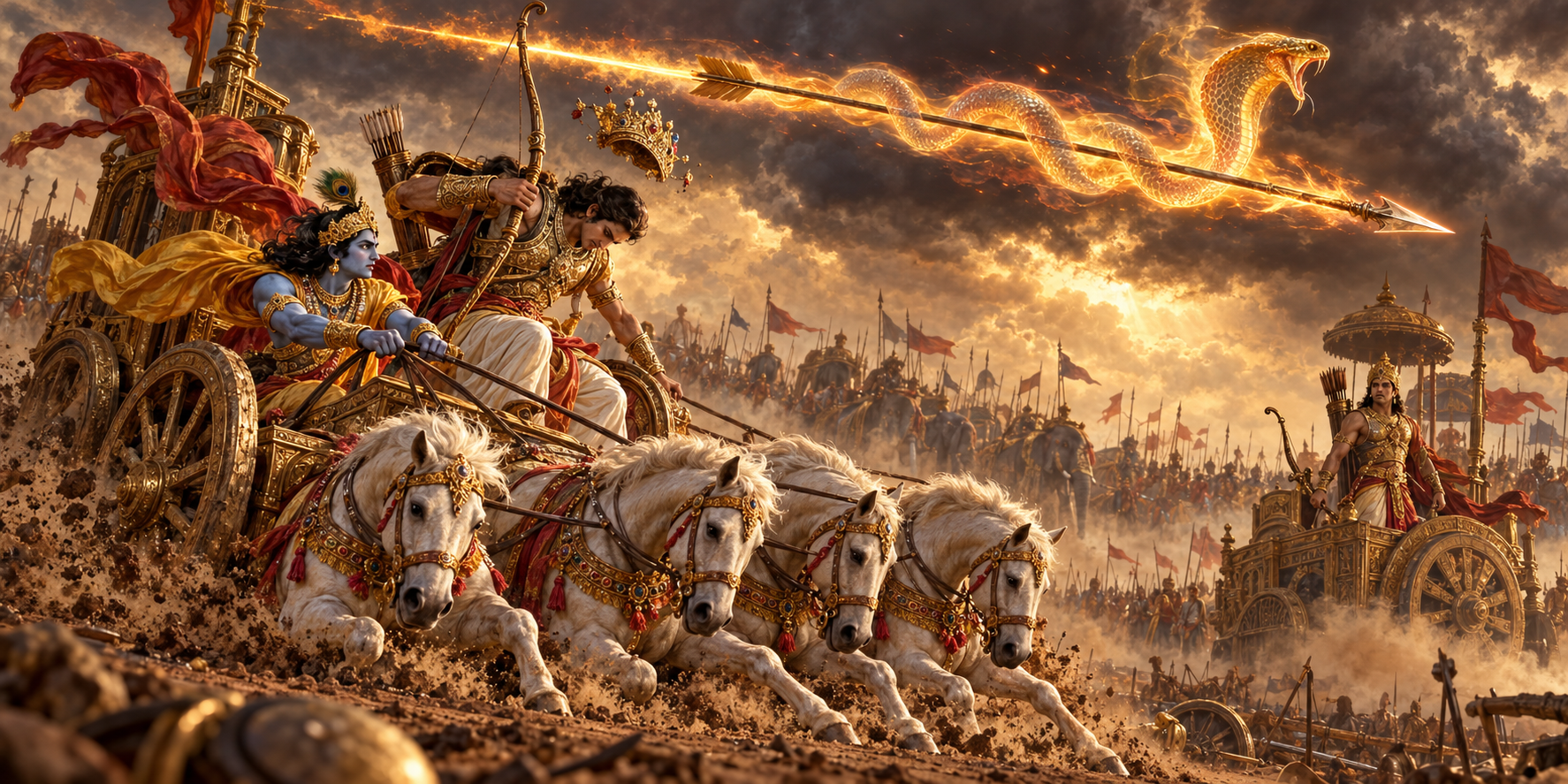
Arjuna’s ascent to Indrakeel Mountain in the Mahabharata is a precise syllabus in responsibility: tapas to steady desire, Shiva’s sanction to regulate technique, and Indra’s counsel to align power with purpose. Rooted in the Vana Parva and celebrated in Kirata Parva traditions, the episode shows how brahma-tejas must govern kshatra-tejas. The narrative affirms a principle…

A three-day immersion at the Middle East Forum’s 2026 conference provided rigorous, real-world lessons in nuclear nonproliferation, counter-extremism, and policy advocacy. Serving in an IAEA role during a crisis simulation, Suraj Pandit stress-tested safeguards, verification, and de-escalation tools relevant to the Middle East’s complex security landscape. Expert panels distinguished faith from political extremism, emphasizing precise,…

Hindu philosophy provides a precise, time-tested method for discerning between wholesome and unwholesome thoughts using tools from Vedanta, the Bhagavad Gita, and the Yoga Sutra. The framework integrates nitya–anitya–viveka, guna diagnostics, and pratipaksha–bhavana to remodel mental habits at the root. Case studies from the Ramayana illustrate how sattva stabilizes action under pressure while rajas and…

Thursday, June 18, 2026 transitions from Shukla Paksha Tritiya at 01:40 to Shukla Paksha Chaturthi for the remainder of the day, making it a strong date for Vinayaka Chaturthi observances. This guide explains tithi mechanics, how Panchang elements (nakshatra, rashi, yoga, karana) are computed, and why civil dates can host multiple tithis. It outlines practical…

An FIR has reportedly been registered in Nerul, Navi Mumbai after allegations that small idols of Hindu deities were placed near a shoe stand in a hospital, prompting a sensitive investigation. This analysis explains the constitutional and penal law framework (Article 25, IPC Sections 295/295A/298) and why courts require deliberate, malicious intent for criminal liability.…

A striking Mahabharata motif recounts a Rakshas warning Duryodhana of Indra’s plan to strip Karna of his birth armor and earrings. Read alongside the Udyoga Parva’s canonical account of Indra’s disguised petition, this version highlights the epic’s multivocality and the tension between strategic counsel and unbreakable personal vows. Karna’s dana-vrata leads him to exchange his…

A trusted mentor’s blunt observation—“You’re seeing yourself as a victim”—ignited a rigorous shift from a victim mindset to stewardship. This long-form reflection maps that shift onto research in locus of control, learned helplessness, growth mindset, and adaptive leadership. It also aligns the practice of stewardship with dharmic principles across Hinduism, Buddhism, Jainism, and Sikhism: Dharma,…

At the Grand Hindu Convention in Wing, Ku. Kranti Petkar (HJS) urged a renewed, law-abiding pride in Dharma that strengthens Hindu Unity while honoring the broader dharmic family—Hinduism, Buddhism, Jainism, and Sikhism. This analysis frames the call as a constitutional, ethical, and community-centered agenda that advances pluralism and public safety. It outlines practical Counterextremism steps…

An entrepreneurs’ session in Kolhapur, Maharashtra examined the expanding “Halal economy” within India’s secular constitutional framework. This analysis reframes the debate in terms of economics, law, and supply-chain design to help traders and MSMEs navigate certification-driven markets. It details how Halal, Kosher, vegetarian/vegan, organic, and jhatka assurances can coexist as voluntary, transparent signals. It outlines…

This in-depth exploration clarifies how Mimamsa and Vaisheshika—two classical Hindu darshanas—define and operationalize dharma in distinct yet complementary ways. Mimamsa establishes the scriptural authority and hermeneutics of duty, introducing apūrva as the unseen link between rite and result. Vaisheshika supplies the ontological grammar and moral causality through adṛṣṭa, defining dharma as the cause of both…

Ancient India developed a distinct historiography that privileged timeless truth over exhaustive chronologies. Rather than ignoring the past, Hinduism, Buddhism, Jainism, and Sikhism embedded history in genres like Itihāsa, Purāṇa, and Śāstra to illuminate Dharma and guide conduct. Epigraphy, coins, and temple records demonstrate rigorous documentation when it served justice, patronage, and community welfare. Examples…

John Richardson’s arc from The Rubettes’ 1970s chart success to Jayadev in the Hare Krishna tradition illustrates how fame and spiritual practice can be meaningfully integrated. Introduced to the Bhagavad Gita and kirtan by an Indian neighbour, he found bhakti-yoga a rigorous, practical framework for calming the mind and redefining purpose. The piece explains the…

The Navina-nirada Sankirtan Seminar, featured on ISKCON NYC TV, explores nama-sankirtana through theology, musicology, and contemporary practice. It clarifies why the Bhakti image of the “new raincloud” aptly frames kirtan as renewal for body and mind. Readers gain technical guidance on voice, breath, tempo, and instrumentation, alongside practical tips for digital broadcast and event facilitation.…

On 10 June 2026, authorities in Sambhal, Uttar Pradesh, demolished an unauthorised structure identified locally as a mosque and registered an FIR against eight individuals after recovering ‘I Love Mohammad’ posters and other printed materials. This analysis explains what happened, the legal framework for clearing illegal religious constructions, and the criminal-law tests that distinguish protected…

The Nathpanthis (Kanphata Yogis) can be respectfully identified by a constellation of signs—split-ear kundalas, tripundra ash, rudraksha malas, jata, austere robes, and mantric salutations such as “Alakh Niranjan” and “Adesh.” This long-form guide explains what each marker means, how it functions within Shaivite practice, and how Nath monastic settings (mathas, akharas, dhunis) provide context. It…

ISKCON Los Angeles has unveiled a master plan to guide the New Dvaraka campus toward a sustainable, inclusive, and resilient future. The framework integrates sacred architecture with modern codes, accessibility, and environmental performance while safeguarding heritage. Anticipated upgrades include improved worship halls, educational spaces, and a hospitality system supporting prasadam distribution and vegetarian outreach. Mobility,…
Categories
Archive