
The essential answer
Kanvariyas offer Gangajal at Baba Baidyanath Dham in Deoghar during Shravan because the pilgrimage unites three sacred elements: water from the Ganga, the season traditionally dedicated to Lord Shiva, and worship at one of the twelve Jyotirlingas. The offering is understood as jala abhisheka, the ritual bathing of the Shivalinga with water. Regional tradition also remembers Lord Rama as an exemplary early pilgrim who carried Ganga water from Sultanganj to Babadham, while the story of Shiva as Neelkantha explains why cooling and purifying substances are offered to him during Shravan. The Kanwar Yatra therefore expresses far more than the physical transfer of water. It is a disciplined journey in which geography, mythology, bodily effort, communal service, and personal devotion converge.
Who are the Kanvariyas?
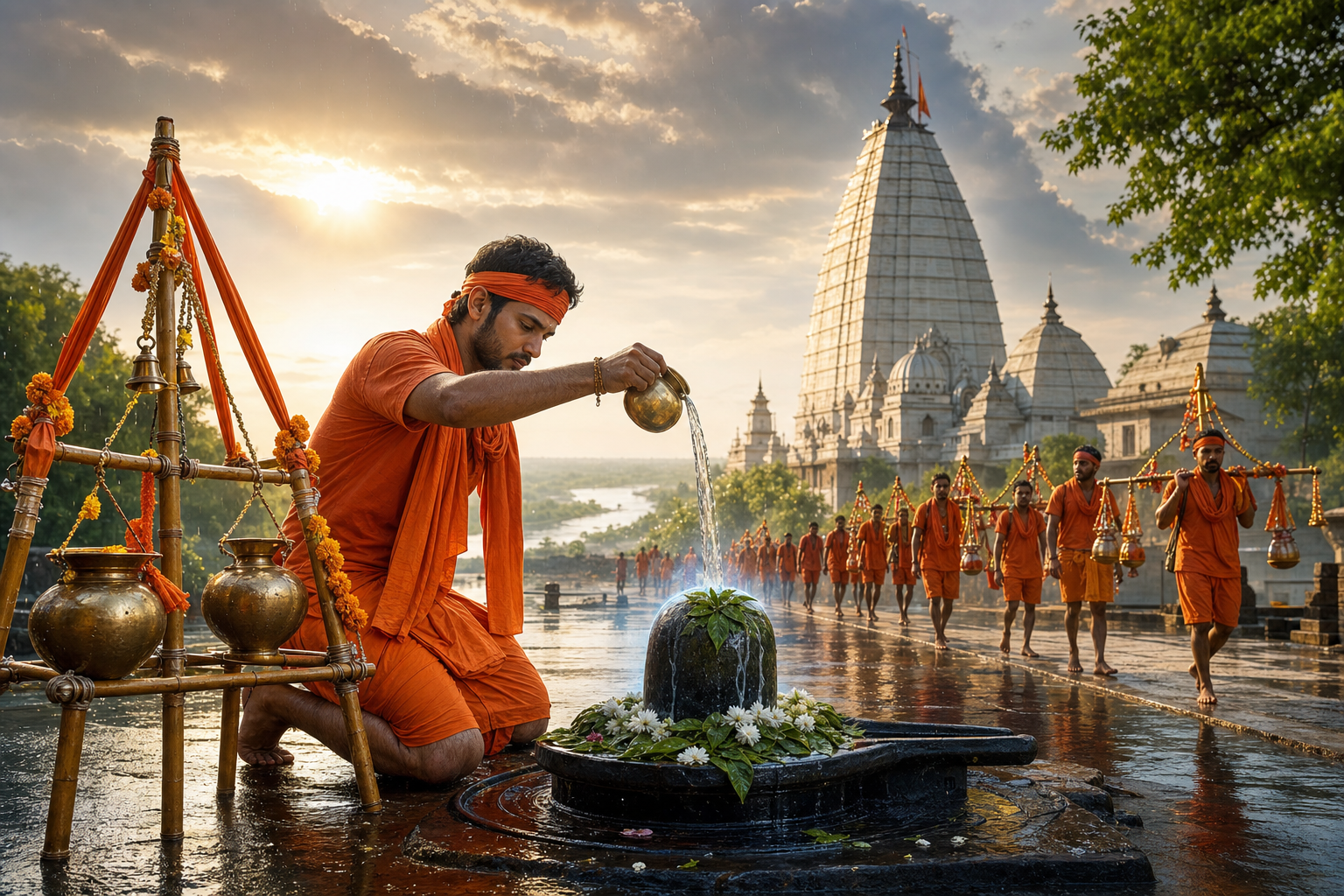
Kanvariyas, also written as Kanwariyas or Kānvariyas, are devotees who carry sacred water in a kanwar for presentation at a Shiva shrine. A traditional kanwar is a balanced shoulder-yoke, commonly made from bamboo or another lightweight material, with water vessels suspended from its two ends. Balancing the containers distributes their weight across the pilgrim’s shoulders and helps prevent unnecessary movement or spillage. The object is practical, but it is also ritualized: once it holds Gangajal, many devotees treat it as sacred, avoid placing it directly on the ground, and suspend it from designated stands while resting. Particular disciplines vary according to family custom, local practice, spiritual teacher, and the form of the vow undertaken.
The word Kanvariya consequently denotes more than a traveller carrying two containers. It identifies a pilgrim who has accepted a temporary rule of life. Walking, restraint, chanting, bathing, food discipline, mutual assistance, and the protection of the water all become parts of a single religious undertaking. This integration of intention and action is central to understanding why the final offering at Deoghar carries such emotional force. What reaches the Shivalinga is materially water, but devotion interprets it as the concentrated fruit of the entire journey.
Why Deoghar and Baba Baidyanath Dham matter
Deoghar, in present-day Jharkhand, is also known as Baidyanath Dham, Baba Dham, or Babadham. Baba Baidyanath is revered as one of the twelve Jyotirlingas, the major sacred manifestations of Shiva worshipped across India. The Deoghar District Administration’s account of the city also identifies the area with a Shakti Peetha and emphasizes the unusual proximity of Jyotirlinga and Shakti traditions. This association gives the site a theological completeness: Shiva is not approached as an isolated deity but in relation to Shakti, the divine power through which existence, healing, and transformation become manifest.
The principal temple is an east-facing stone structure with a pyramidal tower traditionally described as approximately 72 feet high. It stands within a larger sacred complex containing shrines devoted to several deities. The arrangement illustrates a characteristic feature of Hindu temple culture: devotion may focus intensely on one form of the Divine without denying the sanctity of other forms. The red sacred connection traditionally maintained between the temples of Shiva and Parvati further represents their inseparability. For pilgrims, Deoghar is therefore simultaneously a Jyotirlinga kshetra, a landscape of Shiva–Shakti unity, and the culmination of a demanding water pilgrimage.
The sacred route from Sultanganj
The best-known Deoghar Kanwar Yatra begins at Sultanganj in Bihar, near Ajgaibinath Dham. Pilgrims bathe, collect water from the Ganga, secure it in their vessels, place the vessels on the kanwar, and proceed toward Baba Baidyanath Dham. Official descriptions differ slightly because they may measure distinct route points: the Deoghar District Administration’s Shrawani Mela page places Sultanganj about 105 kilometres from Babadham while describing a walk of about 109 kilometres, and other government tourism material commonly summarizes the journey as approximately 100 to 108 kilometres. The most accurate general description is therefore a pilgrimage of roughly 105–109 kilometres, depending on the measured route and endpoints.
Sultanganj has additional ritual importance because the Ganga is understood there as uttaravahini, or north-flowing. Rivers do not always follow a single compass direction, and local bends can create stretches that flow northward. In Indian sacred geography, such a reversal is considered especially auspicious because north is symbolically associated with the Himalayas, spiritual ascent, and the divine realm. The water is not chosen merely because it is geographically available. It comes from a location interpreted as ritually distinctive and is carried without substituting an easier source along the way.
The route converts ordinary distance into sacred discipline. A journey that could be completed rapidly by vehicle becomes a deliberate passage on foot for many participants. Each kilometre increases the significance of the water because the pilgrim has protected it through fatigue, rain, heat, crowds, and interrupted sleep. This is a form of embodied worship: the body does not merely deliver an offering but helps constitute it. Effort becomes inseparable from prayer.
Why Shravan is regarded as Shiva’s month
Shravan, also called Shravana or Sawan, is a lunar month that generally falls during July and August, although exact dates vary by regional calendar and by whether a tradition follows an amanta or purnimanta month reckoning. Across many Hindu communities, Shravan is especially associated with Shiva worship, fasting, Monday observances, mantra recitation, temple visits, and abhisheka. Deoghar’s Shrawani Mela gives these practices an unusually large collective form. The Government of India’s tourism account of Baba Baidyanath Dham describes millions of pilgrims carrying Ganga water from Sultanganj during this period.
The monsoon setting also contributes to Shravan’s religious imagination. Rain renews rivers, fields, and vegetation after intense summer heat. Water consequently appears as both a physical condition of seasonal regeneration and a theological symbol of purification, life, grace, and restraint. It would be simplistic to explain the ritual as nothing more than a response to weather, but the seasonal environment gives its symbolism an immediate sensory form. A pilgrim walking through rain with Gangajal encounters water as landscape, burden, blessing, and offering at the same time.
Samudra Manthan and the theology of Neelkantha
The most influential devotional explanation connects the Shravan offering with Samudra Manthan, the churning of the cosmic ocean. In the Puranic narrative, devas and asuras cooperate in churning the ocean in search of amrita, the nectar of immortality. Before the desired nectar emerges, a devastating poison known as Halahala or Kalakuta threatens the worlds. Shiva accepts the poison to prevent cosmic destruction and contains it in his throat. His throat turns blue, giving rise to the name Neelkantha, the blue-throated one.
A familiar retelling speaks of fourteen ratnas emerging from the ocean. The word ratna is better translated here as treasure or precious manifestation, not simply as ruby. Lists and sequences differ among textual and regional traditions, and it is inaccurate to state categorically that thirteen objects were handed to the asuras while the poison alone remained. Halahala belongs to the larger churning narrative, but its treatment in enumerations of the fourteen treasures is not uniform. This distinction does not weaken the devotional meaning. It clarifies that a rich family of Puranic narratives lies behind the concise popular story.
Later devotional interpretation presents the gods as offering water and other cooling substances to relieve the burning force of the poison retained by Shiva. Ganga water is especially meaningful in this context. Pouring Gangajal over the Shivalinga in Shravan ritually recalls Shiva’s willingness to bear suffering for the protection of all beings. The act is thus both an expression of gratitude and an imitation of compassionate service: the devotee symbolically offers relief to the deity who accepted danger for the welfare of the cosmos.
The language of cooling should be understood ritually rather than as a claim that a physical substance now changes the temperature of a mythic poison. Abhisheka works through sacred representation. Water poured over the Shivalinga gives visible and tactile form to ideas that would otherwise remain abstract: purification, surrender, replenishment, divine grace, and the calming of destructive intensity. This symbolic logic helps explain why the rite continues to speak powerfully across differences of education, region, and social background.
Why Gangajal is offered specifically
Gangajal is not interchangeable with ordinary water in the devotional imagination. The Ganga is revered as a sacred river and as Goddess Ganga, whose water is associated with purification, remembrance, blessing, and liberation. In one of Hinduism’s most familiar sacred images, Ganga descends from heaven with overwhelming force and Shiva receives the river in his matted locks, releasing her flow in a manner the earth can bear. This enduring relationship makes Ganga water particularly appropriate for Shiva worship: the offering returns the sacred river, symbolically, to the deity who receives, regulates, and releases her power.
The rite also joins two holy places through one material substance. Sultanganj supplies the Gangajal; Deoghar receives it. The kanwar and the pilgrim’s body create the connection between them. Religious studies often describes such a network as sacred geography, but the expression is not merely theoretical. The route makes distant sites relational. Once the water collected in Bihar is offered to the Jyotirlinga in Jharkhand, river, road, pilgrim, and temple become parts of a single ritual system.
Lord Rama and the remembered beginning of the tradition
Regional devotional tradition traces the Deoghar Kanwar custom to the Treta Yuga and remembers Lord Rama as an early or primordial Kanvariya. According to this account, Rama carried sacred Ganga water from Sultanganj in a kanwar and offered it to Shiva at Babadham. The traditional account preserved by HinduPad combines this Rama narrative with the Neelkantha explanation for the Shravan offering. Rama’s participation gives the pilgrimage an exemplary model: even a revered divine king approaches Shiva through effort, humility, and personal service.
Academic accuracy requires a distinction between sacred chronology and documentable social history. The Treta Yuga belongs to the cosmological time of Hindu tradition; it cannot be treated as a conventionally dated historical period using modern archaeological methods. The Rama narrative is therefore most responsibly presented as a living sacred memory that explains meaning and establishes an ideal, rather than as a claim verified by surviving travel records from antiquity. For devotees, however, sacred precedent is not insignificant because it is non-archival. It shapes vows, conduct, identity, and the emotional interpretation of the route.
This distinction permits tradition and historical inquiry to coexist without forcing either into the role of the other. Sacred narratives explain why a community regards an action as spiritually compelling. Historical research asks when particular institutions, routes, fairs, and recorded practices became visible in surviving evidence. The Kanwar Yatra can be ancient in sacred memory, historically evolving in its public organization, and thoroughly contemporary in scale—all without contradiction when the categories are kept clear.
The Ravana tradition and the sanctity of the Jyotirlinga
A separate but related legend explains the presence of the Jyotirlinga at Deoghar. Ravana, the powerful king of Lanka and an intense devotee of Shiva, is said to have performed severe austerities and received a sacred linga from Shiva under the condition that it must not be placed on the ground before reaching its intended destination. Through divine intervention, the linga was set down in the Deoghar region and could no longer be moved. Retellings vary in their details, including the identity of the figure who held or placed the linga, but they agree that its establishment made the location permanently sacred.
Another dimension of the Ravana narrative associates the name Baidyanath with Shiva as a divine physician, or vaidya. In devotional retellings, Shiva restores Ravana after his extreme act of self-offering. Baidyanath can therefore evoke healing as well as lordship. This helps explain why worship at the shrine is frequently connected with prayers for health, recovery, resilience, and release from suffering. The Ravana legend primarily explains the sanctity and identity of the Deoghar Jyotirlinga; the Rama and Neelkantha traditions more directly explain the carrying and offering of Gangajal.
Ravana’s place in this sacred history also demonstrates the moral complexity of Hindu epic and Puranic traditions. He is condemned for grave actions in the Ramayana, yet his learning, power, and devotion to Shiva remain acknowledged. Religious characters need not be reduced to one-dimensional categories. This complexity supports an academically mature reading in which devotion, knowledge, pride, wrongdoing, and consequence can coexist within one figure.
How the pilgrimage culminates at Babadham
The official description of the Shrawani Mela records that Kanvariyas commonly proceed to Shivaganga after reaching Babadham, bathe for ritual purification, and then enter the Baba Baidyanath temple to offer Ganga water to the Jyotirlinga. Bathing, approach, darshan, and abhisheka form a sequence rather than a collection of unrelated actions. Each stage marks a transition from the ordinary world toward the sanctum. The journey reaches completion only when the protected water is surrendered.
Many pilgrims begin with a sankalpa, a solemn statement of intention, and undertake the journey as a vrata, or disciplined vow. A sankalpa may be connected with gratitude, repentance, family welfare, healing, spiritual growth, or the fulfilment of a deeply held aspiration. Yet the ritual should not be reduced to a transaction in which physical effort mechanically purchases a divine result. At its theological best, the vow reforms the person making it by cultivating patience, truthfulness, restraint, cleanliness, endurance, and service.
Customs are not completely uniform. Some Kanvariyas move at a measured pace and rest along the route, while faster forms of the pilgrimage may follow more demanding schedules. Some walk barefoot; others adapt their practice for age, health, or safety. Food rules, dress, sleeping arrangements, and methods of protecting the kanwar also differ. These variations reflect Hinduism’s decentralized ritual culture. The shared centre is the reverent transport and offering of Gangajal, not an assumption that every legitimate pilgrim must reproduce one rigid procedure.
The meaning of “Bol Bam”
The chant “Bol Bam” is one of the most recognizable sounds of the route. “Bam” is a popular devotional form associated with Shiva, while the imperative “Bol” calls participants to speak or proclaim the divine name. The chant regulates movement, raises morale, announces the presence of the pilgrimage, and creates rhythmic solidarity among people who may not otherwise know one another. “Har Har Mahadev” performs a similar collective function while affirming Shiva’s presence and greatness.
Repetition has both personal and social effects. For a tired pilgrim, chanting can stabilize attention and align breathing with walking. For the group, it coordinates pace and converts an anonymous crowd into a temporary devotional community. The result is an audible sacred landscape: the path is marked not only by shrines and camps but by recurring sound. Silence, mantra, music, and collective proclamation can all coexist within the broader practice.
Pilgrimage as an embodied spiritual discipline
The Kanwar Yatra can be analysed as a sequence of controlled transformations. River water becomes Gangajal through sacred location and intention. A bamboo carrier becomes a kanwar through ritual use. A road becomes a pilgrimage path through vowed movement. Physical fatigue becomes tapas, or disciplined effort, when it is accepted for a spiritual purpose. Finally, the transported water becomes abhisheka when it is poured over the Shivalinga. This process shows how Hindu ritual links matter, body, place, time, and consciousness.
The emotional climax arises partly from delayed fulfilment. The pilgrim sees the destination only after protecting the water across a long distance. Reaching the sanctum may bring relief, tears, gratitude, or a quiet sense of completion. Such responses are not incidental to the ritual. They demonstrate how disciplined repetition and physical vulnerability can deepen attention. The final pouring of water is brief, but its meaning has accumulated over days of movement.
The pilgrimage can also unsettle ordinary hierarchies. Participants share roads, queues, resting places, weather, fatigue, and chants. Social distinctions do not disappear automatically, but the common identity of bhakta, or devotee, can create moments of unusual fellowship. The simplest act—offering water—remains accessible in principle without requiring an elaborate material gift. Its spiritual value rests on intention, discipline, and reverence rather than luxury.
Community service along the route
A pilgrimage of this scale depends upon extensive cooperation. Residents, voluntary groups, religious institutions, medical teams, sanitation workers, transport personnel, and government agencies all contribute to the functioning of the Shrawani Mela. Resting areas, water stations, food service, first aid, route management, and crowd control turn hospitality into a public form of seva. The journey therefore involves not only devotion offered by Kanvariyas to Shiva but service offered by communities to pilgrims.
The scale is remarkable. District sources have reported millions of visitors during the Shravan season, and a continuous stream of saffron-clad pilgrims can extend across much of the route. Exact attendance estimates vary by year and counting method, so they should not be treated as immutable figures. What remains clear is that Deoghar’s Shrawani Mela is one of India’s largest sustained pilgrimage gatherings and places significant demands on public health, waste management, policing, transport, and emergency planning.
Health, safety, and responsible austerity
Religious discipline does not require neglect of the body. A walk exceeding 100 kilometres during the monsoon can involve dehydration, heat stress, foot injury, contaminated food or water, traffic exposure, infection, and crowd pressure. Responsible participation includes physical preparation, safe hydration, appropriate foot care, awareness of medical limitations, and compliance with official route instructions. A vow adapted to genuine health needs does not become spiritually empty; Hindu ethical thought consistently recognizes that discipline should be guided by discernment rather than reckless self-harm.
Care for fellow pilgrims is equally important. Aggressive crowd behaviour, unsafe rushing, loud sound near hospitals or residential areas, and disregard for emergency personnel contradict the self-restraint the pilgrimage is meant to cultivate. The same principle applies inside the temple: patience in a long queue may be a more meaningful expression of devotion than attempting to force rapid access to the sanctum. The quality of conduct is part of the offering.
Environmental responsibility as sacred practice
Because the ritual honours water, its contemporary practice carries an evident ecological responsibility. Discarded plastic, food waste, synthetic decorations, and polluted resting areas undermine the reverence expressed toward Ganga and Shiva. Reusable vessels, responsible waste disposal, restrained consumption, and cooperation with sanitation systems translate sacred symbolism into environmental conduct. Protecting rivers and pilgrimage routes is not external to devotion; it is a practical extension of gratitude toward the natural systems represented as holy.
This principle has broader significance. Sacred geography can inspire conservation when worshippers understand that a tirtha is not only a point at which a ritual is performed but a living environment requiring care. Riverbank health, water quality, drainage, biodiversity, and waste management affect the future of the pilgrimage. The offering of Gangajal becomes ethically coherent when accompanied by efforts to keep water sources and routes clean.
A tradition that can encourage Dharmic unity
The Kanwar Yatra belongs specifically to Hindu Shiva devotion, and its distinct theology should be respected. At the same time, its values of disciplined movement, non-harm, self-restraint, service, remembrance, and care for sacred spaces can support constructive dialogue among Hindu, Buddhist, Jain, and Sikh communities. These traditions do not become identical by sharing ethical concerns. Unity is strongest when difference is acknowledged without hostility and common commitments are cultivated without erasing particular histories.
The pilgrimage also demonstrates how a tradition may be deeply rooted while remaining socially open. Families transmit customs, ascetics preserve demanding disciplines, volunteers organize public service, and first-time pilgrims discover the route through collective participation. No single social group owns Shiva’s grace or the sacred value of water. This inclusive potential is realized most fully when the journey is conducted with humility, public responsibility, and respect for people following other Dharmic paths.
Common misunderstandings clarified
The Gangajal is not offered merely because Shiva is believed to prefer one liquid. It condenses a network of meanings involving Ganga, Neelkantha, abhisheka, purification, and sacred geography. The Kanwar is not simply luggage; it is a ritual instrument whose balance and protection discipline the carrier. Shravan is not selected only because the fair happens to be scheduled in the monsoon; it is a sacred month already embedded in Shiva worship and the devotional memory of Samudra Manthan.
Deoghar is not simply the nearest temple to Sultanganj. It is the destination because Baba Baidyanath is a Jyotirlinga with a distinctive body of Rama, Ravana, Neelkantha, healing, and Shiva–Shakti traditions. Nor should every mythic detail be presented as a modern historical fact. Mythology, theology, oral memory, ritual practice, architecture, and administrative history are different kinds of evidence. Treating each according to its nature produces a richer and more respectful understanding.
Why the offering endures
Kanvariyas continue to offer Gangajal at Deoghar in Shravan because the practice gives physical form to devotion. The water recalls Ganga’s purifying presence and Shiva’s relationship with the sacred river. The month recalls Neelkantha’s cosmic compassion. The Sultanganj–Deoghar route transforms remembrance into disciplined movement. The precedent attributed to Lord Rama supplies an ideal of humble worship, while Baba Baidyanath gives the journey a sacred destination associated with divine presence and healing.
The deepest significance lies in the transformation of the pilgrim. Gangajal begins the journey as water collected from a holy river and reaches the Jyotirlinga bearing days of care, restraint, companionship, discomfort, hope, and prayer. When it is finally poured over Baba Baidyanath, the devotee symbolically relinquishes both burden and aspiration. That is why a seemingly simple offering can sustain one of India’s most powerful pilgrimage traditions: the final act lasts only moments, but it contains the meaning of the entire road.
Inspired by this post on Hindu Pad.










Leave a Reply
You must be logged in to post a comment.