
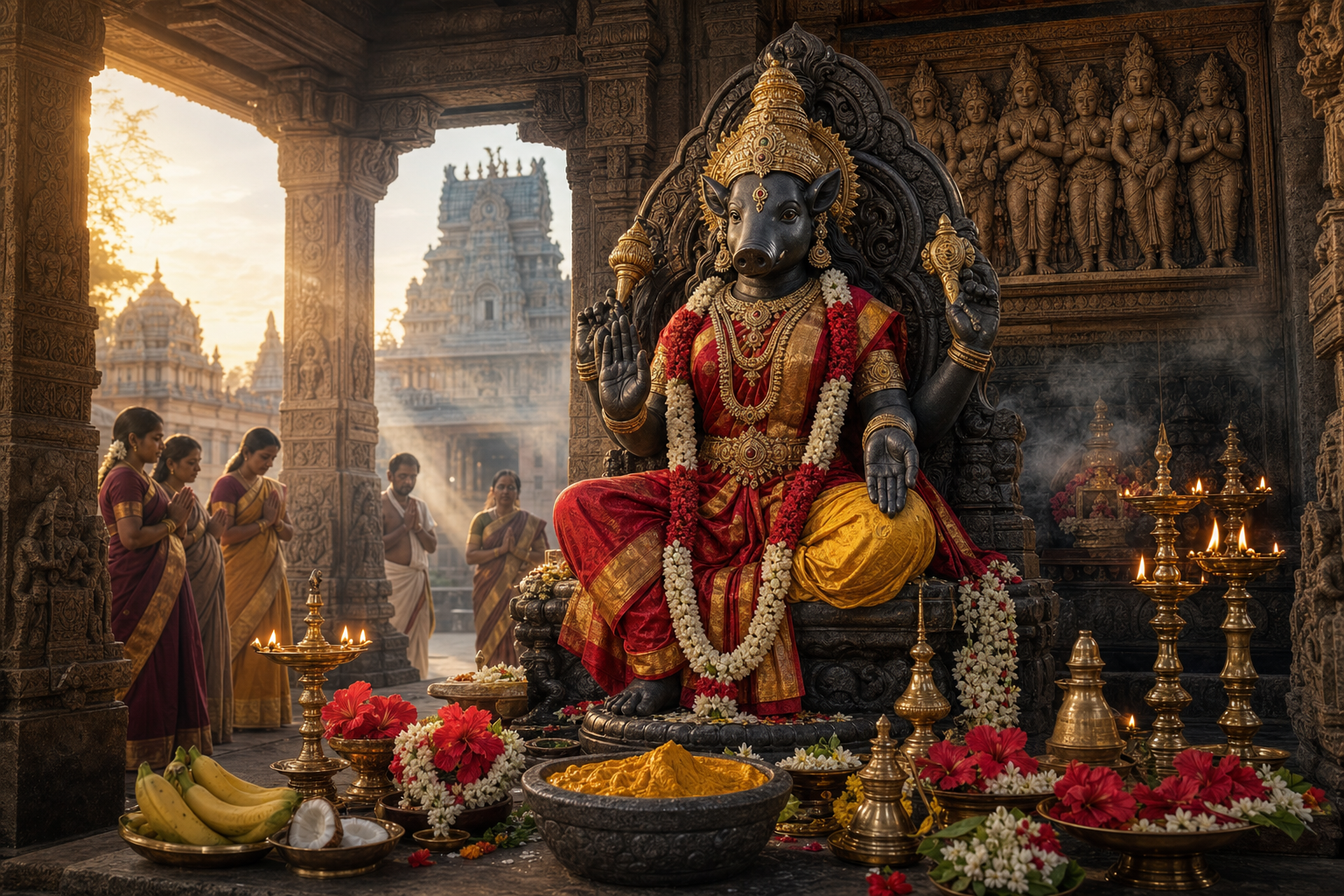
Tamil Nadu’s Varahi temples reveal a religious landscape in which theology, sculpture, ritual, local memory, and community life remain inseparable. Varahi Amman is immediately recognizable by her boar-like face and human form, yet this striking iconography represents far more than divine ferocity. She is revered as a protective expression of Shakti, as the feminine power associated with Vishnu’s Varaha manifestation, and as one of the Sapta Matrikas, or Seven Mothers. Temples and subsidiary shrines dedicated to her are therefore important not only as pilgrimage destinations but also as living records of South Indian Shakta traditions.
The best-known Varahi temples in Tamil Nadu range from locally maintained shrines to devotional institutions with organized festivals, homas, and public worship. They include the Suyambu Varahi Amman Temple at Uthirakosamangai, the Varahi Amman Temple in Woraiyur at Tiruchirappalli, the Haridhra Varahi Amman Temple near Rathinamangalam, the Varahi shrine at Karimangalam, and Sri Kottai Varahi Amman Temple near Katpadi. Older temple complexes, including the Brihadisvara Temple at Thanjavur, also preserve Varahi within a broader sacred and iconographic setting.
A note on evidence and sacred tradition
An academically responsible account must distinguish several kinds of information. Temple addresses and travel distances can often be checked against government pages, institutional websites, or current maps. Iconographic interpretation can be compared with museum catalogues, surviving sculptures, Puranic narratives, and Agamic traditions. Claims that an image is self-manifested, that a shrine is thousands of years old, or that a particular offering produces a desired result belong primarily to temple tradition and devotional testimony unless supported independently by inscriptions, archaeology, or dated architectural evidence.
This distinction does not diminish the religious meaning of a tradition. It simply allows sacred history, community memory, and verifiable chronology to be presented without confusing one category with another. In Tamil temple culture, oral narratives can sustain a shrine’s identity for generations even when early inscriptions are absent. Such narratives are culturally significant evidence, but they should not automatically be treated as archaeological dates.
Who is Goddess Varahi?
Varahi is generally represented with the head of a boar or sow and the body of a woman. Within the Sapta Matrika system, she embodies the active power associated with Varaha, the boar manifestation of Vishnu. This relationship creates a notable theological bridge: Varahi belongs centrally to Goddess worship, yet her visual identity recalls a Vaishnava form. Her appearance within Shaiva temple complexes further demonstrates how Shakta, Shaiva, and Vaishnava traditions have interacted within the same sacred landscape.
The Sapta Matrikas are commonly identified as Brahmi, Maheshvari, Kaumari, Vaishnavi, Varahi, Indrani or Aindri, and Chamunda, although names, order, and the inclusion of additional goddesses can vary. In narrative traditions such as the Devi Mahatmya, the Matrikas participate in the Goddess’s struggle against forces that threaten cosmic order. Varahi’s martial character consequently expresses protection, disciplined power, and the restoration of dharma rather than aggression without purpose.
In Sri Vidya traditions, Varahi may also be honored as Dandanayaki or Dandanatha, a commanding power in the divine retinue of Lalita Tripura Sundari. This identity explains why some temples emphasize authority, strategy, courage, and the removal of obstacles. These associations are tradition-specific, however, and should not be imposed on every Varahi shrine as though all communities followed an identical ritual system.
How Varahi is identified in sculpture
The boar face is the clearest identifying feature, but the rest of Varahi’s iconography is not completely uniform. Depending on the text, region, period, and ritual context, she may carry a staff, plough, sword, shield, goad, discus, conch, vessel, or other implements. Her hands may also display gestures of protection and gift-giving. A buffalo, boar, or another symbolic vehicle may accompany particular forms, while some images are seated without an obvious vehicle.
Weapons in sacred iconography are best understood as signs of spiritual function. A staff can signify command and discipline; a plough evokes cultivation and the transformation of resistant ground; a protective hand communicates reassurance; and a gift-bestowing hand indicates grace. These readings are interpretive conventions rather than a fixed code applicable to every sculpture. The image must be examined as a whole, including its posture, crown, number of arms, neighboring deities, pedestal, and architectural location.
A granite Varahi sculpture from Kanchipuram, dated by the University of Michigan Museum of Art to approximately the early tenth century, provides important material evidence for Varahi imagery in Tamil Nadu. The museum identifies the figure as one of the Seven Mothers and notes her crowned boar head, originally four arms, protective character, and maternal bodily symbolism. This documented sculpture demonstrates that Varahi’s presence in the region is not merely a recent devotional development.
Independent temples and subsidiary shrines
A useful distinction exists between a temple in which Varahi is the presiding deity and a Varahi image installed within a larger complex. In an independent Varahi temple, the ritual calendar, principal sanctum, and public identity normally center on Varahi Amman. In an older Shaiva or Goddess temple, she may instead appear as a parivara devata, a guardian, or one member of a Matrika group. Both settings are significant, but they represent different institutional and theological arrangements.
This distinction also prevents a common error in temple guides: an ancient Varahi sculpture inside an old complex does not necessarily mean that an independent Varahi temple of the same age once occupied that location. Conversely, a recently constructed sanctum can preserve a much older ritual idea. Architecture, image history, inscriptions, renovation records, and current worship must therefore be studied separately before a firm chronology is proposed.
1. Suyambu Varahi Amman Temple, Uthirakosamangai
The Suyambu Varahi Amman Temple is situated at Uthirakosamangai in Ramanathapuram District. The village is already renowned for its ancient Shiva temple, and the Ramanathapuram District Administration places Uthirakosamangai approximately 18 kilometres from Ramanathapuram. The Varahi shrine participates in this wider sacred geography, drawing devotees who often combine its darshan with a visit to the historic Mangalanatha temple.
The term suyambu, also written swayambhu, means self-manifested. Temple tradition regards the Varahi image here as a naturally manifested sacred presence rather than an ordinary human commission. The image is reported to be protected or adorned with silver covering. For devotees, this status is central to the sanctity of the shrine; from a historical perspective, however, it describes the image’s religious classification and does not by itself establish a date.
Devotional accounts frequently describe the shrine as approximately 3,200 years old. That figure should be presented as local or temple tradition because readily accessible government descriptions of Uthirakosamangai confirm the antiquity of the area’s Shiva temple but do not provide archaeological documentation for a 3,200-year-old Varahi structure. A precise historical date would require evidence such as inscriptions, stratigraphic investigation, dated sculpture, archival records, or a formal architectural study.
The temple is especially associated with turmeric worship. Devotees are described as grinding turmeric into a paste near the sanctum and offering or applying it according to local procedure. Turmeric carries longstanding associations with auspiciousness, purification, bodily well-being, marriage, and household prosperity in South Indian ritual culture. Worshippers commonly connect this observance with prayers concerning marriage, pregnancy, family stability, and good fortune.
Such benefits belong to the language of faith and should not be represented as medically guaranteed outcomes. A temple observance can provide hope, communal support, and spiritual focus, but it is not a substitute for qualified medical care, especially in matters involving fertility, pregnancy, mental health, or physical illness. This balanced approach respects devotion without turning a sacred practice into an unsupported clinical claim.
Published visiting information has listed the shrine as open from 7:00 a.m. to 12:30 p.m. and from 4:00 p.m. to 8:00 p.m. Temple schedules can change on festival days, during renovation, or according to local ritual needs. Visitors should confirm the current hours before beginning a long journey and should ask temple personnel how turmeric or other offerings are to be presented rather than assuming that every practice is available at all times.
2. Saptha Matha Varahi Amman Temple, Woraiyur, Tiruchirappalli
The Varahi Amman Temple in Mangal Nagar, on or near Kulumani Main Road in Woraiyur, Tiruchirappalli, represents a more intimate form of urban devotion. It is associated with the worship of Saptha Matha Varahi Amman and is linked in published temple accounts with Sri Varahi Daasar Boopathi Swami. Its identity places Varahi explicitly within the theological company of the Seven Mothers.
The shrine is smaller than Tamil Nadu’s major monumental temple complexes, and public access may follow limited worship periods rather than continuous opening hours. This scale should not be mistaken for a lack of importance. Small neighborhood temples often preserve close relationships between priestly service, household devotion, and local community participation. Their religious influence is measured through continuity of worship rather than through the height of a gopura or the size of an endowment.
Woraiyur is itself an old settlement within Tiruchirappalli’s cultural geography. A visit to the Varahi shrine can therefore be understood as part of a broader study of how ancient urban regions continually acquire new layers of devotional life. Current maps and temple notices should be checked carefully because several Varahi shrines and similarly named Amman temples exist in the Tiruchirappalli region.
3. Haridhra Varahi Amman Temple, Vengadamangalam
Haridhra Varahi Amman Temple is located at Vengadamangalam near Rathinamangalam, in the southern outskirts of the Chennai metropolitan region. Current public listings place it on Varahi Amman Kovil Street in the Vengadamangalam–Rathinamangalam area. It offers an accessible destination for devotees traveling from Chennai, Tambaram, Vandalur, and nearby localities.
The name Haridhra conventionally refers to turmeric and its distinctive yellow color. In Goddess worship, this vocabulary can evoke auspiciousness, fertility, abundance, protection, and ritual purification. The name should not be used to assume a particular ceremony without confirmation from the temple, but it provides a meaningful conceptual connection between Varahi worship and the ritual symbolism of turmeric found elsewhere in Tamil Nadu.
The temple is known primarily through contemporary devotional networks and local listings rather than through a widely published corpus of inscriptions or archaeological reports. It is consequently best approached as a living center of current worship. Statements about prosperity and protection describe the convictions of devotees; they should be recorded respectfully as religious beliefs rather than presented as experimentally verified effects.
4. Sri Varahi Amman Temple, Karimangalam
A Varahi temple is reported at Karimangalam in the Dharmapuri region. The spelling appears in different forms, including Karimangalam and Kariamangalam, and online directories sometimes assign nearby places inconsistently between Dharmapuri and Krishnagiri. Travelers should therefore verify the exact map point, village, and approach road instead of relying on the temple name alone.
The shrine is regarded locally as a place of regular Varahi worship and community devotion. Compared with more visible pilgrimage centers, relatively little critical historical documentation is readily available. This absence of published material should encourage careful documentation rather than speculative claims. Temple inscriptions, foundation records, oral histories, festival notices, and interviews with long-term residents would all be valuable for a fuller study.
Karimangalam also demonstrates why regional temples deserve attention. Religious history is not preserved only by monumental sites. Local shrines can reveal patterns of patronage, women’s devotional participation, household vows, seasonal festivals, and community organization that are rarely visible in royal inscriptions.
5. Sri Kottai Varahi Amman Temple near Katpadi
Sri Kottai Varahi Amman Temple, also presented as Jai Varahi Peedam, is located at Arumparuthi near Katpadi in the Vellore region. The temple’s own public information identifies an address on Sri Kottai Varahi Amman Temple Street, Arumparuthi, Katpadi, with postal code 632106. This direct institutional identification makes the shrine easier to distinguish from other Varahi temples in and around Vellore, Arcot, Ranipet, and Sholinghur.
The temple conducts pujas, homas, and observances associated with multiple forms of Varahi. Its contemporary activities illustrate how a peedam can function simultaneously as a sanctum, ritual institution, teaching center, and community gathering place. The emphasis on Ashta Varahi devotion also shows that Varahi worship cannot be reduced to a single visual form or one universal ritual sequence.
The word kottai can suggest a fort or fortified place in Tamil usage, an evocative designation for a protective goddess. Even so, the title alone should not be interpreted as proof that the temple occupies an archaeological fort. Place-name history, institutional naming, and architectural evidence must be examined independently.
Other Varahi destinations in the northern Tamil Nadu region
Published temple guides also identify Varahi shrines in and around Sholinghur, Pallur, Arcot, Ranipet, and other settlements of northern Tamil Nadu. Administrative boundaries and district names have changed, while multiple institutions use similar titles such as Maha Varahi Amman Temple, Varahi Peedam, or Aadhi Varahi Temple. An exact address, current contact channel, and map coordinates are therefore more dependable than a name by itself.
These additional sites are valuable for comparative study. Some emphasize Varahi as an independent presiding goddess, while others place her within Sri Vidya, Matrika, or broader Amman worship. Their contemporary growth suggests that Varahi devotion remains dynamic rather than confined to archaeological remains.
Varahi at Brihadisvara Temple, Thanjavur
The Brihadisvara Temple at Thanjavur offers an essential historical context for understanding Varahi in Tamil temple culture. The great Chola temple was built by Rajaraja Chola I and completed around 1010 CE. The Indira Gandhi National Centre for the Arts describes it as a major achievement of Chola architecture and as a living tradition whose inscriptions, sculptures, paintings, ritual practices, and later additions must be studied together.
Varahi is worshipped within the complex, but Brihadisvara is fundamentally a Shiva temple rather than an independent Varahi temple. This setting is theologically important. It shows that the Goddess can occupy a protective and ritually meaningful place inside a major Shaiva institution while retaining her association with Varaha and the Matrikas. The site therefore embodies the interconnected character of Hindu traditions without erasing their individual forms.
The present Varahi shrine and its worship should not automatically be dated to 1010 CE simply because they stand inside an eleventh-century complex. Brihadisvara acquired new structures and practices over many centuries. A careful visitor distinguishes the date of the principal monument from the date of a subsidiary shrine, later enclosure, repaired image, or revived festival.
The ritual grammar of Varahi worship
Public temple worship commonly includes lamps, flowers, fruit, turmeric, kumkum, incense, food offerings, archana, abhishekam, alankaram, and the ceremonial waving of light. Not every Varahi temple uses every offering, and local rules may differ according to the form of the deity, the temple’s Agamic affiliation, the day, or the purpose of an observance. Devotees should follow the shrine’s established procedure rather than constructing a ritual from unrelated online instructions.
Turmeric is especially prominent in accounts of Varahi worship in Tamil Nadu. Its yellow color and domestic familiarity connect temple ritual with household life, women’s observances, marriage customs, and concepts of auspicious well-being. The physical act of grinding turmeric also turns an offering into embodied participation: devotion is expressed through time, texture, fragrance, and deliberate effort.
Panchami, the fifth lunar day, is frequently associated with Varahi because she is commonly placed fifth within the Matrika sequence. Fridays, Tuesdays, Ashtami observances, Navaratri, and Ashadha or Varahi Navaratri may also be important at particular temples. There is no single statewide calendar, so the relevant temple’s current festival announcement remains the most reliable guide.
Varahi is often described as a tantric goddess, but the word tantric covers diverse textual, ritual, philosophical, and initiatory traditions. It should not be used as a synonym for superstition, secrecy, or sensational practice. Public darshan and ordinary temple offerings are distinct from specialized mantra or ritual systems that may require initiation and guidance within a recognized lineage.
Claims that Varahi worship defeats curses, black magic, enemies, or hidden forces are widespread in devotional discourse. An academic account records these as beliefs about divine protection. Psychologically, the image of a commanding mother can help devotees frame fear, uncertainty, and vulnerability through courage and moral resolve. This interpretation need not deny faith, but it avoids presenting unverifiable threats as objective diagnoses.
Architecture and the experience of sacred space
Not all Varahi temples display the monumental Dravidian features associated with Tamil Nadu’s famous royal foundations. A large historic complex may include a gopura, multiple prakaras, pillared mandapas, subsidiary shrines, a temple tank, and an axial approach to the garbhagriha. A neighborhood Varahi shrine may consist of a compact sanctum, a small hall, and a limited circumambulatory path. Both forms can sustain elaborate ritual meaning.
The location of an image within a temple is technically significant. A deity in the central garbhagriha has a different institutional position from a figure carved into an exterior niche, installed along a prakara, or included in a Matrika panel. Direction, neighboring figures, ritual accessibility, and the presence of an independent priestly service can all clarify how the deity functions within the complex.
For a first-time visitor, the emotional force of a Varahi shrine often lies in the contrast between her formidable face and the intimate gestures of worship surrounding her. Oil lamps, turmeric, flowers, quiet circumambulation, and family prayers reveal a deity experienced as both fierce and maternal. That apparent tension is not an inconsistency; it is central to an iconography in which protection requires power and power is directed toward care.
A practical Varahi pilgrimage route through Tamil Nadu
Southern circuit: Uthirakosamangai is the principal destination in Ramanathapuram District. It can be approached from Ramanathapuram by road, and the journey can be combined with the area’s historic Shiva temple and other sacred sites. Travelers arriving from farther away commonly use Madurai or Ramanathapuram as transport bases.
Central circuit: Tiruchirappalli and Thanjavur provide a useful comparison between an intimate contemporary Varahi temple at Woraiyur and Varahi’s presence within the monumental Chola environment of Brihadisvara. The two cities are well connected by road and rail, making this the strongest circuit for visitors interested in both living worship and architectural history.
Chennai fringe circuit: Haridhra Varahi Amman Temple near Rathinamangalam can be approached from the southern suburbs of Chennai. Traffic conditions can substantially alter travel time, and the final approach may involve local roads. A current map pin and confirmation of opening hours are important.
Northern and northwestern circuit: Katpadi, Vellore, Arcot, Ranipet, Sholinghur, and Karimangalam contain several Varahi-related institutions. Because similarly named temples occur throughout this zone, travelers should record the full address and not rely solely on a search for “Varahi Amman Temple.”
Respectful and safe temple visiting
Modest clothing is appropriate, and footwear must normally be removed before entering the sacred precinct. Photography may be prohibited inside or near the sanctum even when it is permitted elsewhere. Visitors should avoid touching images, ritual vessels, lamps, or offerings unless invited to do so. Instructions from temple staff take precedence over generalized travel advice.
Temple hours can be interrupted by alankaram, naivedya, private rites, eclipses, maintenance, or festival crowds. Older adults, families with small children, and visitors with mobility limitations should ask about steps, flooring, shade, seating, toilets, and vehicle access. Smaller temples may have fewer facilities than major pilgrimage centers.
Offerings should be purchased or prepared only after local requirements are understood. A practice followed at Uthirakosamangai should not be assumed to apply at Woraiyur, Vengadamangalam, or Katpadi. Respect for variation is part of respecting the deity, the priestly tradition, and the community responsible for the shrine.
Varahi and unity among dharmic traditions
Varahi’s Tamil presence offers a powerful lesson in internal Hindu plurality. Her identity links Goddess theology with the Varaha form of Vishnu, while her shrines also appear within Shaiva sacred environments. These relationships demonstrate that distinct traditions can share ritual space, artistic vocabulary, and reverence without being forced into a single uniform system.
The wider dharmic landscape includes Hindu, Buddhist, Jain, and Sikh communities with distinct histories and doctrines. Unity is best served by recognizing those differences while cultivating shared commitments to disciplined practice, compassion, learning, non-hatred, and protection of cultural heritage. A Varahi pilgrimage can contribute to that outlook when it inspires courage without hostility and devotion without contempt for another path.
Cultural value beyond pilgrimage
Varahi temples preserve more than ritual. They support flower sellers, artisans, musicians, priests, festival workers, oral historians, and household networks. Their calendars organize communal time, while their stories transmit ideas about protection, motherhood, courage, fertility, duty, and moral order. Even a recently built shrine can become a meaningful archive of contemporary religious life.
Responsible heritage documentation should record architectural plans, inscriptions, sculptures, renovations, oral accounts, festival practices, and changes in the surrounding settlement. Dates and sources should be attached to photographs whenever possible. This method allows future researchers to separate an original image from a later mandapa, a restored sanctum from an ancient foundation, and an inherited narrative from a modern institutional claim.
Frequently asked questions
Why does Varahi have a boar’s face? Her boar features express her relationship with Varaha, the boar manifestation of Vishnu. As Varahi, that associated divine power is presented in feminine and maternal form within the Matrika tradition.
Is Varahi only a Shakta deity? Varahi is central to several Goddess traditions, but her iconography is connected with Varaha, and she is also worshipped in Shaiva temple settings. Her history therefore illustrates theological interaction among Shakta, Vaishnava, and Shaiva traditions.
Which is the most prominent Varahi temple in Tamil Nadu? The answer depends on the criterion. Uthirakosamangai is especially known for its suyambu tradition and turmeric observance; Brihadisvara provides major historical and architectural context; and temples at Woraiyur, Vengadamangalam, Karimangalam, and Katpadi represent active regional devotion.
Is the Uthirakosamangai Varahi temple proven to be 3,200 years old? The age is widely repeated as devotional tradition, but it should not be treated as a securely established archaeological date without supporting inscriptions, excavation, or a formal architectural chronology.
What is commonly offered to Varahi Amman? Flowers, fruit, lamps, turmeric, kumkum, incense, food offerings, archana, and abhishekam are reported in different temples. The permitted materials and procedures must always be confirmed locally.
Does a visitor need initiation for temple darshan? Ordinary public darshan and standard temple offerings generally do not require tantric initiation. Specialized mantra, homa, or initiatory practice is a separate matter and should be undertaken only within an appropriate tradition under qualified guidance.
When is the best time to visit? Ordinary weekdays may provide a quieter experience, while Panchami, Fridays, Navaratri, and temple-specific festivals may offer more elaborate worship. Current schedules should be checked directly because opening hours and festival dates can change.
Research sources
This guide expands upon the detailed list published in the HinduPad overview of Varahi temples in Tamil Nadu. Geographic context for Uthirakosamangai was checked against the Ramanathapuram District Administration. Historical iconographic evidence was compared with the University of Michigan Museum of Art’s catalogue entry for a tenth-century Kanchipuram Varahi. The historical context of Brihadisvara was informed by the Indira Gandhi National Centre for the Arts, while current identification of the Katpadi-area shrine was checked against the Jai Varahi Peedam temple website.
Conclusion
Varahi temples in Tamil Nadu form a network rather than a single standardized tradition. Uthirakosamangai preserves a powerful narrative of self-manifestation and turmeric worship; Woraiyur reflects intimate Sapta Matrika devotion; Vengadamangalam emphasizes Haridhra Varahi; Karimangalam preserves a locally rooted community shrine; and Katpadi supports an active institutional peedam. Kanchipuram sculpture and the sacred environment of Brihadisvara place these living traditions within a deeper history of Tamil art and temple culture.
The enduring appeal of Varahi rests in a distinctive union of strength and care. Her face communicates untamed power, while her place among the Mothers expresses protection and nurture. Approached with historical care, ritual respect, and openness to the plurality of dharmic traditions, her temples offer both an intellectually rich field of study and a deeply moving encounter with Tamil Nadu’s living sacred heritage.
Inspired by this post on Hindu Pad.










Leave a Reply
You must be logged in to post a comment.