
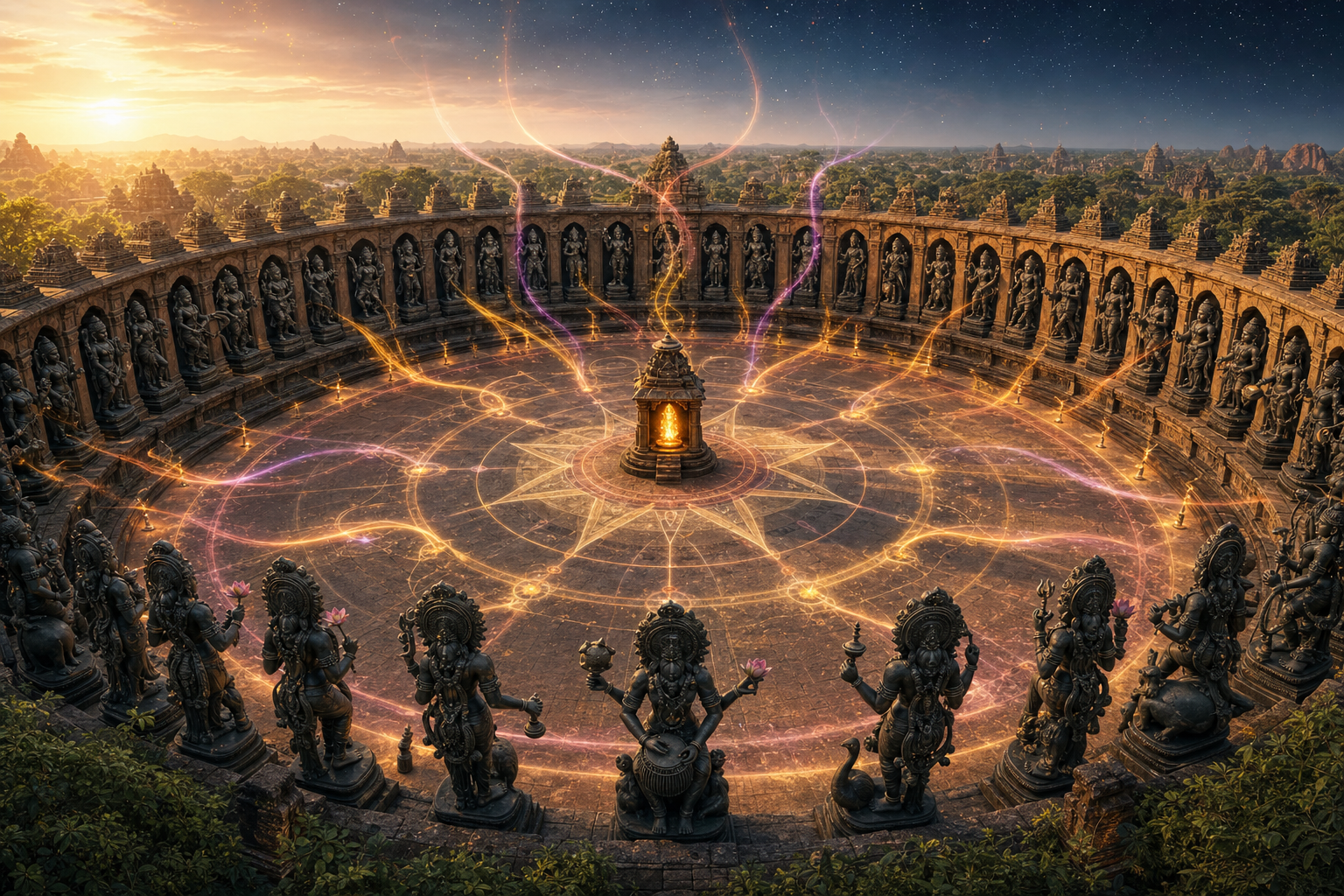
Dancing at the Edge of the Absolute
A visitor entering a Yogini temple encounters an architectural experience unlike that of most monumental Hindu temples. There may be no towering superstructure directing the eye upward, no long sequence of halls, and no single frontal viewpoint from which the sacred space becomes fully intelligible. Instead, multiple female divinities face inward from the perimeter of an open enclosure. As the visitor turns from one image to the next, the body itself begins to follow the geometry of the shrine. Movement, vision, architecture, and devotion converge in a circle.
This circle is commonly called the Yogini Chakra: a sacred configuration associated especially with groups of sixty-four Yoginis in medieval Hindu Tantra. Its significance cannot be reduced to a decorative ring of goddesses. The chakra may simultaneously denote a divine assembly, a ritual community, a spatial mandala, a network of powers, and a pattern imagined within the practitioner’s body. The surviving temples give durable architectural form to concepts that texts more often express through mantra, visualization, initiation, and ritual performance.
The image of sixty-four Yoginis dancing at the margin of cosmic order is therefore best understood as a powerful interpretive synthesis rather than a quotation from one universally authoritative scripture. Some Yogini sculptures dance, others stand or sit, and different textual lineages organize the goddesses in different ways. Yet the language of cosmic dance captures something essential: these deities personify reality as energy, transformation, plurality, and motion. They appear fierce, autonomous, luminous, and resistant to the expectation that sacred femininity must always be gentle or domesticated.
What Yoginī and Cakra Mean in Tantric Contexts
The Sanskrit term yoginī has never possessed only one meaning. In different sources it can designate a woman accomplished in yoga, a female initiate, a ritual partner, a lineage guardian, a semidivine being, a goddess, or an embodiment of a particular power. These meanings overlap without becoming identical. A human female adept described as a Yoginī should not automatically be equated with every temple goddess, while a divine Yoginī should not be reduced to the modern sense of a woman who practices postural yoga.
The Yoginis occupy a spectrum between human and divine categories. Narratives may present them as women whose extraordinary discipline brings supernatural status, while ritual texts describe already-divine beings who grant knowledge, protection, or powers. This permeability is central to Tantra, where the practitioner may ritually identify with a deity and where the human body can be treated as a condensed form of the cosmos. The Yogini is consequently both an object of worship and an image of transformed religious agency.
Cakra, commonly written as chakra, literally evokes a wheel or circle, but its technical range is much broader. It may mean an arrangement of deities, a ritual gathering, a diagram, a sequence of bodily centers, or an organized domain of power. The Yogini Chakra should therefore not be confused automatically with the popular modern model of seven chakras. Some Tantric systems map Yogini circles into the subtle body, but the expression can also refer to an external mandala, a community of initiates, or an architectural enclosure.
Tantra itself is not a single doctrine or institution. The label covers many Śaiva, Śākta, Vaiṣṇava, Buddhist, and other esoteric traditions that developed distinct scriptures, initiations, pantheons, and ritual technologies. Yogini-centered systems are especially important within medieval Śaiva and Śākta environments, including currents associated with Bhairava, the Goddess, Kaula traditions, and the Vidyāpīṭha corpus. Generalizations must consequently be qualified by period, region, text, and lineage.
Historical Formation of the Yogini Traditions
Evidence for organized Yogini traditions becomes particularly visible during the early medieval period. Textual materials point to substantial developments by approximately the seventh and eighth centuries, while the best-known surviving Yogini temples were largely constructed between the ninth and twelfth centuries. This chronology does not imply that the goddesses appeared suddenly. Their formation drew upon older traditions concerning Mothers or Mātṛkās, local protective deities, fierce goddesses, female spirits, ritual specialists, and the growing theological prominence of Śakti.
The Brahmayāmala, also known as the Picumata, is especially important for reconstructing this history. Its oldest strata may date to the seventh or eighth century, although the surviving work contains layers produced over time. A principal manuscript was copied in Nepal in the eleventh century. The text addresses revelation, initiation, deity mandalas, Bhairava mythology, ritual substances, and practices involving Yoginis. The critical edition described by the École française d’Extrême-Orient demonstrates why manuscript study is indispensable to any serious account of early Śaiva Tantra.
Other sources, including the Kubjikāmatatantra, Purāṇic compilations, ritual manuals, regional narratives, and later Śākta works, preserve additional Yogini groupings. These sources do not offer a single chronological sequence or universally accepted theology. Their differences reveal lineages adapting the Yoginis to distinct mandalas, sacred geographies, bodily schemes, and ritual goals. The textual record is therefore best approached as an archive of related traditions rather than as one fixed canon.
Texts and temples also cannot be matched mechanically. A textual list of names may not correspond to the surviving statues at a particular shrine, and damaged or displaced sculptures can make reconstruction uncertain. Conversely, an architectural arrangement may preserve ritual concepts absent from surviving manuscripts. Philology, archaeology, art history, epigraphy, and the study of living practice must be brought together, while disagreements and gaps in the evidence remain visible.
Yoginis as Manifestations of Śakti
Śakti means power, capacity, or energy. In Goddess-centered traditions, it can name both the divine feminine principle and the supreme Goddess herself. Yoginis may be understood as differentiated expressions of this power: not fragments separated from an incomplete whole, but specialized manifestations through which an inexhaustible totality becomes ritually accessible. Their plurality allows divine energy to be encountered as protection, knowledge, desire, ferocity, fertility, sovereignty, dissolution, and renewal.
Calling the Yoginis attendants can therefore be misleading when it suggests insignificance. Certain sources do place them in the retinue of a principal Goddess or Bhairava, but a retinue in Tantric cosmology is not ornamental. It constitutes the operational field through which the central deity acts. The circle can be imagined as a distributed divine body whose members guard directions, transmit commands, confer initiatory authority, and animate the mandala. The center depends upon the circumference just as the circumference receives coherence from the center.
Their relationships with Bhairava and the Mātṛkās vary. Bhairava may occupy the center, appear as a guardian, or be paired conceptually with Yogini powers. The Mothers may be included among the Yoginis, lead Yogini families, or form a related but distinct group. Such variation is not evidence of confusion. It reflects the capacity of medieval Hindu traditions to reorganize divine relationships according to ritual purpose and lineage identity.
Why the Sacred Number Is Sixty-Four
Sixty-four is the number most strongly associated with the Yoginis, but it is not an exclusive or mathematically mandatory count. Groups of forty-two, sixty-four, eighty-one, and other numbers appear in temples or texts. Even monuments popularly called Chausath Yogini temples do not always contain precisely sixty-four peripheral cells. Bhedaghat, for example, has eighty-one peripheral chapels. A peer-reviewed study of Yogini sculpture and temple classification emphasizes this numerical diversity.
The importance of sixty-four is often connected to eight multiplied by eight. Eight can organize directions, divine groups, and ritual subdivisions; its square expands that order into a more comprehensive field. Some traditions arrange eight Yogini families under eight Mātṛkās, producing a circle of sixty-four. The same number also appears in classifications of arts, ritual accomplishments, Tantras, Bhairavas, and other cultural or sacred sets. These parallels establish the symbolic prestige of sixty-four, but they do not prove that every list arose from one numerical theory.
No universally authoritative register of sixty-four names exists. Lists found in different works often diverge, and even separate passages within the same broad textual tradition can preserve different enumerations. Names may identify major goddesses, local powers, bodily functions, animals, emotional states, weapons, diseases, natural forces, or qualities of consciousness. The number supplies a grammar of completeness while allowing the membership of the group to remain regionally and ritually adaptable.
This distinction protects the tradition from a common modern error. A neatly standardized online chart may be useful within the lineage that produced it, but it should not be projected backward as the lost master list behind every temple. Historical accuracy requires asking which text, site, period, and ritual community a particular enumeration represents.
Architecture as a Mandala in Stone
The most recognizable Yogini temples are hypaethral, meaning open to the sky. They usually consist of a circular enclosure with niches or small chapels facing an interior court, although the important Khajuraho example is quadrangular. Compared with the highly elevated towers and axial processional plans of many Hindu temples, these shrines draw attention laterally. The worshipper encounters a sequence of powers along the perimeter rather than only approaching a single image at the end of a straight path.
The open roof has inspired interpretations involving celestial travel, the legendary flight of Yoginis, direct exposure to the heavens, and rites performed under particular lunar conditions. These possibilities are evocative, but no single explanation accounts securely for every monument. What can be observed is that the open court joins earth, horizon, weather, and sky within one ritual field. Daylight moves across the figures, rain reaches the enclosure, and the sky becomes the changing canopy of the chakra.
Circular architecture makes hierarchy relational rather than merely vertical. Each Yogini occupies a distinct position, yet every figure participates in the same circumference. The layout creates multiplicity without disorder. It can be read as a spatial expression of the Tantric claim that differentiated powers arise within one consciousness and remain connected to it even while retaining individual forms.
A central shrine, where present, establishes a productive tension between stillness and movement. The center may be associated with Śiva, Bhairava, the Goddess, or a paired divine form, while the surrounding powers produce an active field. Philosophically, this can suggest consciousness and its energy; ritually, it can organize a mandala of presiding and attendant deities; experientially, it causes the visitor to alternate between the focal center and the encircling multitude.
Hirapur, Ranipur-Jharial, Khajuraho, Bhedaghat, and Mitaoli
The compact Yogini temple at Hirapur near Bhubaneswar in Odisha is among the most complete surviving examples. An official IGNCA archaeological documentation report assigns its architectural and sculptural features to the early tenth century. The circular, east-facing enclosure is built principally of sandstone, while many interior images are carved from dark chlorite. Sixty niches line the interior wall, and the central mandapa incorporates additional Yogini and Bhairava figures, producing a more complex arrangement than a simple ring of sixty-four identical cells.
Hirapur’s intimacy is crucial to its effect. The figures are close enough for individual attributes, vehicles, gestures, hairstyles, and expressions to remain legible. The visitor does not confront an anonymous mass. Each goddess asserts a distinct personality while contributing to the total ensemble. This combination of individuality and interdependence is one of the clearest architectural statements of the Yogini Chakra.
Ranipur-Jharial in Odisha stands within a broader sacred landscape containing numerous temples and archaeological remains. Its Chausathi Yogini shrine is circular and open to the sky. The IGNCA site report places it in the Somavaṃśī period and identifies an early tenth-century date. Many of its Yogini figures possess marked bodily movement, making this site particularly important for the language of dance and dynamic energy.
At Khajuraho in Madhya Pradesh, the Chausath Yogini temple differs sharply from the circular Odisha monuments. It is a quadrangular open-air structure composed of peripheral granite shrines and is commonly dated to the last quarter of the ninth century. An archaeological survey of north Indian temples preserved by IGNCA identifies it as the earliest surviving building at Khajuraho. Its rugged granite construction predates the elaborate sandstone monuments for which the site later became famous.
The Bhedaghat temple near Jabalpur is larger and contains eighty-one peripheral chapels rather than sixty-four. Archaeological surveys generally place its original Yogini complex around the ninth or tenth century, although components were altered over time. A shrine to Umā-Maheśvara occupies the courtyard, reinforcing the relationship between the surrounding female powers and a central Śaiva presence. Bhedaghat demonstrates why the label Chausath Yogini should be treated as a traditional category rather than an inflexible count.
Mitaoli in Morena district is also frequently included in discussions of Yogini architecture. Its circular colonnaded form and peripheral cells are striking, although the site’s chronology, transformations, and precise ritual history require careful treatment. A popular claim holds that its plan inspired the circular Parliament House in New Delhi. The resemblance is real, and an official parliamentary publication describes the connection as a common belief, but resemblance and repeated tradition are not the same as documentary proof of direct architectural borrowing.
Together, these sites disprove the idea that the Yogini temple followed one rigid blueprint. Circular and quadrangular plans, sixty-four and eighty-one cells, different central shrines, and regional sculptural styles reveal a shared ritual-architectural concept adapted by distinct patrons and communities.
How to Read the Yoginis’ Bodies and Attributes
Yogini iconography is deliberately heterogeneous. A figure may be serene, smiling, wrathful, emaciated, sensuous, maternal, martial, or animal-headed. She may stand gracefully, sit in royal ease, crouch, stride, or dance. Uniformity would contradict the logic of the ensemble: the circle represents a coordinated plurality of powers, not the mechanical repetition of one divine personality.
Animal heads, vehicles, and animal companions connect Yoginis with qualities extending beyond ordinary human identity. An elephant, boar, bird, horse, serpent, jackal, buffalo, or other creature may suggest force, speed, appetite, fertility, danger, nocturnal movement, or a regional symbolic association. Such imagery should not be decoded through a single universal key. The identity of a vehicle depends upon the complete iconographic program, relevant texts, and local tradition.
Weapons and ritual implements are equally multivalent. Swords, knives, clubs, shields, skull cups, drums, nooses, and staffs can signify protection, the destruction of obstacles, command over death, the cutting of ignorance, or participation in Bhairava’s ritual world. Domestic objects can appear beside fearsome emblems. The Smithsonian’s National Museum of Asian Art, for example, interprets one Yogini’s combination of household tools, a skull cup, a snake, and wild hair as a purposeful union of domesticity, untamed power, and mortality.
Nudity or exposed breasts in Yogini sculpture should not be reduced either to pornography or to a simplistic modern slogan of liberation. Within Indian sacred art, nudity can communicate fertility, abundance, beauty, ascetic exposure, freedom from social covering, or power beyond conventional modesty. Meaning changes with pose, context, accompanying objects, and ritual use. A disciplined interpretation acknowledges embodied sexuality without treating every image as evidence of a sexual rite.
Fierce imagery likewise does not make the Yoginis evil. Fangs, skulls, severed heads, emaciated bodies, and cremation-ground symbols confront impermanence and the limits of ordinary identity. The same deity may terrify hostile forces while protecting a devotee. Ferocity and care are not opposites in this visual theology; both can express a power capable of breaking attachment, defending sacred order, and transforming fear.
The Dance of the Sixty-Four Yoginis
The language of dance must be used precisely. Not every surviving Yogini is carved in a dancing posture, and no evidence establishes one synchronized choreography performed by the same sixty-four named goddesses at every shrine. Ranipur-Jharial is notable for dynamic figures, while other sites emphasize standing or seated forms. The cosmic dance is therefore both an iconographic reality in particular sculptures and a broader theological metaphor.
Dance gives visible form to energy. A bent knee, displaced hip, lifted foot, flying strand of hair, or asymmetrical arm interrupts static frontality. The body appears to be changing from one position into another. In Tantric terms, this motion can evoke Śakti as vibration, manifestation, and transformative agency. The Absolute is not represented merely as remote stillness; it becomes the inexhaustible capacity through which worlds arise, persist, dissolve, and reappear.
The circle intensifies that symbolism. A line has a beginning and an end, but circular motion returns continually without becoming motionless. The dance of the Yogini Chakra can thus signify recurrence, cosmic rhythm, the circulation of power, and the mutual transformation of center and circumference. It does not simply decorate cosmic order. It expresses the energy by which order remains alive.
The phrase dancing at the edge of the Absolute acquires its deepest meaning here. The edge is not a place outside divinity. It is the boundary where the unbounded becomes perceptible as form, direction, body, emotion, sound, and action. The Yoginis inhabit that threshold. Their circle marks the point at which transcendence becomes immanent without ceasing to be transcendent.
Margins, Thresholds, and Sacred Geography
Yoginis are frequently associated in texts and stories with forests, crossroads, cremation grounds, remote shrines, skies, and other liminal locations. These are places where normal classifications become unstable: settlement meets wilderness, the living meet the dead, one road divides into several, and the earth opens toward the sky. Liminal geography supports a ritual imagination concerned with transformation rather than social routine.
Yet the term marginal should not imply historical insignificance. Monumental temples required resources, land, skilled labor, and patronage. Their construction indicates that Yogini traditions could receive elite support even when their rites were restricted or esoteric. The Yoginis may occupy symbolic boundaries while remaining connected to courts, regional religious networks, and established temple culture.
The perimeter itself is ritually active. In many sacred diagrams, outer circles guard entry, regulate movement, and establish the completeness of the mandala. A Yogini positioned at the edge may therefore exercise authority over access. She is not excluded from the center; she helps create and protect the conditions under which a center can exist.
Ritual Technology of the Yogini Chakra
In Tantric ritual, a chakra can denote an assembly of initiated participants as well as a divine configuration. A rite may organize people, deities, directions, mantras, offerings, and bodily placements into corresponding circles. The gathering does not merely represent the cosmic order from a distance. It is intended to instantiate that order for the duration of worship.
Mantra is central to this process. A deity’s presence is invoked through sound, visualization, gesture, and carefully sequenced acts. In nyāsa, mantras or divine powers are ritually placed upon parts of the body, transforming the practitioner into a suitable field of worship. Mudrās coordinate bodily gesture with doctrine, while a drawn mandala or architectural plan organizes the same powers spatially. Sound, body, image, and space operate as mutually reinforcing media.
Initiation establishes permission and competence to perform restricted rites. Traditional secrecy was not merely an attempt to create mystery; it also protected lineage authority, preserved complex procedures, and limited practices regarded as potent or dangerous. Surviving manuals often assume oral instruction that the written words do not reproduce. Historical descriptions should therefore not be treated as self-sufficient instructions for unsupervised practice.
Some Tantric sources prescribe substances or actions that challenge conventional rules, including alcohol, meat, sexual fluids, cremation-ground materials, or ritualized sexual contact. Other traditions substitute, internalize, reinterpret, or reject such elements. Prescriptive passages do not prove that every community enacted every instruction literally, nor do they define Hindu Tantra as a whole. The relevant question is how a specific lineage transformed an ordinarily restricted substance or act through initiation, mantra, and theological framing.
Yoginis are also associated with siddhis, extraordinary attainments such as heightened knowledge, protection, healing, command over beings, invisibility, flight, or movement across great distances. These should be reported as claims made within religious texts and narratives, not as empirically verified abilities. At a philosophical level, siddhi language dramatizes the conviction that disciplined consciousness can exceed the limitations of ordinary perception. Many traditions nevertheless warn that fascination with powers can distract from liberation.
The Body as an Inner Yogini Temple
Several Tantric systems internalize the mandala by mapping divine groups onto the practitioner’s body. The Kubjikāmatatantra, for example, describes multiple cakras occupied by Devīs, Dūtīs, Mātṛs, Yoginīs, Khecarīs, and associated male deities. The scholarly study of its five-cakra system shows that bodily chakra theories were far more diverse than the standardized seven-center diagram familiar today.
Internalization does not make the outer temple irrelevant. The physical shrine can teach the body how to imagine sacred order. Circumambulation corresponds to mental circulation; the surrounding figures become powers distributed through embodied awareness; the central shrine becomes a still point within experience. Architecture acts as a cognitive and ritual instrument rather than merely a container for statues.
The relation also works in reverse. Once the body is consecrated as a mandala, worship is no longer limited to a distant sanctuary. Speech becomes mantra, perception becomes an offering, and bodily processes become expressions of divine power. This is one reason Tantric traditions can affirm embodiment without simply endorsing every desire. The body is valued because it can be disciplined, reinterpreted, and recognized as a site of sacred consciousness.
Nonduality, Multiplicity, and the Meaning of Sacred Power
In nondual Śaiva and Śākta interpretations, consciousness and power are distinguishable for analysis but inseparable in reality. Consciousness without Śakti would possess no capacity to know, appear, desire, or act; Śakti without consciousness would lack the ground that makes manifestation intelligible. The central deity and encircling Yoginis can therefore be read as two aspects of one divine process.
Multiplicity is not treated as a fall from unity in every Tantric system. It can be the self-expression of unity. The sixty-four Yoginis demonstrate how a single sacred reality may appear through many irreducible powers. Their individuality matters because totality is not achieved by erasing difference. It is achieved by recognizing relationships among distinct forms.
The imagery of death sharpens this philosophy. Skull cups, skeletal figures, severed heads, and cremation-ground associations expose the instability of the social and bodily identities ordinarily treated as permanent. Such images do not necessarily celebrate violence. They force attention toward impermanence, fear, and transformation. Sacred power includes the capacity to end a form so that another mode of understanding can emerge.
This perspective gives the Yogini Chakra emotional force even for a visitor who does not participate in its ritual tradition. The circle presents beauty beside terror, sensuality beside mortality, individuality beside interdependence, and movement around stillness. It refuses the comforting fiction that spiritual life contains only pleasant experiences. Wholeness includes realities that ordinary consciousness would prefer to exclude.
Gender, Agency, and Responsible Interpretation
The Yoginis provide unusually forceful images of female divinity. They act, command, teach, protect, threaten, fly, dance, and grant attainment. Their power is not derived solely from motherhood or marriage. This has made them compelling symbols for modern discussions of the Sacred Feminine and women’s spiritual agency.
Historical complexity must nevertheless temper celebration. Many surviving texts were composed, transmitted, or preserved within male-dominated institutions. A scripture that assigns an indispensable ritual role to a woman does not automatically establish her social equality, and the category of ritual partner may conceal differences in status, consent, or authority. Divine female supremacy and the lived circumstances of historical women must be studied together without assuming that one directly proves the other.
The opposite reduction is equally misleading. Treating every female participant as a passive instrument ignores references to women as initiates, teachers, transmitters, and accomplished practitioners. The term Yoginī itself preserves the possibility of female mastery. A responsible account holds both realities in view: Tantric traditions could create significant forms of female religious authority while still operating within historically unequal societies.
Modern empowerment readings are most persuasive when they remain accountable to the images’ strangeness. The Yogini need not be made harmless, conventionally beautiful, or compatible with contemporary self-help language before she can matter. Her challenge lies precisely in her refusal to conform to a single approved model of femininity.
Royal Patronage, Transformation, and Survival
The construction of Yogini temples suggests an intersection between esoteric power and political authority. Rulers and elite patrons throughout premodern South Asia supported temples to secure merit, legitimacy, protection, prosperity, or victory. Yoginis associated with sovereignty and extraordinary power would have been meaningful within that environment. Specific patronage claims, however, should be accepted only when inscriptions or strong historical evidence support them.
The relative simplicity of some Yogini temples should not be confused with poverty of conception. Their low walls and repetitive cells are part of a deliberate spatial program. Skilled sculptors created individually differentiated figures, while builders translated the geometry of a divine assembly into stone. Monumentality can be horizontal and relational rather than dependent upon great height.
The decline or transformation of temple-based Yogini worship cannot be attributed confidently to one event. Changes in patronage, shifts in regional power, the absorption of esoteric deities into broader Śākta worship, altered ritual institutions, damage, displacement, and the secrecy of initiatory transmission all played possible roles. Some sites ceased to function in their former manner, while Yogini names and concepts survived in liturgy, pilgrimage, local goddess traditions, manuscripts, and later Tantric systems.
Survival also involves reinterpretation. A sculpture may pass from active worship to archaeological protection, from a temple to a museum, or from a regional cult image to an international emblem of feminine power. Each transition changes how it is seen. Preservation should therefore attend not only to stone and architecture but also to provenance, local memory, ritual knowledge, and the communities that continue to value the site.
Hindu and Buddhist Yoginis in a Shared Intellectual World
Yogini traditions developed within a religiously interconnected South Asia. Buddhist Tantras employ Yoginī and Ḍākinī figures, deity mandalas, charnel-ground imagery, fierce female divinities, and ritual methods that parallel Śaiva materials. These similarities do not mean that Buddhist and Hindu systems were identical. Their doctrines of liberation, lineages, central deities, and ritual aims remained distinct even when vocabulary and practices circulated between communities.
Research increasingly describes this history as multidirectional exchange rather than a simple case of one religion borrowing from another. An Oxford study of Yoginī and Ḍākinī traditions identifies striking textual and ritual intersections between Śaiva Vidyāpīṭha works and Buddhist Yoginītantras, including evidence of appropriation in more than one direction. The Yogini thus stands at an important crossroads in the history of medieval Hinduism and Vajrayāna Buddhism.
Comparisons with Jainism and Sikhism require greater caution. Jain traditions possess powerful goddesses, Yakṣiṇīs, protective beings, mandalic structures, ascetic disciplines, and extensive discussions of extraordinary attainments, but these should not be renamed as the Hindu Yogini Chakra. Sikh thought articulates divine power, embodied discipline, and the relation between the formless and manifest through a different scriptural and theological vocabulary. Respectful comparison identifies resonances without erasing boundaries.
This method supports unity among Dharmic traditions more effectively than forced equivalence. Hinduism, Buddhism, Jainism, and Sikhism share a long civilizational environment and have repeatedly engaged common questions about consciousness, ethics, embodiment, liberation, and sacred power. Their unity is strengthened when interaction is acknowledged and their distinctive teachings remain accurately represented.
Five Misconceptions That Obscure the Yogini Chakra
First, a Yogini is not simply a modern female yoga instructor. The historical term may refer to a practitioner, goddess, spirit, lineage figure, or ritual participant. Its meaning must be derived from context.
Second, the Yogini Chakra is not merely one of seven bodily chakras. It can be a deity circle, temple plan, ritual assembly, mandala, or internal configuration. Premodern chakra systems were numerous and did not follow one universal anatomy.
Third, there is no single uncontested list of the sixty-four Yoginis. Names, numbers, family groupings, postures, and attributes vary across texts and sites. Variation is part of the historical evidence, not a defect to be corrected.
Fourth, Tantra cannot be reduced to sexuality or occult spectacle. Sexual and transgressive rites occur in some sources, but Tantra also encompasses initiation, mantra, visualization, philosophical reflection, temple construction, yoga, liturgy, and disciplined worship.
Fifth, fierce imagery is not evidence of moral evil. Within its ritual setting, terror can protect, skulls can teach impermanence, and destruction can symbolize the removal of ignorance. Iconography must be interpreted through the theological world that gave it meaning.
How a Yogini Temple Can Be Read Today
A careful visit begins with the plan rather than with a search for the most dramatic statue. The orientation of the entrance, sequence of cells, presence or absence of a central shrine, building material, sightlines, and relationship to the surrounding landscape all contribute to meaning. Walking slowly around the enclosure reveals how the circle is produced through accumulated encounters.
Each image can then be examined through posture, number of arms, facial form, vehicle, implement, ornament, and position within the ensemble. Missing limbs or empty cells should not be imaginatively completed without evidence. Damage is part of the monument’s history, while displaced sculptures raise questions about collecting, provenance, and cultural stewardship.
Architectural and historical interpretation should remain distinct from ritual participation. Academic information can explain a temple’s development, but restricted practices belong to qualified lineages and living communities. Respect for local rules, active worship, conservation boundaries, and photography restrictions is part of understanding a sacred site rather than an obstacle to it.
The most valuable modern lesson is not a promise of supernatural power. It is a disciplined encounter with plurality. The Yogini Chakra shows that unity can possess many faces, that the sacred may be beautiful and unsettling, and that the edge of an ordered world can become a place of knowledge rather than exclusion.
The Enduring Power of the Cosmic Circle
The sixty-four Yoginis endure because they resist reduction. They are goddesses and powers, guardians and teachers, images and mantras, members of a circle and distinct presences. Their temples unite geometry with movement, multiplicity with coherence, and embodied experience with metaphysical thought. No single name-list, theory, or modern slogan can exhaust them.
Their cosmic dance is therefore not simply a spectacle occurring at the margins of the Absolute. It is a way of imagining how the Absolute becomes a living universe. Every Yogini marks a particular capacity; every interval between figures gives that capacity room to act; every turn around the enclosure returns the visitor to a center perceived anew. The chakra is complete not because difference has disappeared, but because difference has become rhythm.
Approached with historical care, the Yogini Chakra offers an unusually rich synthesis of Hindu Tantra, Shakti philosophy, sacred geometry, temple architecture, dance, and the Sacred Feminine. Its deepest power lies in a demanding vision of wholeness: consciousness includes creation and dissolution, serenity and ferocity, center and edge. The circle holds them together without making them the same.
Research foundation: This account draws upon archaeological documentation from IGNCA, the EFEO critical study of the Brahmayāmala, the Smithsonian National Museum of Asian Art’s research on Yoginis and Dakinis, scholarship on the Kubjikāmatatantra, and peer-reviewed studies of Hindu and Buddhist Yogini traditions. Dates and identifications remain qualified where archaeological or textual interpretations are disputed.
Inspired by this post on Hindu Blog.











Leave a Reply
You must be logged in to post a comment.