Tag: shiva

  • Asitanga Bhairava Unveiled: Iconography, Mantras, and the Sacred Power of the Golden Lord

    Asitanga Bhairava Unveiled: Iconography, Mantras, and the Sacred Power of the Golden Lord

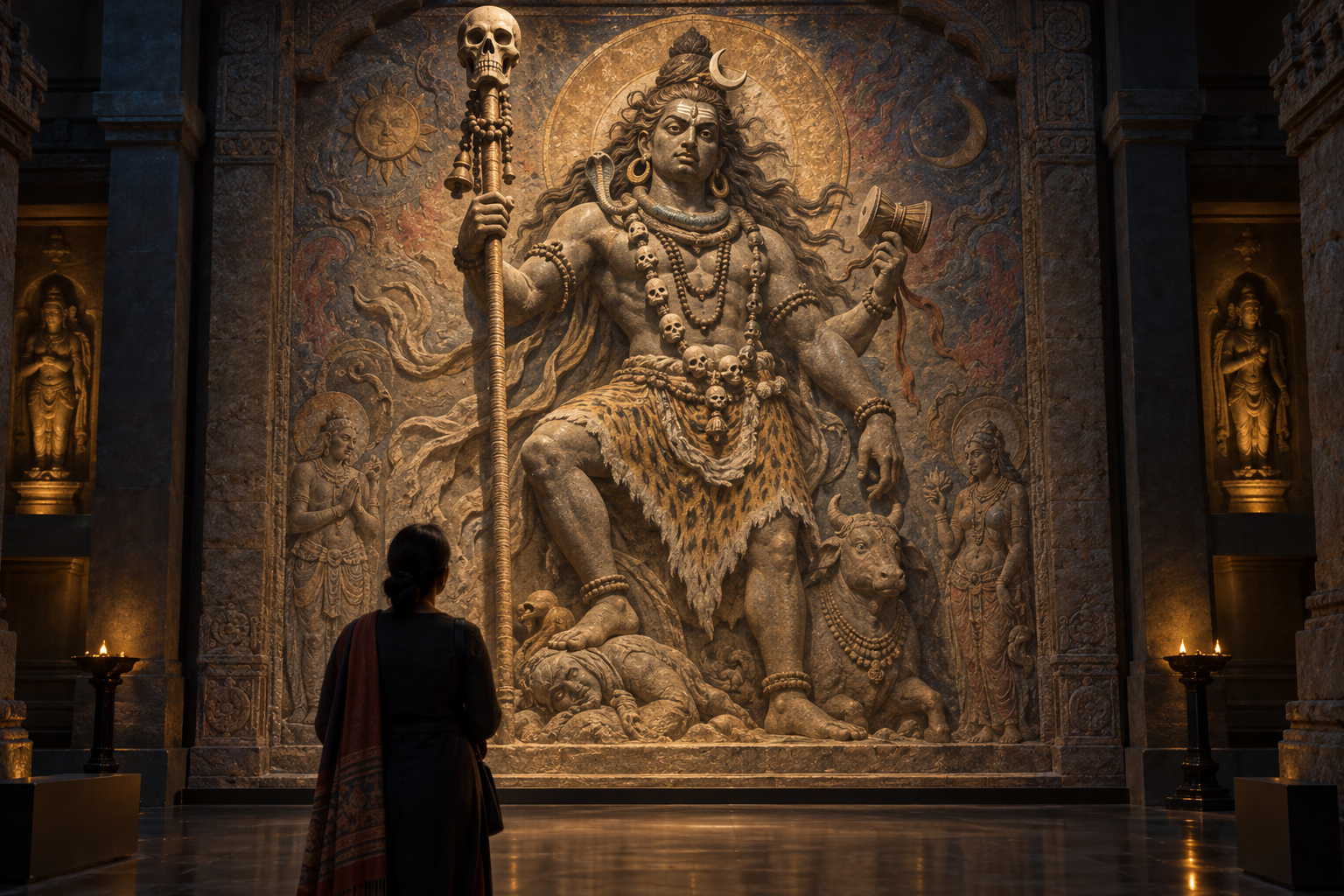
    Asitanga Bhairava, the Golden Lord of the First Octet, embodies a luminous, eastward guardianship that unites protection with awakening. This long-form exploration decodes his iconography—golden hue, trident, drum, skull-bowl, and threshold placement—so readers can recognize and interpret the form in temples and texts. It clarifies how attributes map to disciplined practice, turning weapons into inner…

  • Aghori Tradition Demystified: Fearless Aghora, Sacred Practice, Ethics, and Dharmic Unity

    Aghori Tradition Demystified: Fearless Aghora, Sacred Practice, Ethics, and Dharmic Unity

    Aghora in Sanskrit means “not terrible,” pointing to a serene, compassionate face of Śiva that transforms fear into clarity. The Aghori path draws from Vedic and Śaiva sources and trains practitioners to confront impermanence through disciplined, ethically guided sādhanā, often associated with cremation-ground contemplation. Its symbols—vibhūti, kapāla, and Bhairava iconography—are pedagogies of non-duality, not spectacles…

  • Batuk Bhairav Iconography Decoded: Symbols, Rituals, and the Guardian Child of Shiva

    Batuk Bhairav Iconography Decoded: Symbols, Rituals, and the Guardian Child of Shiva

    Batuk Bhairav, the youthful guardian form of Shiva, unites fierce protection with approachable grace. This iconography guide decodes his attributes—trident, drum, skull-bowl, dog vahana—and explains how each symbol teaches fearless clarity and compassionate vigilance. Readers learn how to identify Batuk Bhairav in temples, where to look for threshold shrines, and how regional styles (Varanasi, Bengal–Nepal,…

  • Decoding Ashta Bhairava’s Eight Directions: Names, Fierce Symbolism, and Sacred Geometry

    Decoding Ashta Bhairava’s Eight Directions: Names, Fierce Symbolism, and Sacred Geometry

    Ashta Bhairava, the eight directional manifestations of Bhairava, unify Tantric metaphysics with temple architecture, ritual time, and ethical practice. This guide clarifies widely attested mappings of names to directions and explains how each form functions as a guardian of thresholds, conduct, and clarity. It situates the Ashta Bhairava within Agamic design, sacred geometry, and living…

  • Swarnakarshana Bhairava: Guardian of Gold, Prosperity, and Dharma in Kali Yuga

    Swarnakarshana Bhairava: Guardian of Gold, Prosperity, and Dharma in Kali Yuga

    Swarnakarshana Bhairava—“the one who draws gold”—is a Shaiva Tantric form that links prosperity to disciplined guardianship, especially relevant in Kali Yuga. The iconography, often golden and protective, signals plenitude anchored in vigilance and ethics rather than greed. Textual and ritual traditions frame this Bhairava as a kṣetrapāla of resources, aligning wealth with dharma, responsibility, and…

  • Bhairava as Kshetrapala: Fierce Guardian of Sacred Space and Why Temples Map the Cosmos

    Bhairava as Kshetrapala: Fierce Guardian of Sacred Space and Why Temples Map the Cosmos

    Bhairava’s identity as Kshetrapala—guardian of the sacred field—explains why Hindu temples are built and maintained as living cosmologies, not just monuments. Drawing on the Shaiva Agamas, Tantras, and the Kashi Khanda, the discussion shows how guardianship works architecturally (gateways, prakaras, bali-pithas) and ritually (bali circuits, threshold vigilance). It clarifies Bhairava’s fierce iconography as a theology…

  • Dasa Bhairava Unveiled: A Powerful Shaiva-Tantric Journey through Fear, Time, and Grace

    Dasa Bhairava Unveiled: A Powerful Shaiva-Tantric Journey through Fear, Time, and Grace

    This long-form, research-based exploration presents Dasa Bhairava (the Tenfold Fierce One) as a living Shaiva-Tantric framework that transforms fear into clarity and ethical action. It clarifies how tenfold schemas vary by lineage, situating them alongside Ashta Bhairava and sixty-four Bhairava traditions without imposing a single orthodoxy. Readers gain a technical yet accessible view of iconography,…

  • Bhairava’s Untamed Jata: Shiva’s Tantric Iconography, Cosmic Fire, and the Discipline of Time

    Bhairava’s Untamed Jata: Shiva’s Tantric Iconography, Cosmic Fire, and the Discipline of Time

    Bhairava’s untamed jata—often described as a “matted flame”—is a precise iconographic language rather than a dramatic flourish. Drawing on Agamic and Purāṇic traditions (including the Skanda Purāṇa’s Kāśī Khaṇḍa), the flame-like hair encodes tapas (ascetic heat), the governance of time (kāla), and the ethics of vigilant guardianship. Read through a yogic lens, it symbolizes the…

  • When Shiva Bled: Vamana Purana’s Origin of the Eight Bhairavas and Andhaka’s Fall

    When Shiva Bled: Vamana Purana’s Origin of the Eight Bhairavas and Andhaka’s Fall

    The Vamana Purana narrates a riveting moment—”when Shiva bled”—to explain how the Eight Bhairavas arose to stop the multiplication of the asura Andhaka and restore cosmic order. Read alongside the Shiva Purana and Skanda Purana, the episode highlights a shared Shakta–Shaiva method: intercept proliferating harm and convert it into insight. The Ashta Bhairavas appear as…

  • The Parashu in Hindu Iconography: A Definitive Guide to Form, Theology, and Dharmic Unity

    The Parashu in Hindu Iconography: A Definitive Guide to Form, Theology, and Dharmic Unity

    The parashu (paraśu), or sacred battle axe, condenses Hindu theology of force, restraint, and renewal into a single powerful ayudha. This long-form guide explains how to recognize the parashu in Hindu Sculptures, details its associations with Shiva, Ganesha, Durga, and Parashurama, and situates it within the ethics of Kshatra and dharma-yuddha. It connects scriptural narratives…

  • Unlocking the Samakanda Shivling: Sacred Geometry, Agama Proportions, and Trimurti Harmony

    Unlocking the Samakanda Shivling: Sacred Geometry, Agama Proportions, and Trimurti Harmony

    The Samakanda Shivling is a mānuṣa liṅga crafted so that the Brahmā, Viṣṇu, and Rudra sections are exactly equal in height. This sacred geometry embodies the Trimūrti’s harmony, turning complex theology into an accessible visual and ritual language. Drawing on Śilpa-Śāstra and Śaiva Āgama guidance, it balances square, octagonal, and circular principles across the vertical…

  • Decoding the Pitha of the Shivling: Divine Architecture, Agamic Science, and Living Ritual

    Decoding the Pitha of the Shivling: Divine Architecture, Agamic Science, and Living Ritual

    The pitha or yoni-pitha of the Shivling is not merely a base but a sacred support that grounds, stabilizes, and channels divine energy. Rooted in Agamic prescriptions and Shilpa Shastra canons, it integrates precise geometry, structural stability, and a hydraulically sound soma-sutra or gomukha outlet for abhishekam. The linga’s three-part articulation fits into the pitha…

  • Parvati and the Sacred Bilva in Skanda Purana: Symbolism, Ritual Science, and Ecology

    Parvati and the Sacred Bilva in Skanda Purana: Symbolism, Ritual Science, and Ecology

    The Skanda Purana portrays the Bilva as emerging from Parvati’s sacred perspiration on Mount Mandara, placing the tree at the heart of Shaiva devotion and uniting Shiva and Shakti in a single living symbol. The trifoliate Bilva leaf mirrors core Shaiva triads, from Shiva’s three eyes to the three shaktis, transforming daily worship into contemplative…

  • Divine Geometry of the Shivling: Six Sacred Components, Agamic Ratios, and Alignment

    Divine Geometry of the Shivling: Six Sacred Components, Agamic Ratios, and Alignment

    The manmade Shivling follows a six-part sacred architecture codified in Shaiva Agamas and Shilpa Shastra: a foundation slab, a yoni-pitha with drainage channel, and a triune bana comprising Brahma-, Vishnu-, and Rudra-bhaga. This article explains the function, symbolism, and geometry of each component, with practical notes on proportions, materials, and orientation in the garbhagriha. Readers…

  • Kamantaka Murti of Shiva: Awe-Inspiring Iconography, Third-Eye Fire, and Mastering Desire

    Kamantaka Murti of Shiva: Awe-Inspiring Iconography, Third-Eye Fire, and Mastering Desire

    This in-depth study decodes Kamantaka (Madana Dahana), the powerful murti of Shiva who burns Kama with the third eye’s jñāna-agni, as a visual pedagogy on mastering desire. It explains field-ready markers—Kama’s sugarcane bow, bee-string, five flower-arrows, and Rati—so readers can confidently identify the scene in temples and sculpture. It situates the form in Purāṇic, Āgamic,…

  • Tripura’s Death-Reviving Nectar and Shiva’s Cosmic Arrow: Power, Ethics, and Dharmic Unity

    Tripura’s Death-Reviving Nectar and Shiva’s Cosmic Arrow: Power, Ethics, and Dharmic Unity

    This long-form, research-informed retelling examines the Purāṇic episode of Tripura, three mobile fortresses granted by Brahma to the asura brothers and sustained by a sacred reservoir of death‑reviving nectar. It outlines how Shiva’s single cosmic arrow—released at a rare celestial alignment—resolved a conflict made otherwise insoluble by continual revivification. Drawing on Shiva Purana, Linga Purana,…

  • Unlocking Tripurantaka: Shiva’s Cosmic Archer—Iconography, Temple Art, and Inner Alchemy

    Unlocking Tripurantaka: Shiva’s Cosmic Archer—Iconography, Temple Art, and Inner Alchemy

    Tripurantaka, Shiva’s cosmic archer, unites myth, philosophy, and temple art into a single visual theology. This long-form exploration traces the Puranic narrative of Tripura Samhara, decodes canonical iconography from bow to chariot, and surveys major temple depictions from Ellora to the Chola heartland. Readers learn how to identify Tripurantaka murtis, understand Agamic design rules, and…

  • Rakshasa Linga Explained: How Fierce Tapas Wins Shiva’s Non‑Discriminating Grace

    Rakshasa Linga Explained: How Fierce Tapas Wins Shiva’s Non‑Discriminating Grace

    This in-depth exploration clarifies what a Rakshasa Linga is and why it matters: a Shivalinga worshipped or installed by a Rakshasa in Purana and sthala-mahatmya traditions. It explains how Skanda Purana and Shiva Purana preserve narratives—such as Gokarna’s Atma Linga and Baidyanath Jyotirlinga—that highlight Ravana’s fierce tapas and Shiva’s impartial grace. It situates these accounts…

  • Sura Linga Revealed: Celestial Shivalingas of the Devas, Cosmic Order, Ritual Science, Protection

    Sura Linga Revealed: Celestial Shivalingas of the Devas, Cosmic Order, Ritual Science, Protection

    Sura Lingas—Shivalingas believed to be installed by Devas—embody a sophisticated synthesis of metaphysics, temple architecture, and ritual science in Hinduism. This long-form guide explains how Sura Lingas anchor cosmic order (ṛta) and provide a protective axis for communities, drawing on Puranic, Agamic, and śilpa-śāstra perspectives. Readers gain clarity on consecration (prāṇa-pratiṣṭhā), canonical Linga morphology, vastu-aligned…

  • Decoding Aghora Shiva: The Non‑Terrible Power Transforming Fear, Ignorance, and Karma

    Decoding Aghora Shiva: The Non‑Terrible Power Transforming Fear, Ignorance, and Karma

    Aghora Shiva, the a-ghora or “non-terrible” aspect of Shiva, transforms fear into clarity by revealing the compassionate core behind seemingly fierce symbols. Rooted in the pañcabrahma framework, Aghora aligns with the southern face, the fire principle, and the function of transformative dissolution (saṁhāra). Iconography—triśūla, ḍamaru, khaṭvāṅga, kapāla, vibhūti, tiger skin, and cremation-ground motifs—forms a coherent…