-
Purusha, the All-Pervading Cosmic Being: Vedic origins, Yogic meaning, living significance

Purusha, the all-pervading Cosmic Being, bridges Vedic cosmology, Upanishadic self-knowledge, Yoga philosophy, and everyday spiritual practice. The article clarifies etymology and the ‘city of the body’ metaphor, then unpacks the Purusha Sukta as a symbolic vision of interdependence rather than rigid social prescription. It examines Advaita, Vishishtadvaita, and Dvaita perspectives, and presents Samkhya-Yoga’s precise account…
-
Mudgala Upanishad and the Purushasukta: Decoding Cosmic Personhood, Unity, and Dharma

The Mudgala Upanishad, preserved in several Rigvedic lists, offers a concise contemplative counterpart to the Purushasukta (Rig Veda 10.90). Read together, they articulate a powerful vision of the Cosmic Person (Purusha) that harmonizes ritual symbolism with precise Upanishadic metaphysics. The essay explains key motifs—immanence and transcendence, cosmic sacrifice, and microcosm–macrocosm mappings—while clarifying socially sensitive verses…
-
Moksha Beyond the Gunas: A Definitive, Scholarly Guide to Liberation and Dharmic Unity

Moksha in Hindu philosophy is best understood as freedom from the three gunas—sattva, rajas, and tamas—rather than the dominance of any one of them. This comprehensive guide explains how Sankhya, Vedanta, and Yoga converge on transcending material nature, while the Bhagavad Gita clarifies why even sattva can bind. It offers a clear synthesis of Jnana,…
-
Mahatparinama Unveiled: The Transformative Journey from Subtle to Manifest Reality in Hindu Philosophy

Mahatparinama—the transformation from subtle to manifest—provides a unifying grammar for Hindu philosophy, linking Samkhya’s cosmology, Vaisheshika’s atomism, Vedanta’s metaphysics, and Yoga’s inner practice. This comprehensive explainer maps the emergence from mahat (cosmic intelligence) through ahamkara, tanmatras, and the mahabhutas, clarifying how sukshma processes shape sthula outcomes. It contrasts satkaryavada and asatkaryavada, situates parinama and vivarta…
-
Virat Purusha Awakens: Srimad Bhagavatam 3.26 Reveals the Power of the Supersoul

Srimad Bhagavatam 3.26.62–71 presents a clear philosophical insight: the senses, mind, and intelligence remain inert until the Supersoul (Paramatma) enters and animates the Virat Purusha. Mukunda Goswami’s exposition clarifies that all faculties are instruments requiring the integrative power of consciousness to become meaningful. Readers gain a practical framework for aligning speech, thought, and action through…
-
Sixteen Kalas of Purusha in Prashna Upanishad: Awe-Inspiring Insights on Unity and Creation

The Prashna Upanishad’s sixth discourse presents the sixteen kalas of Purusha as a lucid framework for understanding creation and spiritual unity. It shows how discrete aspects—prāṇa, śraddhā, the elements, mind, and ethical disciplines—arise together as expressions of one reality. Readers gain a practical lens for integrating breath, faith, discipline, and action into daily life. The…
-
Pradeśa-Mātra Unveiled: Upanishadic Wisdom on the Infinite Within the Heart

Pradeśa-mātra, a refined Upanishadic term, explains how the Infinite can be contemplated in a “measurable” heart-space without limiting the Self. Grounded in the Chandogya and Katha Upanishads, it offers a practical doorway for meditation and self-inquiry. By focusing attention in the hṛdaya-ākāśa, practitioners stabilize the mind and intuit the all-pervading Ātman. Vedānta resolves the paradox…
-
Rama–Sita and Shiva–Shakti: Sankhya’s Purusha–Prakriti and the Promise of Wholeness

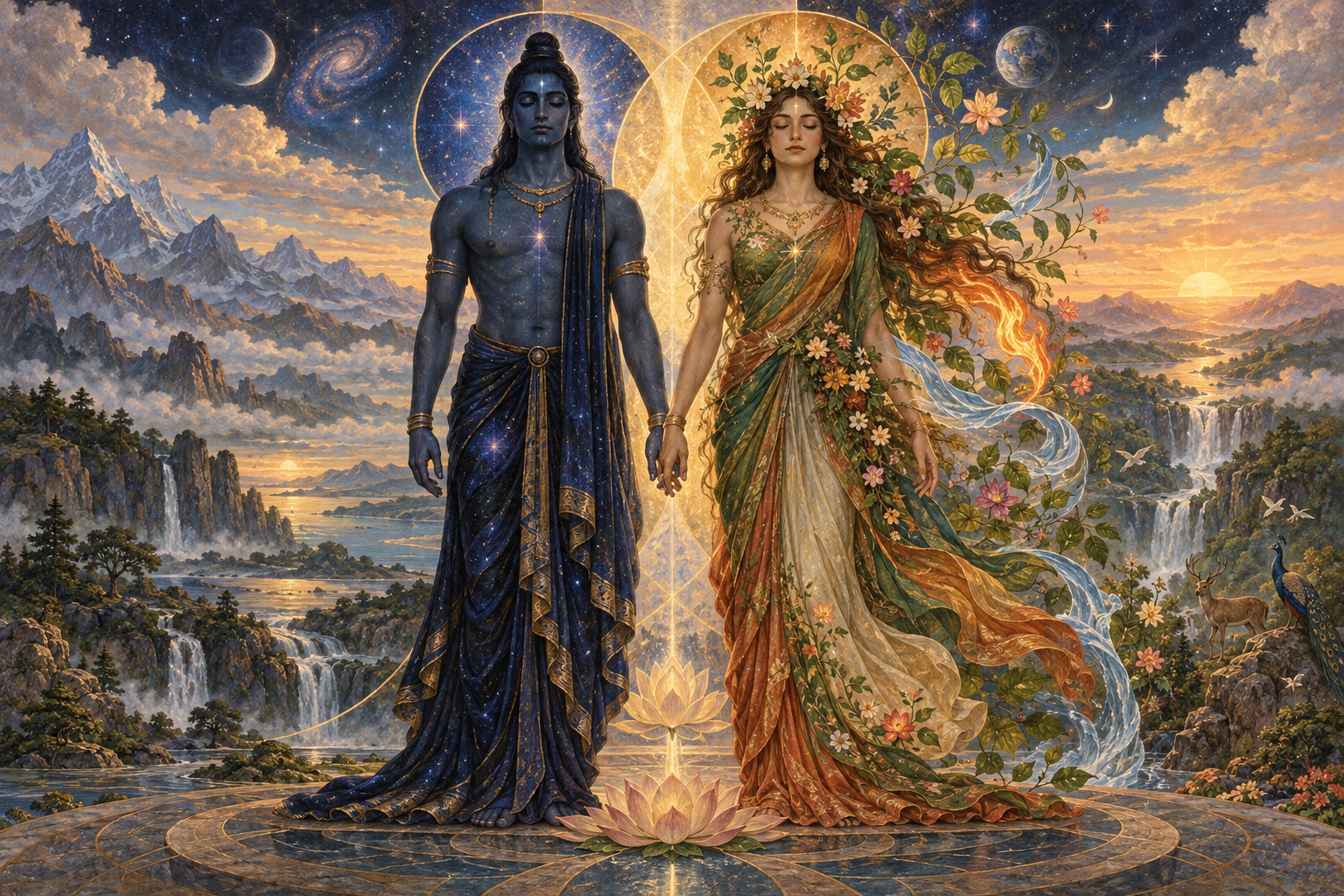
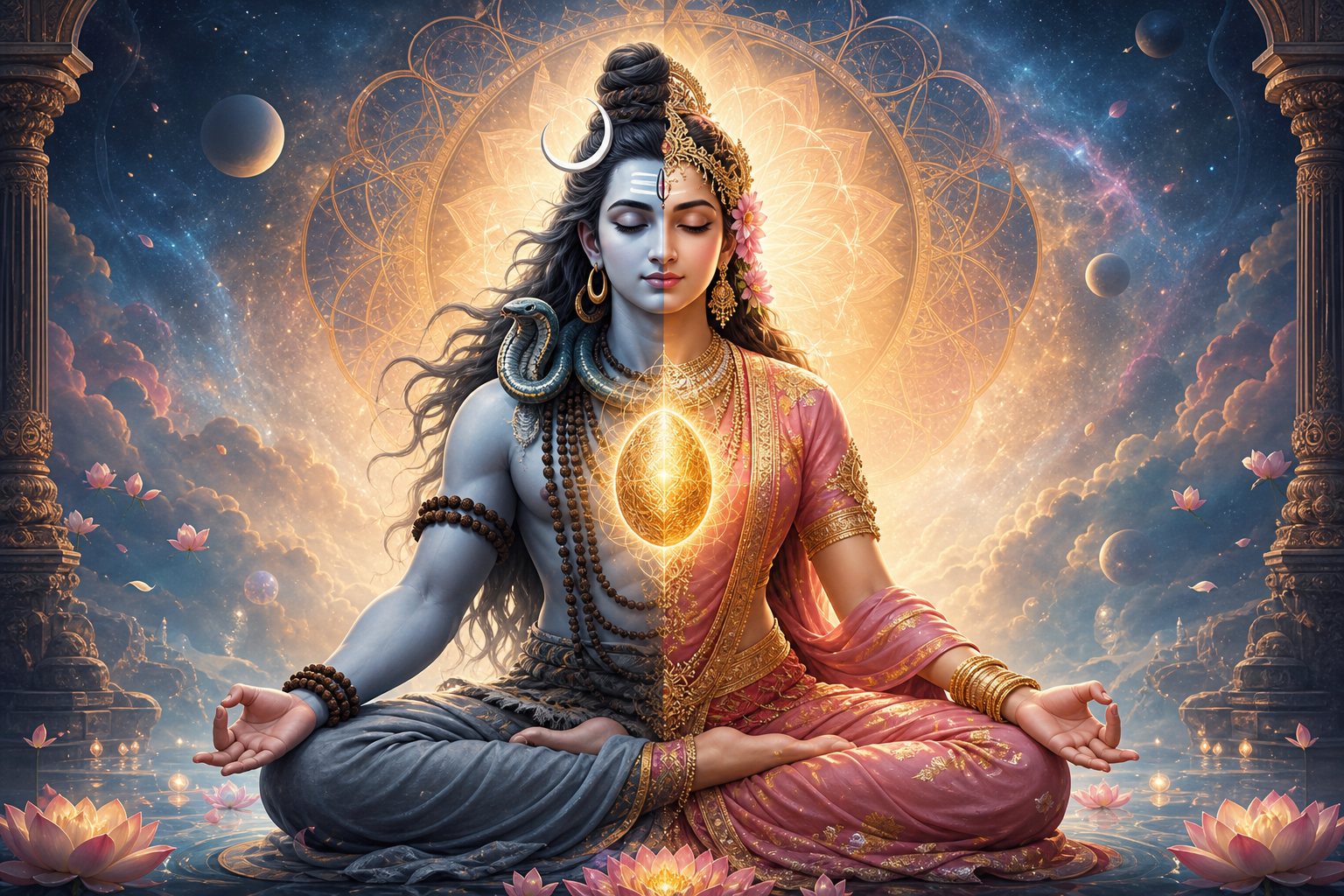
Sankhya’s vision of Purusha (consciousness) and Prakriti (primordial nature) is illuminated by the sacred unions of Rama–Sita and Shiva–Shakti. These symbols present wholeness as a harmonious interplay rather than a clash of opposites. The essay connects Ardhanārīśvara, Maryāda-Puruṣottama, and Shakti’s resilience to psychological integration and ethical balance. Parallels from Buddhism (prajñā–upāya), Jainism (jīva–ajīva and the…
-
Unlocking Kundalini: The Mad Sadhu on Purusha–Prakriti, Nirvikalpa, and Praṇava

This rigorous retelling of Babaji’s discourse on Kundalini Yoga clarifies how the mind’s restraint (nirodha) opens into laya and nirvikalpa samādhi, where stillness reflects Purusha and activity reflects Prakriti. It explains how icchā-śakti awakens near nirvikalpa, refining desire into a unitive will aligned with pure consciousness. The analysis of bhāva-ākāśa shows how feeling unfolds as…