-
Ramayana’s Human–Asura Divide: Dharma, Social Order, and the Psychology of Power

This long-form analysis reads the Ramayana as a rigorous philosophical statement about two enduring orientations: the social human bound by maryada and the Asura driven by unbounded appetite. It clarifies how Dharma-Yuddha, Rajadharma, and lokasangraha translate into modern ethics of governance, technology, and community. Drawing on Hindu, Buddhist, Jain, and Sikh perspectives—Māra in Buddhism, Anekantavada…
-
SB 11.2.42 Decoded at ISKCON Vrindavan: Vedavyasa Priya Swami on Bhakti, Anubhava, Vairāgya

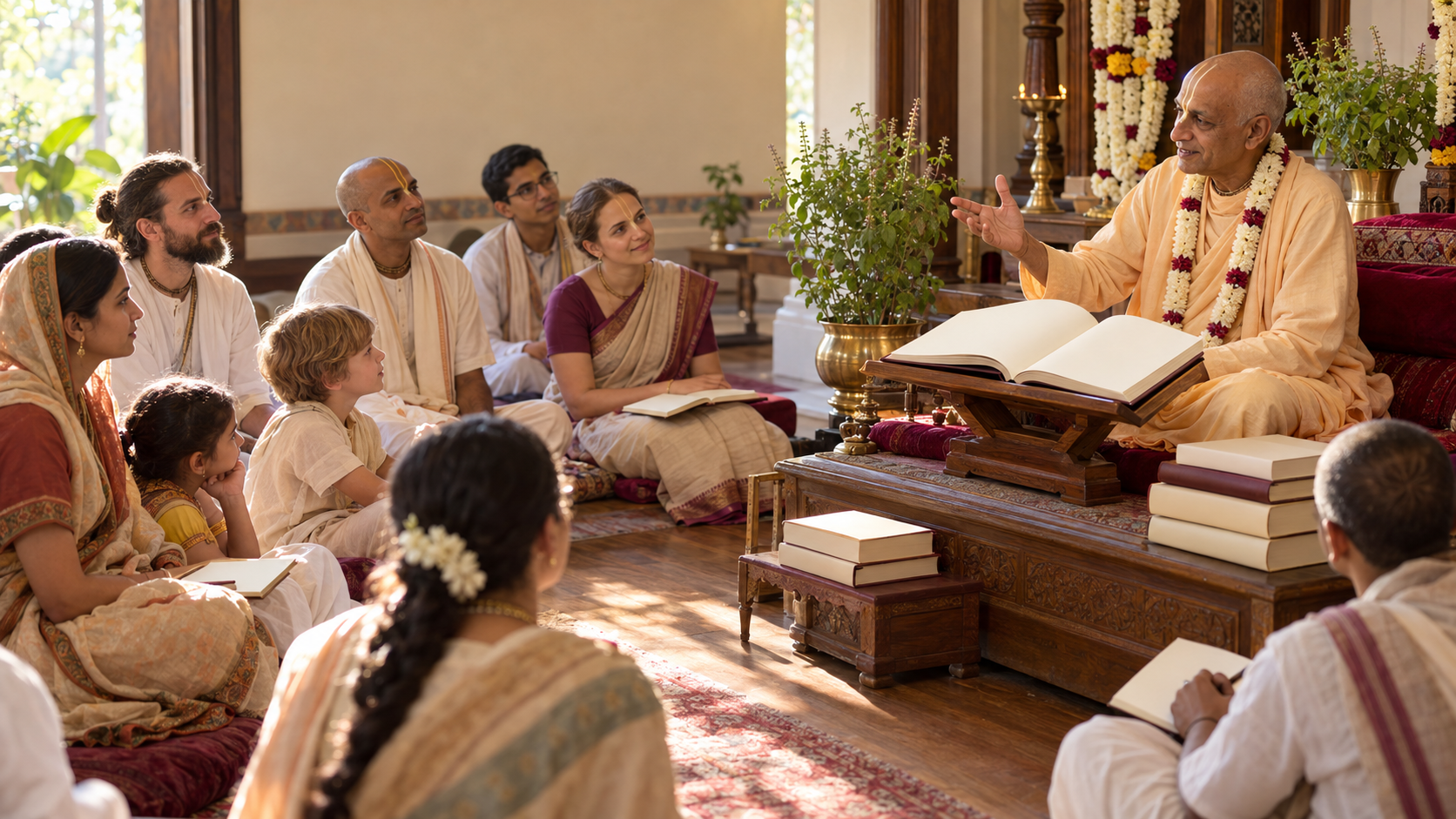
Srimad-Bhagavatam 11.2.42 offers a rigorous, lived measure of spiritual progress—devotion (bhakti), experiential realization (pareśānubhava), and natural detachment (virakti) arising together like satisfaction, nourishment, and hunger’s relief when eating. Presented at ISKCON Vrindavan by His Holiness Vedavyasa Priya Swami Maharaj on 30-05-2026, the teaching clarifies how to verify inner growth without sectarian anxiety. Readers gain a…
-
SB 10.6.22–23 Decoded: Mercy, Protection, and Purification in HG Bhakta Prabhu’s Class

This Śrīmad Bhāgavatam (SB 10.6.22–23) session with HG Bhakta Prabhu at Hare Krishna Melbourne examines the pivotal moments in the Pūtanā narrative when fear turns into faith-guided action. The analysis highlights three core themes—divine protection (rakṣaṇa), maternal compassion (vatsalya), and ritual purification (śuddhi)—and shows how they function together in Vraja’s communal response. Drawing on the…
-
Mahiravana and Ahiravana Unmasked: Untangling Folk Ramayanas, Patala Sorcery, and Panchamukhi Hanuman

Are Mahiravana and Ahiravana one demon or two? This long-form, academically grounded exploration surveys medieval vernacular Ramayanas, regional theatre (from Ramlila to Yakshagana), and Southeast Asian tellings to clarify how the Patala episode evolved beyond the Valmiki Ramayana. It explains why most traditions treat the names as interchangeable while some stage lineages present them as…
-
Reva Khanda in Skanda and Vayu Puranas: Narmada’s Timeless Power, Sacred Myths, and Pilgrimage

The Reva Khanda, preserved in the Skanda Purana and Narmada-focused sections aligned with the Vayu Purana, is a comprehensive tirtha-mahatmya of the River Narmada (Reva). It integrates mythic origins, sacred geography, and rigorous codes of pilgrimage, mapping an ethical and devotional journey from Amarkantak to the sea. Readers gain a clear view of how the…
-
Padma Samhita Unveiled: Timeless Pancharatra Rituals to Elevate Modern Spiritual Life

Padma Samhita is a cornerstone of the Pañcarātra tradition, detailing thirty-one chapters that integrate temple construction, mūrti consecration, daily worship, and ethical formation. This overview explains its core theology—the vyūha doctrine and arcā avatāra—and shows how mantras such as Om Namo Nārāyaṇāya and Om Namo Bhagavate Vāsudevāya shape steady household practice. Readers gain a practical…
-
Unshakable Safety in Saranagati: Why Krishna’s Protection Surpasses All Obstacles

This essay examines the Vaishnava doctrine of saranagati—surrender to Krishna—as an intellectually rigorous and ethically disciplined path to unshakable protection. Anchored in Bhagavad Gita assurances (4.11, 9.22, 18.66) and illuminated by case studies such as Gajendra, Draupadi, Prahlada, and Govardhana, it shows how divine shelter operates within, not outside, responsible agency. The six limbs of…
-
Neither Sat Nor Asat: Rigveda’s Nasadiya Sukta, Vedic Cosmology, and Sacred Paradox Explained

Rigveda’s Nasadiya Sukta opens with the paradox “neither sat nor asat,” a precise philosophical strategy rather than a rhetorical flourish. Read in concert with the Upanishads, the hymn marks a pre-categorical horizon where ordinary predicates fail, complementing later Vedantic distinctions between ultimate and conventional truth. Classical schools clarify its logic: Sāṅkhya’s causal latency, Nyāya’s theory…
-
Is Any Indian Scripture Equal to the Quran or Bible? A Definitive Guide to Dharmic Canons

Is any Indian scripture equal to the Quran or Bible? In the dharmic world, authority is polycentric rather than centralized in one book. Hinduism distinguishes Sruti (the Vedas, as apex authority) from Smriti (Itihāsa, Purāṇa, Dharmashastras, and Agamas), with the Bhagavad Gita serving as the most accessible synthesis for general readers. Sikhism centers on a…
-
Lakshmi Ganapati in the 32 Forms: Tantric Iconography, Sacred Symbolism, and Meaning

Lakshmi Ganapati—one of Ganesha’s thirty-two forms—embodies the sacred union of wisdom and prosperity within a Tantric and puranic framework. This in-depth guide clarifies that the name denotes Ganesha infused with Lakshmi-tattva, often attended by Siddhi and Riddhi, rather than a substitution with Goddess Lakshmi. Readers will learn how each attribute—pasha, ankusha, ratna-kumbha, modaka, and lotus—maps…
-
Morning Class on SB 10.6.10: Pūtanā, vātsalya-rasa, and the life-changing power of divine grace

Delivered on 27 May 2026, this Melbourne morning class examines Śrīmad Bhāgavatam 10.6.10 within the broader Pūtanā narrative to illuminate how divine grace transforms karma through the aesthetics of vātsalya-rasa. The analysis connects Gaudiya Vedānta insights to the Bhagavad-Gītā’s vision of devotion reshaping destiny. Ethical nuances of intention, compassion, and communal responsibility are explored alongside…
-
Lead with Devotion, Live Unattached: Dhruva Maharaja’s Lessons in Bhagavatam 4.12 (10–16)

Bhagavatam 4.12 (10–16) presents Dhruva Maharaja as a saint-king who unites devotion with rāja-dharma, demonstrating how to lead decisively while remaining inwardly detached. The passage operationalizes the Bhagavad-Gita’s counsel to act and remember simultaneously, turning smaraṇaṁ into a discipline that purifies action at its source. Readers gain a practical, stepwise protocol—establish attention with śravaṇa-kīrtana, return…
-
Agneyas among the Gandharvas: Timeless Insights into Kubera’s Celestial Musicians

This article examines the Agneyas as a Gandharva collective in Hinduism, drawing on Puranic and allied textual traditions to clarify their identity as celestial musicians and attendants in divine courts. It explains how several narratives place the Agneyas in the orbit of Kubera (Vaiśravaṇa), the god of wealth and guardian of the northern direction, where…
-
Dashabhujeshwara Decoded: Five-Faced, Ten-Armed Shiva—Iconography, Mantras, Ritual Power

Shiva’s Dashabhujeshwara form—five-faced and ten-armed—embodies the Pañcabrahma theology in which one Absolute performs five cosmic acts: creation, sustenance, dissolution, concealment, and grace. Drawing on the Śiva Purāṇa, Āgamas, and Śilpa-Śāstras, this explainer clarifies how each face (Tatpuruṣa, Aghora, Vāmadeva, Sadyojāta, Īśāna) aligns with directions, mantras, and meditative practice. It decodes the ten arms as sovereignty…
-
Did Goddess Lakshmi Slay Demons? Scriptural Evidence on Kolhasura and Mahishasura

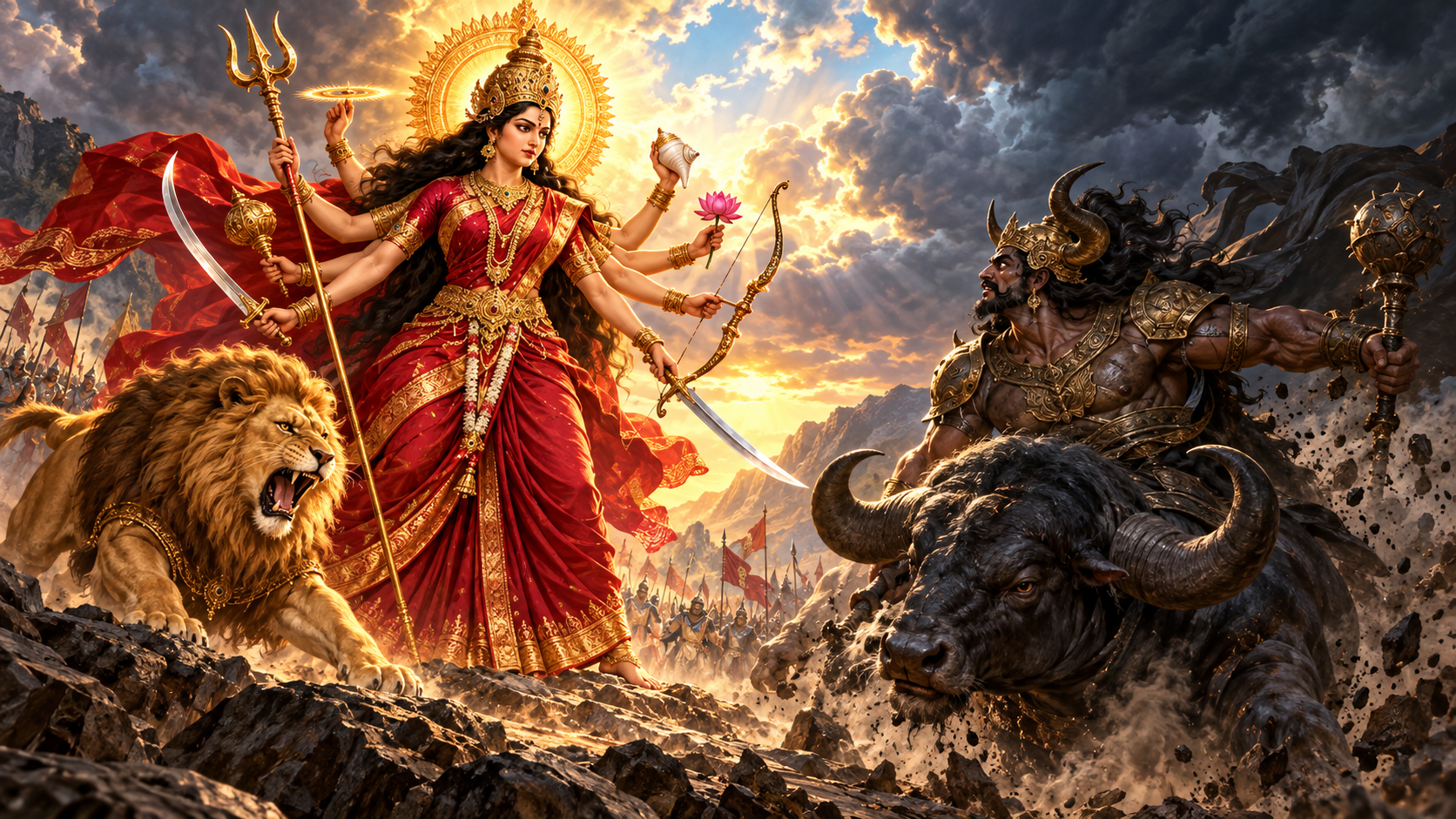
Did Goddess Lakshmi slay demons? Scriptural and regional traditions answer yes in her fierce Mahalakshmi form. The Skanda Purana’s Karavira Mahatmya narrates Mahalakshmi (Ambabai) defeating Kolhasura at Kolhapur, while the Devi Mahatmya’s Mahishasuramardini cycle—often assimilated devotionally to Mahalakshmi—captures the goddess’s triumph over Mahishasura. This article clarifies how Śrī-Lakshmi’s benevolent identity and Mahalakshmi’s protective power coexist…
-
Ugra Lakshmi Unveiled: Fierce Iconography, Tantric Theology, and Living Rituals of Protective Grace

This comprehensive study explores the fierce (ugra) manifestations of Goddess Lakshmi through iconography, tantric theology, and living ritual practice. It clarifies that ugra, far from implying aggression, denotes vigilant, protective radiance aligned with dharma. Drawing from the Śrī Sūkta, Purāṇic hymns, the Lakṣmī Tantra, and the Devī Māhātmya, it maps how Lakshmi’s compassion assumes martial…
-
Hanuman’s Honeybee Stratagem: Foiling Mahiravana in Patala to Save Rama and Lakshmana

This long-form analysis narrates how Hanuman’s honeybee form and Panchamukhi manifestation foil Mahiravana’s Patala ritual to rescue Rama and Lakshmana. It situates the episode in later and regional Ramayana traditions, clarifying its relationship to Valmiki while highlighting its wide cultural reception in performance and temple iconography. The essay unpacks Patala cosmology, the five-lamp life-bond, and…
-
Decoding Vishnudharmottara Purana: The Awe-Inspiring Vyuha Manifestations of Vishnu

This article decodes the Vyuha doctrine of Vaishnava theology through the lens of the Vishnudharmottara Purana and the Pancharatra–Vaikhanasa traditions. It explains the fourfold emanations—Vasudeva, Sankarshana, Pradyumna, and Aniruddha—and the classical distribution of the six divine excellences across them. It shows how the Purana’s image-making canons turn metaphysics into clear, teachable iconography, especially in Caturvyuha…