
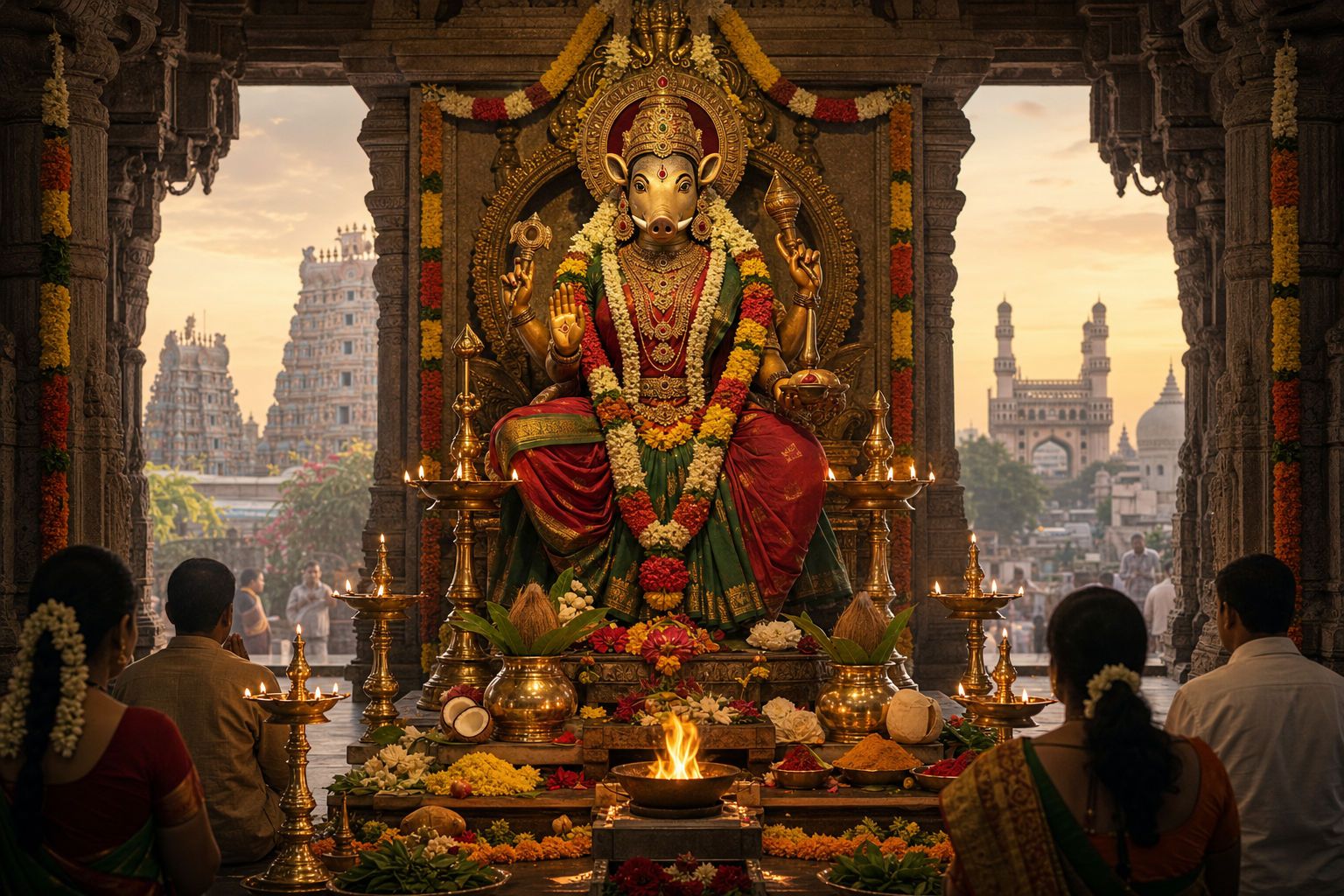
Varahi Navaratri in Hyderabad: an informed pilgrimage guide
Varahi Navaratri, also known as Ashada Navaratri, has become increasingly visible in Hyderabad, Secunderabad and other parts of Telangana. The observance brings together temple worship, household devotion, special Pooja, Homams and the wider culture of goddess veneration associated with Ashada Masam. Although Hyderabad has few temples devoted exclusively to Goddess Varahi, several prominent Shakti temples conduct relevant celebrations or provide an appropriate setting for darshanam during these nine sacred lunar days.
This distinction is important. A list of temples for Varahi Navaratri should not be interpreted as a directory of dedicated Varahi shrines. Most of the Hyderabad temples discussed here are associated with Pratyangira, Peddamma Thalli, Kanakadurga, Lakshmi, Mahankali, Yellamma or Matheshwari. They are included because Ashada Navaratri, Bonalu, Shakambari Utsavams, Yellamma Kalyanotsavam or other forms of Devi worship make them significant destinations during the same sacred season.
Who is Goddess Varahi?
Goddess Varahi is one of the Saptamatrikas, the group of seven mother goddesses represented in Hindu textual, sculptural and ritual traditions. Her most recognizable feature is a boar or sow head joined to a female body. She is commonly understood as the feminine power, or Shakti, corresponding to Varaha, the boar-headed incarnation of Vishnu. This relationship gives her iconography a distinctive place at the intersection of Vaishnava imagery and Shakta theology.
The University of Michigan Museum of Art, which preserves an early tenth-century granite image of Varahi from the Kanchipuram region, identifies her as a member of the Seven Mothers and the female counterpart of Varaha. The sculpture combines a crowned boar’s head with maternal bodily features, illustrating how protection, strength and nurture can coexist in a single divine form. Such museum evidence is useful because it demonstrates that Varahi worship is not merely a recent social-media phenomenon; it belongs to a much older history of Indian sacred art and goddess traditions.
Varahi’s attributes vary across regions, texts and ritual lineages. Images may include implements associated with authority, agriculture, restraint or protection, but no single description should be imposed on every shrine. In some traditions she is approached as a commanding guardian; in others she is contemplated as a mother goddess, a source of courage or an embodiment of disciplined spiritual power. These interpretations are theological and devotional rather than claims that can be tested scientifically.
Her place within Hinduism is also broader than a single sectarian category. Varahi appears in Shakta settings, in Shaiva ritual environments and through her relationship with Varaha in Vaishnava thought. This plurality demonstrates how Hindu traditions frequently share symbols while giving them distinct theological meanings. Respect for those differences is essential when discussing mantra, iconography or ritual practice.
Why Ashada Navaratri is observed
Ashada Navaratri is calculated according to the Hindu lunar calendar rather than a fixed Gregorian date. It generally begins with the bright fortnight of the month of Āṣāḍha and continues through nine lunar observances. Because lunar dates do not align permanently with the civil calendar, the corresponding dates change from year to year. Panchang traditions and local temple conventions can also produce differences in the announced beginning, concluding Pooja or major Homam.
The source guide recorded June 26 through July 4 for the 2025 observance. Those dates are historical and should not be reused automatically for another year. Pilgrims planning a current visit should consult a reliable regional Panchang and confirm the temple’s published schedule. This is particularly important when a lunar tithi begins or ends during the day, because a temple may select its ritual time according to sunrise, evening worship or lineage-specific rules.
Ashada Navaratri is sometimes described in contemporary devotional calendars as a Gupta Navaratri, emphasizing forms of worship that may be quieter or more lineage-specific than the large public celebrations of Sharad Navaratri. That description does not make every Varahi practice secret, nor does it authorize unsupervised ritual experimentation. Public darshanam, archana and temple Pooja remain distinct from specialized Tantric disciplines transmitted under qualified guidance.
The growing circulation of festival calendars, temple announcements and devotional talks through social media has made Varahi Navaratri more familiar in Telangana, Andhra Pradesh, Karnataka and Tamil Nadu. Digital visibility can help devotees discover local observances, but popularity should not be confused with historical origin. The underlying goddess traditions, Saptamatrika imagery and regional Devi worship are considerably older than the platforms through which information now travels.
Why Hyderabad is especially significant during Ashada Masam
Hyderabad’s importance during Ashada Masam extends beyond any single shrine. The city and Secunderabad support a dense network of Devi temples, neighborhood festivals, family observances and Bonalu traditions. During this season, public devotion can be encountered in historic localities, modern residential districts and major commercial areas. Varahi Navaratri therefore unfolds within an already active culture of worshipping the Divine Feminine.
For many pilgrims, the experience is both theological and deeply personal. The transition from a crowded road to a temple courtyard, the sound of bells, the sight of lamps and the disciplined movement of a darshanam queue can create a powerful sense of participation. An academic account cannot measure an individual’s spiritual response, but it can recognize that embodied experience, family memory and community belonging are central to living temple traditions.
The following temples are drawn from the detailed HinduPad guide to Varahi Navaratri temples in Hyderabad, last updated on July 1, 2025. The profiles retain its core information while distinguishing devotional interpretation from verifiable location and festival details.
1. Sri Maha Pratyangira Parameshwari Devi Temple, Sri Rama Krishnapuram
Sri Maha Pratyangira Parameshwari Devi Temple is located in Sri Rama Krishnapuram near Kothapet and Dilsukhnagar. The source associates its foundation and management with Sri Kurthalam Siddheshwari Peetham Peetadhipathi Sri Sri Sri Siddheshwarananda Bharathi Swamy. It presents the temple as an important Hyderabad center for Pratyangira and the Dashamavidya goddesses.
This temple has the most direct ritual relevance to the guide’s Varahi Navaratri theme. According to the source, Varahi Navaratri is celebrated with special Poojas and Homams. Visitors interested in a structured temple observance may therefore consider it a primary destination, provided they confirm the current programme, registration arrangements and permitted forms of participation with the temple.
Pratyangira and Varahi are distinct goddess forms, even when both appear within a wider Shakta ritual environment. Their names, iconography and mantras should not be treated as interchangeable. A respectful visitor follows the sequence established by the temple, receives sankalpa or offering instructions from authorized personnel and avoids reproducing specialized practices from unverified online material.
2. Sri Peddamma Thalli Temple, Jubilee Hills
Sri Peddamma Thalli Temple in Jubilee Hills is among the best-known goddess temples in the Hyderabad–Secunderabad metropolitan area. The name Peddamma conveys the devotional idea of a great or senior mother, and the shrine occupies an important place in the religious life of many local families. Its accessibility from western and central Hyderabad also makes it a practical destination for pilgrims who cannot undertake a long circuit.
The source connects the temple with Shakambari Utsavams and Ashada Navaratri celebrations. In devotional understanding, darshanam of Peddamma Thalli during this period is regarded as meritorious. An academic formulation treats this as a community belief: the value of the visit arises from faith, ritual participation and the symbolic association of the goddess with protection and maternal power.
Festival days can attract substantial crowds in Jubilee Hills. A well-planned visit should account for traffic, security checks, footwear arrangements and queue time. Elderly visitors, children and people with limited mobility may benefit from choosing a less congested weekday or an off-peak period confirmed by the temple.
3. Ameerpet Kanakadurga Temple
Ameerpet Kanakadurga Temple provides a centrally situated option for Ashada Navaratri darshanam. The source records that the festival is observed here and describes darshanam of Kanakadurgamma during the Navaratri days as auspicious. This language expresses the devotional significance attributed to the visit rather than a guaranteed material outcome.
Kanakadurga is a form of Durga, whereas Varahi has her own identity within the Saptamatrika and Shakta traditions. The temple remains relevant because Navaratri is a framework for honoring multiple manifestations of Devi. A visit can therefore be understood as participation in the broader theology of Shakti without erasing the distinctive identity of either goddess.
Ameerpet is a busy commercial and transit district. Metro access and public transport may be more convenient than private parking during peak periods. Visitors should still verify the temple’s exact location, opening hours and festival entry arrangements before departure, as operational information can change more quickly than the religious significance of the shrine.
4. Ashtalakshmi Temple, Kothapet
Ashtalakshmi Temple in the Kothapet–Dilsukhnagar area is dedicated to eight forms of Goddess Lakshmi. Its inclusion demonstrates that a Varahi Navaratri journey in Hyderabad need not be restricted to temples bearing Varahi’s name. The wider sacred geography includes shrines where different dimensions of feminine divinity—prosperity, courage, nourishment, knowledge and protection—are ritually contemplated.
The source describes darshanam of the eight forms as creating an Aloukik spiritual atmosphere and notes the presence of a Nitya Annadana Sathram offering prasadam. Because food-service schedules and eligibility arrangements may change, visitors should treat this as a reason to inquire rather than an unconditional guarantee. Prasadam should be received respectfully, and food allergies or medical dietary restrictions should still be considered.
Ashtalakshmi Temple can be paired geographically with Sri Maha Pratyangira Parameshwari Devi Temple, reducing unnecessary travel across the city. Such clustering is especially useful during Navaratri, when traffic and queues can make an ambitious multi-temple itinerary tiring. A slower visit often leaves more time for attentive darshanam and lessens pressure on children and older relatives.
5. Ujjaini Mahankali Temple, Secunderabad
Ujjaini Mahankali Temple in Secunderabad is one of the region’s most prominent Ashada Masam destinations. Its public identity is closely associated with Bonalu, when neighborhood participation, offerings and processional activity transform the surrounding area. The temple’s inclusion in a Varahi Navaratri itinerary reflects the convergence of the lunar festival with Secunderabad’s established Mahankali devotion.
Mahankali and Varahi should again be understood as distinct forms within a plural Shakta landscape. Darshanam at Ujjaini Mahankali Temple does not replace a temple’s specific Varahi Pooja, but it can deepen appreciation of how Ashada worship is embedded in Telangana’s local history. For many devotees, this combination of household vows, neighborhood identity and temple ritual gives the season its emotional intensity.
Bonalu-related days may involve road restrictions, dense crowds, loud sound environments and extended waiting. Pilgrims should follow police and temple instructions, remain hydrated and avoid obstructing ritual routes. People sensitive to noise or crowd pressure may prefer a quieter day within the Navaratri period rather than the largest public celebration.
6. Balkampet Yellamma Temple
Balkampet Yellamma Temple is another important Ashada Masam destination. The source highlights Yellamma Kalyanotsavam and the offering of Bonalu during this period, making the shrine relevant to a broader Varahi Navaratri pilgrimage. Yellamma devotion has its own regional history and should be approached on its own terms rather than reduced to a generic form of goddess worship.
The temple can be incorporated into a central-western Hyderabad route with Ameerpet and Jubilee Hills. Travel time, however, should be calculated conservatively. Festival congestion can turn geographically close locations into a demanding circuit, and a pilgrimage should not become a race to accumulate temple visits. Ritual attention, safety and consideration for fellow worshippers matter more than the number of shrines completed in a day.
7. Laldarwaza Sri Matheshwari Temple
Laldarwaza Sri Matheshwari Temple represents the cultural diversity of Hyderabad’s goddess traditions. The source describes a devotional community that includes Telugu, Hindi, Gujarati, Rajasthani and Marathi participants. This multilingual character gives the temple special significance as a place where regional customs can meet within a shared reverence for Devi.
A visit during Ashada Navaratri offers insight into religion as a lived form of social unity. Different communities may use distinct songs, ritual vocabularies, foods or family customs while recognizing a common sacred presence. Such diversity does not require every practice to become identical; it demonstrates that unity can be sustained through hospitality and mutual respect.
Laldarwaza lies in a historically dense part of Hyderabad where traffic, narrow approaches and festival activity may affect access. Public transport or a planned drop-off point may be more practical than searching for nearby parking. Visitors unfamiliar with the locality should confirm the route in advance and preserve sufficient time for return travel.
Dedicated Varahi temples beyond Hyderabad
The source observes that temples exclusively dedicated to Goddess Varahi are comparatively uncommon. It identifies a Varahi Temple at Chaurasi in Odisha, MahaVarahi Temple in Ulsoor, Bengaluru, Varahi Amman Temple in Mangal Nagar of Woraiyur in Tiruchirapalli, and Varahi Amman Koil in Uthirakosamangai, Tamil Nadu. These examples are illustrative rather than an exhaustive national directory.
The relative scarcity of standalone shrines does not imply that Varahi was historically insignificant. Saptamatrika panels, temple sculptures, portable bronzes and ritual texts can preserve a deity’s presence even when she is not the presiding goddess of a separate temple. Art history and living worship therefore require different kinds of evidence and should be studied together.
A practical Hyderabad pilgrimage plan
A geographically organized route is usually more realistic than attempting all seven temples in one day. An eastern Hyderabad circuit can combine Sri Maha Pratyangira Parameshwari Devi Temple and Ashtalakshmi Temple around Kothapet and Dilsukhnagar. A central-western circuit can include Ameerpet Kanakadurga Temple, Balkampet Yellamma Temple and Sri Peddamma Thalli Temple. Ujjaini Mahankali Temple is best treated as a Secunderabad visit, while Laldarwaza Sri Matheshwari Temple can anchor a separate journey into the older city.
Temple timetables should be checked on the day of travel. Navaratri programmes may include morning abhishekam, alankaram, archana, evening Pooja, Homam, cultural events or special darshanam arrangements, but not every temple offers every ritual. Festival posts circulating online should be checked for the correct year, location and issuing institution before they are relied upon.
A concise preparation checklist includes modest clothing, a reusable water bottle where permitted, necessary medicines, a small bag for footwear and sufficient time for queues. Offerings should be purchased or prepared according to temple rules. Plastic packaging, food waste and discarded flowers should never be left around the shrine, because environmental responsibility is compatible with the dharmic principle of care for shared space.
Photography should be treated as a privilege rather than an entitlement. Many sanctums prohibit cameras, and photographing private vows, intense ritual moments or other worshippers without consent can be intrusive. A pilgrim who spends less time documenting the visit may discover that attention to the ritual environment produces a more enduring memory.
How to approach Pooja responsibly
Public temple worship can include darshanam, a simple archana, receipt of prasadam and participation in an announced group Pooja. Specialized Varahi mantra, yantra, nyasa or fire rituals belong to particular lineages and should not be improvised from short videos or unattributed posts. When uncertainty arises, the temple’s authorized priest or administration is the appropriate source for procedural guidance.
Devotional claims about protection, success or the removal of obstacles should be understood within the language of faith. Pooja can provide meaning, discipline, communal support and emotional steadiness, but it is not a substitute for medical care, legal advice, financial planning or emergency assistance. Maintaining this distinction protects both religious integrity and personal welfare.
Visitors should also be cautious about commercial packages that promise guaranteed supernatural results. A transparent temple receipt, clearly stated sankalpa and published schedule are preferable to pressure-based claims. Varahi Navaratri is most meaningfully approached through reverence, ethical conduct, self-discipline and respect for the community rather than fear.
Varahi and unity across Dharmic traditions
Varahi’s historical study also offers an opportunity for respectful dialogue across Dharmic traditions. Research on eastern Indian art has documented complex interaction between Hindu goddess imagery and Buddhist iconographic environments. A peer-reviewed study in Cracow Indological Studies discusses Vārāhī imagery in Bihar and Bengal and the appearance of related boar symbolism in Buddhist deities such as Vajravārāhī.
This connection should be presented carefully. Hindu Varahi and Buddhist Vajravārāhī are not simply alternate names for one interchangeable deity; each belongs to a distinct ritual, textual and philosophical setting. Their historical proximity nevertheless demonstrates that Hindu and Buddhist communities participated in a shared South Asian world of artistic exchange. Recognizing interaction without erasing difference supports informed unity among Hinduism, Buddhism, Jainism and Sikhism.
A meaningful conclusion to the journey
The most valuable Hyderabad Varahi Navaratri pilgrimage is not necessarily the longest one. It is the journey that combines accurate calendrical information, realistic travel planning, attention to temple rules and an informed understanding of Goddess Varahi. Sri Maha Pratyangira Parameshwari Devi Temple offers the clearest Varahi-focused observance in the source list, while the other temples reveal the remarkable breadth of Ashada Devi worship across Hyderabad and Secunderabad.
From the Saptamatrika heritage of Varahi to Bonalu in Secunderabad and multilingual devotion at Laldarwaza, the sacred season presents a layered picture of Telangana’s religious culture. A thoughtful visitor can experience personal devotion while also appreciating art history, regional custom and community life. Current dates, Pooja schedules, entry procedures and service availability should always be confirmed directly with the relevant temple before travel.
Inspired by this post on Hindu Pad.










Leave a Reply
You must be logged in to post a comment.