
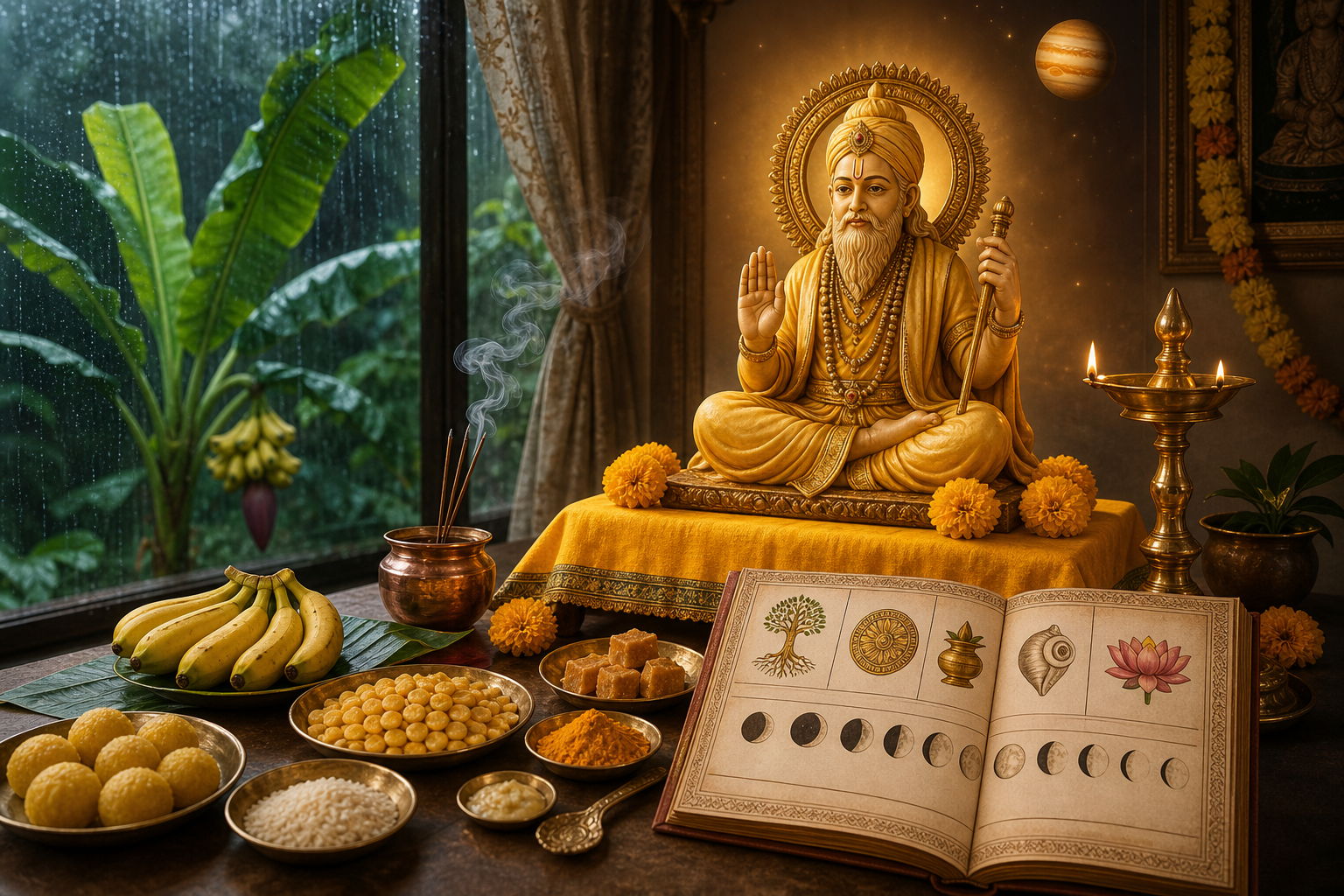
Shravan Guruvar Puja brings together two important strands of Hindu devotional life: the sacred atmosphere of Shravan month and the Thursday worship of Brihaspati, the divine guru associated with wisdom, ethical judgment and spiritual guidance. In many households, each Thursday of Shravan becomes an occasion for Brihaspati Puja, Guru Graha Puja, prayer to Lord Vishnu, fasting, mantra recitation and charitable giving. The practice varies across regions and family traditions, but its central purpose remains remarkably consistent: to cultivate clarity, humility, disciplined learning and reverence for genuine knowledge.
Shravan Guruvar Puja dates in 2026
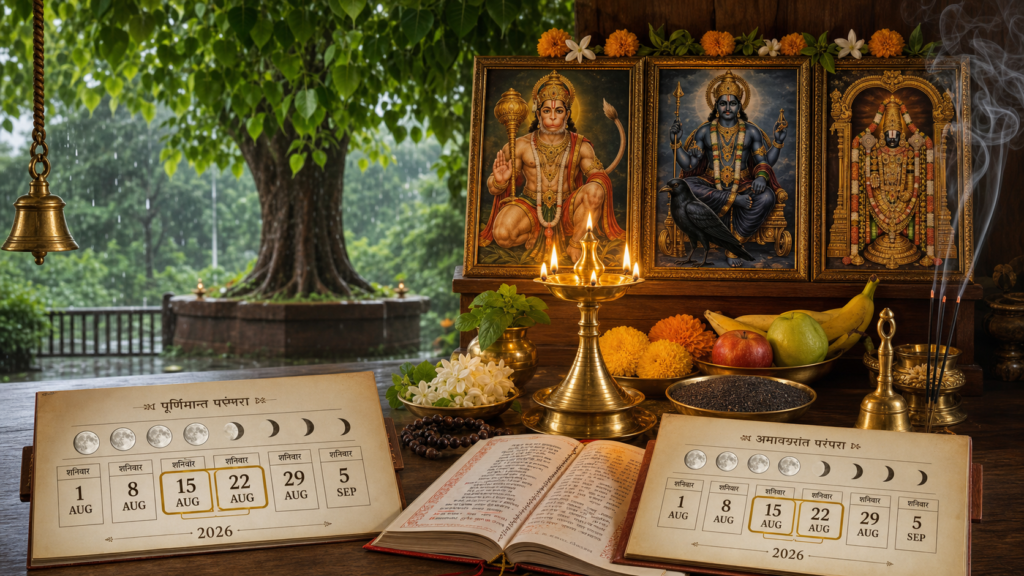
In the Purnimanta lunar calendars commonly followed across much of North India, Shravan extends from Thursday, 30 July 2026, to Friday, 28 August 2026. The five Shravan Guruvar dates in this calendar system are 30 July, 6 August, 13 August, 20 August and 27 August 2026. These are the principal 2026 dates for devotees observing Brihaspati Puja during Sawan in states that follow the North Indian reckoning.
In the Amanta or Amavasyanta calendars followed in Maharashtra, Gujarat, Goa and several southern and western regions, Shravan begins on Thursday, 13 August 2026, and concludes around the Amavasya of 10–11 September. The corresponding Shravan Thursdays are 13 August, 20 August, 27 August, 3 September and 10 September 2026. Marathi and Gujarati households should therefore follow these later dates unless their family panchang or sampradaya prescribes a different reckoning.
2026 calendar summary: North Indian Purnimanta tradition — 30 July, 6 August, 13 August, 20 August and 27 August; Marathi, Gujarati and other Amanta traditions — 13 August, 20 August, 27 August, 3 September and 10 September. Because the beginning of a lunar day can differ slightly by location, devotees living outside India or near a calendrical boundary should confirm the observance through a reliable local panchang.
Why do the Shravan dates differ by region?
The variation does not represent a disagreement about the sanctity of Shravan. It arises from two established methods of organizing lunar months. In the Purnimanta system, the month ends at the full moon, and the Krishna Paksha generally appears before the Shukla Paksha within the named month. In the Amanta system, the month ends at the new moon, and the Shukla Paksha precedes the Krishna Paksha. Both systems follow the same lunar phases, but they assign parts of the cycle to named months differently.
This distinction explains why 13, 20 and 27 August are common to both 2026 lists, while the earlier North Indian dates fall in late July and early August and the later Amanta dates extend into September. A date copied from another region may therefore be locally inappropriate even when it is correct for its intended calendar. Regional panchang, sunrise, location and inherited family practice remain more authoritative for household observance than a single universal list.
Who is Brihaspati?
Brihaspati occupies several interconnected roles in Hindu tradition. Vedic hymns associate Brihaspati or Brahmanaspati with sacred formulation, prayer, inspired speech and priestly intelligence. Later sacred narratives describe Brihaspati as the guru of the devas, whose counsel represents learning guided by dharma rather than knowledge used merely for power. In Jyotisha, Brihaspati is identified with Guru Graha, corresponding to Jupiter within the Navagraha system.
These theological, ritual and astrological meanings should be related carefully rather than treated as identical. Jupiter is a physical planet in astronomy, while Brihaspati as Devaguru belongs to sacred cosmology, and Guru Graha functions within the interpretive framework of traditional Jyotisha. Brihaspati Puja is consequently a religious practice shaped by faith and inherited tradition; its spiritual claims should not be represented as laboratory-established effects of the astronomical planet.
Thursday is called Guruvar or Brihaspativar in many Indian languages. The day is associated with Brihaspati, teachers and the disciplined pursuit of knowledge. Depending on Kula Parampara and regional custom, a household may worship Brihaspati Deva, Lord Vishnu, a form of Narayana, the banana tree as a sacred representation, or the lineage of gurus from whom spiritual instruction has been received. These approaches are complementary expressions of distinct traditions rather than mandatory elements of one standardized ceremony.
Why Brihaspati Puja is observed during Shravan
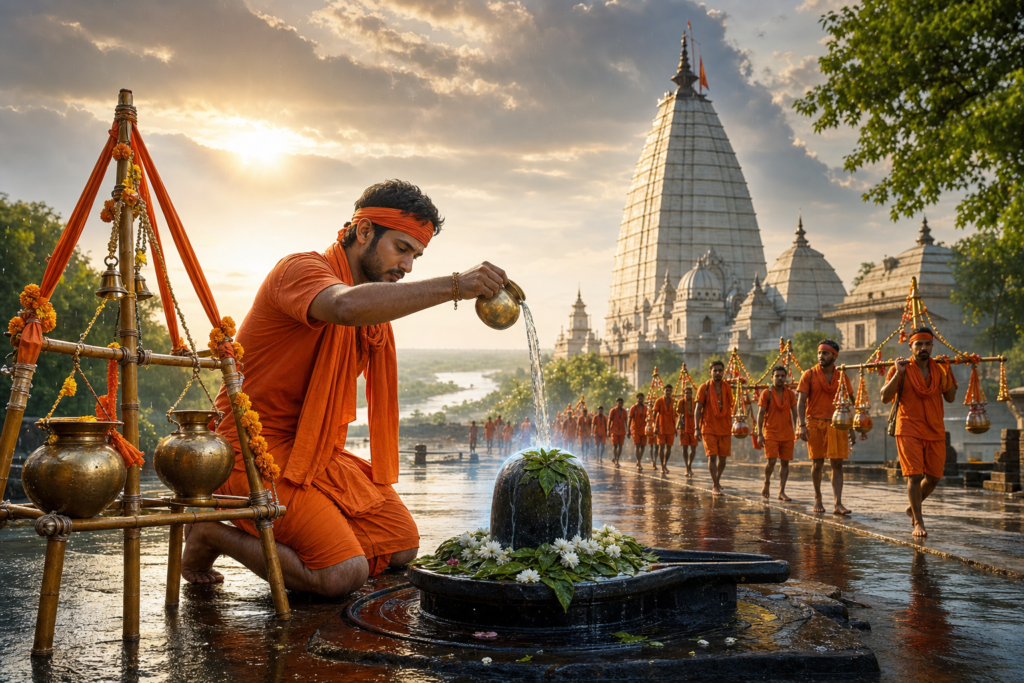
Shravan is widely associated with Lord Shiva, abhisheka, vrata, pilgrimage, restraint and intensified spiritual practice. This emphasis does not exclude the weekday devotions observed throughout the month. Mondays may be dedicated especially to Shiva, Tuesdays to Mangala Gauri in several regions, and Thursdays to Brihaspati or Vishnu. Shravan Guruvar Puja places the pursuit of wisdom within the broader discipline of the sacred month.
Traditional accounts connect Brihaspati worship with education, eloquence, sound judgment, social respect, family welfare, courage, longevity and recovery from adversity. These outcomes are best understood as devotional aspirations rather than guaranteed transactions. The ritual invites a devotee to examine whether speech is truthful, knowledge is being used responsibly, teachers are being respected and decisions are consistent with dharma.
The most emotionally resonant aspect of the observance is often its quiet domestic character. Against the monsoon atmosphere of Shravan, a cleaned altar, a small lamp, yellow flowers and a few minutes of deliberate prayer can create a meaningful pause in a crowded week. The value of that pause lies not only in completing prescribed offerings but also in remembering the people, scriptures and experiences through which wisdom has entered everyday life.
Shravan Guruvar Puja samagri
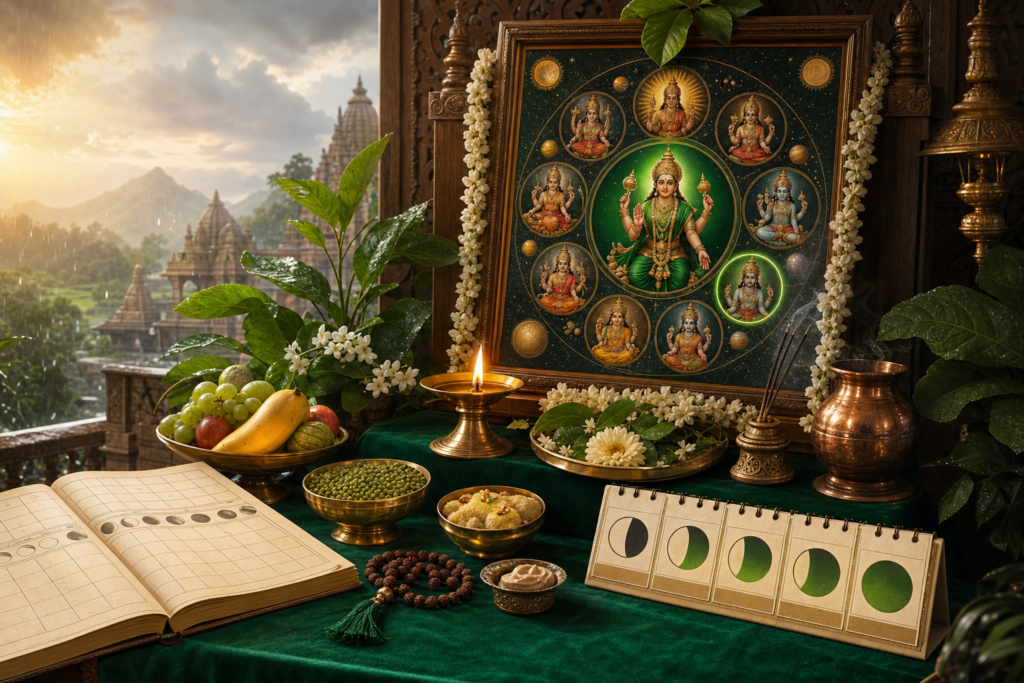
A simple household puja may use an image or murti of Brihaspati Deva or Lord Vishnu, a clean yellow cloth, water in a small vessel, a lamp, incense, sandalwood paste, turmeric, kumkum according to custom, akshata, yellow flowers, fruit and a suitable naivedya. Chana dal, jaggery, bananas, besan preparations, saffron-colored sweets or other yellow foods are commonly associated with the observance. A vrat katha, mantra text and a clean asana may also be kept ready.
Yellow has become the principal ritual color of Brihaspati Vrat. It evokes auspiciousness, learning, ripened grain, nourishment and the traditional attributes of Guru Graha. Yellow clothing and offerings are customary rather than absolute requirements. When flowers, specific foods or elaborate materials are unavailable, a respectful offering of water, a lamp, a simple fruit and sincere prayer is sufficient for a modest household observance.
Materials should be chosen without unnecessary expense or waste. Fresh local flowers, a reusable metal lamp and a small quantity of food are preferable to plastic decorations and excessive offerings that may later be discarded. Naivedya should remain fit for consumption and be shared as prasada. The ethical quality of the ritual is strengthened when reverence is joined with cleanliness, moderation and care for the natural world.
Step-by-step Brihaspati Puja vidhi at home
1. Preparation: The devotee bathes, wears clean clothing and prepares a quiet worship space. Yellow clothing may be worn if it is part of the household custom. The altar is cleaned, the image or murti is placed respectfully, and the required offerings are arranged before the puja begins. The procedure should be performed calmly rather than hurried through as a checklist.
2. Sankalpa: A clear intention is made for the Shravan Guruvar observance. The sankalpa may mention the place, date, family tradition and purpose of the vrata. Appropriate intentions include the cultivation of wisdom, success in righteous learning, clarity in difficult decisions, gratitude toward teachers, family harmony and the welfare of all beings. A sankalpa directed toward ethical growth preserves the deeper meaning of Guru worship.
3. Preliminary prayer: Many households begin by remembering Ganesha and their Ishta Devata before invoking Brihaspati or Vishnu. A lamp is lit, followed by incense if it can be used safely. The devotee settles the breath and mind, allowing the transition from ordinary activity to worship to become deliberate and attentive.
4. Dhyana and invocation: Brihaspati is contemplated as Devaguru, the source of wise counsel, disciplined speech and dharmic understanding. Households worshipping Lord Vishnu may meditate on Narayana as the sustaining ground of order and wisdom. Formal avahana can be performed by those familiar with the appropriate procedure; a sincere mental invocation is suitable for a simpler practice.
5. Offerings: Water, sandalwood or turmeric, akshata, yellow flowers, incense, light and naivedya are offered in sequence. This compact form resembles Panchopachara Puja, whose central offerings are fragrance, flowers, incense, lamp and food. Shodashopachara Puja expands the rite into sixteen forms of ritual hospitality and is best followed according to a trusted manual, temple practice or qualified priestly guidance.
6. Brihaspati mantra: The accessible mantra ॐ बृहस्पतये नमः may be recited slowly and respectfully. Its transliteration is Om Brihaspataye Namah. A practitioner may repeat it 11, 27 or 108 times according to ability, although numerical targets should support concentration rather than produce anxiety. Correct attention, clear pronunciation and a composed mind are more meaningful than rapid repetition undertaken only to complete a count.
7. Vrat katha and reflection: Where customary, the Brihaspativar Vrat Katha is read or heard after the offerings. Traditional katha communicates ethical lessons through narrative, including the consequences of ingratitude, carelessness or disrespect toward sacred duties. It should not be reduced to a promise of automatic material gain. A brief reflection on how its lessons apply to speech, study, work and family relationships makes the observance more substantial.
8. Aarti, prayer and prasada: The puja concludes with aarti, pranam and prayers for collective well-being. Naivedya is offered and then distributed as prasada. The devotee may also remember living teachers, departed elders and educational mentors. Gratitude can be expressed practically through a respectful message, assistance to a student, the donation of books or support for a legitimate educational need.
9. Dana and seva: Traditional observance frequently includes the donation of yellow grain, chana dal, food, clothing or dakshina. The underlying principle is generosity, not the mechanical transfer of a prescribed color. Feeding someone in need, helping a learner obtain materials, serving at a community institution or supporting the preservation of knowledge can all express the ethical purpose of Brihaspati Puja.
Brihaspati Vrat and fasting rules
There is no single fasting rule followed by every Hindu community. Some devotees take only fruit, milk or simple sattvic food; some observe Ekabhukta by eating once; and some traditions avoid salt or particular ingredients. Others perform the puja without a food fast. Family practice, health, age, occupation and spiritual guidance should determine the appropriate discipline.
Fasting is intended to refine attention and self-restraint, not to cause harm. Children, older adults, pregnant or nursing individuals, people managing illness and anyone taking medication should not adopt a restrictive fast without appropriate professional advice. A modified vrata based on simple food, moderation, mantra, study and charity can retain religious meaning when abstention from food is unsuitable.
Some regional instructions attach additional rules to Thursday, including restrictions concerning household tasks, particular foods or personal grooming. Such customs should not be presented as universally binding. A devotee may honor inherited Kula Parampara while recognizing that another community can observe Brihaspati Vrat legitimately through a different set of practices.
Guru Graha Shanti, japa and homa
People who have been advised within Jyotisha that Brihaspati is weak, afflicted or associated with a challenging period may undertake Guru Graha Puja, Brihaspati Shanti japa or homa. These are specialized applications of the broader Thursday devotion. A formal homa involves mantras, fire ritual, offerings and procedural details that are not interchangeable with the simple household puja described above.
A fire ritual should be conducted with competent guidance, correct fire safety and respect for the relevant tradition. Astrological interpretation should likewise come from a responsible practitioner who avoids fear-based claims and guaranteed outcomes. Brihaspati dosha is a category within traditional Jyotisha, not a medical diagnosis or scientific measurement. Puja may provide spiritual structure and emotional reassurance, but it should never replace medical care, education, financial planning or other practical action.
Observing a series of Shravan Thursdays
A devotee may worship on every Thursday falling within Shravan or select one significant Guruvar when a full series is not practical. Some Brihaspativar traditions prescribe seven Thursdays, sixteen Thursdays or a longer period followed by Udyapana. Those sequences are broader Thursday vratas and need not be confused with the finite set of Shravan Guruvar dates in a regional calendar.
For a five-Thursday Shravan observance, continuity can be created by assigning a reflective theme to each week: gratitude for teachers, discipline in study, responsibility in speech, generosity in action and humility in judgment. This approach does not replace puja vidhi; it translates its symbolism into conduct. The final Thursday may include additional prayer, food distribution or educational charity as an informal act of thanksgiving.
If one Thursday is missed because of illness, travel, menstruation-related family custom, caregiving or unavoidable work, the practice need not become a source of guilt. The devotee may resume on the next appropriate Thursday, perform a simple mental prayer or consult the family tradition about completion. Vrata is most constructive when discipline is joined with compassion and honesty.
The spiritual meaning of Guru worship
The Sanskrit and vernacular idea of guru extends beyond the modern image of a charismatic religious personality. It can refer to a spiritual preceptor, teacher, elder, scripture or principle that removes confusion and directs the learner toward truth. Brihaspati Puja gives ritual form to the recognition that intelligence requires guidance, and that knowledge without character can become destructive.
Reverence for a guru does not require the suspension of conscience or critical judgment. Authentic guidance is traditionally associated with learning, restraint, integrity and concern for the disciple’s welfare. Shravan Guruvar therefore offers an appropriate occasion to distinguish responsible mentorship from manipulation, and humility from unquestioning dependence.
This emphasis also creates a respectful bridge among Dharmic traditions. Hindu, Buddhist, Jain and Sikh communities each preserve distinctive understandings of teachers, lineages, scripture and authority. Those differences should not be erased by transferring one tradition’s ritual into another. Nevertheless, humility before wisdom, disciplined learning, ethical conduct and gratitude toward genuine guides can support mutual respect without theological homogenization.
Common questions about Shravan Guruvar Puja
Is Shravan Guruvar dedicated to Brihaspati or Vishnu? It may be dedicated to Brihaspati Deva, Lord Vishnu or both, depending on Kula Parampara. The household tradition should guide the principal form of worship. Devotion to Shiva during Shravan and worship of Brihaspati or Vishnu on Thursday are not contradictory.
Can Brihaspati Puja be performed without fasting? Yes. Fasting is one possible limb of the vrata, not the only form of devotion. Mantra, prayer, sattvic conduct, study, dana and service can constitute a meaningful observance when a food fast is impractical or medically unsuitable.
Is yellow clothing compulsory? No. Yellow is strongly associated with Brihaspati and is widely preferred, but clean and respectful clothing is the essential practical requirement. The ritual should not be abandoned merely because a particular color or offering is unavailable.
What is the best time for the puja? Many households perform it after the morning bath and daily purification, while others worship later in the day before their permitted meal. There is no single time valid for every location and lineage. A local panchang or family priest can identify a more specific muhurta when one is required.
Can anyone perform a simple household Brihaspati Puja? A respectful Panchopachara-style puja, mantra recitation and prayer can generally be undertaken by household devotees. Elaborate Shodashopachara rites, large japa commitments and homa should follow the instructions of the relevant sampradaya or a competent guide.
What should a devotee do if online calendars disagree? The location setting and calendar system should be checked first. A North Indian Purnimanta date should not automatically be imposed on a Marathi or Gujarati Amanta observance. When uncertainty remains, the panchang traditionally used by the family, temple or local community provides the most coherent basis for practice.
A practical 2026 observance plan
Devotees following the North Indian calendar may begin on 30 July and continue on 6, 13, 20 and 27 August. Those following Marathi, Gujarati or comparable Amanta calendars may begin on 13 August and continue on 20 and 27 August, followed by 3 and 10 September. Each observance can include a clean altar, sankalpa, lamp, yellow flower, ॐ बृहस्पतये नमः, simple naivedya, prayer, prasada and one intentional act of learning or generosity.
The lasting benefit of Shravan Guruvar Puja lies in the pattern it establishes. A weekly ritual can turn reverence for wisdom into disciplined study, careful speech, gratitude toward mentors and responsible service. In this sense, Brihaspati Vrat is not confined to an altar or a calendar date. Its deepest expression appears when knowledge becomes ethical conduct and spiritual aspiration contributes to the welfare of the wider community.
Shravan Guruvar Puja 2026 is therefore both a calendrical observance and a contemplative discipline. Its regional dates demonstrate the diversity of Hindu timekeeping, while its offerings express a shared longing for wisdom and guidance. Observed with accuracy, moderation and respect for living traditions, Brihaspati Puja can become one of Shravan month’s most thoughtful practices: a recurring invitation to learn well, speak responsibly and place knowledge in the service of dharma.
Inspired by this post on Hindu Pad.



Leave a Reply
You must be logged in to post a comment.