
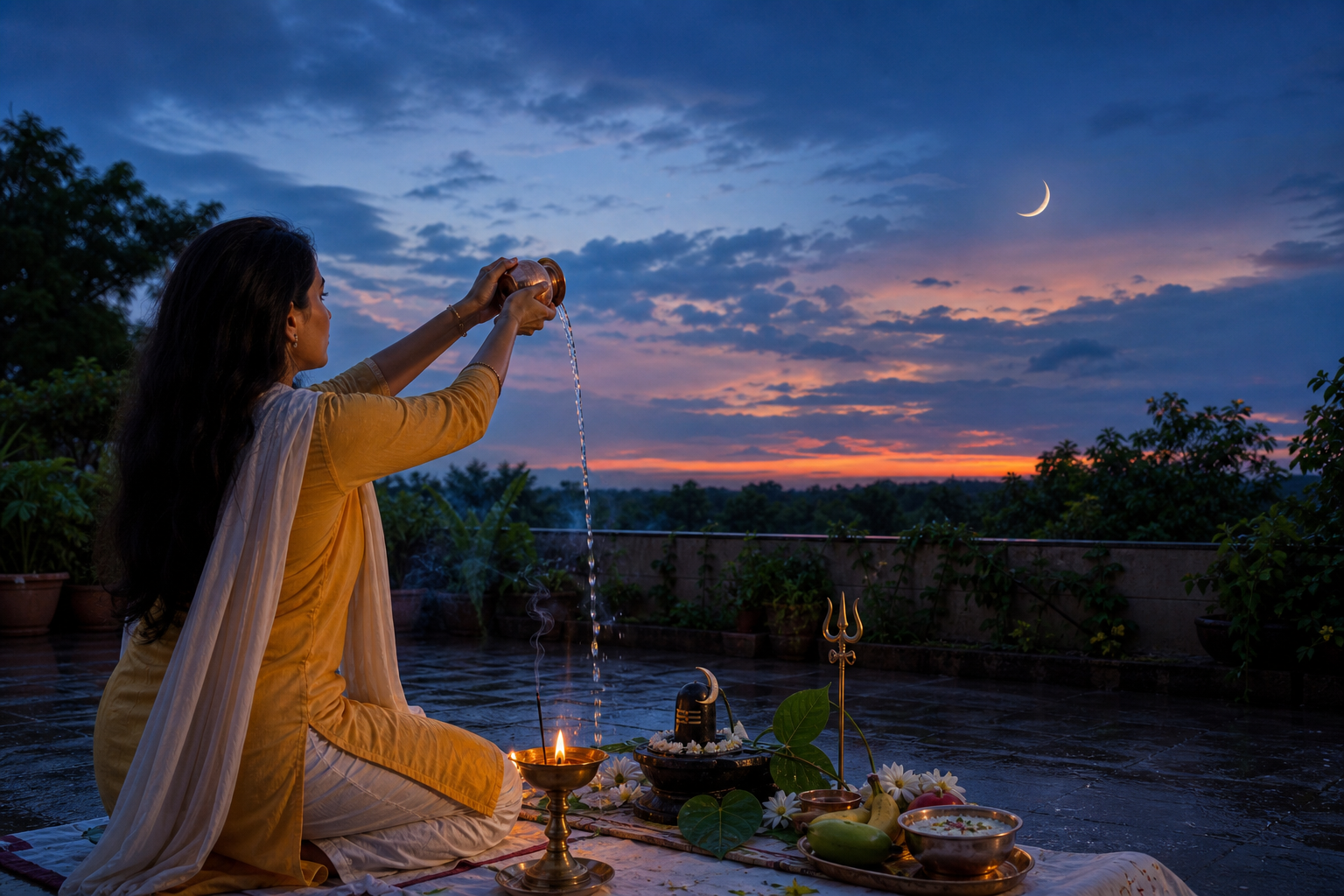
Chandra Darshan in Shravan 2026 will be observed on Friday, August 14, marking the first practical evening sighting of the waxing crescent after Amavasya. The observance brings together lunar timekeeping, devotional worship and the contemplative atmosphere of Shravan. Households may perform Ganesha Puja, Shiva Pooja, Gauri Pooja or a simple Chandra Puja, while a formal Chandra Graha Shanti Poojan may be undertaken according to family tradition and qualified guidance.
Essential details for 2026: The observance falls on Friday, August 14, 2026. A commonly published India-based worship window is approximately 7:02 PM to 8:01 PM IST, corresponding broadly to the period between sunset and moonset. This interval must be treated as a planning reference rather than a universal muhurat because sunset, moonset, atmospheric visibility and panchang calculations vary by location.
For New Delhi, astronomical tables place sunset close to 7:02 PM and moonset shortly after 8:00 PM on August 14. Devotees elsewhere should consult a reputable local panchang using the correct city and time zone. The relevant practical window begins only after local sunset, when the young Moon may become distinguishable from the bright western twilight, and ends when the crescent sets below the horizon.
What Chandra Darshan means
Chandra Darshan literally denotes the reverential viewing, or darshan, of Chandra, the Moon. In this monthly observance, the object of attention is not the invisible astronomical new moon itself but the first slender waxing crescent that can be seen after Amavasya. The reappearance of light in the evening sky has consequently become a natural symbol of renewal, continuity, composure and hope.
The expression “new moon” can create confusion because astronomy and customary religious language do not always use it in the same way. Astronomically, new moon is the instant of geocentric conjunction, when the Moon lies approximately between Earth and the Sun and its illuminated hemisphere faces mostly away from Earth. Chandra Darshan occurs later, when orbital motion produces sufficient angular separation from the Sun for a thin illuminated arc to become visible after sunset.
The United States Naval Observatory records the August 2026 astronomical new moon at 17:37 UTC on August 12, equivalent to 11:07 PM IST. The Moon is therefore already waxing by the evening of August 14. By then it is nearly forty-four hours beyond conjunction in India, providing a more realistic opportunity to see the delicate crescent than on the immediately preceding evening.
Tithi, civil date and visibility are related but distinct
A tithi is calculated from the angular separation between the Sun and Moon, with each tithi representing an increase of twelve degrees. Shukla Paksha begins after Amavasya: Shukla Pratipada covers the first twelve degrees of elongation and Shukla Dvitiya the next twelve. A civil date, by contrast, runs from midnight to midnight, while a traditional observance may be assigned according to the tithi prevailing at sunrise, sunset or another prescribed moment.
Chandra Darshan is consequently not determined by the English calendar alone. It may occur on Pratipada in some lunar cycles, but the first reliably visible crescent can appear on Dvitiya when conjunction occurs late or the younger Moon sets too close to sunset. Local latitude, longitude and calendar convention can also affect the listed date. This explains why the observance is sometimes described as falling on the day after Amavasya and sometimes on the following day.
Why the crescent can be difficult to see
First-crescent visibility depends on more than the Moon’s age. Important variables include elongation from the Sun, the Moon’s altitude at sunset, the interval between sunset and moonset, atmospheric transparency, haze, cloud cover and the observer’s horizon. A crescent may be astronomically above the horizon yet remain invisible because it is exceptionally thin or overwhelmed by twilight. Panchang timings should therefore be understood alongside actual observing conditions.
The best viewing direction is generally low in the western sky after sunset. An open terrace, field or other location with an unobstructed western horizon is preferable. The eyes should be given time to adapt as twilight fades. Binoculars are not required for the ritual, and they must never be directed toward the Sun. If optical assistance is used after the Sun has completely set, ordinary observational safety remains essential.
Why Shravan gives this Chandra Darshan special resonance
Shravan, also called Shravana or Sawan in different regions, is widely associated with devotion to Lord Shiva, vrata, pilgrimage, abhishekam, mantra recitation and disciplined living. Its monsoon setting also carries a powerful cultural association with replenishment: dry ground receives rain, vegetation returns and agricultural landscapes recover their vitality. The first crescent after Amavasya fits naturally within this wider imagery of restoration and renewed spiritual attention.
The relationship between Chandra and Shiva is especially prominent in Shaiva iconography. Shiva is Chandrashekhara, the bearer of the crescent Moon upon his matted hair. The crescent can be interpreted as time brought into balance, the changing mind held within higher awareness, and cyclical existence placed in relation to the unchanging sacred. Chandra Darshan during Shravan therefore becomes an occasion for both lunar reverence and Shiva bhakti.
Regional calendar differences
India’s lunar calendars do not all define a month in the same manner. Amanta systems end the lunar month at Amavasya, whereas purnimanta systems end it at Purnima. The same civil evening can therefore occupy different structural positions in regional calendars even when communities agree on the astronomical Moon being observed. In several amanta traditions, Shukla Pratipada begins a new lunar month immediately after Amavasya.
Regional solar calendars add another layer of naming. The corresponding season may be identified with Aadi Masam in the Tamil calendar, Karkidaka Masam in the Malayalam calendar and Shraban in the Bengali calendar. These variations do not invalidate one another. They demonstrate how a shared celestial cycle has been interpreted through distinct linguistic, geographic and ritual frameworks across the subcontinent.
Chandra in Hindu thought
Chandra occupies several overlapping roles in Hindu traditions. Chandra is a visible celestial deity, a Navagraha and a regulator of lunar time. Classical Jyotisha associates Chandra with manas, responsiveness, memory, receptivity and nourishment. Puranic narratives connect the Moon with Soma, beauty, fertility, medicinal plants and the measurement of months. These associations differ in emphasis across texts and sampradayas, but they consistently present lunar change as meaningful rather than merely decorative.
The waxing crescent is particularly suitable for reflection because it is neither darkness nor fullness. It represents an incremental beginning. Its light is small, yet unmistakably growing. For a household emerging from a demanding period, a student beginning disciplined study or a devotee renewing a neglected practice, the image offers a relatable lesson: meaningful change may begin quietly and strengthen through regular attention.
Ganesha, Gauri and Shiva worship
The source tradition identifies Chandra Darshan in Shravan as an auspicious occasion for Ganesha Puja, Shiva Pooja, Gauri Pooja and Chandra Graha Shanti Poojan. Ganesha may be worshipped at the beginning of the observance as the remover of obstacles and guardian of auspicious undertakings. Shiva worship reflects the special character of Shravan, while Gauri worship honours the sacred feminine through Parvati as strength, auspiciousness and compassionate presence.
A formal Chandra Graha Shanti Poojan is more specialized than ordinary crescent worship. It may involve a prescribed sankalpa, mantra count, homa, dana or procedures associated with a horoscope. Such a rite should not be presented as mandatory for every devotee. Those following a particular parampara should use its instructions, while others may undertake a simple, respectful observance without elaborate materials or astrological claims.
A practical Chandra Darshan puja vidhi
The observance can begin in the morning with bathing, clean clothing and the orderly preparation of the puja space. Cleanliness in this context is both physical and intentional: the surroundings are arranged, distractions are reduced and the day’s purpose is recalled. A devotee may make a simple sankalpa to observe Chandra Darshan with steadiness, gratitude and concern for the well-being of the household.
A modest arrangement may include a clean water vessel, a small diya, incense if appropriate, white flowers, unbroken rice or akshata, fruit, milk and a simple sweet such as kheer. No single list is universal. Local practice, family custom, environmental considerations and the availability of materials should guide preparation. Devotion and ethical conduct carry greater importance than expensive or excessive offerings.
Some devotees observe Chandra Darshana Vrata, Chandra Vratham or Chandrodaya Vrata from sunrise until the crescent is sighted. Practices range from a complete fast to fruit, milk or a simple sattvic diet. Fasting is voluntary and should be adapted responsibly. Anyone with medical, dietary, pregnancy-related or age-related needs should prioritize appropriate nourishment and professional health advice rather than treating physical hardship as a measure of devotion.
Before sunset, the puja space may be prepared and the local sunset and moonset times checked. Once the Sun has fully disappeared, the observer can look toward the western horizon without staring at the earlier solar position. The first sight of the crescent may be received in silence, with folded hands or with a short prayer. If the Moon is not immediately visible, patience is more appropriate than anxious searching.
After sighting the crescent, the diya may be lit and flowers and akshata offered at the shrine or designated worship space. A simple invocation to Ganesha can precede prayers to Shiva, Gauri and Chandra. Households may follow their customary order of worship, since there is no need to erase legitimate regional or sampradaya differences in pursuit of artificial uniformity.
Offering arghya to Chandra
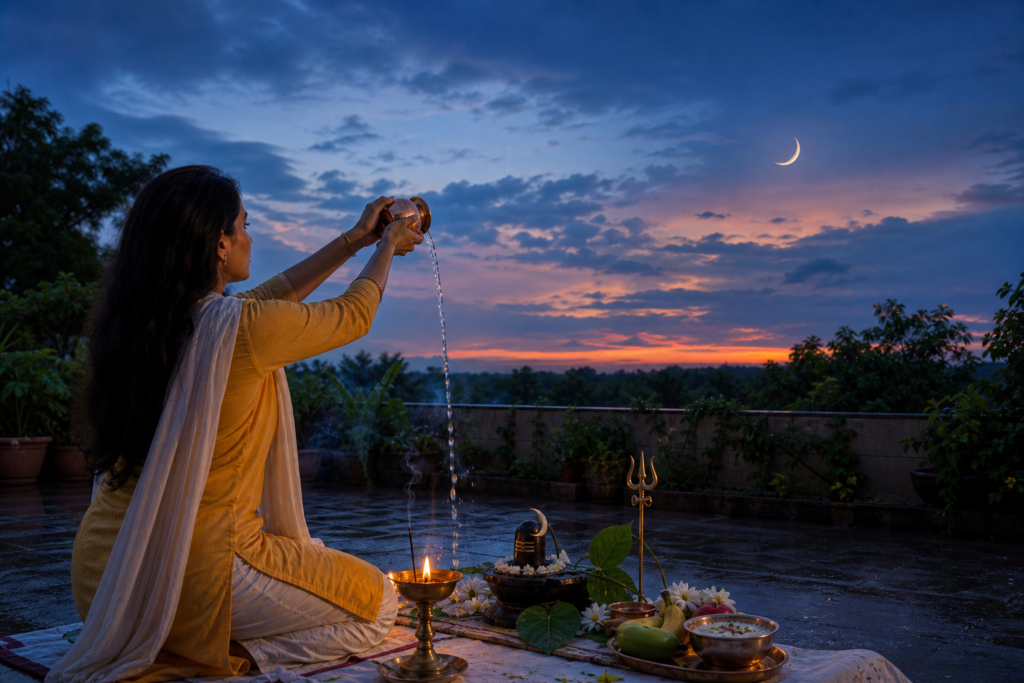
Arghya is commonly offered by holding a vessel of clean water with both hands and pouring the water in a controlled stream while facing the visible Moon. Some traditions add milk, white flowers or rice; others use water alone. The offering should be performed where spilled liquid will not create a slipping hazard, damage a building or cause waste. An indoor symbolic offering is reasonable when outdoor access is unsafe.
The gaze may briefly rest on the crescent and then on the falling stream of water, according to local custom. The act expresses reverence, gratitude and the surrender of mental agitation. It should not become a test of technical perfection. A careful, unhurried offering consistent with family practice is more meaningful than copying unfamiliar procedures assembled from unrelated sources.
Mantra and contemplative prayer
Short invocations commonly associated with the observance include “Om Chandraya Namah” and “Om Somaya Namah.” A devotee may chant one of these mantras eleven, twenty-one or 108 times, but the count is optional unless a guru or family discipline prescribes it. Those unfamiliar with mantra practice may offer a plain prayer for clarity, compassion, emotional restraint and harmony within the home.
During Shravan, the Chandra prayer may be followed by Shiva worship, silent meditation or the recitation of a familiar Shiva mantra. The crescent worn by Shiva makes the connection especially immediate: the changing mind is acknowledged without being allowed to dominate conduct. This interpretation turns the ritual from a request for favourable circumstances into an ethical discipline of responding to circumstances with greater balance.
A few minutes of silent observation can deepen the experience. Attention may be directed toward the Moon’s fragile light, the movement of clouds and the changing colour of the western sky. Such sensory details make the lunar calendar tangible. Instead of encountering tithi only as a printed calculation, the household witnesses how calendrical knowledge arises from sustained attention to celestial cycles.
Completing the vrata
After darshan, arghya and prayer, the fast may be concluded with water, fruit, milk, kheer or another light sattvic meal consistent with the observer’s tradition. Food can first be offered as naivedya and then shared as prasadam. Eating calmly and without excess preserves the disciplined character of the day and prevents the fast from becoming merely an interval before a heavy meal.
Dana may accompany the observance, especially through the responsible sharing of rice, food, clothing or other useful necessities. Charity should respond to an actual need and respect the recipient’s dignity. Feeding people, supporting a community kitchen or assisting a vulnerable neighbour often expresses the principle of nourishment more effectively than disposing of ceremonial materials without thought.
The vrata is traditionally strengthened by calm speech, restraint from anger and avoidance of harmful conduct. These disciplines are not peripheral restrictions. They translate the symbolism of lunar coolness into social behaviour. A household that performs an elaborate puja but continues unnecessary conflict misses a central practical insight of the observance: inner composure should become visible through consideration for others.
If clouds prevent the Moon’s sighting
Monsoon clouds often conceal the crescent during Shravan. The Moon’s absence from view does not mean that the astronomical event has failed to occur or that the observer has committed an error. A devotee may wait until the calculated moonset, complete the prayer symbolically and conclude the vrata according to family custom. Some traditions require actual sighting before parana, so stricter observers should consult their own acharya or panchang authority.
A mobile application can help identify the Moon’s direction, but an online image or livestream is not automatically equivalent to darshan in every ritual system. Digital tools are best used for orientation and education. Whether mediated viewing has ritual validity is a matter for the relevant parampara rather than a universal rule imposed on all communities.
Observing Chandra Darshan outside India
Devotees in Canada, the United States, Europe, Southeast Asia and other regions should not mechanically convert an Indian time into their local time. The sky must be calculated for the observer’s own longitude, latitude and civil date. In some places, the first visible crescent may fall on a different evening because conjunction and sunset occur at different local times. A city-specific panchang is therefore indispensable for diaspora practice.
High-rise buildings, mountains, trees, wildfire smoke, urban haze and seasonal weather may shorten the effective viewing interval. The safest approach is to identify an accessible western horizon before the observance, confirm local sunset and moonset, and avoid restricted rooftops or roadside locations. Chandra Darshan is intended to cultivate awareness, not to encourage risky attempts at sighting.
A valuable family and educational practice
Families can use the occasion to introduce children to both cultural tradition and observational astronomy. A simple monthly journal can record the date, sunset, weather, direction of the crescent and a sketch of its shape. Over several months, children can observe how the Moon’s position and visibility change. Ritual knowledge and scientific curiosity can coexist when the difference between devotional meaning and measurable astronomy is explained honestly.
The observance also preserves intergenerational memory. Elders may explain how the Moon was located before digital calendars, which foods were prepared after the fast and which prayers belonged to the family’s region. Younger participants can contribute astronomical data or weather observations. This exchange keeps tradition active without freezing it into a performance detached from lived experience.
Scientific description and sacred interpretation
Astronomy explains lunar phases through changing Sun-Earth-Moon geometry. The Moon does not generate visible light; it reflects sunlight, and approximately half of it is always illuminated. From Earth, the visible fraction changes as the Moon orbits. The synodic cycle from one new moon to the next averages about 29.5 days, while local moonrise and moonset times shift from day to day.
This physical explanation does not remove the ritual’s cultural meaning. Religious traditions frequently interpret observable natural cycles through symbolism, prayer and ethical reflection. Academic clarity simply requires the two levels to be distinguished. Claims that Chandra worship guarantees wealth, cures illness or mechanically changes planetary forces belong to devotional or astrological belief and should not be presented as experimentally established medical or scientific outcomes.
Within Jyotisha, Chandra Graha Shanti is intended to address a horoscope-specific assessment. Its interpretation belongs to that knowledge tradition and is not identical to modern astronomy. Respectful discussion can acknowledge the ritual framework while avoiding exaggerated promises. Emotional steadiness may be cultivated through prayer, fasting discipline, family support and contemplation, but persistent health concerns still require appropriate professional care.
Common misunderstandings to avoid
The first misunderstanding is attempting to see the Moon at the exact instant of astronomical conjunction; the new moon is ordinarily invisible because its illuminated side faces away from Earth. The second is treating a national timing as valid everywhere. The third is assuming that Chandra Darshan must always occur on Shukla Pratipada. Actual observance depends on the relationship among tithi, sunset, moonset and crescent visibility.
Another error is confusing Chandra Darshan with Chandra Grahan. Chandra Darshan concerns the young crescent following Amavasya, whereas Chandra Grahan is a lunar eclipse occurring near Purnima. The August 12, 2026 solar eclipse is connected astronomically with the preceding new moon, but it is not the Chandra Darshan ritual itself. By August 14, the Moon has moved beyond conjunction and appears as a waxing crescent.
A concise schedule for August 14, 2026
In the morning, the observer may bathe, establish the sankalpa and begin the chosen form of vrata. During the day, conduct remains simple and restrained. Before local sunset, the diya, water for arghya, flowers, akshata and naivedya are arranged. After the Sun has fully set, the western sky is observed during the city-specific visibility window. Following sighting, arghya, mantra, Shiva-Gauri-Ganesha worship and silent prayer may be completed. The vrata concludes with prasadam and an appropriate sattvic meal.
Can someone observe without fasting? Yes. A person may participate through darshan, prayer, arghya, meditation or charity without undertaking a complete fast. The form of discipline should remain proportionate to health, responsibilities and family tradition. Chandra Darshan is not made spiritually meaningful by avoidable physical harm.
Is a telescope necessary? No. The waxing crescent is intended to be viewed with the unaided eye when conditions permit. Binoculars may help locate it after sunset, but they are optional and require strict solar safety. A clear western horizon is generally more useful than magnification.
Can the puja be performed at home? Yes. A clean domestic shrine, balcony, courtyard or safe outdoor space is sufficient for a simple observance. Temple participation may enrich the occasion, but it is not required unless a particular vrata or family instruction specifies it.
A shared contemplative value
Although Chandra Darshan is a specifically Hindu observance, its attention to restraint, renewal, compassion and the cycles of nature can encourage respectful dialogue among Hindu, Buddhist, Jain and Sikh communities. Unity among Dharmic traditions does not require their distinct doctrines or liturgies to be collapsed into one practice. It grows through informed respect, ethical conduct and recognition of each tradition’s contribution to disciplined and compassionate living.
Research and timing note: The date and ritual context were reviewed against the original HinduPad source page, the United States Naval Observatory phase table, NASA’s explanation of lunar phases, the New Delhi moon table and a published 2026 Chandra Darshan schedule. Local panchang verification remains necessary before worship.
Chandra Darshan in Shravan 2026 ultimately joins a precise celestial transition with a deeply human practice of beginning again. The thin crescent does not arrive with the brilliance of a full moon; it appears quietly, close to the horizon and only for a limited time. That modest light gives the observance its emotional force. Through careful timing, simple puja, responsible fasting and compassionate conduct, the evening can become a disciplined celebration of renewal rather than a mechanical calendar entry.
Inspired by this post on Hindu Pad.










Leave a Reply
You must be logged in to post a comment.