
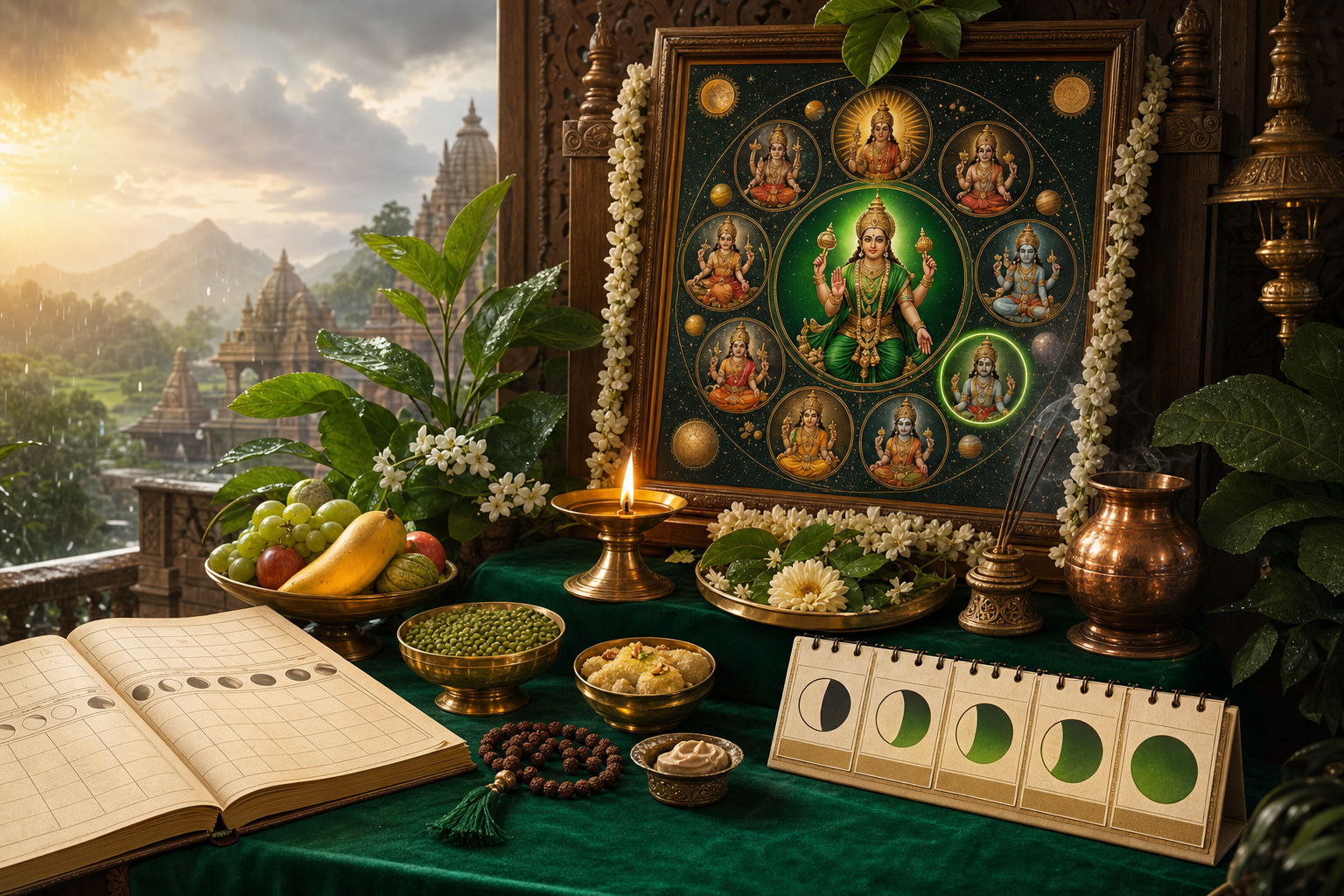
Budh Pujan in Shravan is a regional Wednesday observance dedicated to Budha, the Navagraha deity associated with Mercury in Hindu tradition. The vrat brings together the sacred atmosphere of Shravan, the weekly rhythm of Budhwar, and practices traditionally connected with clarity, learning, communication, discernment, and disciplined conduct. Particularly familiar in Maharashtra and in parts of Karnataka and Gujarat, it offers devotees a structured way to pause in the middle of the week, undertake worship, regulate food and speech, and translate devotion into ethical action.
Source-listed Budh Pujan dates for Shravan 2026:
Wednesday, 12 August 2026
Wednesday, 19 August 2026
Wednesday, 26 August 2026
Wednesday, 2 September 2026
Wednesday, 9 September 2026
An important calendar qualification: The supplied source schedule lists all five Wednesdays above. A separate Amanta-calendar calculation used for Maharashtra, Gujarat, Karnataka, Goa, Andhra Pradesh, and Telangana places the beginning of Shravan on 13 August 2026 and its conclusion on 11 September 2026. Under that calculation, the Wednesdays fully within Shravan are 19 August, 26 August, 2 September, and 9 September; 12 August is the preceding new-moon boundary. The original schedule is therefore preserved here, but devotees should confirm whether 12 August is observed in their family tradition or local Marathi Panchang.
This difference is not merely a printing inconsistency. Hindu calendars are calculated through interacting elements such as lunar month, paksha, tithi, weekday, sunrise, location, and the regional convention used to name a month. The 2026 regional Shravan calculation explains that the Purnimanta system followed across much of northern India begins Shravan approximately fifteen days before the Amanta system commonly used in Maharashtra, Gujarat, and Karnataka. A Panchang day also generally runs from sunrise rather than from civil midnight, so the applicable calendar must be set for the devotee’s city.
What Budh Pujan means
The expression combines three related ideas. Budha identifies the graha associated with Mercury; pujan refers to reverential worship through prayer and offerings; and vrat denotes a voluntarily accepted discipline or sacred commitment. A vrat may include fasting, but it is broader than abstaining from food. It can also involve truthful speech, restraint, mantra recitation, study, charity, simplicity, and repeated observance on designated days.
Budha should not be confused with Buddha, the title associated with Siddhartha Gautama in Buddhist tradition. The two words may look similar in English transliteration, but they identify distinct figures and religious contexts. Budha belongs to the Hindu Navagraha framework, whereas Buddha means an awakened one and is central to Buddhism. Maintaining this distinction respects both traditions and prevents a frequent search and pronunciation error.
Budha within the Navagraha tradition
Navagraha literally denotes nine grahas: Surya, Chandra, Mangala, Budha, Brihaspati, Shukra, Shani, Rahu, and Ketu. In ritual language, a graha is more than a modern astronomical planet. The group includes the Sun and Moon as well as Rahu and Ketu, which correspond to the lunar nodes used in eclipse calculation. It is therefore more precise to describe the Navagrahas as nine celestial or astral powers within Hindu cosmology rather than as nine planets in the contemporary scientific sense. An official description of Assam’s Navagraha Temple likewise identifies Budhan with Mercury within this ninefold sacred arrangement.
Academic study also shows that Navagraha worship has a substantial textual, artistic, and temple history. Surviving group images became increasingly visible in the first millennium CE, and later temple traditions developed distinctive iconography for individual grahas. An extensive University of Michigan study of the early Navagrahas examines the relationship among texts, inscriptions, calendrical systems, and material representations. Such scholarship does not replace living religious interpretation, but it demonstrates that Navagraha practice is a layered tradition rather than a single uniform ritual.
Budha worship also appears within established temple networks. The Mayiladuthurai Municipality’s account of the Tamil Navagraha circuit identifies Thiruvenkadu as the shrine associated with Budhan and records the traditional connection with education and the arts. This official temple overview illustrates how the worship of Budha exists alongside devotion to Shiva rather than functioning as an isolated or competing system.
Why Wednesday is associated with Budha
Indian weekday names preserve the association between each day and a graha. Wednesday is Budhavara or Budhwar, the day of Budha. This linguistic connection supplies the ritual logic for Wednesday worship: the day bearing Budha’s name becomes a recurring occasion for remembrance, prayer, fasting, and charitable action. A devotee does not need to imagine that worship is impossible on another day; Wednesday simply provides the conventional weekly focus.
Within Jyotisha, Budha is traditionally connected with intelligence, analysis, memory, language, calculation, learning, adaptability, trade, and communication. These associations help explain why students, teachers, writers, accountants, merchants, and people seeking greater care in speech may find the observance personally meaningful. Such correspondences belong to a religious and astrological interpretive system. They should not be presented as conclusions established by modern experimental astronomy or psychology.
The significance of Shravan
Shravan is among the most active devotional months in many Hindu calendars. It is especially associated with Shiva, yet its ritual landscape is broader than Monday worship alone. Different regions maintain observances connected with Shiva, Parvati, Vishnu, the Nagas, household deities, local goddesses, and the Navagrahas. Budh Pujan demonstrates this diversity by placing a Mercury-related Wednesday vrat within the larger sacred rhythm of the month.
The monsoon setting gives Shravan additional emotional and cultural force. Rain, renewed vegetation, agricultural work, temple festivals, and recurring family vrats create a seasonal atmosphere in which restraint and abundance coexist. Green offerings associated with Budha can therefore be understood not only as an astrological colour correspondence but also as an evocative sign of regeneration, learning, and careful growth.
Regional character of the observance
The detailed source account of Shravan Budh Pujan describes the vrat as being observed mainly in Maharashtra and in some communities of Karnataka and Gujarat. It is not among the most widespread Shravan practices in northern India. This regional concentration should not be treated as a weakness or as evidence of lesser authority. Hindu practice is sustained through many regional calendars, family customs, temple lineages, languages, and sampradayas.
In some homes, the observance may be recognisable as a formal Budha Graha Puja. In others, it may consist of a simple Wednesday fast, a lamp, a short prayer, a visit to a Navagraha shrine, or an offering made through the family’s Ishta Devata. A household may also integrate Budha remembrance with worship of Ganesha, Vishnu, Shiva, or a local deity. These variations are consistent with the plural and adaptive character of Hindu ritual life.
Understanding Budha Graha dosha carefully
The source presents Budh Pujan as a traditional remedy for people believed to be affected by Budha Graha dosha. In Jyotisha, a dosha or difficult planetary condition is interpreted through the whole birth chart, including houses, signs, aspects, conjunctions, planetary strength, and periods of influence. It cannot be responsibly inferred from a single personality trait, an online checklist, or the fact that a person is experiencing temporary difficulty with study or communication.
A ritual observance may offer discipline, hope, community, and a framework for self-examination, but it should not be advertised as a guaranteed cure for financial, educational, medical, or psychological problems. Budha dosha is an astrological category, not a medical diagnosis. Professional healthcare, educational support, legal guidance, or financial advice should not be discontinued or delayed because of a puja. A competent Jyotisha practitioner may be consulted when an individual seeks a chart-specific religious interpretation, but fear-based claims and expensive guaranteed remedies deserve caution.
A practical household method for Budh Pujan
No single procedure governs every family. A household should follow its inherited paddhati, temple guidance, or guru’s instruction when one is available. The method below is a conservative devotional template suitable for readers who want a simple practice. It is not a replacement for a lineage-specific ritual manual, and it does not attempt to reproduce a formal Graha Shanti Homa or a complete Shodashopachara ceremony.
Basic materials: A clean altar or cloth, an image or symbolic representation of Budha or the Navagrahas, a stable lamp, water, incense if appropriate, flowers or clean leaves, sandal paste or another customary fragrance, seasonal fruit, a simple sattvic food offering, and green gram may be assembled. Green cloth or green flowers are optional symbolic additions, not compulsory purchases. Existing household items are sufficient; devotion does not require an elaborate display.
Preparing the space: The worship area is cleaned, unnecessary distractions are removed, and the lamp is positioned safely away from fabric, children, pets, and moving air. The devotee bathes or washes as circumstances permit and wears clean clothing. Ritual purity is best joined with practical cleanliness, calm attention, and respectful conduct rather than anxiety about minor imperfections.
Choosing the time: Many households prefer the morning after bathing, while others perform the puja during an available Wednesday period. The exact Budha Hora, tithi boundaries, sunrise, Rahu Kaal, and other timing factors vary by location. A city-specific Panchang should be used when the family tradition requires precise timing. For a simple weekly devotion, a consistent and peaceful time is generally more sustainable than an elaborate schedule that cannot be maintained.
Making the sankalpa: The devotee begins by forming a clear intention. The sankalpa may mention the date, place, name, family lineage if known, and purpose of the worship. Appropriate aims include clearer understanding, responsible speech, disciplined study, ethical work, family harmony, and spiritual growth. The intention should avoid demands for another person’s control or harm, because a vrat is fundamentally a discipline of self-regulation.
Opening the worship: After a moment of quiet, the devotee may remember Ganesha, the guru-parampara, the family deity, and the chosen form of the Divine. A lamp is lit, and water or flowers are offered according to household custom. This opening situates Budha within the larger sacred order and prevents the puja from being reduced to a transactional attempt to manipulate a planet.
Invoking Budha: Attention is then directed toward Budha as a member of the Navagrahas. A devotee may mentally contemplate the qualities of intelligence, discrimination, balanced expression, and skilful learning. Those worshipping before a full Navagraha image can honour the entire group before making a focused offering to Budha. This recognises that the grahas function as an interconnected system in Jyotisha.
Offering the upacharas: A simple Panchopachara Puja commonly uses five categories of offering: fragrance, flowers, incense, lamp, and food. The materials and sequence can vary by lineage. Each offering is made deliberately, without rushing. A formal Shodashopachara Puja expands worship into sixteen services and may include ritual seat, water for welcome, bathing, clothing, fragrance, flowers, light, and food. Readers unfamiliar with the longer procedure should learn it from a reliable priest or family tradition rather than improvising complex mantras.
Mantra practice: A widely accessible nama mantra is ॐ बुधाय नमः. It may be transliterated as Om Budhāya Namaḥ. The mantra can be recited slowly for a manageable count such as 9, 27, or 108 repetitions. Accuracy, attention, and regularity are more important than speed. Seed-syllable mantras and highly formal japa disciplines should be undertaken according to the requirements of the relevant tradition, especially when initiation or specialised pronunciation is expected.
Devotees who know an established Budha stotra, Navagraha stotra, or family prayer may recite it after the mantra. Others may sit silently and reflect on speech, study, and decision-making. The reflective portion is especially valuable because it links symbolic worship with observable conduct. A prayer for eloquence has greater integrity when accompanied by a commitment not to lie, humiliate, gossip, or communicate carelessly.
Naivedya and conclusion: Fruit, cooked food, or another customary vegetarian preparation may be offered as naivedya. The food should be fresh, affordable, and suitable for those who will receive it. The puja concludes with a short arati where customary, pranam, and a prayer for the well-being of family, teachers, students, colleagues, and the wider community. Prasad is then shared respectfully rather than wasted.
How the Budhwar vrat may be observed
Fasting customs differ considerably. One devotee may undertake a complete fast, another may eat fruit and milk, and another may take one simple vegetarian meal. Some families avoid particular grains or salt, while others emphasise moderation rather than a restricted menu. No single food rule should be declared universal without reference to a specific sampradaya or household tradition.
The deeper discipline of the day can include reduced entertainment, mindful speech, careful accounting, focused study, and avoidance of needless argument. These practices make the symbolism of Budha concrete. Communication becomes more precise, study receives protected time, and the vow continues beyond the few minutes spent before the altar.
Fasting should remain proportionate to health and capacity. Children, older adults, pregnant or breastfeeding people, individuals with diabetes or eating disorders, and anyone taking medication may require a modified observance or no food restriction at all. Medical guidance takes priority when fasting could create risk. Prayer, charity, japa, study, or restraint of harmful speech can serve as meaningful alternatives.
Dana as an expression of the vrat
Green gram, green vegetables, clothing, stationery, and books are frequently associated with Wednesday charity in popular Budha practice. The ethical principle matters more than colour symbolism. Food should reach someone who can use it; educational materials should be relevant and in good condition; and giving should preserve the recipient’s dignity. Supporting a student, library, language programme, or person seeking employment can express Budha’s association with knowledge and practical skill.
Dana also prevents the observance from becoming exclusively self-focused. Instead of asking only for personal success, the devotee contributes to another person’s capacity to learn, communicate, or work. That shift from anxiety to service can be among the most spiritually constructive dimensions of Budh Pujan.
Temple worship and formal Graha Shanti
A visit to a temple with a Navagraha shrine may replace or complement household worship. Temple etiquette, circumambulation patterns, offerings, and archana procedures should be learned locally because they are not identical everywhere. A formal Budha Graha Shanti, Homa, or chart-specific rite ordinarily involves more detailed sankalpa, nyasa, mantra, fire offerings, and priestly procedure. Such ceremonies should be conducted by a trained practitioner rather than reconstructed from fragments found online.
The ritual relationship between Budha and other deities also varies. In a Shiva temple, Budha may be approached within a Shaiva sacred environment; elsewhere, the observance may include Vishnu or Ganesha. These relationships are complementary within Hindu practice. The Navagrahas are not ordinarily treated as rivals to the Supreme or to an individual’s Ishta Devata.
Using the five Wednesdays as a progressive discipline
The source-listed five-date sequence can be used as a practical framework even when the first boundary date is observed only according to local custom. The first Wednesday may focus on listening before speaking. The second may emphasise disciplined study. The third may address honesty in work and financial records. The fourth may cultivate patience in difficult conversations. The final Wednesday may bring these themes together through gratitude, charity, and a sustainable commitment for the months ahead.
This progressive structure does not claim to be an ancient mandatory sequence. It is a contemporary reflective application of Budha’s traditional associations. Its value lies in joining puja with measurable habits. A student may protect a weekly study session, a professional may review communication practices, and a family may create a period in which each person speaks without interruption. The observance then enters daily life without losing its sacred orientation.
A brief private record can support continuity. The devotee may note the date, mantra count, food discipline, charitable act, and one communication habit being examined. Such a record is not a scorecard of divine favour. It simply reveals whether the vrat is producing greater steadiness, attention, and ethical clarity.
Can Budh Pujan be performed without a horoscope?
Yes. A person may honour Budha as part of the Navagraha tradition without claiming to possess a Budha dosha. General devotional worship, study, charity, and prayer do not require a negative chart diagnosis. Horoscope analysis becomes relevant only when specific astrological remedies are being prescribed for an individual.
Is an idol or yantra compulsory?
No universal rule makes an expensive object necessary for a simple household observance. A clean Navagraha image, a Budha image already used by the family, a temple visit, or even a lamp accompanied by focused prayer may be sufficient according to local custom. A consecrated yantra is not decorative merchandise; anyone adopting one should understand the maintenance and worship expected by the relevant tradition.
What happens if a Wednesday is missed?
A missed date need not create fear. Illness, caregiving, travel, work, and emergencies are legitimate constraints. The devotee may resume on the next applicable Wednesday, offer a short prayer when able, or seek family guidance if a formal vow was made. A vrat intended to cultivate clarity should not become a source of panic or coercion.
Must the vrat continue for a fixed number of weeks?
Some popular traditions recommend a set series of Wednesdays, but the number is not universal. Budh Pujan during Shravan may be limited to the Wednesdays recognised by the local calendar. A longer vrata should be adopted only when its rules, concluding rite, and health implications are understood. Consistency in a modest vow is preferable to an ambitious promise that cannot be responsibly maintained.
How should the observance be adapted outside India?
Devotees living abroad should use a Panchang calculated for their actual city rather than copying sunrise, tithi, or hora timings from Mumbai, Pune, Bengaluru, or Ahmedabad. The Gregorian date may occasionally differ when a ritual depends on the tithi prevailing at local sunrise. If a family is maintaining an India-based inherited convention, that choice should be made consciously and consistently.
Materials can also be adapted without diminishing reverence. Locally grown flowers, seasonal fruit, reusable metal lamps, modest food offerings, and digital access to familiar prayers can support the practice. In apartments, dormitories, hospitals, or fire-restricted buildings, an electric lamp and silent prayer may be safer than flame or incense. Practical responsibility is itself compatible with sacred intention.
Environmental and social responsibility
A meaningful puja avoids plastic decorations, chemically coloured materials, excessive packaging, and food waste. Flowers can be composted where possible, lamps should be handled safely, and edible offerings should be distributed promptly. Green symbolism becomes more coherent when the observance protects living environments rather than generating avoidable waste.
The same principle applies socially. No family member should be pressured to fast against medical advice, and children should not be frightened with deterministic claims about planetary punishment. Participation can be encouraged through stories, simple prayers, reading, music, art, or acts of generosity. Budha’s link with learning makes education a particularly appropriate form of inclusion.
Dharmic plurality and shared ethical purpose
Budh Pujan is specifically rooted in Hindu Navagraha and vrata traditions. Respectful unity among Hindu, Buddhist, Jain, and Sikh communities does not require presenting every ritual as common to all four paths. Genuine unity recognises differences while appreciating shared ethical concerns such as disciplined conduct, learning, truthful communication, compassion, restraint, and service. The distinction between Budha and Buddha is therefore compatible with harmony: clarity protects mutual respect.
Within Hinduism itself, the observance also demonstrates unity without uniformity. Shaiva, Vaishnava, Shakta, Smarta, regional, temple, and household traditions may frame the grahas differently. No single local form needs to invalidate another. A family can follow its sampradaya faithfully while acknowledging that other communities maintain equally sincere disciplines.
Common mistakes to avoid
The most common errors are treating a source-listed date as universally valid, confusing Budha with Buddha, purchasing costly ritual objects out of fear, assuming every difficulty is caused by Budha dosha, imposing severe fasting on vulnerable people, and expecting puja to replace practical action. Other mistakes include rushing mantra pronunciation, wasting offerings, copying another city’s muhurta, and making promises that cannot be kept.
A more balanced approach combines three forms of verification. The date is checked in a local Panchang; the ritual method is checked with family, temple, or lineage guidance; and the intended outcome is checked against ethical and practical responsibility. This combination protects both devotion and accuracy.
Concise 2026 observance checklist
Before beginning, the devotee confirms the locally applicable Shravan dates and decides whether the 12 August boundary date belongs to the family tradition. A manageable form of fasting or restraint is selected with health in mind. The altar and simple offerings are prepared without unnecessary expense. The puja includes sankalpa, remembrance of the wider sacred order, Budha invocation, mantra or prayer, naivedya, and a respectful conclusion. The day is completed through truthful speech, focused learning, useful charity, and the sharing of prasad.
Final perspective
Budh Pujan in Shravan is most meaningful when ritual precision and ethical purpose reinforce one another. Its lamp represents attention, its mantra trains concentration, its vrat restrains impulse, and its dana extends knowledge and nourishment beyond the self. Whether conducted through a formal temple service or a quiet household prayer, the observance can create a memorable midweek rhythm of learning, careful communication, and devotion.
For 2026, the source-provided sequence is 12 August, 19 August, 26 August, 2 September, and 9 September. Because the Amanta regional calculation places Shravan from 13 August to 11 September, 12 August requires local confirmation, while the remaining four Wednesdays fall within that span. This calendar awareness does not weaken the vrat; it honours the technical diversity through which Hindu sacred time is preserved.
Inspired by this post on Hindu Pad.











Leave a Reply
You must be logged in to post a comment.