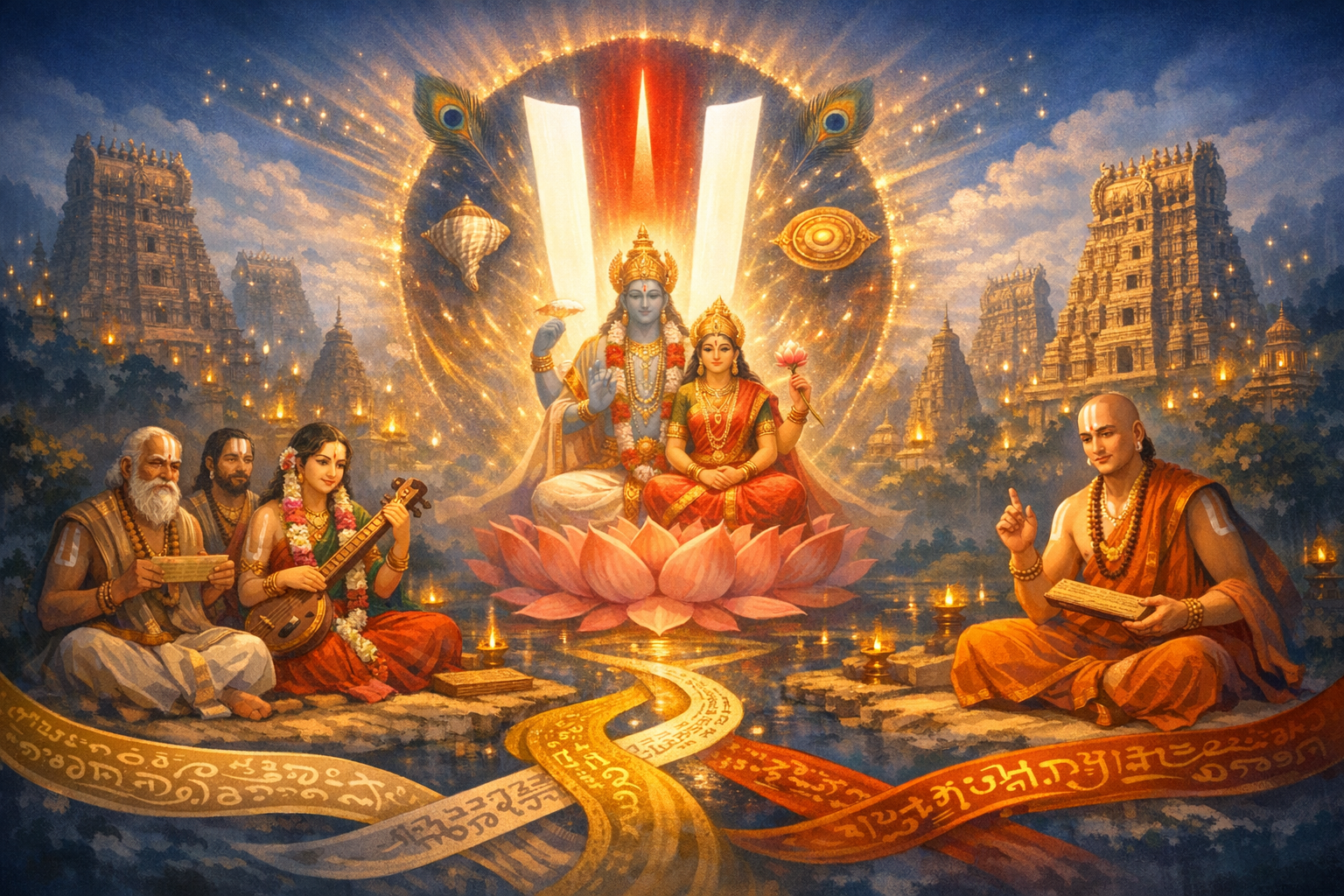
Divine paths converge upon a single, compassionate center in the Sri Vaishnava sampradaya. Within this living tradition, the Azhwarstwelve Tamil poet-saints of the Bhakti Traditionand Ramanujacharyathe 11th–12th century systematizer of Viśiṣṭādvaita Vedantastand as complementary beacons. Their vocabularies differecstatic Tamil poetry for the Azhwars, rigorous Sanskrit exegesis for Ramanujacharyayet their destination is one: surrender (śaraṇāgati), loving service (bhakti), and union with Vishnu as the supreme, personal reality (Nārāyaṇa). A comparative, academically grounded reading reveals how experiential devotion and philosophical clarity mutually reinforce a spacious, inclusive Hindu philosophy that continues to nourish contemporary practice and inter-dharmic harmony.
The Azhwars, active broadly between the 6th and 9th centuries CE, composed approximately 4,000 Tamil versescollectively revered as the Divya Prabandham and later compiled by Nathamunithat sanctified 108 Divya Desams (sacred Vishnu temples) and carried the immediacy of divine presence into everyday life. Figures such as Nammalvar, Andal (the only female Azhwar), Periyalvar, and Thirumangai Azhwar articulated a theology of intimacy: the soul as servant (dāsa), friend, lover, or child of Vishnu, enveloped by the grace of Sri (Lakshmi). Their poetry transformed kṣetra-yātra (pilgrimage) into a walking commentary on devotion, ethics, and aesthetics, making temples both libraries of living wisdom and theaters of compassionate practice.
Ramanujacharya (c. 1017–1137 CE) forged a parallel yet intertwined contribution by articulating Viśiṣṭādvaitaqualified non-dualismthrough celebrated works such as the Śrībhāṣya (a commentary on the Brahma Sūtras), the Gita Bhāṣya, and the Vedārtha Saṅgraha. He affirmed three eternally real categoriesĪśvara (the Supreme, Vishnu), cit (sentient beings), and acit (insentient matter)bound together by the śarīra–śarīrī relation: the universe and souls as the body, and Vishnu as the indwelling Self. Employing a sophisticated hermeneutic that honored both Sanskrit śruti (Upanishads) and the Tamil hymns (termed Dravida Veda), Ramanujacharya established an Ubhaya Vedanta“dual-source” Vedantawherein śāstra and song, logic and love, converge.
Philosophically, the Azhwars advance an experiential theology. Their verses display rasa-rich devotion where longing (viraha), surrender (prapatti), and ecstatic union are not metaphors but modes of knowing. In Andal’s Tiruppavai and Nammalvar’s Tiruvaymoli, devotion becomes a comprehensive epistemology: the divine is not merely inferred but tasted, seen, and sung. This is congruent with the Ishta philosophy in Hinduismeach devotee approaches the Supreme through a chosen, intimate form (Ishta), cultivating a distinctive yet harmonizing path. The result is an embodied praxis where ritual, ethics (dharma), and aesthetics interpenetrate.
Ramanujacharya provides the formal scaffolding for that experience. In Viśiṣṭādvaita, Brahman (Vishnu-Narayana) is the substantive unity with real attributes, knowable through śabda (scriptural testimony), supported by pratyakṣa (perception) and anumāna (inference). Aprithak-siddhi (inseparable inherence) clarifies how attributes do not stand apart from substance. Soteriologically, bhakti-yoga, nourished by knowledge (jñāna) and ethical action (karma), matures into śaraṇāgatitotal self-offering dependent on the Lord’s grace. Sri (Lakshmi) is mediator and universal mother, making divine compassion immediately accessible.
Śaraṇāgati forms the deepest bridge between Azhwars and Ramanujacharya. The classical articulation of its limbsanukūlyasya saṅkalpa (embracing the favorable), prātikūlyasya varjanam (avoiding the adverse), rakṣiṣyatīti viśvāsa (trust in divine protection), goptṛtva varaṇam (accepting divine guardianship), and kārpaṇya (humble helplessness)is lived out in Azhwar hymns and codified by Ramanujacharya. In Andal’s dawn-inviting Tiruppavai, the refrain of reliance upon “Nārāyaṇan” recasts winter mornings into seasons of surrender and grace.
Scripturally, the Azhwars functioned as living commentators of the Upanishads, Bhagavad Gita, and the broader Vedic vision by expressing them in the heart-language of Tamil. Their Divya Prabandham became a people’s śāstra, recited in daily and seasonal liturgies across South India. Ramanujacharya, without diminishing Sanskrit authority, elevated these Tamil hymns to canonical dignity within temple worship, affirming that revelation flows through both Veda and Prabandham. This is the hallmark of Sri Vaishnava Ubhaya Vedanta: a twofold canon that unites the intuitions of saints with the analyses of philosophers.
Institutionally, the Azhwars nurtured a sacred geography108 Divya Desamsby singing temples into theological prominence and social relevance. Ramanujacharya stabilized that geography through Pancharatra tradition–aligned liturgical norms, training of archakas, codification of festival cycles, and robust systems of temple governance at centers such as Srirangam, Kanchipuram, and Melkote. Hagiographical memories also recall his inclusive outreachsharing core mantras and initiating seekers across social stratathereby exemplifying dharma as compassionate stewardship (seva) and shared belonging.
Key differences can be mapped without fracturing unity. First, genre and method: the Azhwars employ poetic immediacy and affective theology; Ramanujacharya deploys scholastic precision and systematic Vedanta. Second, language and horizon: the Azhwars sing in Tamil, centering lived devotion in temple, home, and street; Ramanujacharya writes in Sanskrit, engaging pan-Indic philosophical debates. Third, function: the Azhwars ignite religious emotion and communal piety; Ramanujacharya consolidates doctrine, institutions, and intellectual defense. These differences, far from being oppositions, are complementary axesdevotion’s flame and philosophy’s lanternguiding the same pilgrimage.
At the same time, their convergences are profound. Both elevate Vishnu-Narayana as the personally accessible Supreme. Both affirm Sri (Lakshmi) as the ever-compassionate interlocutor. Both hold bhakti and śaraṇāgati as sufficient means to moksha, where divine grace (prasāda, dayā) completes human striving. Both center temple worship, kirtan, and service as transformative. Both embrace pluralism through Ishta, allowing many forms of devotion to harmonize under one compassionate canopy. The result is a powerful unity of mystic song and metaphysical argument, sustaining Hindu spirituality across centuries.
Ethically, the Azhwars and Ramanujacharya converge on dharma as love-in-action. The Azhwars’ poetry rebukes pride, extols humility, and celebrates inclusion; Ramanujacharya’s reforms emphasize seva, community kitchens, and equitable access to sacred resources. Together they nourish a social vision resonant with Vasudhaiva Kutumbakamthe world as one familyby making devotion inseparable from compassion, and learning inseparable from service.
This unity also dialogues fruitfully with sister Dharmic traditions. The Azhwars’ universal love echoes Buddhist mettā; the ethic of non-harm and disciplined self-mastery aligns with Jain ahiṃsā and tapas; the devotional remembrance (nāma) and community service (seva) parallel Sikh Naam-simran and langar. Without erasing distinctives, such resonances underscore a civilizational tapestry where plurality is a strength, truth is approached through many complementary doors, and spiritual kinship prevails over competition.
For contemporary practice, this comparative lens suggests a balanced sādhanā. Daily remembrance of Vishnu through recitation of select Divya Prabandham verses, the Bhagavad Gita, or the Vishnu Sahasranama can be paired with reflective study of Viśiṣṭādvaita fundamentalsĪśvara, cit, acit; śarīra–śarīrī bhāva; aprithak-siddhiso that the heart burns bright and the intellect shines clear. Temple participation during festivals such as Garuda Seva or Vaikuntha Ekadasi becomes more than observance; it is participation in a living Sanskrit–Tamil dialogue where kirtan and commentary meet, and where seva extends the sanctum’s grace into society.
Historically grounded reflection also refines academic understanding. The Azhwars demonstrate how vernacular poetics function as hermeneutics of śruti by translating metaphysical insight into accessible devotion. Ramanujacharya illustrates how Vedanta can be both faithful to śāstra and responsive to lived religion, institutional realities, and ethical imperatives. Together they offer a methodological paradigm for Comparative Analysis within Hindu studies: hold text and practice together, honor regional languages alongside pan-Indic Sanskrit, and allow philosophy to be judged by the quality of life it engenders.
In sum, the Azhwars and Ramanujacharya illuminate a single path of grace seen from two vantage pointsecstasy and exegesis. Their synergy preserves the heart of Hindu philosophy and the breadth of the Bhakti Tradition while fostering inter-dharmic unity. Many songs, one silence; many arguments, one assurance: surrender to the all-good Vishnu, trust in Sri’s compassion, and let devotion mature into service for the welfare of all.
Inspired by this post on Hindu Blog.