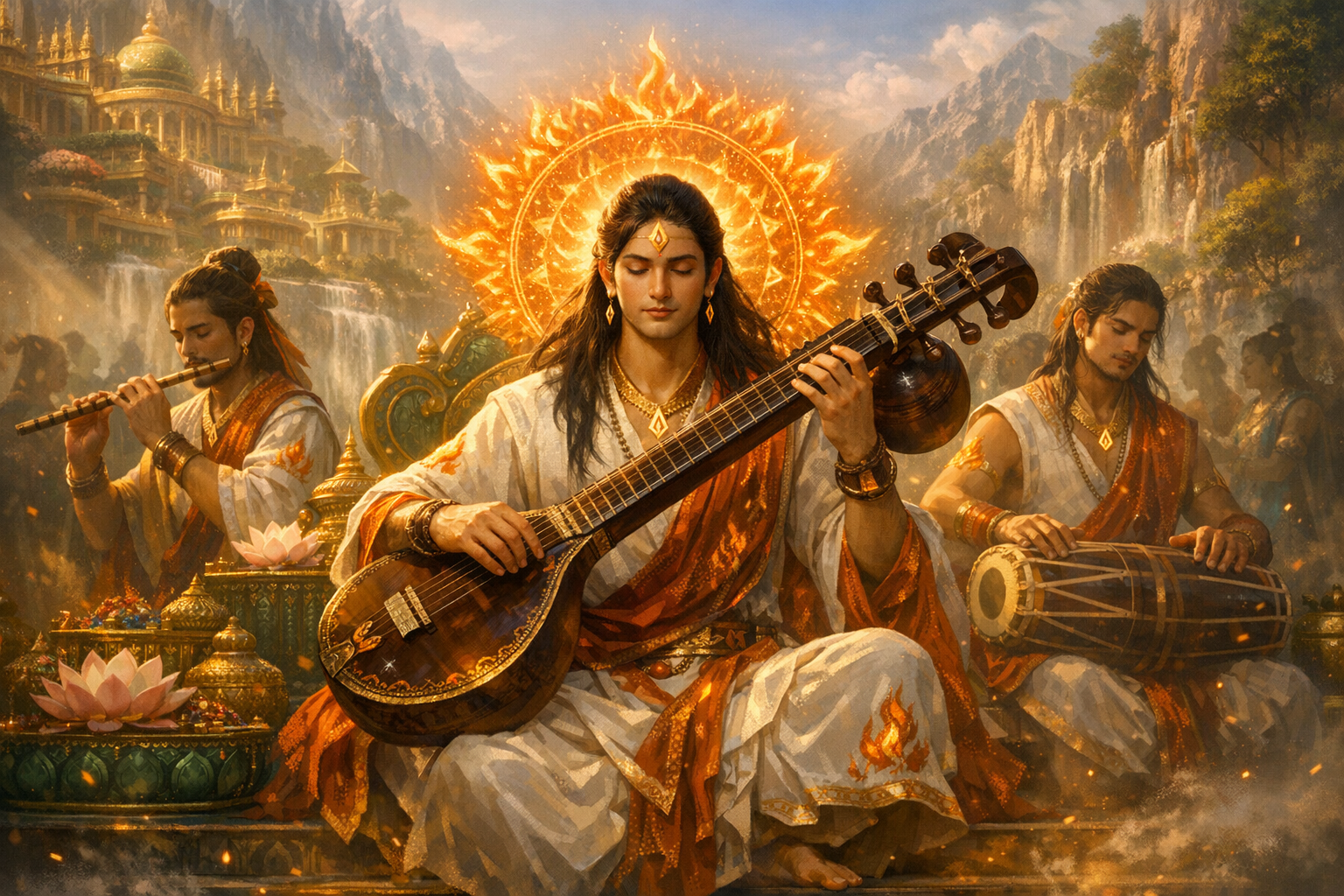
Within Hindu scriptures and the broader tapestry of Indian mythology, the Agneyas are described as a collective among the Gandharvas, the celebrated celestial beings associated with music, dance, and refined aesthetic sensibilities. References across the Puranas and related narrative traditions present the Agneyas as participants in the divine courts, where their art upholds order and auspiciousness. Several strands of textual interpretation further situate the Agneyas in the retinue of Kubera (Vaiśravaṇa), the god of wealth and treasurer of the devas, underscoring how musical excellence, prosperity, and ritual harmony intertwine in Hindu cosmology.
Gandharvas occupy a distinctly liminal role in Hinduism: neither wholly human nor fully divine, yet indispensable to the cosmic order. Their presence spans the Vedas, Itihasas, and Puranas, where they appear as custodians of sacred sound and as facilitators of ritual atmospheres conducive to wellbeing and abundance. The Agneyas, as a group within this larger class, exemplify the Gandharvas’ composite identitydevotional, artistic, and ceremonialwhile highlighting how the divine ecosystem in Hindu thought functions through interdependent roles rather than in isolation.
Philologically, the term “Agneya” in Sanskrit commonly denotes “pertaining to Agni” or “of a fiery nature,” and it can also designate the southeast (āgneya) among the directions. In mythological and Puranic contexts, “Agneyas” functions as a group designation. The coexistence of these meanings is typical of Sanskritic literature, where terms develop layered senses across ritual, cosmological, and narrative usage. In the case at hand, the Agneyas as Gandharvas should be distinguished from directional or adjectival usages of agneya, a reminder that careful reading of textual context is vital for accurate interpretation.
Vedic precedents illuminate the Gandharvas’ antiquity and gravitas. Hymns in the Ṛgveda gesture to Gandharva as a celestial figure associated with the protection of sacred substances and with the resonance of cosmic order. Over subsequent centuries, this early, somewhat elusive portrait broadens in the epics and Puranas, where Gandharvas become a richly peopled community of skilled musicians, singers, and connoisseurs of rasa (aesthetic essence). Their music, aligned with dharma, is portrayed as not merely ornamental but structurally integral to divine courts and rituals.
Epic and Puranic literature name exemplary Gandharvas such as Tumburu and Citraratha, whose roles exemplify the class’s artistic and diplomatic functions. In many narratives, Gandharvas act as envoys, performers, and bearers of auspicious presence at key turning points, especially those involving coronations, ceremonial assemblies, or reconciliatory moments. The Agneyas, understood as a Gandharva group within these sources, illustrate how Hindu scriptures often represent celestial communities not as isolated figures but as lineages, cohorts, or guild-like bodies, each reinforcing the layered social fabric of the divine realm.
The association of the Agneyas with Kubera reflects broader Puranic patterns. Kuberaalso known as Vaiśravaṇais the guardian of the northern direction (dikpāla), the deity of wealth, and the sovereign of Yakshas. In several narrative traditions, his court features a synthesis of Yakshas, Kinnaras, and Gandharvas, with music, poetry, and dance signifying prosperity and ethical order. In this milieu, the Agneyas emerge as one of the Gandharva groups whose refined artistry complements Kubera’s role as custodian of abundance. While Gandharvas frequently serve multiple deities across the textual corpus, their involvement in Kubera’s court underscores a sustained mythic logic: wealth, properly held, is harmonized by beauty, virtue, and measured joy.
Iconographically and culturally, Gandharvas are linked to the aesthetic canons of Indian music and dance. The term “Gandharva” itself lends its name to classical frameworks of musical knowledge, often glossed as Gandharva-vidyā or Gandharva-veda in traditional discourse. In this light, the Agneyas figure as exemplars of rasa creation, whose performance animates sacred spacesfrom the imagined terraces of Alakapuri (Kubera’s city) to the ritualized atmospheres of temple festivals and household worship. Their narrative function resonates with lived practice: sacred sound (nāda) is invoked to sanctify, to heal, and to align the human microcosm with the cosmic macrocosm.
Cosmologically, Gandharvas are sometimes situated in their own abodes (Gandharva-loka) or depicted as frequenting Svarga-loka and the courts of the devas. Kubera’s domain in the Himalayan north (as guardian of the quarter) further illustrates the textual habit of mapping ethical functions onto sacred geography; the confluence of music, wealth, and auspiciousness is not accidental but patterned. The Agneyas’ placement within this pattern clarifies how Hindu cosmology configures specialized communities whose arts and offices sustain the integrity of divine governance.
Comparative dharmic perspectives reinforce a shared civilizational grammar. In Buddhist cosmology, the Gandharvas (Pāli: gandhabba) and Vaiśravaṇa (Kubera) appear as recognized celestial categories, while Jain texts classify Gandharvas among celestial beings (devas) within vyantara groupings. Such cross-textual presence suggests a pan-dharmic consensus about the reality and function of aesthetic and protective beings in the sacred order. Read together, these traditions cultivate a vision of unity in spiritual diversity, where varied narratives point toward a shared appreciation of music, virtue, and guardianship as pillars of cosmic wellbeing.
Ritually, the Gandharvas’ aura infuses practices that privilege sacred soundmantra recitation, kīrtana, and the musical dimensions of pūjā. The Agneyas, by extension, symbolize the refinement that devotees seek to bring into offerings, whether in formal temple contexts or in the intimate theater of household worship. This continuity between scripture and practice affirms a core principle of Hinduism: art is sādhanā (discipline), and beauty is an avenue of dharma. Through melodic praise, the heart is trained toward clarity, gratitude, and right relation with the world.
From a textual-critical standpoint, it is important to acknowledge that Puranic catalogues of celestial beings vary across recensions and regional tellings. The identification of the Agneyas as a Gandharva group and their link to Kubera appear in strands of Puranic and later narrative tradition; other sources accentuate Gandharvas’ service to Indra or their participation in divine assemblies more generally. This variability is not a flaw but a signature of living traditions, where layered memories and local idioms interact with pan-Indic themes to keep meaning alive and adaptable.
Thematically, the Agneyas highlight an ethical synthesis characteristic of Hindu thought: prosperity (artha) is properly aligned with beauty (śrī) and virtue (dharma). In Kubera’s orbit, the presence of skilled musicians communicates that wealth is not an end in itself but a means to support right order, generosity, and celebratory gratitude. The Gandharvas’ musicexemplified here by the Agneyasprovides the tonal architecture for this ethical message, shaping an atmosphere in which both gods and humans remember what abundance is for.
In cultural history, the Gandharva motif has inspired classical music, dance, and temple arts across the Indian subcontinent and beyond. Diasporic communities continue to draw on these images to frame concerts, festivals, and devotional gatherings that promote intergenerational continuity. In such contexts, the Agneyas can be read as guardians of an intangible heritage: the conviction that disciplined art refines perception, fosters communal harmony, and opens pathways to spiritual insight across the dharmic traditions of Hinduism, Buddhism, Jainism, and Sikhism.
Taken together, the Agneyas’ portrayal as Gandharvas within Hindu scriptures, and their frequent association with Kubera’s court, offer a compact but powerful lens on Hindu cosmology. They embody the conviction that sacred sound stabilizes worlds, that prosperity is luminous when yoked to virtue, and that divine society is sustained by cooperative excellence rather than solitary power. Read amid cognate Buddhist and Jain representations of similar celestial communities, the Agneyas also invite a broader civilizational appreciation: diverse dharmic paths converge in honoring beauty, ethics, and unity as enduring foundations of spiritual life.
Inspired by this post on Hindu Blog.