Tag: Srimad Bhagavatham

  • Again Become Mouse: A Powerful Bhagavatam Parable on Ego, Desire, Fear, and True Growth

    Again Become Mouse: A Powerful Bhagavatam Parable on Ego, Desire, Fear, and True Growth

    This essay retells the widely shared Bhagavatam parable “Again become mouse” and analyzes its enduring relevance for self-assessment. It shows how external upgrades without inner transformation intensify fear, inflate ego, and erode gratitude. Drawing on Srimad Bhagavatam’s ethical psychology—and resonances from Buddhism, Jainism, and Sikhism—it proposes an integrative, dharmic path where power follows purification. Readers…

  • Morning Class on SB 10.6.10: Pūtanā, vātsalya-rasa, and the life-changing power of divine grace

    Morning Class on SB 10.6.10: Pūtanā, vātsalya-rasa, and the life-changing power of divine grace

    Delivered on 27 May 2026, this Melbourne morning class examines Śrīmad Bhāgavatam 10.6.10 within the broader Pūtanā narrative to illuminate how divine grace transforms karma through the aesthetics of vātsalya-rasa. The analysis connects Gaudiya Vedānta insights to the Bhagavad-Gītā’s vision of devotion reshaping destiny. Ethical nuances of intention, compassion, and communal responsibility are explored alongside…

  • Azhwars and Ramanujacharya: Timeless Bhakti, Living Vedanta, and the Path of Grace

    Azhwars and Ramanujacharya: Timeless Bhakti, Living Vedanta, and the Path of Grace

    This comparative study explores how the Azhwars and Ramanujacharya jointly shape the Sri Vaishnava tradition by uniting ecstatic devotion with systematic Vedanta. It situates the Azhwars’ Divya Prabandham and Ramanuja’s Viśiṣṭādvaita within one inclusive, Ubhaya Vedanta canon that values both Tamil and Sanskrit revelation. Readers gain a clear map of similarities—Vishnu’s supremacy, Sri’s compassion, bhakti…

  • HG Daivi Shakti Mataji revives Srila Prabhupada-lilamrita: Devotion, Method, Dharma Unity

    HG Daivi Shakti Mataji revives Srila Prabhupada-lilamrita: Devotion, Method, Dharma Unity

    This Vrindavan-focused analysis of Srila Prabhupada Lilamrita—framed by insights associated with HG Daivi Shakti Mataji—shows how a well-sourced spiritual biography can simultaneously inform scholarship and deepen sadhana. It outlines the text’s historiographical method, balancing documentation with a devotional register rooted in Gaudiya Vaishnava theology. Readers gain clarity on key narrative arcs, from the Jaladuta voyage…

  • 2026 Sadhu Sanga Day 1: Transformative Kirtan, Deep Bhakti, and Dharmic Unity Insights

    2026 Sadhu Sanga Day 1: Transformative Kirtan, Deep Bhakti, and Dharmic Unity Insights

    2026 Sadhu Sanga – Day 1 establishes a clear, practice-centered foundation for the retreat by combining immersive kirtan, structured japa, and scriptural framing from Bhagavad-gita and Śrīmad-Bhāgavatam. The opening day focuses on sādhu-saṅga—uplifting association—as a catalyst for devotion and ethical conduct. Participants benefit from accessible orientation, inclusive spaces, and community norms that translate humility and…

  • Decoding Srimad Bhagavatam 3.26.9: Sankhya, Consciousness, and a Roadmap to Dharmic Unity

    Decoding Srimad Bhagavatam 3.26.9: Sankhya, Consciousness, and a Roadmap to Dharmic Unity

    This in-depth exploration of Srimad Bhagavatam 3.26.9, inspired by H.H Subhag Swami Maharaj’s discourse at ISKCON Mayapur, unpacks Kapila’s Sankhya as a precise map of consciousness, causality, and liberation. It clarifies how purusha, prakriti, time, and the three gunas co-operate to shape experience, and why that structure makes ethical effort and devotion both meaningful and…

  • Dhruva’s Turning Point: Manu’s Counsel on Anger, Humility, and Surrender (SB 4.11.15–35)

    Dhruva’s Turning Point: Manu’s Counsel on Anger, Humility, and Surrender (SB 4.11.15–35)

    Bhagavatam Class 4.11 15–35 explores Svayambhuva Manu’s intervention as Dhruva Maharaja shifts from reactive anger to disciplined humility. The class clarifies a core Vaishnava principle: the Supreme Lord is the ultimate cause behind all causes, guiding practitioners toward surrender rather than escalation. Verse 27 functions as a cognitive pivot, redirecting the mind from krodha to…

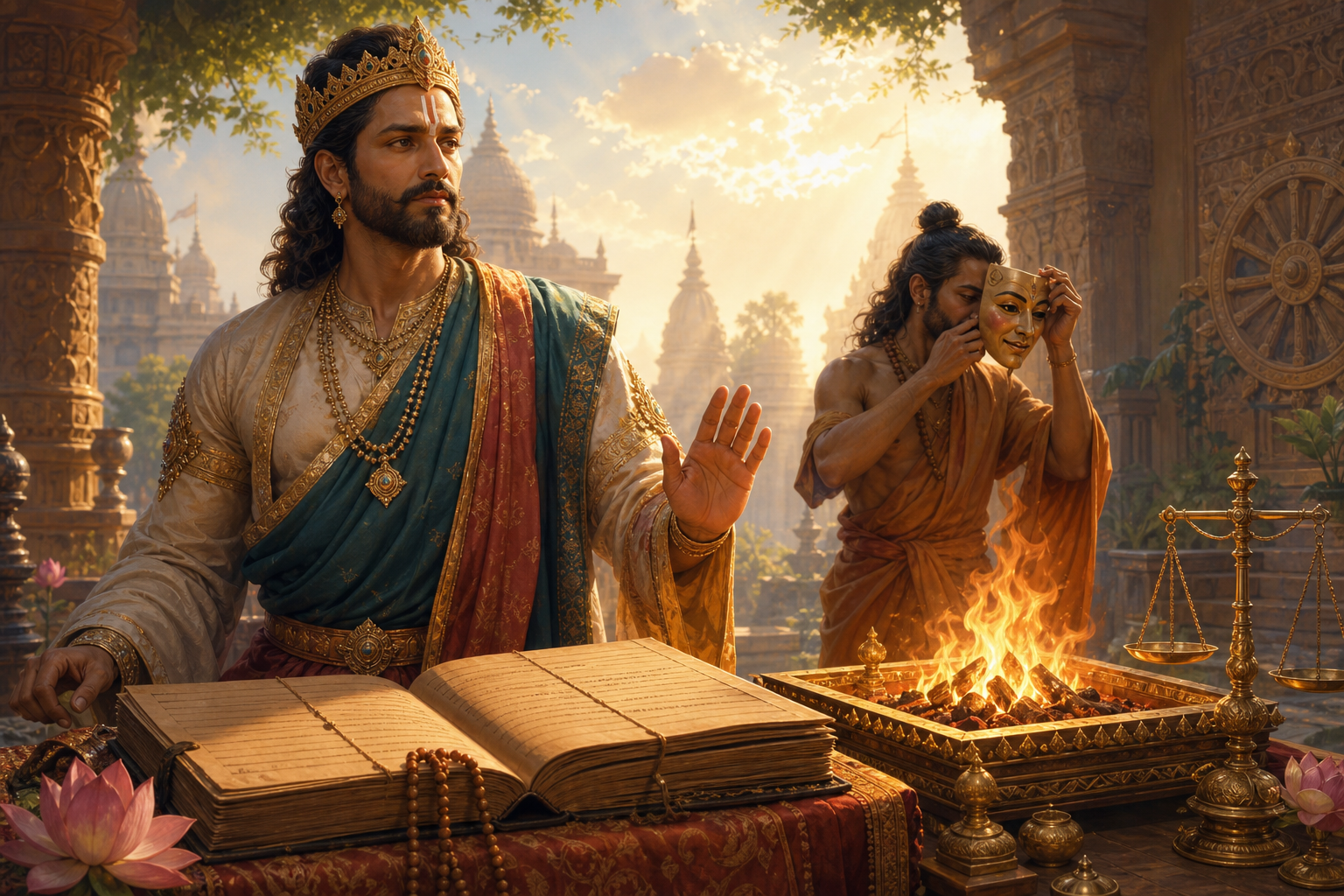
  • The Peril of Vaishnava Aparādha: SB 11.1.13–15 and the Yadu Dynasty’s Devastating Fall

    The Peril of Vaishnava Aparādha: SB 11.1.13–15 and the Yadu Dynasty’s Devastating Fall

    Srimad Bhagavatam 11.1.13–15 warns that mocking saintly persons—illustrated by the Yadu youths disguising Samba as a pregnant woman—carries devastating karmic and social consequences. Drawing on HH Guru Prasad Swami Maharaj’s insights, this analysis clarifies the doctrine of Vaishnava aparādha and shows how even technical fixes cannot undo moral causes. Readers gain precise context for the…

  • Srimad-Bhagavatam: Timeless Wisdom That Transcends Dharma, Artha, Kama, and Moksha

    Srimad-Bhagavatam: Timeless Wisdom That Transcends Dharma, Artha, Kama, and Moksha

    Srimad-Bhagavatam, the Bhagavata Purana, honors the classic Hindu puruṣārthas—dharma, artha, kāma, and mokṣa—while demonstrating how each is perfected and transcended through bhakti. Presented through a refined narrative and commentarial tradition, it integrates theology, cosmology, ethics, and contemplative practice. Readers encounter vivid exemplars such as Dhruva, Prahlāda, Ajamila, Gajendra, and Ambarīṣa, alongside philosophical teachings that unite…

  • SB 4.9.37–53 Decoded: Dhruva’s Unshakable Devotion, Cosmic Boons, and Inner Renewal

    SB 4.9.37–53 Decoded: Dhruva’s Unshakable Devotion, Cosmic Boons, and Inner Renewal

    Srimad-Bhagavatam Canto 4, Chapter 9, verses 37–53 narrate how Dhruva Maharaja’s devotion matures from personal austerity to public responsibility. The passage culminates in Dhruvaloka—symbolizing unwavering devotion—and a restored social order that validates rajadharma as service. Drawing on themes often highlighted by Kalakantha Prabhu, the analysis explains how bhakti integrates knowledge and action while transmuting anger…

  • Across the Waters: Divine Protection, Tirtha Symbolism, and Rebirth in Dharmic Traditions

    Across the Waters: Divine Protection, Tirtha Symbolism, and Rebirth in Dharmic Traditions

    Sacred river crossings in Dharmic traditions encode a shared grammar of divine protection, purification, and rebirth. From Krishna’s midnight passage over the Yamuna in the Bhagavata Purana to the Jain ideal of the Tirthankara as a “ford-maker,” from Buddhism’s raft simile to Sikh teachings on crossing the bhavsagar through the Guru’s Naam, each tradition converges…

  • Srimad Bhagavatam Distribution Guide: Ethical, Scalable, Data-Driven Outreach to 100,008 Homes

    Srimad Bhagavatam Distribution Guide: Ethical, Scalable, Data-Driven Outreach to 100,008 Homes

    This guide presents an ethical, inclusive, and data-driven framework for distributing Srimad Bhagavatam at scale, aligning cultural heritage stewardship with modern outreach practices. It situates the Bhagavata Purana within the wider corpus of Hindu scriptures and emphasizes unity among Hinduism, Buddhism, Jainism, and Sikhism through non-coercive, consent-based engagement. The roadmap covers volunteer training, legal compliance,…

  • Narayaneeyam: A Soul-Stirring, Scholarly Guide to the Bhagavata Purana in 100 Dasakas

    Narayaneeyam: A Soul-Stirring, Scholarly Guide to the Bhagavata Purana in 100 Dasakas

    Nārāyaṇīyam (Narayaneeyam) condenses the Srimad Bhagavatham into 100 daśakas and just over a thousand ślokas, uniting poetry, philosophy, and devotion. Composed in 16th‑century Kerala by Melpathur Nārāyaṇa Bhaṭṭathiri at Guruvayur, it offers a structured path from cosmology and avatāras to Krishna’s intimate līlās and a culminating meditative vision. This guide clarifies its history, architecture, meters,…

  • Dhruva’s Homecoming in Srimad Bhagavatham 4.9 (18–26): Transformative Grace and Dharma

    Dhruva’s Homecoming in Srimad Bhagavatham 4.9 (18–26): Transformative Grace and Dharma

    This in-depth, verse-focused reading of Srimad Bhagavatham 4.9 (18–26) examines Dhruva Maharaja’s homecoming as a masterclass in devotion, ethical leadership, and reconciliation. It situates the passage within the broader Dhruva narrative, highlighting how grace, disciplined practice, and guru-guidance transform reactive motives into service. Readers gain clear, actionable insights on integrating bhakti with rāja-dharma, healing family…

  • Eternal Longing, Infinite Union: Decoding Radha–Krishna’s Divine Love and Sacred Separation

    Eternal Longing, Infinite Union: Decoding Radha–Krishna’s Divine Love and Sacred Separation

    This long-form exploration decodes why Radha–Krishna’s love is revered not as a tragic failure of union but as a sacred pedagogy of longing. Drawing on Srimad Bhagavatham, Gīta Govinda, and Gaudiya Vaishnava theology, it explains how vipralambha (separation) heightens devotion and refines ethical action. The article clarifies key concepts—rasa, sambhoga, vipralambha, and mahābhāva—while situating them…

  • From Sadhana to Etiquette: Angas of Bhakti for Daily Practice and Interfaith Dharmic Harmony

    From Sadhana to Etiquette: Angas of Bhakti for Daily Practice and Interfaith Dharmic Harmony

    This in-depth reflection on a Sat Sanga with HH Krishna Kshetra Swami (09.05.2026) unpacks the Angas of Bhakti—how sadhana (disciplined daily practice) and Vaishnava etiquette (sadachara) jointly mature devotional life. Readers gain a clear map of foundational and potent practices from the Gaudiya tradition, learn practical routines for japa, kirtana, and study, and see how…

  • Srila Prabhupada’s 1976 Vrindavan Marathon: Seva, Scholarship, and Global Sankirtana

    Srila Prabhupada’s 1976 Vrindavan Marathon: Seva, Scholarship, and Global Sankirtana

    In 1976 at Vrindavan, Srila Prabhupada’s day began at mangal arotik and ended past midnight with a Mathura pandal program before more than twenty thousand attendees. Eyewitness details—such as the right-hand lesson during a morning walk—reveal how subtle etiquette conveyed dharmic principles. His apology for speaking in Hindi at the pandal highlighted humility and inclusive…

  • Surrender that Liberates: How Dāsa‑Bhāva Shapes Bhakti, Seva, and Dharmic Unity

    Surrender that Liberates: How Dāsa‑Bhāva Shapes Bhakti, Seva, and Dharmic Unity

    The Bhakti concept of “dasa” (dāsa)—a chosen identity of loving service and surrender—anchors Hindu spirituality in a disciplined ethic of humility, seva, and śaraṇāgati. Grounded in scriptural sources like the Bhagavad Gita and Srimad Bhagavatham, dāsya-bhāva appears across Vaishnava, Śaiva, and Śākta traditions and is elaborated by Ramanujacharya, Madhvacharya, and Chaitanya Mahaprabhu. It flourishes in…

  • From Cosmic Ocean to Cosmic Web: How Scientific Cosmology Can Enrich Dharmic Faith

    From Cosmic Ocean to Cosmic Web: How Scientific Cosmology Can Enrich Dharmic Faith

    This evidence-based reflection shows how the Srimad-Bhagavatam’s image of a “cosmic ocean” aligns, at the level of metaphor, with the cosmic web mapped by modern astronomy. It explains what science reliably says about origins and possible endings—Big Bang, dark matter, dark energy, and competing end-of-universe scenarios—while clarifying where responsible uncertainty remains. It places these insights…

  • Srimad Bhagavatam 3.25.43: Kapila’s Transformative Bhakti‑Sankhya, Sādhu‑Saṅga, and Dharmic Unity

    Srimad Bhagavatam 3.25.43: Kapila’s Transformative Bhakti‑Sankhya, Sādhu‑Saṅga, and Dharmic Unity

    Śrīmad-Bhāgavatam 3.25.43 crowns Kapila’s theistic bhakti‑sāṅkhya, showing how analysis attains completion only when joined to devotion. This academic yet accessible exploration, based on a Mayapur TV – English discourse by H.H. Bhakti Arjava Priti Vardhan Swami Maharaj, explains why sādhu‑saṅga, śravaṇa, and sevā reliably reconfigure consciousness. It clarifies how Bhāgavatam treats bhakti as a rigorous…