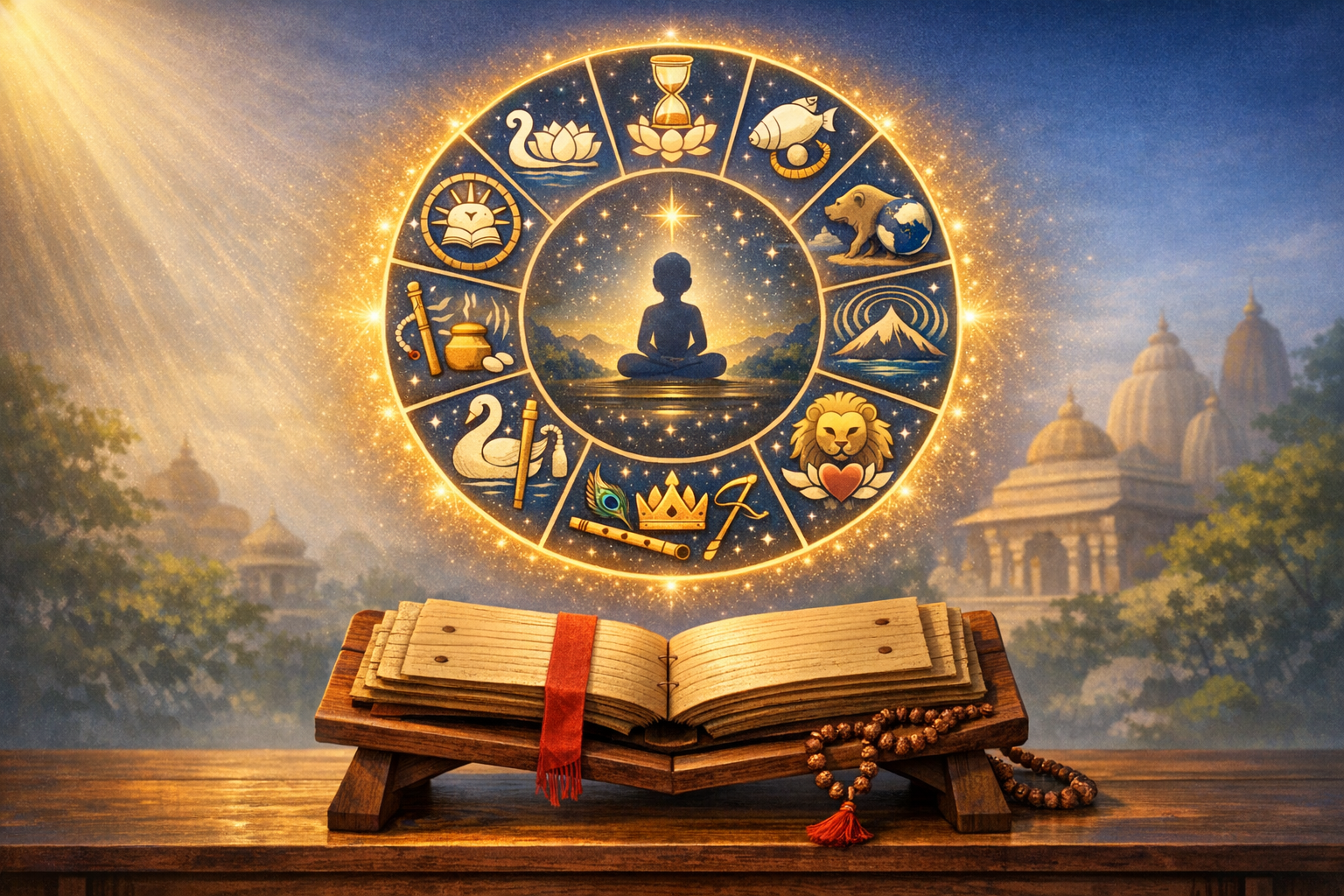
Srimad Bhagavatham (Bhagavata Purana) stands among the Maha Puranas of Hindu literature, renowned for its sustained exposition of bhakti (devotion) to Vishnu and, preeminently, to Krishna. Comprising twelve skandas (cantos) and approximately 18,000 verses in Sanskrit, the text integrates theology, philosophy, mythic narrative, and spiritual practice into a single panoramic vision.
Tradition attributes compilation to Veda Vyasa at the cusp of Kali Yuga, motivated by Narada’s counsel to compose a work centered on pure devotion. Its principal narrative frame is the seven-day dialogue in which the sage Shuka instructs King Parikshit, who awaits death by the serpent Takshaka. A secondary frame presents Suta recounting this discourse to sages at Naimisharanya, establishing a lineage of transmission that ennobles public recitation and communal study.
Historically, the text circulated across the subcontinent with influential commentaries by Shridhar Swami, Vallabha, Jiva Goswami, and Madhvacharya, among others. Modern scholarship places its crystallization between the early and late first millennium CE, while living traditions regard it as the spiritual culmination of Puranic revelation. Both perspectives illuminate the Bhagavata Purana’s layered composition and enduring authority within Hindu scriptures.
At its theological core, Srimad Bhagavatham proclaims bhakti as the most accessible and efficacious path in the age of Kali, harmonizing jnana (knowledge), karma (ethical action), and yoga (discipline). It delineates the nature of Bhagavan as the ultimate reality manifesting through avataras, while affirming an intimate, personal relationship between the devotee and the divine. The Navadha Bhakti typologyhearing, chanting, remembering, serving, worshiping, bowing, servitude, friendship, and surrenderstructures devotional praxis for householders and renunciants alike.
Canto 1 sets the stage: sages inquire into the supreme good of humanity, Narada guides Vyasa toward composing a devotional scripture, and episodes from the aftermath of the Mahabharata establish a moral horizon. The questionwhat should one do at the hour of death?introduces Parikshit’s crisis and prepares the ground for Shuka’s teaching.
Canto 2 opens the teaching proper with meditations on the cosmic form of Vishnu, gradations of yogic absorption, and the salvific potency of the divine name. The canto affirms that the substance of reality knowable through this text yields auspiciousness and freedom from fear, anchoring the work’s soteriological promise.
Canto 3 narrates cosmogony and the emanation of worlds, details the Varaha avatara, and preserves the theistic Sankhya of Kapila. Through the dialogue of Vidura and Maitreya, readers encounter a subtle philosophy of matter, mind, and consciousness that complements devotional practice rather than competing with it.
Canto 4 explores paradigms of kingship and devotion: Dhruva’s austere quest and childlike surrender, Prithu’s ideal rulership grounded in service, and the Pracetas’ depth of meditation blessed by Shiva (Rudra). The text here models respectful integration across sectarian lineages, exemplifying the Dharma’s plural spirit.
Canto 5 presents Rishabha’s teachings on renunciation and the transformative odyssey of King Bharata, whose name the land Bharata bears. Its famed cosmography of Jambudvipa, oceans, and mountain ranges serves both as a sacred map and as contemplative symbolism, inviting reflective, not merely literal, reading of Puranic science.
Canto 6 turns to divine grace and moral recovery. The legend of Ajamila showcases the purifying power of nama (the sacred name), while narratives of Daksha’s sacrifice and Vritrasura’s redemption probe intricate questions of duty, repentance, and the heart’s ultimate orientation toward Vishnu.
Canto 7 centers on Prahlada, whose fearless love for Nrisimha (the Man-Lion avatara) transcends birth and social identity. His teachings articulate bhakti as universally available, while reflections on varnasrama are framed by the primacy of inner realization over mere formality.
Canto 8 gathers tales of cosmic churnings and vows: the Samudra Manthana with its ambrosial ethics of cooperation and discernment; Gajendra’s distress and deliverance through heartfelt surrender; and Vamana’s gentle reclamation from Bali Maharaja, a narrative honored in regional traditions such as Onam for its celebration of generosity, humility, and divine reciprocity.
Canto 9 surveys royal lineages and dharmic exemplars across the Solar and Lunar dynasties, linking mythic memory to historical imagination. It gestures toward Rama within the Puranic canvas while setting the stage for the advent of Krishna.
Canto 10, the longest and most cherished, unfolds Krishna’s lila from birth and childhood in Vrindavana to princely life in Mathura and Dvaraka. Pastimes such as the lifting of Govardhana and the rasa-lila are presented as theological aestheticsrasa as a medium for realizing non-dual love of Bhagavanguiding devotees from moral virtue to ecstatic union without abandoning ethical responsibility.
Canto 11 offers the Uddhava Gita, synthesizing yoga, bhakti, and wisdom for times of dissolution. The Avadhuta’s twenty-four teachers and the dialogue with the Navayogendras provide a contemplative curriculum, emphasizing self-knowledge, equanimity, and continuous remembranceideals resonant across Dharma traditions.
Canto 12 closes the arc with reflections on Kali Yuga’s symptoms, cycles of time, and the supremacy of recitation and devotion as stabilizing practices. Parikshit’s serene departure seals the teaching: a life oriented to Bhagavan transforms even mortality into illumination.
The Bhagavata Purana advances an ethic of compassion (daya), truthfulness (satya), non-harm (ahimsa), and inner freedom (moksha), joined to devotion (bhakti). These values harmonize with the shared civilizational vocabulary of Buddhism’s karuna and maitri, Jainism’s ahimsa and samayika, and Sikhism’s seva and nam-simran, affirming unity-in-diversity among dharmic paths.
Philosophically, Srimad Bhagavatham mediates between the personal and the absolute, allowing devotion to mature into insight and insight to soften into love. Psychologically, its narratives model emotional regulation, resilience, and ethical repair: Dhruva’s anger sublimated into devotion, Ajamila’s guilt healed by remembrance, and Prahlada’s courage sustained by contemplative steadiness.
As literature, the text blends kavya, theology, and performance. Its Krishna-katha animates classical dance forms such as Bharatanatyam, Odissi, and Kuchipudi; inspires kirtan and bhajan traditions; and informs vernacular retellings from the Bhakti movements of North and South India. The Bhagavata Purana thus serves both as scripture and as a cultural engine of devotion.
The cosmological chapters introduce kalpas, manvantaras, and yuga cycles, organizing historical time within sacred time. Rather than a rival to empirical science, this symbolic cosmology offers contemplative scale and ethical orientation, reminding readers that human agency is meaningful within vast, ordered rhythms.
Textual transmission spans multiple recensions, with widely read commentaries illuminating grammar, poetics, and philosophy. Public parayana during Kartika, vrata on Ekadashi, and daily nama-japa derive scriptural encouragement from the Bhagavata Purana’s emphasis on accessible practice in Kali Yuga.
For new readers, a structured approachoverview of Cantos 1–2, selected narratives from 3–7, then Krishna-lila in Canto 10, followed by the Uddhava Gitasupports comprehension. Comparative reading alongside the Bhagavad Gita and Upanishads deepens philosophical understanding, while exposure to kirtan and sadhana translates doctrine into lived experience.
In contemporary life marked by uncertainty, the Bhagavata Purana functions as a guide to meaning and community. It validates household spirituality, sanctifies ethical work, and offers relational intimacy with the divine through remembrance and serviceresources equally valuable to seekers across Hindu, Buddhist, Jain, and Sikh backgrounds committed to compassion and truth.
In short, Srimad Bhagavatham is a devotional and philosophical summa: twelve cantos, 18,000 verses, a frame of dialogue at life’s horizon, and a sustained invitation to love and wisdom. Its message is simple yet profoundhear, remember, and serveand its promise is liberation through devotion informed by knowledge.
Read as scripture, poem, and practice manual, the Bhagavata Purana unites head and heart, culture and contemplation. Its capacious vision dignifies plurality within the Dharma family and guides sincere seekers toward a shared horizon of awakening and compassionate action.
Inspired by this post on Hindu Pad.