-
Ashada Purnima: Powerful Spiritual Lessons for Sannyasis and Seekers

Ashada Purnima, also known as Guru Purnima or Vyasa Purnima, is one of the most meaningful observances for Hindu sannyasis and yatis. It marks a sacred moment of gratitude to the guru, reverence for Maharishi Veda Vyasa, and the beginning of Chaturmasya in many monastic traditions. The day highlights the importance of parampara, scriptural study,…
-
Guru Purnima 2026 at Gangapur: Powerful Datta Paduka Darshan Guide

Guru Purnima 2026 at Gangapur Dattatreya Temple falls on Wednesday, July 29, on Ashada Purnima. The festival is one of the most important observances at Deval Gangapur, where devotees seek Datta Paduka darshan and honor the Guru Parampara. This guide explains the spiritual meaning of Guru Purnima, its connection with Vyasa Purnima, and the importance…
-
Powerful Truth: Why Mahabharata Was Not Simply Jaya Expanded into Bharata

The familiar claim that the Mahabharata evolved from an 8,800-verse Jaya into a 24,000-verse Bharata and then into the 100,000-verse Mahabharata is more complicated than it appears. A close reading of the Adi Parva suggests that the number 8,800 refers to difficult or knotty verses, not necessarily to a complete early text called Jaya. The…
-
Nava Chiranjeevis: Powerful Lessons from Hinduism’s Immortal Witnesses

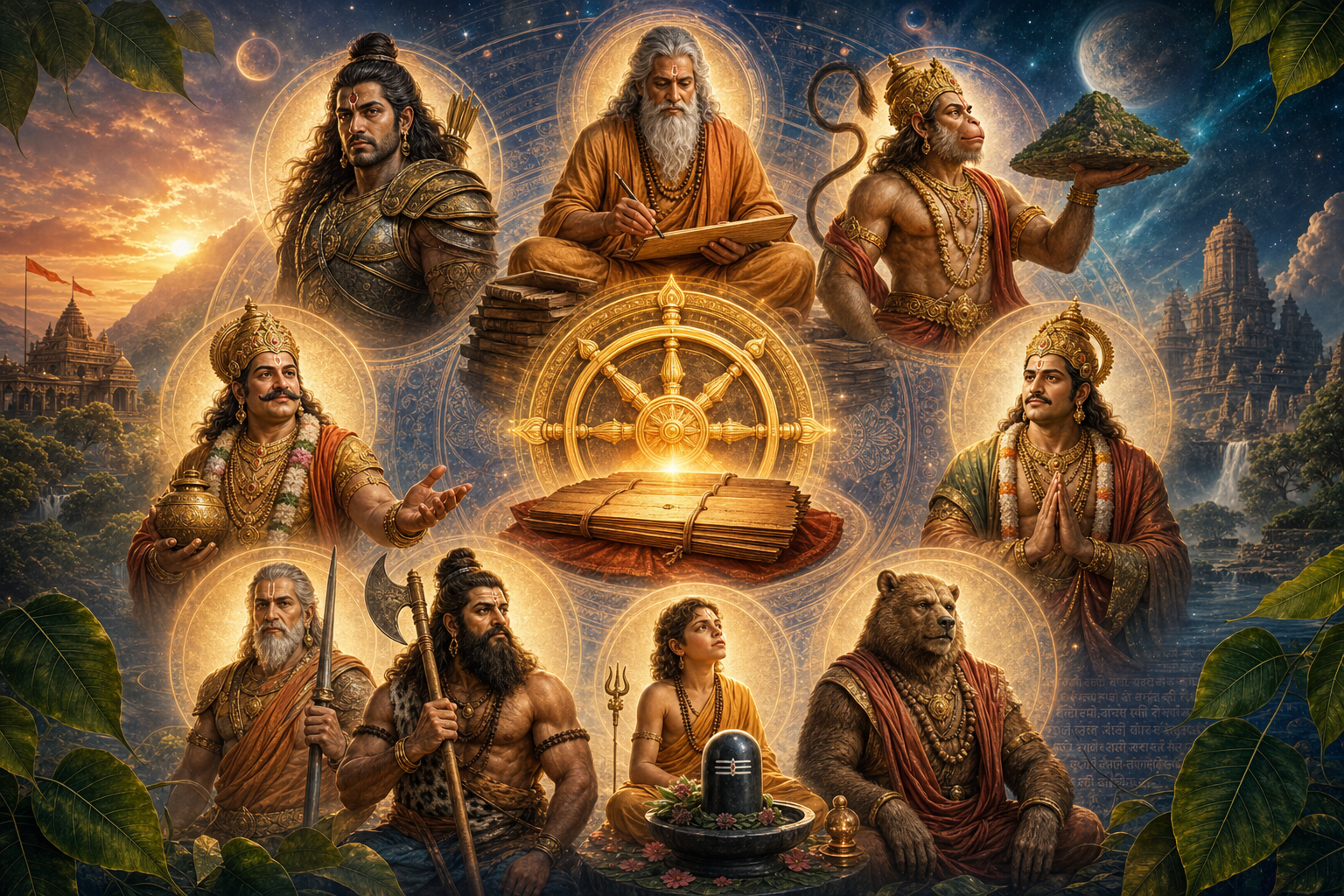
The Nava Chiranjeevis, or Nava Sanjivis, are the nine enduring witnesses of Hindu Puranic and Itihasa tradition. Their stories show that immortality in Hinduism is not merely endless life, but a deeper responsibility shaped by dharma, memory, devotion, knowledge, and consequence. Ashwatthama, Mahabali, Veda Vyasa, Hanuman, Vibhishana, Kripacharya, Parashurama, Markandeya, and Jambavan each preserve a…
-
Arjuna on Indrakeel: Himalayan Tapas, Kshatra-Dharma, and the Life-Changing Audience with Indra

Arjuna’s ascent to Indrakeel Mountain in the Mahabharata is a precise syllabus in responsibility: tapas to steady desire, Shiva’s sanction to regulate technique, and Indra’s counsel to align power with purpose. Rooted in the Vana Parva and celebrated in Kirata Parva traditions, the episode shows how brahma-tejas must govern kshatra-tejas. The narrative affirms a principle…
-
Ashadha Purnima (Guru Purnima) 2026: Date, Rituals, Vyasa Puja Guide & Dharmic Unity

Ashadha Purnimaalso known as Guru Purnima or Veda Vyasa Purnimafalls on 29 July 2026 and honors the Guru-Shishya Tradition across the dharmic family. The festival venerates Bhagavan Veda Vyasa and the transpersonal Guru principle that links knowledge with ethical living. This long-form guide explains the lunar calendar basis of the observance, regional variations, and the…
-
Veda Murtis Demystified: Living Forms that Illuminate Vedic Wisdom, Ritual, and Iconography

Hindu tradition presents the Vedas as living, relational knowledge by personifying them as Veda Murtisanthropomorphic embodiments that translate sacred sound into contemplative sight. Grounded in Mīmāṃsā, Agamas, and Śilpa-śāstra canons, these forms do not replace scripture; they deepen Vedic study by aligning hearing, seeing, and practice. Typical depictions personify the four Vedas with manuscripts and…
-
Maharshi Shukadeva (Shuka Muni): The Fearless Sage Who Voiced the Bhagavata Purana

Sage Śukaknown as Maharshi Shukadeva, Shuka Muni, and Shuka Brahmais celebrated as the realized narrator of the Bhagavata Purana and the son of Veda Vyasa. Classical sources, including the Mahabharata and Puranas, portray him as the archetypal paramahamsa who unites jñāna, bhakti, and vairāgya. His seven-day discourse (saptāha) to King Parikshit distills creation, avatāra theology,…
-
Are the Puranas Just Fiction? A Rigorous, Heart-Centered Guide to Finding God and Trusting Truth

Are the Puranas fiction or a reservoir of living wisdom? This analysis explains how Puranic narratives operate beyond a literal-versus-fable dichotomy by integrating mythic memory, ethics, ritual rationale, and contemplative instruction. Drawing on Indian epistemology (pramāṇa), it clarifies how śabda (trustworthy testimony), anumāna (inference), and yogic pratyakṣa (direct insight) jointly ground a rational, testable faith.…
-
BG 18.75 Unveiled: Vyāsa’s Grace, Kṛṣṇa’s Living Voice, and the Timeless Science of Yoga

Bhagavad-gītā 18.75 crystallizes how liberating wisdom is known: by Vyāsa’s grace, Sañjaya directly hears Kṛṣṇa guiding Arjuna, modeling lineage-based transmission and receptive practice. The verse illuminates Vedic epistemologyśabda-pramāṇa, paramparā, and divya-dṛṣṭiwhile clarifying that “most confidential” teaching is inward profundity, not exclusion. By presenting Kṛṣṇa as Yogeśvara, it frames yoga as an integrated science of action,…
-
Muni Shukadeva Jayanti 2026: Sacred Date, Ritual Guide, and Timeless Bhagavata Wisdom

Muni Shukadeva Jayanti 2026, honoring the son of Sage Veda Vyasa and the primary narrator of the Bhagavata Purana, falls on Friday, 17 April. The observance aligns with Vaishakh Amavasya in the Purnimanta (North Indian) system and with Chaitra Amavasya in Amavasyant calendars, reflecting legitimate regional diversity in the Hindu calendar. The day invites devotees…
-
Muni Shukadeva Jayanti 2026: Date, Amavasya Tithi, Puja Vidhi, and Bhagavata Wisdom

Muni Shukadeva Jayanti in 2026 is on Friday, 17 April, observed on Amavasya tithiVaishakh Amavasya in the North Indian Purnimant calendar and Chaitra Amavasya in Amavasyant regions. The day venerates Śukadeva Muni, son of Bhagavan Veda Vyasa, whose seven-day exposition of the Srimad Bhagavatham to King Parikshit shaped the Hindu katha tradition. Observances typically include…
-
Akshaya Tritiya’s Eternal Blessings: Scriptural Events, Shared Dharma, and Timeless Charity

Akshaya Tritiya, observed on Vaishakha Shukla Tritiya, is celebrated across dharmic traditions as a day of inexhaustible merit and compassionate action. Hindu scriptures connect it with Parashurama Jayanti, the Akshaya Patra narrative in the Mahabharata, Annapurna’s alms to Shiva, and the traditional commencement of Vyasa’s dictation to Ganesha. Popular associations also include the spirit of…
-
Srimad Bhagavatham Explained: A Definitive Guide to the 12 Cantos of Bhagavata Purana

Srimad Bhagavatham (Bhagavata Purana) distills the heart of bhakti through twelve cantos and 18,000 verses within a compelling narrative of Parikshit’s seven-day dialogue with Shuka. This long-form guide clarifies the structure of the text and highlights major narratives such as Dhruva, Prahlada, Ajamila, and Gajendra, culminating in the Krishna-lila of Canto 10. It outlines core…
-
Navaratri Vrata Mahatmyam: Scriptural Roots and Seasonal Science Behind Chaitra & Ashwin Fasts

Navaratri Vrata Mahatmyam explains why the sacred nine-night fast centers on Chaitra and Ashwin: both occur at powerful seasonal junctions near the equinoxes, making them ideal for renewal and inner rebalancing. Scriptural foundations in the Devi Mahatmya and traditions attributed to Veda Vyasa affirm the efficacy of the vow when aligned with Shukla Pratipada to…
-
Mahabharata Masterguide: Clear, Powerful Summary of Dharma, War, and Wisdom (18 Parvas)

This academically grounded summary presents the Mahabharata in short while preserving the epic’s depth and coherence. It outlines authorship traditions (Veda Vyasa as composer, Lord Vinayaka as scribe), textual history, and the 18-parva structure. Readers gain a clear, chronological narrativefrom the Kuru lineage and the dice game to the Bhagavad Gita and the 18-day Kurukshetra…