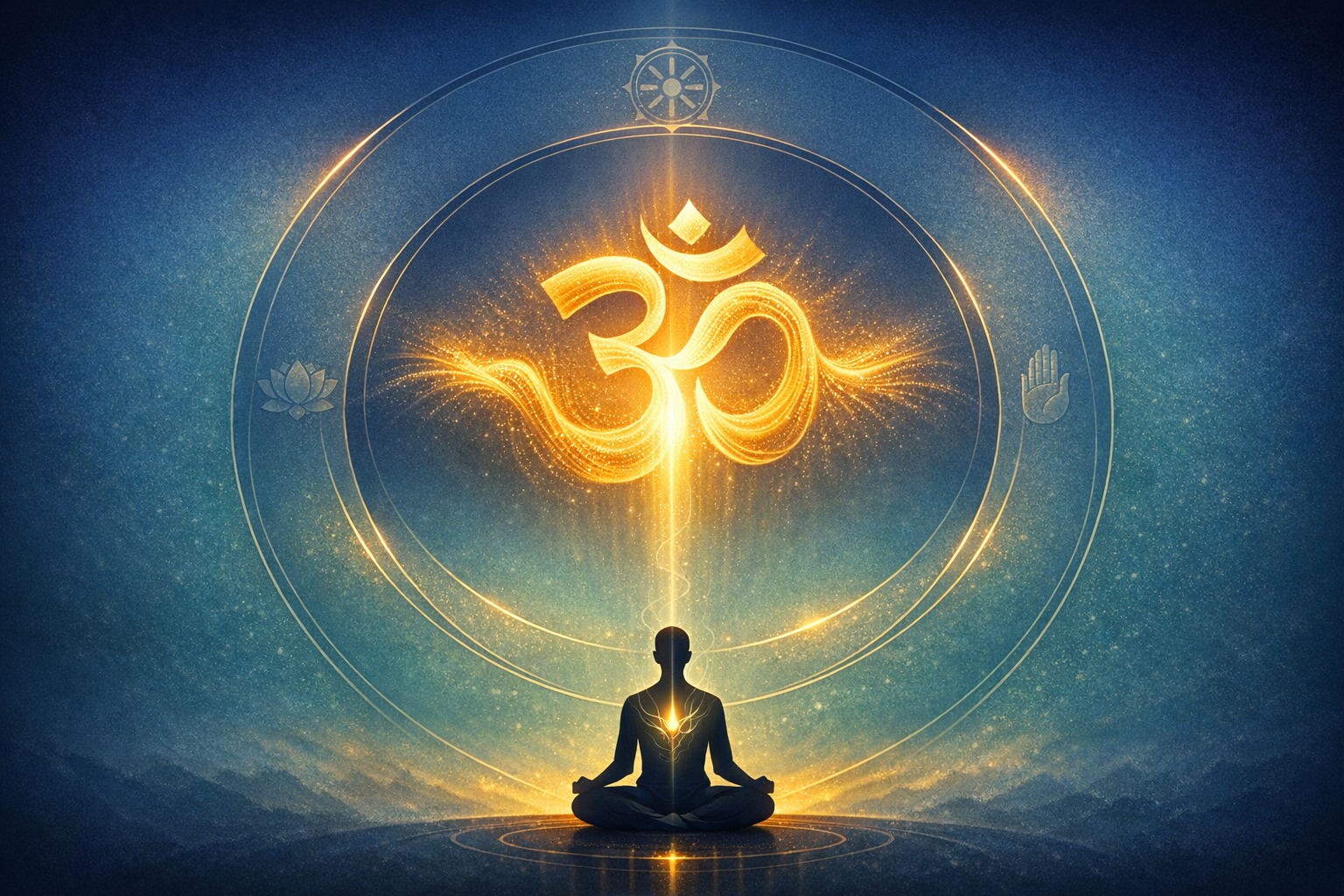
Pranavopasanameditation on the Pranava (ॐ)occupies a pivotal place in Hinduism and Advaita Vedanta as a disciplined pathway from sound to silence, from symbol to the Ultimate Reality (Brahman). More than recitation, it is an interiorized upasana that refines attention (dharana), deepens meditation (dhyana), and culminates in insight (jnana) into the identity of Atman and Brahman. Practitioners across traditions describe a felt shift from restlessness to inner poise, often reporting a quiet joy and spacious awareness that naturally extends as compassion toward others.
Classical sources present Pranava as the seed-syllable that condenses Vedic wisdom and the entire field of experience. The Upanishads, notably the Mandukya, expound ॐ as the key to understanding the three states of consciousnesswaking, dream, deep sleepand the fourth, turiya, the non-dual ground of awareness. This mapping is not merely theoretical; it serves as a meditative framework that guides attention from gross to subtle, and then to the unconditioned.
In Advaita Vedanta, the three phonetic elementsA, U, and Mcorrespond to the manifest modes of experience (avasthatraya), while the silent plenitude following the sound points to turiya. Engaging Pranava in this contemplative way transforms the mantra into a pramana (a means of knowledge) for the Self, bridging devotional focus and incisive inquiry. Traditional commentaries by Gaudapada (Mandukya Karika) and Adi Sankara clarify that upasana matures into direct recognition (aparoksha anubhuti) when the meditator steadily relinquishes identification with the transient.
Phonetically, the arc of ॐ moves from open A (throat), through rounded U (palate and lips), to humming M (nasal cavity), resolving into silence. This journey mirrors a psychological quieting: articulation softens into resonance, resonance fades into stillness. The acoustic and somatic profile of prolonged M and its gentle vibration along the craniofacial sinuses can entrain slower, steadier breathing, supporting the parasympathetic “rest-and-digest” response and enhancing mindful presence.
Across Hindu philosophy, Pranavopasana is both inclusive and integrative. In the Yoga tradition, Patanjali identifies Pranava as the designator of Ishvara (tasya vacakah pranavah), making Om-japa a practical doorway to Ishvara-pranidhana. In Bhakti, major Vedic mantrasOm Namah Shivaya, Om Namo Narayanayablend devotion with the contemplative depth of the Pranava, harmonizing love of the Divine with the clarity of Vedanta.
Resonances with sister Dharmic traditions are profound. In Buddhism, particularly in Mahayana and Vajrayana, “Om Mani Padme Hum” frames Om as an auspicious opening into compassion and wisdom. Jain practice recognizes Oṃ as a later, compressed emblem of the Namokar Mantra, honoring the five supreme beings and the ethic of ahimsa. Sikh sacred vision centers on “ੴ Ik Onkar,” affirming the One Reality pervading all; while conceptually distinct, it converges in spirit with the Pranava’s pointer to unity. These convergences illustrate a shared civilizational intuition: sound, reverence, and contemplation can guide beings toward truth and harmony.
Pranavopasana rests on ethical and cognitive preparation. In the Advaita tradition, the sadhana-chatushtayaviveka (discernment), vairagya (dispassion), shama–dama–uparati–titiksha–shraddha–samadhana (mind mastery and steadiness), and mumukshutva (yearning for liberation)stabilize attention and intention. From a Yoga perspective, yama and niyama (non-violence, truthfulness, contentment, discipline, and self-study) align conduct with contemplative aims, ensuring that mantra practice ripens into insight rather than mere sensory calm.
A concise, reproducible method can anchor daily practice. First, choose a steady asana (e.g., sukhasana or any stable seated posture) with the spine erect. Second, soften the gaze or close the eyes, relaxing the jaw, throat, and shoulders. Third, settle breath awareness for one to two minutes. Fourth, begin slow Om-japa, elongating A–U–M and allowing silence to “complete” each round. Fifth, let attention rest in the after-sound, as if listening to stillness. Sixth, progressively shift from audible chanting (vaikhari) to whispered (upamshu) and then mental repetition (manasika). Seventh, when mental repetition becomes effortless, rest briefly in silence. Eighth, close with gratitude and a clear intention to carry equanimity into action. Nine to twenty-one minutes daily are sufficient to begin; consistency matters more than intensity.
Classical sources differentiate japa modes to meet evolving sensitivity. Loud japa steadies a distracted mind, whispered japa refines it, and mental japa condenses attention into a fine stream. Ajapa-japaeffortless, continuous remembrance of ॐ synchronized with natural breathemerges when practice matures, gently pervading work, relationships, and study without strain.
Pranayama enhances Pranavopasana by calming prana and supporting one-pointedness. Simple ratiossuch as a breath cycle with a comfortably elongated exhale (e.g., 4-in/6-out)can be paired with Om on the out-breath, allowing the sound to “ride” the exhalation. More advanced ratios and kumbhaka (breath retentions) should be introduced gradually and, ideally, under guidance, especially for those with cardiovascular or respiratory conditions. The intent is clarity and steadiness, not hyperventilation or force.
Physiologically, slow resonant breathing and sustained vocalization of M are associated with increased vagal tone, improved heart-rate variability, and reduced markers of stress reactivity. Many practitioners report improved attentional stability and reduced emotional volatility after several weeks of steady Om-japa. While research designs vary, converging evidence suggests that mantra meditation, breath regulation, and contemplative focus cooperatively engage neural circuits associated with salience detection, interoception, and executive regulation.
Traditional sound theory further refines the journey from gross to subtle speech: vaikhari (articulated), madhyama (subtle ideation), pashyanti (pre-conceptual vision), and para (source-silence). Pranavopasana skillfully traverses these layers, using sound as a ladder that is eventually set aside. The ripening insight is not a new experience to accumulate but a recognition of what always illumines experiencepure awareness.
Many lineages also speak of inner sound (anahata-nada) and the central channel (sushumna nadi) as metaphors and experiential hints. As Om softens into inner quiet, attention may naturally gather at the heart (anahata) or the brow (ajna), with a sense of upright ease along the spine. Such phenomena are treated as passing markers rather than goals; the aim remains clear seeing, ethical clarity, and compassionate action.
Scriptural anchors are unambiguous. The Bhagavad Gita presents Om as the sacred syllable linked with Ishvara and as an aid in meditation aligned with devotion and discrimination. Vedic mantras and the Upanishads extol Om as udgitha and as the “name” pointing to Brahman, urging upasana that matures into knowledge. The formula “Om Tat Sat” sanctifies action (Karma Yoga), thought (Jnana Yoga), and devotion (Bhakti Yoga), ensuring practice translates into an integrated life.
Several pitfalls are familiar and surmountable. Mechanical repetition without attentive meaning reduces efficacy; tethering each Om to its signifiedthe non-dual groundresolves this. Chasing experiences or lights and sounds can fragment attention; privileging clarity over novelty re-centers the path. Irregular practice weakens momentum; brief, daily sessionspreferably during brahma-muhurta or at a steady evening timere-establish rhythm.
Advaita Vedanta clarifies the arc from upasana to jnana: sustained Pranavopasana thins habitual identifications, preparing the mind for mahavakya-vichara (inquiry into great Upanishadic statements). When the mind is sufficiently sattvic (clear and steady), the recognition “I am not the transient body-mind; I am the witnessing awareness” ceases to be conceptual and stands as immediate understanding. In this light, Om is both raft and river: it carries the aspirant and quietly dissolves into the very ocean it reveals.
Contemporary relevance is immediate. In a world of overstimulation, Pranavopasana provides a time-tested method to cultivate inner calm, ethical sensitivity, and cognitive resilience. Many aspirants share that even nine mindful minutes of Om-japa each morning reset the day’s emotional baseline, making it easier to respond rather than react, to listen more deeply, and to act from care.
A 40-day (mandala) discipline consolidates gains: choose a fixed time, sit for 12–21 minutes, keep a simple log of steadiness, distractions, and insights, and briefly reflect on how practice influenced speech and conduct that day. Supportive satsangreading a passage from the Upanishads or Bhagavad Gita, or contemplating Patanjali’s guidancereinforces both inspiration and intellectual clarity. This contemplative ecology ensures that mantra, meaning, and life mutually enrich one another.
Pranavopasana also nurtures interfaith and intrafaith harmony within the broad Dharmic family. The shared intuitionsound as a doorway to silence, devotion as a doorway to wisdom, and conduct as the ground of realizationinvites mutual respect among Hindus, Buddhists, Jains, and Sikhs. Honoring diversity of form while recognizing unity of purpose preserves the living plurality that defines the civilizational ethos of Bharat.
Ultimately, Pranavopasana points beyond itself. When attention abides in the silence after Om, the mind tastes the effortless awareness that does not begin or end with any sound or state. Advaita Vedanta names this ever-present reality Brahman, identical with the innermost Self (Atman); the heart names it peace. Living from that recognition, the ordinary rhythms of speech, work, and relationship become transparent to meaning, and the mantra’s promise is fulfilled: the many shine as the One, and the One expresses as care for the many.
Inspired by this post on Hindu Blog.