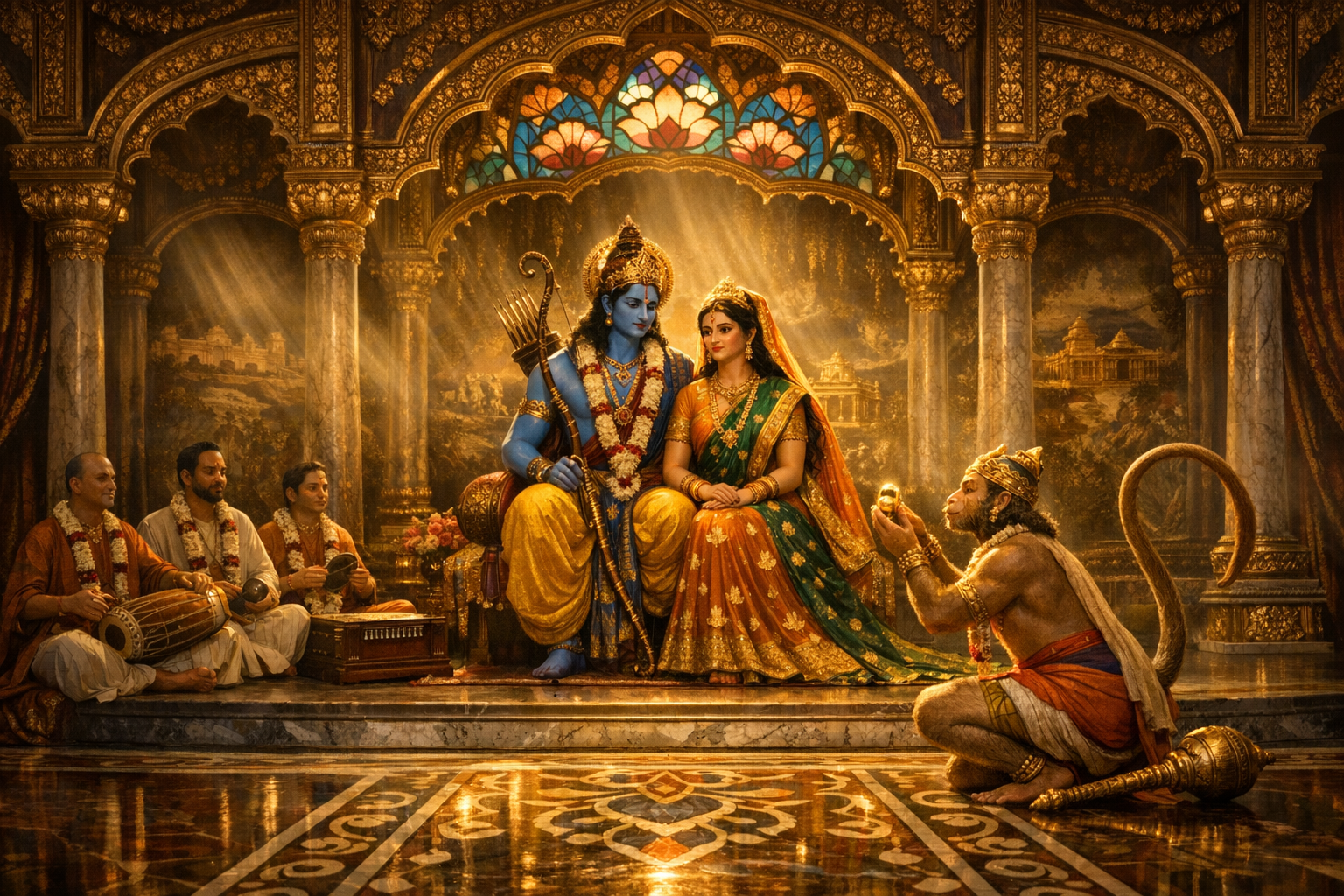


Recorded at Prabhupada’s Palace of Gold in New Vrindaban (West Virginia, USA), this 78‑minute ISKCON Ramayana presents a compact, devotional retelling of the Indian epic that enables viewers to journey from Ayodhya to Lanka in a single sitting. Framed by the shrine’s luminous interiors, the performance balances narrative clarity with bhakti-centered expression, allowing the story of dharma, courage, and compassion to resonate with contemporary audiences while preserving classical sensibilities.
The venue itself is integral to the viewing experience. Prabhupada’s Palace of Goldconceived and handcrafted by devotees to honor A. C. Bhaktivedanta Swami Prabhupadaembodies Gaudiya Vaishnava aesthetics through its marble inlays, stained glass, and gilded ornamentation. Presenting the Ramayana within this sacred architectural environment underscores the production’s intent: to situate epic storytelling within a living devotional space that unites worship, culture, and education.
Rooted in Gaudiya Vaishnavism, ISKCON’s devotional arts tradition integrates kirtan, theatre, and dance as vehicles for transmitting sacred narratives. In this staging, the grammar of bhakti performance is readily legible: melodic frameworks and rhythmic cycles support recitation and dialogue; mridanga, kartal, and harmonium often guide tempo and mood; and movement vocabulary is employed to reinforce character, setting, and rasa. The result is devotional theatre that privileges affective understandinginviting viewers to feel the text as much as to follow it.
The narrative arc adheres to the Ramayana’s canonical progression, illuminating ethical statecraft and familial duty in Ayodhya; the testing of virtue and resilience during forest exile; alliance-building and ethical diplomacy in Kishkindha; the devotional heroism of Hanuman in Sundara Kanda; and the principles of righteous warfare culminating in the restoration of order in Yuddha Kanda. Throughout, the figure of Maryada Purushottama exemplifies rectitude in action, while Sita’s fortitude clarifies the epic’s discourse on dignity, fidelity, and agency.
Aesthetically, the performance draws upon the classical theory of rasa to guide audience engagement, moving fluidly among vīra (heroic), karuṇa (compassionate), adbhuta (wonder), and śānta (tranquil) moods. Costume choices and color palettes mark ethical alignments and psychological states; tilaka patterns signal Vaishnava identity; and emblematic propsparticularly the bow and the ringencode duty, protection, and trust. These semiotic choices ensure that even first-time viewers can track the moral cartography of the epic with ease.
The recording’s 78‑minute runtime is pedagogically effective. It preserves the continuity necessary for immersion while remaining accessible to families, youth groups, and classroom settings. Clear scene transitions, cohesive soundscapes, and close framing on dialogue and kirtan passages sustain narrative momentum. For many viewers, the synergy of music, mantra, and movement creates a meditative cadence that deepens comprehension well beyond a purely textual encounter.
As cultural heritage in motion, the ISKCON Ramayana supports intergenerational learning. Parents and educators frequently use such productions to introduce the epic’s ethical architecturedharma (responsibility), satya (truthfulness), karuṇa (compassion), and seva (service)in ways that are memorable and emotionally intelligible. Viewers often report that the combination of live performance energy and sacred space yields a felt sense of continuity with India’s performative traditions, even when experienced far from the subcontinent.
Importantly, the Ramayana’s civilizational reach extends across the dharmic family. Jain retellings (such as Vimalasuri’s Paumacariya) and Buddhist narratives (including the Dasaratha Jataka) reinterpret the tale’s ethical motifs through their own doctrinal lenses, while Sikh teachings emphasize maryada (disciplined conduct) and seva as enduring virtues consonant with the epic’s moral core. By foregrounding universal values rather than sectarian boundaries, a presentation like this advances unity in spiritual diversity and highlights a shared commitment to compassion, restraint, and truthful action.
For researchers and students of performance studies, the production offers a living laboratory in devotional dramaturgy. It demonstrates how diaspora communities curate staging, music, and narrative pacing to serve multilingual, multigenerational audiences without diluting theological content. The work also models how temple-based arts ecosystems function as hubs for cultural transmission, ensuring that Indian epics remain experientially vibrant as part of a broader Hindu cultural heritage.
A concise metadata snapshot underscores the production’s contours: it is a stage film capturing a complete Ramayana performance; the runtime is approximately 1 hour 18 minutes; the venue is Prabhupada’s Palace of Gold (New Vrindaban, West Virginia); and the performing community is ISKCON (International Society for Krishna Consciousness). These elements together explain the film’s devotional register, its emphasis on bhakti aesthetics, and its suitability for study within comparative religion, literature, and performance curricula.
In sum, this ISKCON Ramayana integrates sacred narrative, music, and movement within an iconic devotional space to deliver a clear, emotionally resonant, and culturally grounded experience. It stands as a bridge between text and practice, diaspora and homeland, andmost significantlyamong the intertwined streams of Hinduism, Buddhism, Jainism, and Sikhism, where virtues of dharma and seva remain a shared, unifying horizon.
Inspired by this post on Dandavats.