-
Padma Samhita Unveiled: Timeless Pancharatra Rituals to Elevate Modern Spiritual Life

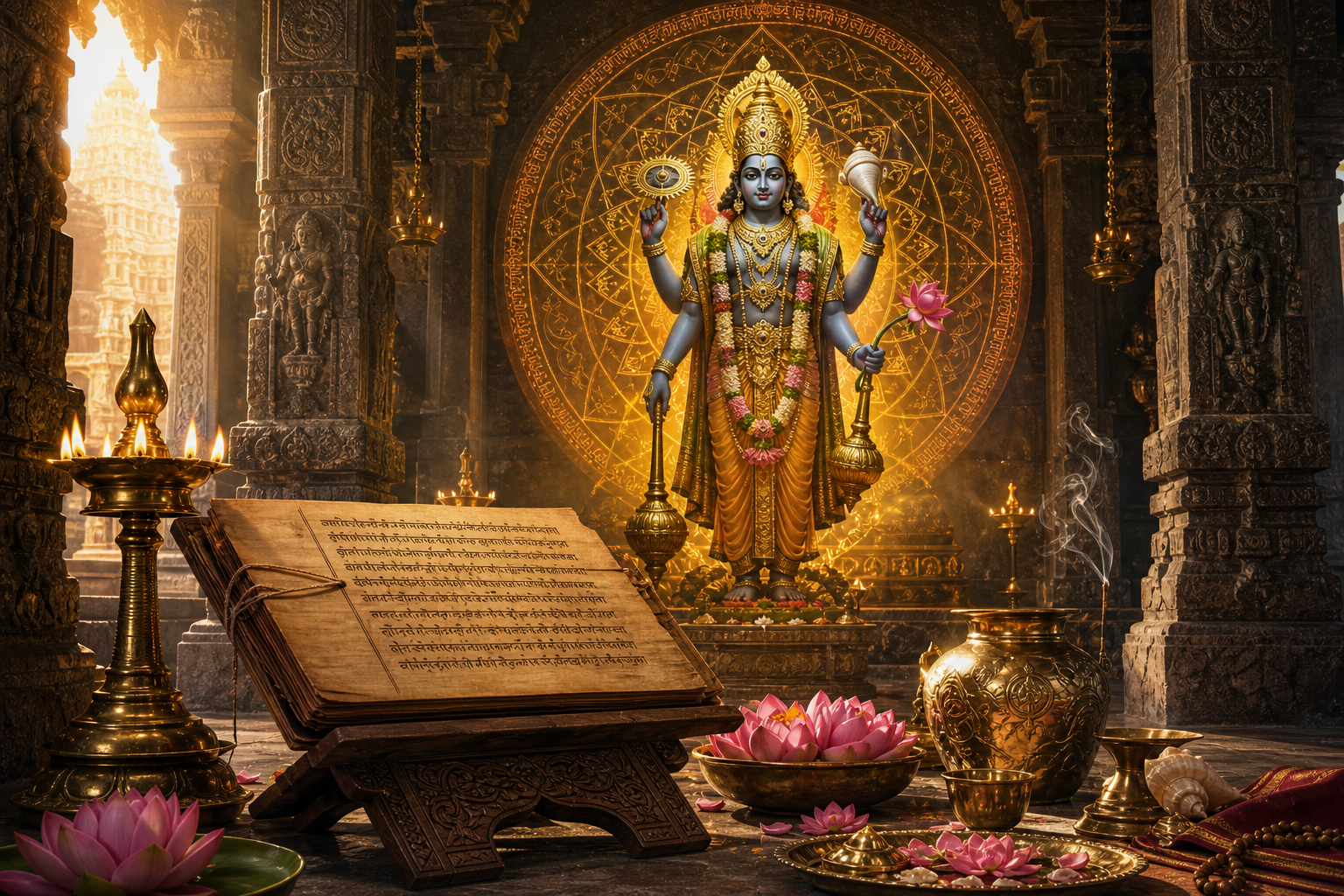
Padma Samhita is a cornerstone of the Pañcarātra tradition, detailing thirty-one chapters that integrate temple construction, mūrti consecration, daily worship, and ethical formation. This overview explains its core theology—the vyūha doctrine and arcā avatāra—and shows how mantras such as Om Namo Nārāyaṇāya and Om Namo Bhagavate Vāsudevāya shape steady household practice. Readers gain a practical…
-
Neither Sat Nor Asat: Rigveda’s Nasadiya Sukta, Vedic Cosmology, and Sacred Paradox Explained

Rigveda’s Nasadiya Sukta opens with the paradox “neither sat nor asat,” a precise philosophical strategy rather than a rhetorical flourish. Read in concert with the Upanishads, the hymn marks a pre-categorical horizon where ordinary predicates fail, complementing later Vedantic distinctions between ultimate and conventional truth. Classical schools clarify its logic: Sāṅkhya’s causal latency, Nyāya’s theory…
-
Jnana–Karma Samuccaya Vada in Vedanta: Unifying Knowledge and Action on the Path to Moksha

Jnana Karma Samuccaya Vada explains how knowledge (jnana) and action (karma) can operate together on the path to moksha without diluting the distinctive role of each. Drawing on the Bhagavad Gita, Brahma Sutra, and classical Vedanta, it clarifies why Advaita treats karma as preparatory, how Bhedabheda argues for a robust synthesis, and how Vishishtadvaita and…
-
Is the Universe an Illusion? A Rigorous Vedic Guide to Maya, Vedanta, and Liberation

Vedic scriptures call the world an “illusion” not to deny its existence, but to redefine reality with precision. Advaita Vedanta distinguishes absolute reality (Brahman) from empirical, dependent reality (the cosmos as mithyā) and explains how māyā and avidyā generate the appearance of multiplicity. Upanishadic teachings, supported by the Bhagavad Gita, show why the world is…
-
Work Without Motive: Sri Sri Ravi Shankar on Intuition, Nishkama Karma, and Flow States

This article unpacks the axiom “the best work comes out when you work without any motive” through Sri Sri Ravi Shankar’s description of intuition as a “sudden sprout of thought,” the Bhagavad Gita’s Nishkama Karma, and insights from modern psychology. It distinguishes non-attachment from aimlessness, showing how purpose can remain strong while egoic craving for…
-
Unlocking Innate Bliss: A Cross-Dharmic Guide to the Self and the Veils of Matter

Human beings everywhere seek happiness because, as Vedanta-sutra affirms—anandamayo ‘bhyasat—consciousness is intrinsically blissful. This essay maps the beginning of spiritual knowledge across Hinduism, Buddhism, Jainism, and Sikhism, showing how each tradition diagnoses the veils of matter and mind and prescribes ethical and contemplative methods to remove them. Readers learn the shared language of gross and…
-
Samavayikarana Unveiled: The Inherent Cause Shaping Reality in Nyaya-Vaisheshika Thought

Samavayikarana—the “inherent cause”—explains why effects are inseparably constituted by their material parts, as in the classic example of cloth and threads. Rooted in the Nyaya-Vaisheshika account of Samavaya (inherence), it distinguishes three cooperating causes: Samavayi (material), Asamavayi (non-inherent), and Nimitta (efficient). The framework solves regress worries by treating Samavaya as a sui generis, ultimate relation,…
-
Dashabhujeshwara Decoded: Five-Faced, Ten-Armed Shiva—Iconography, Mantras, Ritual Power

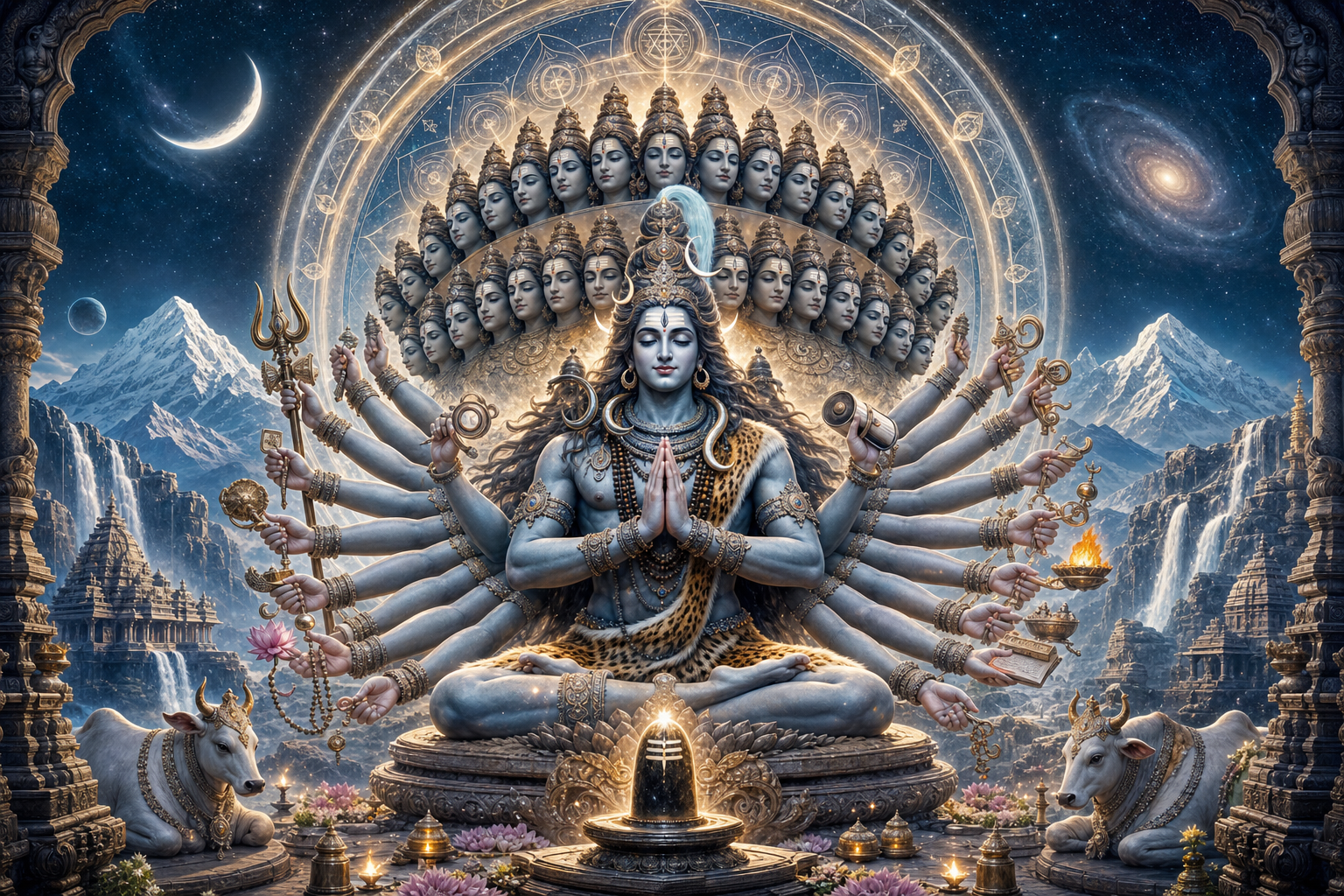
Shiva’s Dashabhujeshwara form—five-faced and ten-armed—embodies the Pañcabrahma theology in which one Absolute performs five cosmic acts: creation, sustenance, dissolution, concealment, and grace. Drawing on the Śiva Purāṇa, Āgamas, and Śilpa-Śāstras, this explainer clarifies how each face (Tatpuruṣa, Aghora, Vāmadeva, Sadyojāta, Īśāna) aligns with directions, mantras, and meditative practice. It decodes the ten arms as sovereignty…
-
Beyond the Chase: Hinduism’s Radical Blueprint for Lasting Happiness and Inner Freedom

This long-form analysis explains a core Hindu teaching: lasting happiness is revealed when the compulsive pursuit of happiness ends. It clarifies the difference between sukha (pleasure) and ananda (bliss), grounding the argument in the Upanishads, Bhagavad Gita, and Patanjali’s Yoga Sutra. Readers gain a rigorous framework for understanding moksha, along with a practical blueprint that…
-
What Is the Purpose of Creation? A Dharmic, Scholarly Guide to Līlā and Liberation

The question “What is the purpose of creation?” can be read most fruitfully through the dharmic idea of līlā—cosmic play—where manifestation is a free, blissful self-expression rather than a utility-driven project. Hindu philosophy frames this across Advaita, Vişiṣṭādvaita, Dvaita, Śaiva thought, and Sāṁkhya–Yoga, uniting expressive freedom with ethical purpose and liberation (mokṣa). Purāṇic aesthetics and…
-
Does God Really Exist? A Dharmic Deep Dive into Suffering, Karma, and Yuga Dharma

This long-form exploration reframes “Does God really exist?” through the dharmic lenses of Hinduism, Buddhism, Jainism, and Sikhism. It explains how Yuga Dharma situates the present age (Kali Yuga) and why accessible practices—like nāma-japa, kīrtana, satsanga, and seva—are especially potent now. Drawing on pramāṇa theory, Nyāya arguments, and Vedānta’s non-dual and devotional streams, it outlines…
-
Arghya to the Sun: Vedic Symbolism, Subtle Physiology, and Daily Surya Worship Benefits

Arghya—offering water to the rising Sun—unites Vedic symbolism, yogic subtle physiology, and modern circadian insights in a simple, potent daily rite. Rooted in sandhyā-vandana and popularized in contemporary teachings as “water is love,” arghya blends mantra, breath, and gratitude to steady attention and uplift mood. Yogic traditions describe a gentle activation of the solar current…
-
Sharpening the Inner Compass: Trusting Intuition on the Dharmic Path with Clarity and Courage

Trustworthy intuition in Hinduism is not impulse but disciplined, dharma-aligned insight that integrates perception, reason, and sacred testimony. This article clarifies how the inner compass relates to Atman, the Upanishads, and the Bhagavad Gita, while showing convergences with prajñā in Buddhism, anekāntavāda in Jainism, and hukam in Sikhism. Readers learn practical tests for discernment—ahiṃsā, satya,…
-
Liberate the Self: Hindu, Buddhist, Jain, and Sikh Insights on Embracing True Nature

This long-form essay explores how Hinduism, Buddhism, Jainism, and Sikhism converge on a single, practical insight: suffering intensifies when one strives to become someone other than one’s true nature. Drawing on the Upanishads, Bhagavad Gita, Yoga Sutra, Sāṅkhya analysis, Buddhist teachings on craving and anatta, Jain doctrines of aparigraha and anekāntavāda, and Sikh wisdom on…
-
Kamantaka Murti of Shiva: Awe-Inspiring Iconography, Third-Eye Fire, and Mastering Desire

This in-depth study decodes Kamantaka (Madana Dahana), the powerful murti of Shiva who burns Kama with the third eye’s jñāna-agni, as a visual pedagogy on mastering desire. It explains field-ready markers—Kama’s sugarcane bow, bee-string, five flower-arrows, and Rati—so readers can confidently identify the scene in temples and sculpture. It situates the form in Purāṇic, Āgamic,…
-
Curiosity as Sacred Practice: How Hinduism Champions Inquiry, Dialogue, and Self-Realization

This article presents a rigorous, accessible account of why Hinduism treats curiosity as a sacred discipline. It traces the spirit of inquiry from the Upanishadic dialogues and Bhagavad Gita to Nyaya logic, Mimamsa hermeneutics, Vedanta inquiry, and Yoga’s epistemology. It explains pramana—valid means of knowledge—and shows how disciplined questioning is bound to ethics, humility, and…
-
Neo‑Vedanta Unveiled: A Powerful Modern Synthesis Bridging Dharmic Wisdom and Pluralism

This article examines Neo‑Vedanta as a rigorous, modern synthesis of Vedāntic wisdom grounded in the Prasthanatraya (Upanishads, Bhagavad Gita, Brahmasutras). It traces historical catalysts in nineteenth‑century India and explains how Sri Ramakrishna and Swami Vivekananda anchored a plural, practice‑oriented vision. Readers gain a clear understanding of Ishta as a principle of respectful diversity and see…
-
Hindu Views on Love: A Scholarly Guide to Bhakti, Dharma, and the Heart’s Awakening

This in-depth guide explains love (prema) in Hinduism as both a metaphysical principle and a cultivated virtue, drawing on the Upanishads, the Bhagavad Gita, and classical bhakti theology. It clarifies distinctions between kāma, sneha, maitri, karuṇā, and prema, and shows how love matures through Bhakti, Jñāna, Karma, and Rāja Yoga. Readers gain practical exercises—japa, mindful…
-
Do Planets Shape Our Destiny? A Timeless Vedic Guide to Jyotisha, Karma, and Free Will

Is astrology truly the “eyes of the Vedas,” and do planets govern human fate? This in-depth, academically grounded guide clarifies what Vedāṅga Jyotiṣa is, how it historically joined astronomy and ritual timing, and why life is physically and culturally entangled with celestial cycles. Readers learn the technical building blocks—rāśi, nakṣatra, lagna, pañcāṅga, daśā, gochara, and…
-
Eternal Longing, Infinite Union: Decoding Radha–Krishna’s Divine Love and Sacred Separation

This long-form exploration decodes why Radha–Krishna’s love is revered not as a tragic failure of union but as a sacred pedagogy of longing. Drawing on Srimad Bhagavatham, Gīta Govinda, and Gaudiya Vaishnava theology, it explains how vipralambha (separation) heightens devotion and refines ethical action. The article clarifies key concepts—rasa, sambhoga, vipralambha, and mahābhāva—while situating them…