
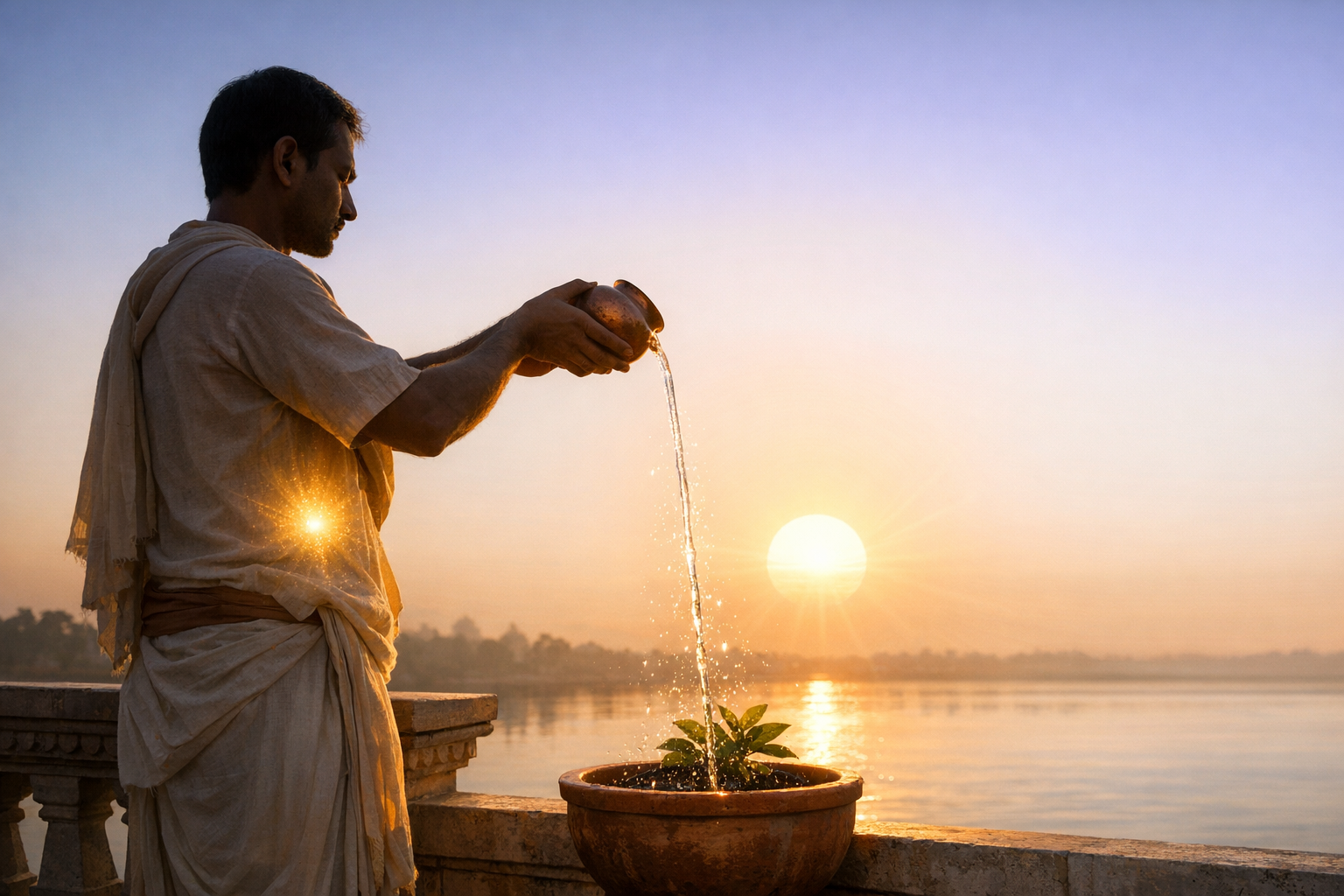
Arghyaoffering water to the rising Sunstands at the intersection of Vedic ritual, contemplative psychology, and ecological mindfulness. In the Indic understanding popularized in contemporary discourse by Sri Sri Ravi Shankar, water symbolizes love; the Sanskrit term “āpa/apa” denotes water and is evocatively linked to affection and tenderness. When water is offered to Surya (the Sun), the gesture transmits devotion as fluid grace: love given back to the cosmic source of light, warmth, and time.
Etymologically, arghya derives from the Sanskrit root “arh,” meaning worthiness, honor, and value. In the classical ritual lexicon, arghya is a respectful libation presented to a revered presencedeity, guest, or principleto acknowledge its sanctity. In Surya-upasana (sun worship), the arghya becomes a distilled rite of hospitality to the solar principle that animates life, order (ṛta), and rhythm (kāla).
Scriptural textures point to a deep antiquity. Vedic hymns celebrate Āditya/Surya as seer and sustainer; later vedic and smriti traditions preserve arghya within the daily sandhyā-vandana performed at dawn and dusk. Across schools, three arghyas offered to the rising Sun remain a common thread, emphasizing cyclical renewal, sattvic clarity, and the consecration of time at its threshold.
Mantric recitation varies by lineage and region, yet frequently includes salutations such as “Om Suryaya Namah,” the Gayatri mantra during sandhyā, or invocations like “Ghrinih Suryah Adityah.” In practice, the mantra animates the offeringbreath, sound, and intention aligning as a single current.
The procedure, in its most prevalent form, is simple and contemplative. At sunrise, facing east with a clean vessel (often copper), a small volume of clean water is raised in cupped palms or poured in a thin stream while intoning the chosen mantra. Many practitioners allow the gaze to meet the solar disc briefly through the falling ribbon of water to soften glare. The offering is repeated typically three times, with a concluding moment of quiet gratitude.
Symbolically, water embodies love, cohesion, and reciprocity. This interpretationarticulated in modern satsangs as “Apa means water and it also means love”captures an old intuitive truth: water binds communities, nourishes fields, and softens the mind. In arghya, the devotee yields a share of that gentle abundance to the source of illumination, reaffirming kinship with all beings that depend on the same light.
Yogic subtle physiology provides a complementary lens. Dawn practice is traditionally said to awaken piṅgalā-nāḍī (the solar current), kindle the agni of the manipura region, and balance prāṇa-vāyu. The synchrony of breath, mantra, and gesture stabilizes attention (ekāgratā) and fosters a lucid, uplifted mood carried into the duties of the day.
Contemporary chronobiology echoes these insights. Early-morning light exposure entrains circadian rhythms via intrinsically photosensitive retinal ganglion cells (ipRGCs), improving daytime alertness and supporting melatonin regulation at night. Habitual sunlight in the morning corridor correlates with better sleep quality, mood stability, and metabolic alignment. While vitamin D synthesis depends more on total UVB exposure than the arghya gesture itself, combining safe morning light with a mindful rite compounds benefitsphysiological and reflective.
The custom of briefly viewing the Sun through a thin water stream has a plausible optical rationale: flowing water diffuses and refracts light, reducing glare intensity for a gentler visual experience. However, it should not be mistaken for eye protection. Safety remains paramount: arghya is best performed at sunrise or sunset when solar intensity is low; prolonged direct gazing is to be avoided.
Arghya also nurtures an ethos of ecological responsibility. Using modest quantities of clean water, returning it to soil or a plant base, and preferring metal or earthen vessels all align with traditional dharmic care for the elements (pañca-mahābhūta). Even this small rite can become a daily affirmation of conservation and gratitude toward the waters that sustain life.
Psychologically, the rite functions as a morning anchor. Many householders report that the quiet, deliberate actstanding beneath the brightening sky, invoking an enduring mantra, and letting water flow from the palmsdissolves mental clutter. The result is a felt shift from haste to composure, from self-absorption to reverence. Such experiential outcomes align with classical aims of śraddhā (faithful attention) and prasāda-buddhi (a serene, accepting mind).
Dharmic traditions converge around these elements in complementary ways. Buddhism preserves protective discourses like the Surya Sutta (SN 2.10), acknowledging solar deities within a larger soteriological framework focused on mindfulness and compassion. Jain practice venerates the elemental order through non-violence (ahiṃsā) and restraint (aparigraha), encouraging reverence for the same waters and light that arghya honors. Sikh wisdom in Japji Sahib proclaims, “Pavan Guru, Pani Pita, Mata Dharat Mahat,” venerating air, water, and earth as sacred kin. Across these paths, the shared ethic is luminous: honor the elements, live gently, and cultivate love as the common inheritance.
Within Hindu practice itself, regional expressions deepen the tapestry. Chhath Puja, for instance, offers arghya to both setting and rising Sun with striking ecological disciplinefasting, riverbank purity, and community solidarity. Vedic sandhyā integrates arghya with the Gayatri mantra, while many yoga practitioners pair morning arghya with Surya Namaskar and brief pranayama to harmonize body, breath, and attention.
Astrologically and ritually, Surya signifies ātman (the luminous core), clarity, courage, and rightful agency. Traditional jyotiṣa prescribes Surya-upasana, including arghya, as an upāya (remedial measure) for perceived imbalances related to vitality, confidence, or leadership. While these interpretations are theological and symbolic rather than scientific, their contemplative value and behavioral benefits are widely acknowledged in lived practice.
Practical considerations support inclusivity and safety. Those with limited mobility or living in high-rise settings may offer arghya on a balcony or at a sunlit window, returning the water to a planter afterward. On overcast days or when travel precludes outdoor practice, a mental arghyaperformed with joined palms, mantra, and visualizationpreserves continuity. Seasons with harsher light invite shorter durations and greater caution.
Mantric and procedural diversity is a feature, not a flaw, of the Vedic tradition. Vaishnava, Shaiva, Shakta, and Smarta lineages maintain distinct mantra-sets and invocatory emphases; some recite Aditya Hridayam passages, others lean on seed salutations (namaḥ, svāhā forms). This pluralism reflects a mature spiritual ecosystem that values sincere intent above uniformity, encouraging unity-in-diversity across devotional idioms.
An integrated morning routine often unfolds naturally: a brief cleansing, a few cycles of pranayama, Surya Namaskar to awaken circulation, arghya with mantra and contemplation, and a minute of stillness to dedicate the day’s works (karma-yoga) to the highest good. Such sequencing harmonizes physiology with devotion and embeds spiritual awareness into practical living.
Safety and stewardship round out best practices. Arghya is most appropriate at sunrise or the soft light of sunset. The eyes should not be strained; sunglasses are unnecessary at dawn but can be used before and after the offering. Water should be clean and used sparingly, with respect for local conditions. If copper vessels are used, they should be well maintained for hygiene.
In sum, arghya to the Sun is not mere custom; it is a compact spiritual science. It unites Vedic symbolism (water as love, Sun as consciousness), yogic subtle physiology (prāṇa balance, manipura steadiness), and modern insights on circadian health. It also gestures toward a dharmic consensus that spans Hinduism, Buddhism, Jainism, and Sikhism: honor the sustaining elements, cultivate inner luminosity, and let love flow outward in service. In that spirit, each morning becomes a renewal of belongingto light, to life, and to one another.
Inspired by this post on Hindu Pad.







