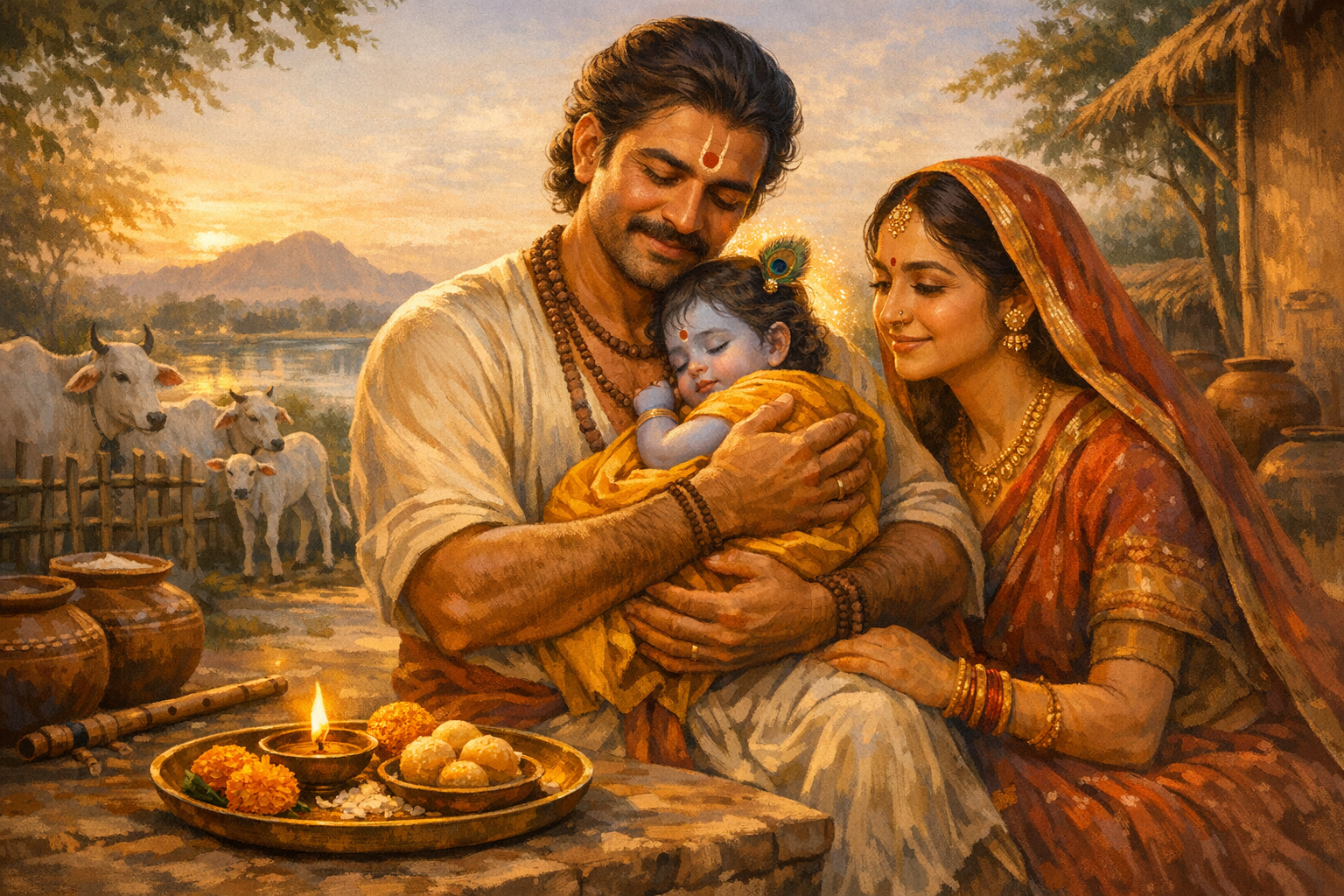
Nandagoparevered across Vraja as Nanda Maharajastands in Hindu memory as the father whose choice of love over blood redefined the meaning of kinship. In the pastoral landscape of Gokula and Vṛndāvana, he led the Gopa community with steadiness, warmth, and deep devotion. Yet what elevates Nandagopa from respected headman to exemplar of dharma is the way paternal duty was embraced not through lineage, but through care, courage, and unqualified affection for Śrī Krishna.
According to the Bhagavata Purana and related Purāṇic traditions, the Mathura–Vraja narrative pivots on a dramatic nocturnal crossing of the Yamunā. Vasudeva carried the infant Krishna out of Kamsa’s prison to protect the divine child from a tyrant’s decree. In Gokula, the newborn was placed with Yashoda and Nandagopa, while Yogamāyā’s power concealed the mystery of birth and exchange. From that hour, Nandagopa became Krishna’s social and ritual fatherperforming the sacred samskāras, assuming protection, and anchoring the child within community and custom.
Texts variously call him Nanda, Nandagopa, and Nanda Maharaja. Harivaṁśa, Viṣṇu Purāṇa, and especially the tenth skandha of the Bhagavata Purana embed him within the Yadu–Vṛṣṇi cultural matrix while foregrounding his role as Vrajarāja, the pastoral chief. His presence frames numerous childhood līlās, not as a passive witness but as the householder whose responsibilities, anxieties, and joys give those episodes their lived, human texture.
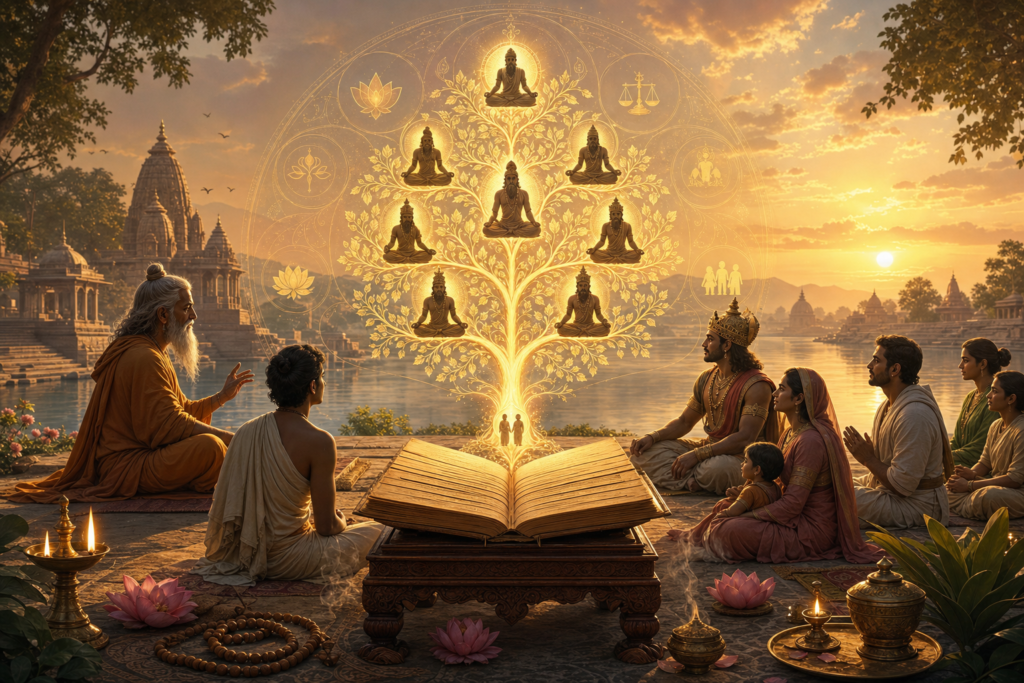
Dharmic thought distinguishes between biological generation and the assumption of duty. While janma (birth) confers one form of relation, it is samskāra (sacrament and cultivation) that perfects social personhood. Dharmashāstra literaturefrom Manusmṛti and Nārada Smṛti to Dharmasūtrasrecognizes modes of fatherhood grounded in upbringing and ritual responsibility. Within this framework, Nandagopa’s pitr̥tva (fatherhood) is fully valid: he enacts the father’s obligations, shapes the child’s social world, and becomes the visible hand of protection and love.
Classical jurisprudence on adoption (datta-putra) and allied categories demonstrates how Hindu society legally and ritually sanctioned filial bonds beyond blood. Though Krishna’s placement in Vraja emerges from divine design rather than a juristic act, the effect is analogous: Nandagopa embodies the principle that fatherhood arises as much from ethically grounded nurture as from procreation. The Purāṇic narrative thereby offers a normative template, not merely a miracle tale.
As chief of the Gopas, Nandagopa organized pastoral lifemanaging cattle wealth, negotiating levies demanded from Mathura, and stewarding communal safety. His house becomes the first orbit of Krishna’s world. The daily choreography of milking, grazing, festivals, and neighborly exchange unfolds under his watch, rendering Vraja not simply a sacred stage but a functioning society aligned to dharma.
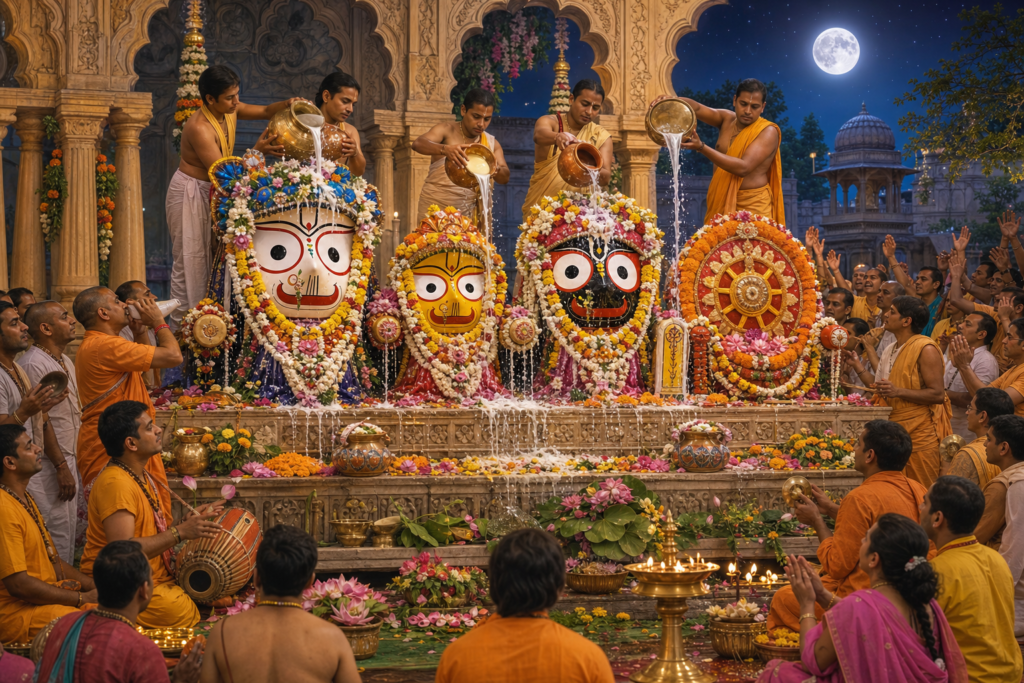
Ritually, Nandagopa presides over Krishna’s samskārasthe naming, the distribution of sweets, the communal rejoicing later celebrated as Nandotsava. These frames of ritual fatherhood are not incidental; they publicly acknowledge and sacralize his status. In villages and temples today, Janmāṣṭamī celebrations still echo this recognition, blending theology with social memory.
The early Vrindāvan līlās are punctuated by dangers that sharpen paternal duty. Putanā’s infiltration, the collapse of the cart (Śakaṭāsura), and Trināvarta’s whirlwind menace transform Nandagopa’s courtyard into a crucible of vigilance. Each threat crystallizes the parental tasks of safeguarding the vulnerable while submitting, humbly and unreservedly, to the inscrutable grace that repeatedly preserves the child.
A poignant episodesometimes called the Nanda–Varuṇa narrativenarrates how Nandagopa is seized during a ritual bath under an inauspicious tithi. Krishna rescues him, revealing domains beyond ordinary perception. Here the paternal bond becomes a channel through which metaphysical assurance enters social life: the father’s humility and the son’s protection converge into a theology of trust.
In Govardhana-līlā, Nandagopa’s stature as community leader is once again visible. When Krishna redirects the community’s offerings from Indra to Govardhana and dharma-anchored duties (go-rakṣā, stewardship of land and cattle), Nandagopa accepts a new ethic without rancor. His assent exemplifies a hallmark of dharma: correcting course when truth becomes clearer, even if it challenges entrenched habit.
Emotionally, Nandagopa’s paternity demonstrates how love, not lineage, is often the decisive grammar of belonging. The texts honor Vasudeva as begetter, but they also honor Nandagopa as the father who wakes before dawn to responsibilities, who bears risk and worry, who tastes the sweetness and ache of everyday care. The social and spiritual weight assigned to him validates a central dharmic claim: in matters of moral identity, nurture is not secondary to nature.
Indian epic literature repeatedly affirms this ethos. Adhiratha raises Karna with unwavering affection; Janaka shapes Sita’s virtue not through birth but through cultivation. Such patterns show a civilizational comfort with kinship forms rooted in intention (bhāva) and duty (dharma). Nandagopa’s example, therefore, is not an exception but a luminous instance of a broader ideal.
Across dharmic traditions, the valuation of care over blood finds strong resonance. Buddhist Jātaka narratives celebrate guardianship, compassion, and the formative power of ethical upbringing. Jain literature, anchored in ahiṁsā and aparigraha, prizes responsibility and self-restraint within familial life. Sikh tradition places seva at the heart of community, underscoring that dignity and duty extend beyond the tight bounds of lineage. In this shared civilizational space, Nandagopa’s fatherhood feels intuitively at home.
Philosophically, the Gītā’s emphasis on intention and action reveals why Nandagopa’s life matters: dharma is not an abstraction but enactment. He models niṣṭhā (steadfastness), kṣamā (forbearance), and śraddhā (faith) under the pressures of uncertainty. By making right choices long before outcomes are visible, he shows how households become schools of virtue.
Nandagopa’s fatherhood is inseparable from Yashoda’s motherhood. Together they constitute a pedagogy of tenderness and disciplineshe with the rope in the Dāmodara-līlā, he with the steadying hand of provision and order. The Purāṇas suggest that divinity seeks precisely such homes, where affection is authentic, responsibilities are embraced, and everyday life itself becomes a sacrament.
Bhakti literature, especially Gaudiya Vaiṣṇava poetry, often names Krishna as Nanda-nandana“the joy of Nanda.” The epithet is revealing: it encodes theology in kinship. To invoke Krishna as the delight of Nandagopa is to honor the home that formed the horizon of his early life and to acknowledge the spiritual potency of familial bonds rightly lived.
Historically and text-critically, the Purāṇic corpus is layered and didactic, less concerned with linear chronology than with moral and theological instruction. Read in that light, Nandagopa’s portrait is a carefully crafted archetype for householders: protect dependents, honor community, remain corrigible in the face of truer insight, and prefer compassion to vanity.
For contemporary readers, the narrative offers a constructive ethic for adoptive and foster parenting. By locating true paternity in samskāra, daily presence, and moral guardianship, the tradition dignifies families formed through love and duty rather than genetics alone. The message is not merely consoling; it is norm-setting: society thrives when it recognizes and supports the vast, unseen labor of those who parent beyond blood.
Culturally, Nandotsava processions and Janmāṣṭamī festivities preserve communal memory of this ideal. In songs, dramas, and temple rituals across India and the diaspora, Nandagopa’s name is spoken with gratitude. The celebrations are not historical reenactments alone; they are renewals of commitment to a dharma that prizes care, courage, and hospitality to the vulnerable.
Ethically, the story counters narrow hereditarianism. Dharma, as embodied by Nandagopa, is neither sentimental nor abstractit is practical love: waking early, making provision, listening to counsel, adjusting practices when wisdom demands, and holding steady when storms gather. Such virtues make familial life a public good.
Theologically, Nandagopa’s reverence before Krishna does not diminish his paternal agency; it perfects it. By acknowledging transcendence, he becomes freer to perform immanently needed tasksjust, patient, and unafraid. His household reveals how divine proximity deepens, rather than erases, human responsibility.
Read togetherscriptural testimony, bhakti poetics, and the living calendar of festivalsNandagopa emerges as a model of fatherhood whose righteousness flows from nurture, not lineage. In affirming this, the dharmic world affirms itself: Hinduism, alongside Buddhism, Jainism, and Sikhism, converges on an ethic where duty, compassion, and community outweigh the accidents of birth.
Nandagopa’s legacy, therefore, is both intimate and civilizational. Intimate, because it speaks to anyone who has chosen to love a child into personhood. Civilizational, because it sets a standard of kinship that is capacious, humane, and aligned to dharma. In a time of shifting family forms and urgent social needs, this ancient portrait remains a precise, demanding, and hopeful guide.
Inspired by this post on Hindu Blog.