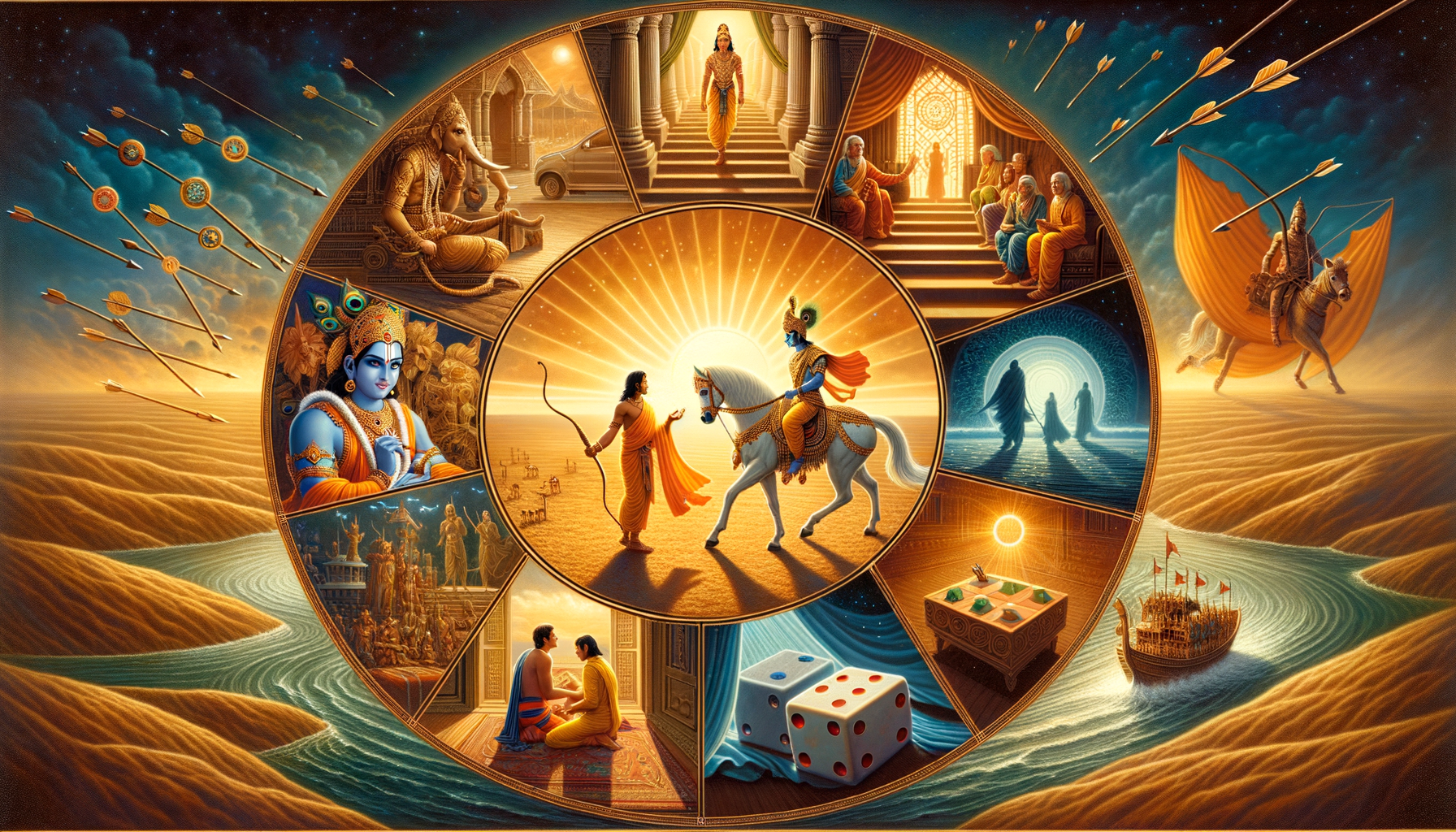
The Mahabharata stands as a foundational epic of the Indian subcontinent, interweaving philosophy, statecraft, ethics, and human emotion. Its iconic moments continue to guide discussions on dharma, leadership, and moral courage across communities. Read as a shared civilizational text, it resonates with the values cherished in Hinduism, Buddhism, Jainism, and Sikhismduty, compassion, self-mastery, and truthoffering a unifying ethical vocabulary for contemporary life.
Dyutakrida, the game of dice, marks a decisive turning point in the epic. The moral failure of elders to intervene, the manipulation by Shakuni, and the humiliation of Draupadi in the sabha illustrate how institutional silence can enable adharma. For modern readers, this moment clarifies how ethical leadership demands timely dissent, procedural integrity, and courage to protect dignityprinciples central to a dharmic society.
Bhishma’s pratigya, the terrible vow of lifelong celibacy to secure his father’s happiness, represents a paradox: a virtuous decision that creates an unforeseen crisis of succession. Later, Bhishma’s sharashayya, the bed of arrows, invites reflection on the costs of rigid duty when it becomes detached from evolving justice. Readers often see in this arc a cautionary reminder that vows must remain aligned with living dharma, not merely precedent.
Krishna’s peace embassy in the Udyoga Parva exemplifies diplomacy anchored in moral clarity. He argues for reconciliation, proportionality, and restraint, even revealing the Virata-rupa in the Kaurava court when threatenedsignalling that peace is not passivity but principled strength. This vision of conflict resolution, grounded in truth and compassion, speaks to interfaith and intercommunity harmony within a plural dharmic fabric.
The Bhagavad Gita, delivered on the eve of the Kurukshetra War, reframes action through the lenses of svadharma, yoga, and equanimity. Arjuna’s ethical paralysis becomes a universal case study in moral psychology: duty without attachment, courage without cruelty, and service without ego. Across dharmic traditions, this synthesis of wisdom and action is received as a call to inner clarity and social responsibility.
Karna’s dana, giving away his kavacha-kundala to Indra, embodies generosity and honor under the shadow of fate. His life stages a profound dialogue between daiva and purusharthadestiny and human effortshowing how character persists even when outcomes are uncertain. Contemporary leadership readers often draw from Karna the insight that ethical giving requires prudence alongside valor.
Abhimanyu’s entry into the Chakravyuha highlights youthful brilliance, partial knowledge, and the high cost of war. His fall, surrounded and outnumbered, remains one of the epic’s most emotionally charged episodes, underscoring the responsibility of elders to transmit complete knowledge and uphold fair conduct. It cautions that strategy without ethics corrodes legitimacy.
Drona’s fallprecipitated by the ruse “Ashvatthama is dead”raises difficult questions about truth in wartime. The Mahabharata does not offer easy answers; rather, it compels readers to confront ethical gradations when protecting a just order. This complexity keeps the epic academically vital and morally instructive, fostering careful deliberation rather than simplistic judgments.
Ghatotkacha’s sacrifice transforms the battle’s trajectory by forcing Karna to expend the Shakti meant for Arjuna. Strategy and self-offering converge here, demonstrating how personal loss can safeguard a larger dharmic purpose. The episode evokes empathy and respect across traditions that honor selfless service.
When Krishna rushes forward with a chariot wheel to shield Arjunadespite a vow to remain unarmedthe scene demonstrates the primacy of protecting dharma over rigid formalism. The message is not vow-breaking but vow-fulfillment at a higher register: commitments exist to defend life, justice, and truth. Ethical flexibility, guided by wisdom, preserves the heart of righteousness.
The war’s aftermathGandhari’s curse, the Pandavas’ remorse, and Yudhishthira’s eventual renunciationconfronts victory with accountability. The epic closes not in triumphalism but in reflection: power is transient, responsibility is enduring, and inner conquest surpasses outer conquest. This ending harmonizes with the broader dharmic insight that genuine leadership culminates in humility, service, and the pursuit of inner peace.
Taken together, these ten iconic moments reveal why Mahabharat stories remain timeless. They equip readers to navigate ethical dilemmas, cultivate courageous compassion, and build unity across diverse paths. By illuminating dharma as both principle and practice, the Mahabharata continues to inspire communities seeking harmony, justice, and spiritual clarity.
Inspired by this post on Hindu Pad.