Tag: Mahabharata

  • Kapi Dhvaja Unveiled: How Hanuman on Arjuna’s Banner Powered Dharma at Kurukshetra

    Kapi Dhvaja Unveiled: How Hanuman on Arjuna’s Banner Powered Dharma at Kurukshetra

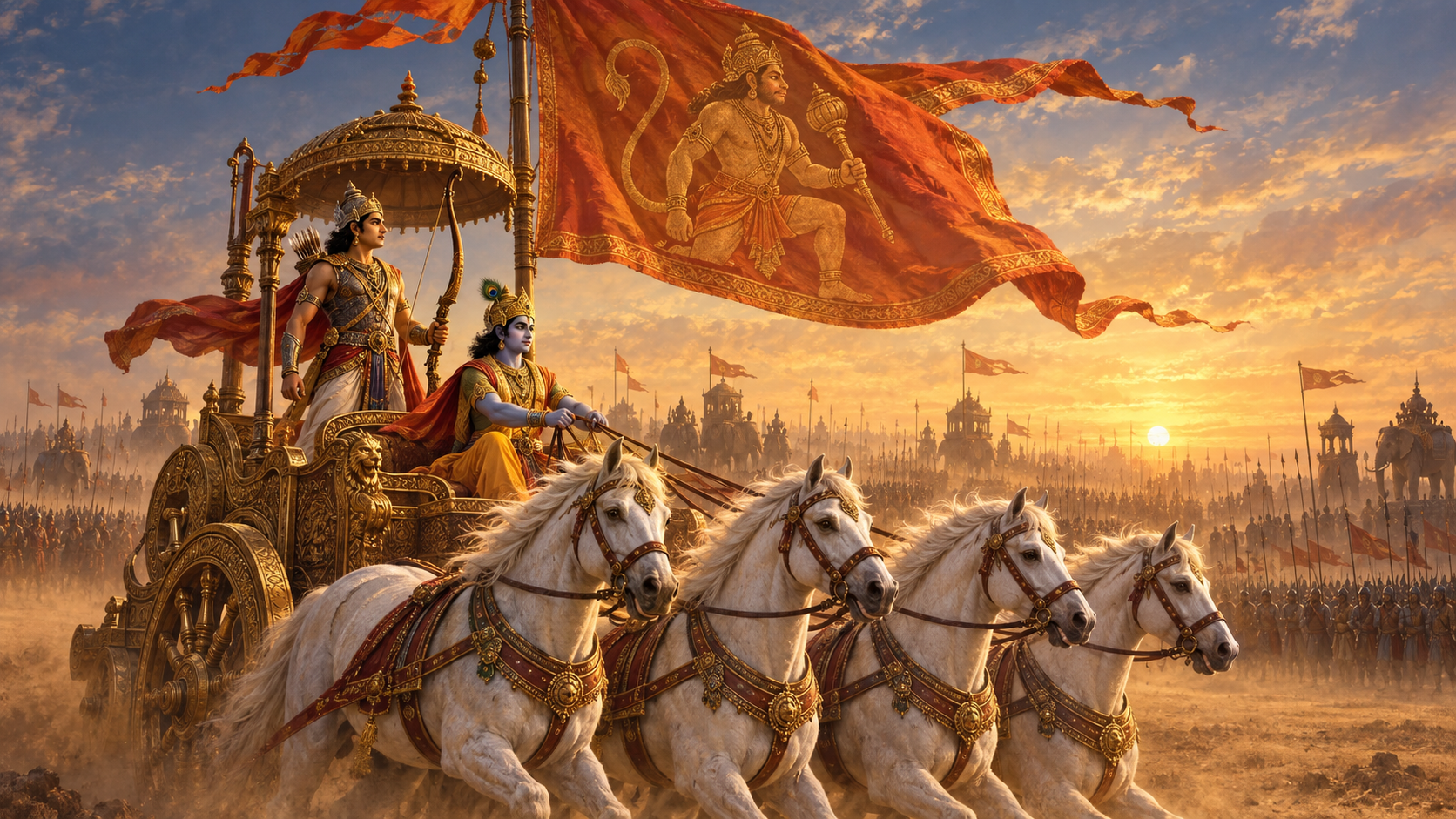
    Arjuna’s Kapi Dhvaja—the “ape-banner” of Hanuman—anchors the Bhagavad Gita’s battlefield in a powerful blend of scripture, strategy, and spirituality. The term kapidhvajaḥ in Gita 1.20 is not decorative; it signals divine sanction, morale-building semiotics, and an ethic of service above strength. Traditional lore explains Hanuman’s presence as a boon following Arjuna’s humility before Krishna, binding…

  • Mayasura: Legendary Demon Architect of Maya Sabha, Mandodari’s Lineage, and Vastu Shastra

    Mayasura: Legendary Demon Architect of Maya Sabha, Mandodari’s Lineage, and Vastu Shastra

    Mayasura (Maya Dānava) stands at the confluence of epic imagination and technical science—an unrivaled asura architect who builds palaces, aerial cities, and enduring canons of design. The Mahabharata’s Maya Sabha showcases optical and spatial ingenuity while warning against hubris. The Ramayana’s lineage threads—through Mandodari, Mayavi, and Dundubhi—demonstrate how moral counsel and unchecked pride shape political…

  • Unraveling Mayasura, the Demon Architect: Epic Engineering, Sacred Geometry, and Maya Sabha’s Legacy

    Unraveling Mayasura, the Demon Architect: Epic Engineering, Sacred Geometry, and Maya Sabha’s Legacy

    Mayasura—Maya Dānava in the epics—emerges as a master engineer whose works combine optics, hydrology, geometry, and ethics. The Mahabharata’s Khandava-daha and Maya Sabha episodes showcase advanced architectural thinking framed by Dharma: perception can be trained or misled, and design must answer to conscience. Purāṇic narratives such as Tripura reaffirm this ethic by sparing the architect…

  • Unveiling the Musala of Balarama: Agrarian Power, Sacred Iconography, and Divine Strength

    Unveiling the Musala of Balarama: Agrarian Power, Sacred Iconography, and Divine Strength

    The musala—Balarama’s sacred pestle—embodies agrarian power transformed into protective, ethical strength. This long-form analysis clarifies how its cylindrical form differs from the gadā, why Vaishnava texts hail Balarama as Hala-muṣala-dhara, and how the Mausala Parva frames the musala as a moral instrument entwined with dharma and time. Readers learn practical iconographic cues for identifying the…

  • Devaki’s Six Sons and Krishna’s Grace: The Harivamsa Tale of Curse, Karma, and Redemption

    Devaki’s Six Sons and Krishna’s Grace: The Harivamsa Tale of Curse, Karma, and Redemption

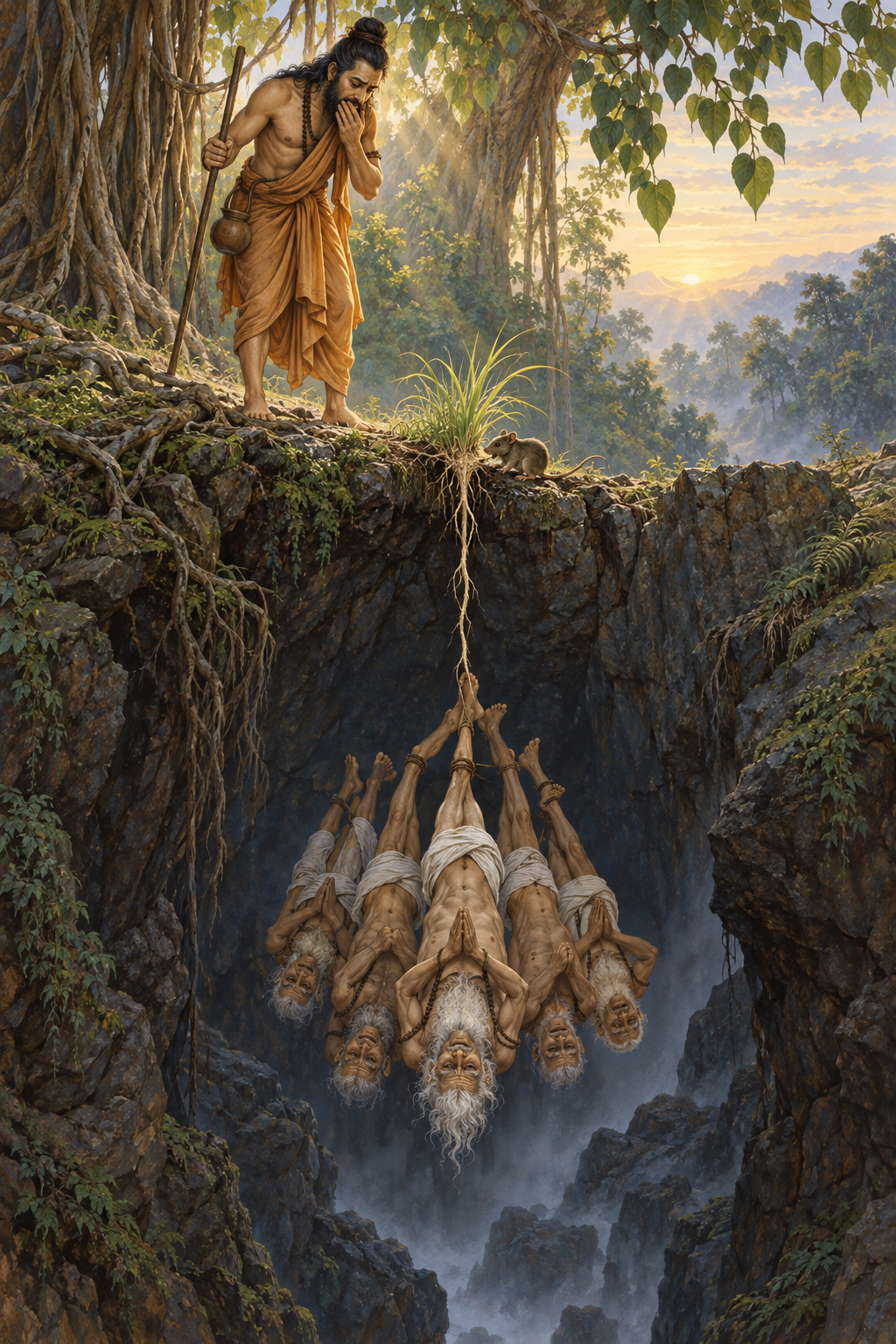
    This long-form exploration synthesizes Harivamsa, Mahabharata, and Purana traditions to explain why Devaki’s first six sons were slain by Kamsa and how Krishna’s grace ultimately redeemed them. Readers gain a clear map of the narrative’s variants, from the Shadgarbha’s primordial transgression and curse to their rebirth in Mathura and liberation after Kamsa’s fall. The essay…

  • Unmasking Putana and Jara: Demoness-Mother Archetypes, Tyranny’s Birth, and Dharma

    Unmasking Putana and Jara: Demoness-Mother Archetypes, Tyranny’s Birth, and Dharma

    Tyranny in Puranic and Itihasic literature emerges through distorted or restorative caregiving. This study compares two maternal archetypes: Putana, who weaponizes nurture under Kamsa’s regime in the Bhagavata Purana, and Jara, who joins the halves of the future Magadhan king Jarasandha in traditions linked to the Mahabharata. The contrast illuminates how intention and method shape…

  • When a Republic Fell: Kamsa’s Coup, Mathura’s Sudharma, and the Price of Lost Dharma

    When a Republic Fell: Kamsa’s Coup, Mathura’s Sudharma, and the Price of Lost Dharma

    Mathura’s fall from republican equilibrium to Kamsa’s tyranny illustrates how coups dismantle not only rulers but also institutions such as the Sudharma council that once mediated power through counsel and custom. Drawing on the Bhagavata Purana, Vishnu Purana, Harivamsa, and the Arthasastra, the narrative analyzes the mechanics of usurpation, alliance with Magadha, and the militarization…

  • Krishna’s Birth Reimagined: Jain Mahabharata on Karma, Kamsa, Jarasandha, and Destiny

    Krishna’s Birth Reimagined: Jain Mahabharata on Karma, Kamsa, Jarasandha, and Destiny

    The Jain Mahabharata reframes Krishna’s birth through the lenses of karma, Anekantavada, and ethical responsibility while honoring narrative motifs cherished across India. It presents Krishna as a Vasudeva, Balarama as a Baladeva, and Jarasandha as a Prativasudeva, aligning familiar events with a precise moral taxonomy. Rather than divine interruption, the sequence unfolds as the fruition…

  • Kumbhakarna and Vikarna: Tragic Brothers of Conscience, Loyalty, and Dharma in the Epics

    Kumbhakarna and Vikarna: Tragic Brothers of Conscience, Loyalty, and Dharma in the Epics

    Kumbhakarna (Ramayana) and Vikarna (Mahabharata) embody the epic dilemma between loyalty to kin and loyalty to dharma. This rigorous, text-grounded comparison explains how each man speaks the truth, anticipates disaster, and yet dies fighting for causes he judged unjust. Readers gain a practical framework—kṣātra-dharma, bandhu-dharma, rāṣṭra-dharma, and ātma-dharma—to evaluate conflicts of duty. The analysis connects…

  • Bhagavan Parashurama: Warrior‑Sage Avatar of Vishnu Who Restored Dharma and Balance

    Bhagavan Parashurama: Warrior‑Sage Avatar of Vishnu Who Restored Dharma and Balance

    Bhagavan Parashurama, the sixth avatar of Vishnu and a devoted worshipper of Shiva, embodies the Hari–Hara unity at the heart of Sanatana Dharma. Drawing on the Bhagavata Purana, Vishnu Purana, the Mahabharata, and the Ramayana, this comprehensive essay explains how Parashurama restored ethical order when royal power became predatory, then withdrew in penance to model…

  • Beyond the Flute: Why Bala‑Krishna Thrives as Parthasarathi’s Warrior Ethos Lies Dormant

    Beyond the Flute: Why Bala‑Krishna Thrives as Parthasarathi’s Warrior Ethos Lies Dormant

    Images of Bala‑Krishna dominate homes and temples, while Parthasarathi—the charioteer and teacher of the Bhagavad Gita—appears less often in popular devotion. This long‑form analysis explains the imbalance through rasa theory, bhakti history, temple networks, pedagogy, and modern media. It shows how intimacy‑focused worship naturally favored child and flute‑playing forms, whereas Krishna’s kshatra ethics are harder…

  • Parashurama: The Saint-Warrior Avatar Who Reset Kshatra Dharma and Reclaimed the Land

    Parashurama: The Saint-Warrior Avatar Who Reset Kshatra Dharma and Reclaimed the Land

    Parashurama, the sixth avatar of Lord Vishnu and a devoted bhakta of Lord Shiva, embodies the union of spiritual austerity and disciplined strength to restore dharma. Scriptural accounts from the Bhagavata Purana, Vishnu Purana, Ramayana, and Mahabharata portray his mission as a principled reform of Kshatriya power when it strays into adharma. The narrative explores…

  • Toxic Counsel and Fallen Crowns: Leadership Lessons from Shakuni–Duryodhana in the Mahabharata

    Toxic Counsel and Fallen Crowns: Leadership Lessons from Shakuni–Duryodhana in the Mahabharata

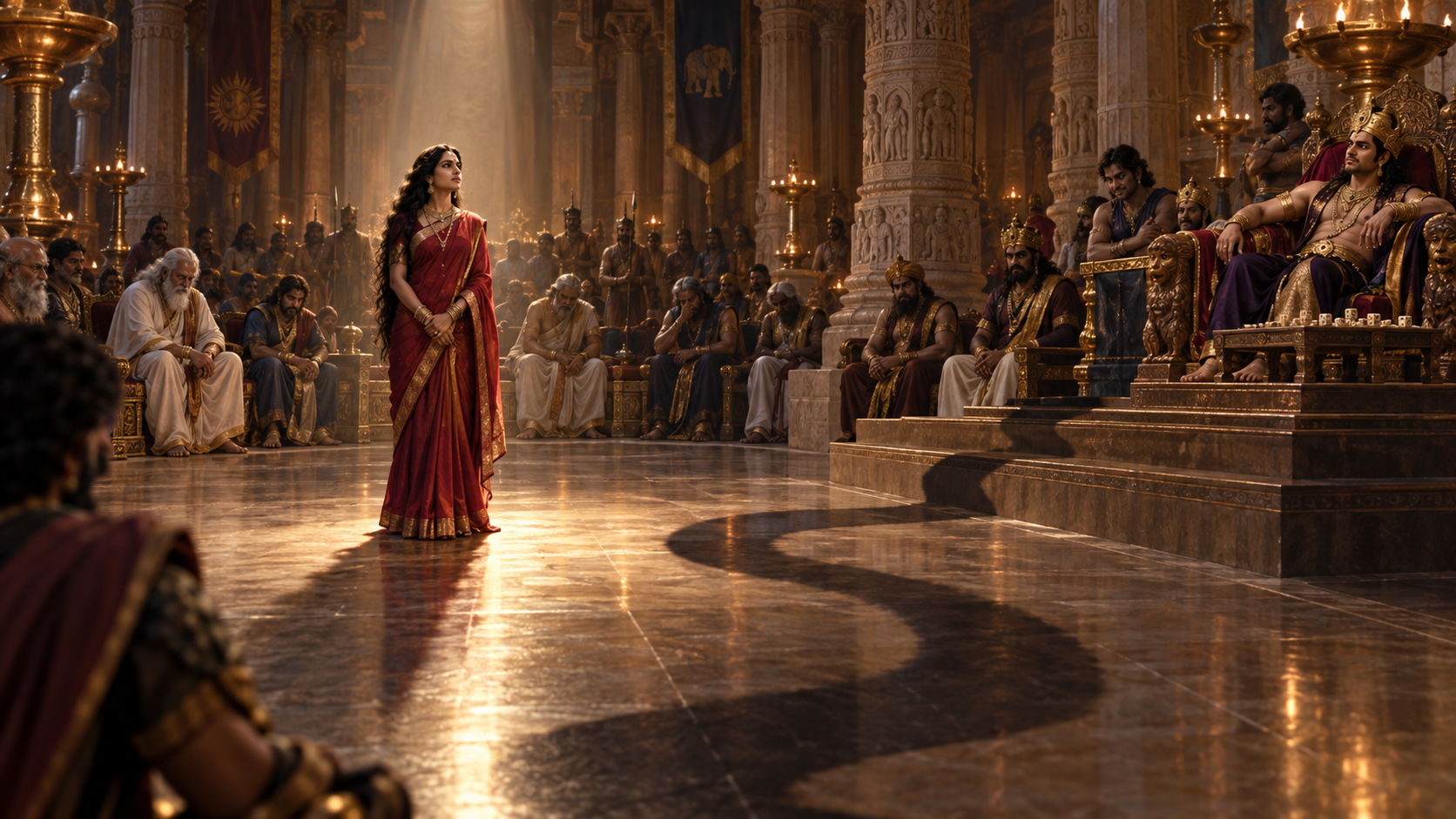
    The Mahabharata’s Shakuni–Duryodhana alliance is a precise study of toxic counsel, ego-driven decision-making, and the predictable collapse that follows when dharma yields to manipulation. By tracing key episodes—from the rigged dice game in Sabha Parva to the failed peace in Udyoga Parva and ethical breaches during the Kurukshetra War—the analysis shows how short-term spectacle corrodes…

  • Maharshi Shukadeva (Shuka Muni): The Fearless Sage Who Voiced the Bhagavata Purana

    Maharshi Shukadeva (Shuka Muni): The Fearless Sage Who Voiced the Bhagavata Purana

    Sage Śuka—known as Maharshi Shukadeva, Shuka Muni, and Shuka Brahma—is celebrated as the realized narrator of the Bhagavata Purana and the son of Veda Vyasa. Classical sources, including the Mahabharata and Puranas, portray him as the archetypal paramahamsa who unites jñāna, bhakti, and vairāgya. His seven-day discourse (saptāha) to King Parikshit distills creation, avatāra theology,…

  • Kumbhakarna vs Karna: Loyalty’s Tragic Valor and Vibhishana’s Dharma in the Ramayana

    Kumbhakarna vs Karna: Loyalty’s Tragic Valor and Vibhishana’s Dharma in the Ramayana

    The crisis in Lanka dramatizes a timeless ethical conflict: should loyalty to kin outrank allegiance to universal righteousness? Through Vibhishana’s principled dissent and Kumbhakarna’s tragic loyalty, the Ramayana clarifies how Dharma-Yuddha prioritizes justice over faction. A comparative glance at the Mahabharata’s Karna sharpens this lesson, showing that valor cannot redeem complicity in adharma. Read alongside…

  • Kirata Sastha of Ayyappa: The Divine Hunter-Guardian of Dharma in Kerala’s Living Traditions

    Kirata Sastha of Ayyappa: The Divine Hunter-Guardian of Dharma in Kerala’s Living Traditions

    Kirata Sastha—revered in northern Kerala as Vettakkoru Makan—offers a dynamic, guardian dimension to the Ayyappa (Dharma Sastha) tradition. This analysis traces the kirata (hunter) motif from the Mahabharata to Kerala’s living practices, showing how regional ritual, iconography, and ecology inform a distinctive protector-deity. It explains why Kirata Sastha complements Sabarimala’s Yoga Sastha, uniting inner discipline…

  • Karna’s Elephant-Chain Banner: Fate, Dharma, and the Unyielding Spirit of Kurukshetra

    Karna’s Elephant-Chain Banner: Fate, Dharma, and the Unyielding Spirit of Kurukshetra

    The Mahabharata’s standards were a battlefield lexicon, distilling each warrior’s identity and philosophy into potent symbols. Within this system, tradition associates Karna with an elephant-chain emblem, a motif that fuses material realism—control of war elephants—with moral allegory—power managed by duty. While not uniformly attested across all recensions, the emblem appears in parts of the textual…

  • Eighteen Parvas of the Mahabharata: Sacred Architecture, Dharma, and Timeless Symbolism

    Eighteen Parvas of the Mahabharata: Sacred Architecture, Dharma, and Timeless Symbolism

    The Mahabharata’s division into eighteen Parvas is a sacred architecture that encodes as much meaning as the verses themselves. Eighteen recurs across the tradition—Parvas, war days, akshauhinis, and the Gita’s chapters—signaling a deliberate design that integrates nature and human faculties under dharma. Organized in arcs from origins and diplomacy (Udyoga Parva) to war (Bhishma to…

  • Unveiling the Serpent Divine: Rigorous Comparison of Hindu Nagas and Ancient Greece’s Glycon

    Unveiling the Serpent Divine: Rigorous Comparison of Hindu Nagas and Ancient Greece’s Glycon

    Serpent deities crystallize a universal human intuition about healing, protection, and moral order. This rigorous, evidence-based comparison places Hindu Nagas—plural, ecologically integrated, and cosmologically central—alongside the Greco-Roman Glycon, a historically bounded healing and oracular cult. Drawing on the Mahabharata, Puranas, and living festivals such as Naga Panchami and Nagula Chavithi, it shows how Nagas unify…

  • Mannarasala’s Sacred Serpent Grove: Origins in Mahabharata’s Khandava Fire and Kerala’s Ecology

    Mannarasala’s Sacred Serpent Grove: Origins in Mahabharata’s Khandava Fire and Kerala’s Ecology

    Mannarasala Sree Nagaraja Temple in Kerala is a living sacred grove that unites epic memory with ecological care. Local tradition links its origin to the Mahabharata’s Khandava forest burning, reframing epic destruction through rituals of reconciliation and fertility. The article unpacks the toponymy of “Mannarasala,” the temple’s unique priestess lineage, and its signature rites such…