
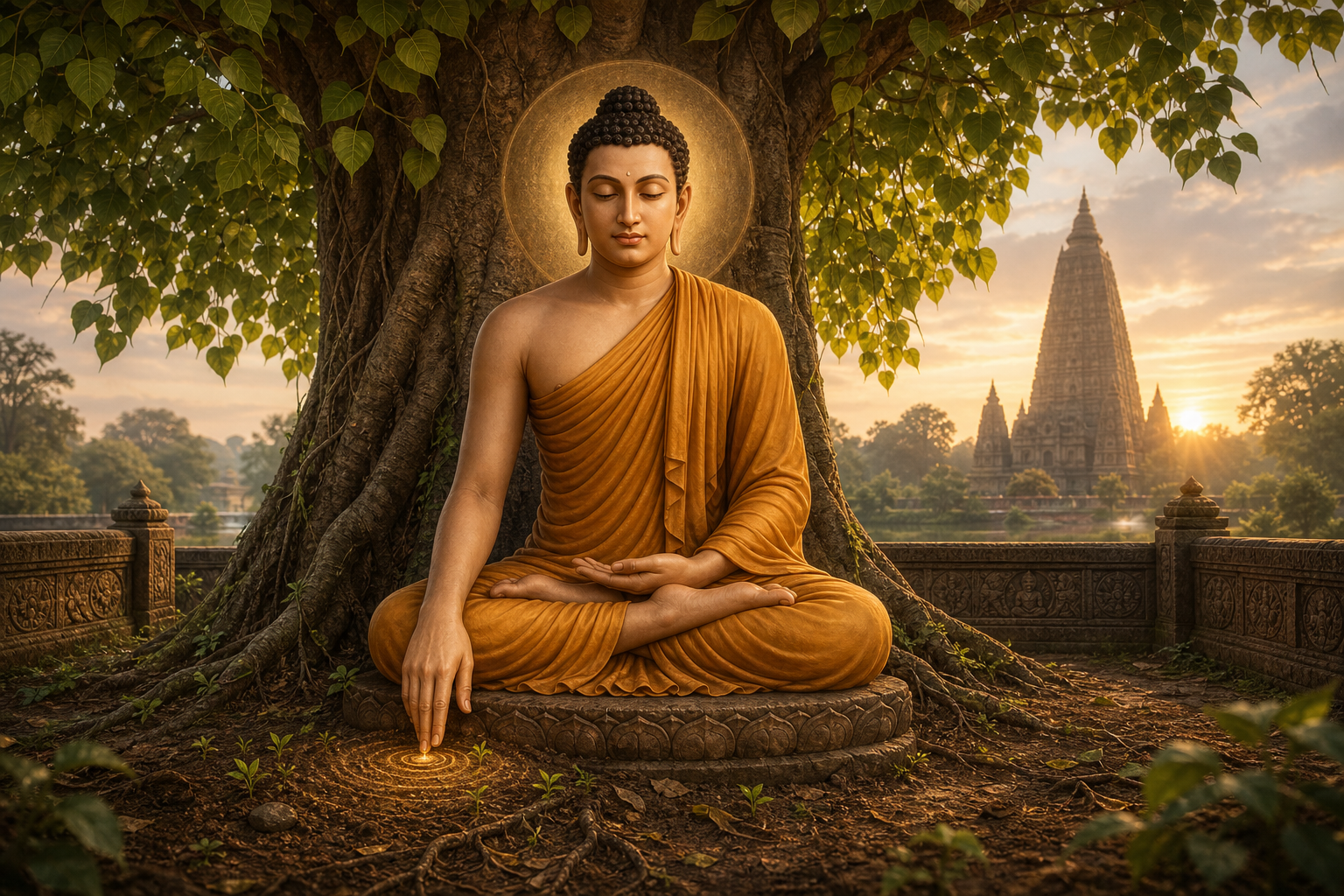
Bhumi Sparsha Mudra: the sacred gesture of witnessing the Earth
Within Hindu and other Indian sacred traditions, the body is understood as more than a physical organism. It can become an instrument of worship, contemplation, communication, and disciplined self-transformation. A carefully positioned hand may express protection, generosity, teaching, meditation, or surrender. Such gestures are known broadly as mudras, although the meaning and function of that term vary considerably among ritual manuals, schools of yoga, systems of dance, and traditions of sacred art.
Bhumi Sparsha Mudra is among the most visually compelling gestures to emerge from this wider Indic world. Its descending hand appears simple, yet it conveys an entire sacred narrative: temptation has been confronted, moral preparation has been tested, and the Earth has been called to witness the truth of a life. The image can feel immediately grounding because spiritual realization is not represented as an escape into abstraction. Awakening is confirmed through contact with the ground that supports every embodied being.
Academic accuracy requires an important clarification. The fully developed Bhumi Sparsha Mudra is identified most specifically with Buddhist iconography, especially representations of Siddhartha Gautama at the moment of awakening. It is not ordinarily a defining hand gesture of a Hindu deity. Its symbolism nevertheless developed within the shared cultural, linguistic, artistic, and religious environment of South Asia, where Hindu, Buddhist, and Jain communities exchanged visual forms while giving them distinct theological meanings. It can therefore be studied in relation to Hindu ideas of mudra, Bhumi Devi, sacred embodiment, and the ethical authority of the Earth without incorrectly relabelling a Buddhist image as Hindu.
What Bhumi Sparsha Mudra means
The Sanskrit expression Bhūmisparśa Mudrā combines three ideas. Bhūmi means Earth or ground, sparśa means touch or contact, and mudrā can mean a seal, sign, mark, or formal gesture. Bhumi Sparsha Mudra may consequently be translated as the “Earth-touching gesture” or “gesture of touching the Earth.” The Smithsonian’s National Museum of Asian Art likewise defines it as a downward-pointing gesture associated with the Buddha’s awakening beneath the bodhi tree in its Bhumi Sparsha Mudra glossary entry.
In its standard sculptural form, the Buddha is seated in a stable meditative posture. The left hand rests in the lap with the palm facing upward, usually in a form of Dhyana Mudra. The right arm extends over the right knee, and the fingers point downward toward the ground. The hand may touch the pedestal or hover immediately above it, depending on the material, region, period, and condition of the image. When a sculpture is viewed from the front, the Buddha’s right hand normally appears on the viewer’s left.
The two hands create a meaningful visual balance. The left hand remains collected within meditation, while the right hand reaches outward to the world. Stillness and action, interior realization and public testimony, are thus held together within a single composition. This interpretation should not be imposed as a universal doctrine for every Buddhist school, but it helps explain why the pose communicates both profound calm and decisive moral authority.
The sacred narrative behind the Earth-touching gesture
The gesture refers to the events preceding Siddhartha Gautama’s enlightenment at Bodh Gaya. As Siddhartha meditated beneath the bodhi tree, Māra attempted to disturb his concentration and challenge his fitness to occupy the seat of awakening. Buddhist narratives present Māra through different combinations of fear, desire, pride, doubt, hostile forces, and competing claims to spiritual authority. These elements are not merely external enemies; they also dramatize the psychological and ethical obstacles that prevent clear perception.
When Māra demanded a witness to Siddhartha’s worthiness, Siddhartha did not answer through argument or self-praise. He extended his right hand and touched the Earth. The Earth was invoked as witness to the accumulated generosity, discipline, and meritorious conduct cultivated across his long path toward awakening. A twelfth-century devotional plaque in the Metropolitan Museum of Art presents this moment as the central event in a condensed visual account of the Buddha’s life.
Popular retellings frequently personify the witness as an Earth goddess who rises, responds, or causes the ground to tremble. Textual and artistic versions are not completely uniform. Some traditions emphasize the physical touch and an earthquake, while others give the Earth deity a visible role. This variation is significant because sacred iconography is rarely produced by one text alone. Narratives, ritual practices, pilgrimage traditions, regional aesthetics, and the decisions of artists all contribute to the form eventually encountered in stone, bronze, terracotta, wood, or paint.
The resulting image does not depict a magical shortcut to enlightenment. The touch is the culmination of prior ethical and contemplative work. The Earth can serve as witness because the claim being made is supported by conduct rather than rhetoric. This is one of the gesture’s most enduring insights: a spiritual declaration acquires authority when it is grounded in a life that can bear examination.
Why the Earth becomes a witness
The Earth in this narrative is not a passive object. It is the stable field upon which actions occur and leave consequences. Human beings can exaggerate, forget, or manipulate their own stories, but the Earth symbolically receives every footprint, offering, struggle, and act of care. Calling the Earth to witness therefore replaces personal assertion with a more expansive form of testimony.
The symbolism also reverses a familiar assumption about transcendence. Spiritual achievement is sometimes imagined as a movement away from matter and ordinary life. Bhumi Sparsha Mudra instead directs the hand downward. The awakened figure remains seated upon the Earth and acknowledges the conditions that made practice possible. The gesture suggests that genuine insight need not reject embodiment; it can transform the way embodiment, responsibility, and interdependence are understood.
For many viewers, this downward movement carries an emotional force that elaborate theological language cannot easily reproduce. A person facing fear, distraction, or self-doubt may recognize the need to return to something verifiable: the breath, the body, the consequences of past choices, and the next ethical action. Such a response is a modern contemplative interpretation, but it remains faithful to the image’s central movement from destabilizing claims toward grounded witness.
Bhumi, Prithvi, and the sacred Earth in Hindu traditions
Bhumi Sparsha Mudra is primarily Buddhist, but reverence for the Earth is deeply rooted in Hindu traditions. The Earth may be addressed as Bhumi, Bhu, or Prithvi, with meanings that range from the physical ground to a divine mother and sustaining cosmic principle. The official Vedic Heritage Portal identifies the celebrated Bhumi Sukta as Atharvaveda 12.1. This extensive hymn praises the Earth as the bearer of peoples, plants, waters, settlements, languages, and forms of life.
The maternal image of the Earth is especially important. Humanity is not presented as standing outside the natural world or possessing it without obligation. Life is received from a supporting reality that precedes individual ownership. Gratitude, restraint, and responsibility follow naturally from this relationship. The traditional reverence is religious and cosmological rather than a modern environmental policy, but it can still inform contemporary reflection on ecological stewardship.
In Vaishnava iconography, Bhudevi is the personified Earth and is frequently associated with Vishnu. She may appear beside Vishnu with Sri or Lakshmi, or within the narrative of Varaha, the boar-headed avatara who raises the Earth from the cosmic waters. The British Museum’s guide to Ancient India: Living Traditions describes Varaha carrying the goddess Bhu after rescuing her from the cosmic ocean, while the National Museum of Asian Art notes Bhudevi’s place in Vaishnava imagery in its exhibition on the Wisdom of the Goddess.
These Hindu images and the Buddhist Earth-witness narrative should be compared carefully rather than merged. Bhudevi beside Vishnu has a Vaishnava theological identity, while the Earth invoked by Siddhartha belongs to the narrative of Buddhahood. The connection lies in a shared recognition that the Earth is sacred, sustaining, and capable of being represented as more than inert matter. The distinctions reveal the richness of Dharmic traditions rather than diminishing their unity.
How mudras function in Hinduism
The word mudra does not name one uniform system. In Hindu temple iconography, a gesture can identify a deity’s disposition or the relationship being offered to a devotee. Abhaya Mudra communicates freedom from fear or protection. Varada Mudra signifies generosity, blessing, or the granting of a boon. Anjali Mudra expresses reverence through joined palms. Other gestures accompany teaching, meditation, ritual offerings, mantra, visualization, or the handling of a deity’s attributes.
In ritual traditions, mudras may be performed in conjunction with mantra and carefully ordered acts of worship. In yoga and tantra, the term can extend beyond hand positions to bodily seals intended, within those systems, to direct attention or regulate subtle processes. In Indian dance, codified hand gestures become a language of narration, emotion, relationship, and action. The Indira Gandhi National Centre for the Arts emphasizes this multidimensional range by presenting mudra across iconography, performance, ritual, and communication.
Context is therefore essential. A hand shape used in dance cannot automatically be assigned the ritual effect described in a tantric manual. A gesture on a Buddha image cannot automatically be treated as the defining mudra of a Hindu deity. Similar forms can circulate across traditions while acquiring different meanings. Iconographic interpretation depends on posture, attributes, companions, inscriptions, location, artistic style, and the larger narrative program.
This contextual method protects both accuracy and reverence. It prevents the broad category of Hindu mudras from becoming an undifferentiated list, and it allows Bhumi Sparsha Mudra to be appreciated as part of a shared Indic visual vocabulary without obscuring its specifically Buddhist function.
Bhumi Sparsha Mudra across sacred sculpture
The Earth-touching Buddha became one of the most recognizable images in Asian sacred art. Indian examples from Bihar and Bengal were especially influential, including works associated with Bodh Gaya, Nalanda, and the Pala-period artistic world. A late tenth- or eleventh-century Nalanda sculpture discussed by the Metropolitan Museum presents the Buddha in yogic meditation with the right hand reaching toward the Earth. The museum explains that the gesture bears witness to the past actions culminating in realization in its account of Buddhist pilgrimage sites in North India.
As Buddhist teachings and artistic models travelled, the gesture appeared in Himalayan regions and throughout Southeast and East Asia. Artists translated it into different bodily proportions, garments, thrones, halos, crowns, surface treatments, and materials. The essential downward movement remained legible even when local conventions transformed almost every other aspect of the image. This stability demonstrates the efficiency of mudra as a visual code: a hand can preserve a narrative across substantial linguistic and geographic distance.
Materials alter the experience of the gesture. In stone, the hand may appear inseparable from the massive stability of the seated body and pedestal. In bronze, the extended fingers can create a more delicate transition between figure and base. Gilded wood or lacquer may emphasize the radiance of awakening, while terracotta plaques make the sacred scene repeatable and portable. Each medium shapes devotion without replacing the underlying iconographic identity.
Damage must also be considered. Fingers are vulnerable projections and may be broken, worn, or repaired. A missing hand does not make identification impossible, but it requires supporting evidence. The remaining forearm angle, seated posture, position of the left hand, bodhi-tree imagery, throne, attendant figures, inscription, provenance, and comparison with related objects can collectively support an attribution.
A practical method for reading the iconography
First, establish the figure’s orientation. Sacred images describe the represented figure’s right and left, not the viewer’s. In a frontal image, the hand seen on the left side of the photograph may therefore be the Buddha’s right hand.
Second, examine the complete posture. Bhumi Sparsha Mudra normally belongs to a seated meditative composition. A lowered hand on a standing figure is more likely to represent another gesture, a damaged attribute, or an ordinary bodily position.
Third, inspect the palm and fingers. In the standard Earth-touching gesture, the right hand passes over the knee and the fingers extend toward the ground. In Varada Mudra, by contrast, the palm is generally displayed more openly toward the devotee, communicating giving or blessing.
Fourth, read the other hand. The left hand resting palm-up in the lap strengthens an identification with the Buddha’s meditation and awakening. It may occasionally support a bowl or be modified by a regional convention.
Fifth, identify the surrounding narrative. A bodhi tree, Māra’s forces, an Earth goddess, a vajra seat, or scenes from the Buddha’s life can confirm the episode. No single accessory is required in every example, but a coherent cluster of signs is stronger than an isolated resemblance.
Sixth, consult the object’s history. Date, region, material, inscription, archaeological context, and conservation record can distinguish an early image from a later reproduction. Museum labels are useful starting points, but serious attribution also compares catalogues, inscriptions, excavation records, and closely related works.
Distinguishing Bhumi Sparsha from related mudras
Bhumi Sparsha Mudra sends the right hand downward over the knee and recalls the Earth witnessing awakening. Its narrative specificity is one of its defining features.
Dhyana Mudra places the hands in the lap and signifies meditation or concentrated composure. The left hand in an Earth-touching Buddha often retains this meditative position while the right hand performs Bhumi Sparsha.
Abhaya Mudra raises an open palm outward, conveying reassurance, protection, or freedom from fear. Its upward-facing visual address differs sharply from the downward reach of Bhumi Sparsha.
Varada Mudra presents a lowered hand with the palm open toward the recipient. It signifies giving, grace, charity, or the granting of a boon. Because both Varada and Bhumi Sparsha can involve a lowered hand, the direction of the palm, relation to the knee, and narrative context must be examined.
Anjali Mudra joins the palms before the body in reverence or greeting. It is widely recognizable across Hindu, Buddhist, and Jain settings and in South Asian social life, demonstrating how one physical form can participate in several related but non-identical contexts.
Subtle energy, grounding, and responsible interpretation
Traditional Hindu yogic and tantric systems sometimes describe mudras as seals that coordinate bodily discipline, breath, attention, mantra, and subtle energy. Such explanations belong to particular lineages and technical frameworks. They should be represented as traditional models rather than automatically translated into modern anatomy or neuroscience.
Bhumi Sparsha Mudra is frequently described online as a universal grounding technique, but its primary historical function is iconographic and narrative. It identifies the Buddha’s victory over Māra and invocation of the Earth as witness. A modern practitioner may find the gesture calming or use it as a reminder of stability, yet those experiences do not establish a standardized physiological effect.
The symbolic grounding of Bhumi Sparsha should also be distinguished from commercial claims about electrical “earthing.” Touching soil, attending to bodily sensation, and slowing the breath may be meaningful contemplative acts, but medical or electrical claims require separate empirical evidence. Respect for tradition is strengthened, not weakened, when historical meaning, personal experience, and scientific evidence are kept conceptually distinct.
A respectful contemporary contemplation
A simple contemplative exercise can draw inspiration from the Earth-witness symbolism without claiming to reproduce an ancient initiation or canonical ritual. The practice is best understood as a modern reflection on accountability, steadiness, and ethical memory.
1. Establish a stable seat. The practitioner may sit on a chair, cushion, or firm surface with the spine comfortable rather than rigid. Accessibility takes priority over reproducing a sculptural posture.
2. Allow the left hand to rest. It may remain palm-up in the lap as a sign of receptivity. The shoulders and jaw are allowed to soften while the breath continues naturally.
3. Lower the right hand. The fingertips may touch the floor, a stone, a patch of soil, or simply the side of the chair. A person unable to reach downward may place the hand on the knee and visualize contact with the supporting ground.
4. Recall evidence rather than self-description. Attention turns toward one concrete act of patience, generosity, truthfulness, or repair. The purpose is not self-congratulation but recognition that character is formed through repeated conduct.
5. Acknowledge an unresolved responsibility. The Earth-witness theme becomes ethically meaningful when it includes what remains unfinished. The practitioner identifies one apology, duty, boundary, or act of care that requires attention.
6. Form a limited intention. A practical next step is chosen rather than a grand promise. The hand then returns to the lap, marking a transition from reflection to deliberate action.
This exercise should not be presented as a substitute for medical or mental-health care. Its value lies in contemplative structure: sensory contact interrupts abstraction, memory tests identity against conduct, and intention links insight with responsibility.
Dharmic unity without erasing difference
Bhumi Sparsha Mudra offers a productive example of how Dharmic traditions can be studied together. Hinduism contributes extensive reflections on Bhumi, Prithvi, sacred embodiment, ritual gesture, and the Earth as divine support. Buddhism gives the Earth-touching gesture its best-known narrative form in the awakening of the Buddha. Jain traditions share a rigorous emphasis on disciplined conduct, karma, non-attachment, and contemplative stillness, although Bhumi Sparsha is not a defining Jain mudra. Sikh tradition does not depend on an elaborate sculptural mudra system, yet its emphasis on truthful living, humility, remembrance, and responsible action can enter a meaningful ethical conversation with the gesture.
Unity does not require declaring that every symbol has the same origin or meaning. A more durable unity emerges through accurate comparison, mutual respect, and recognition of historical interaction. Distinct teachings can illuminate one another while remaining distinct. Bhumi Sparsha Mudra belongs most securely to Buddhist iconography, but its reverence for grounded truth can be appreciated across the wider Dharmic family.
Ecological and ethical relevance today
The Earth-witness motif carries renewed relevance in a period marked by ecological strain and highly disembodied communication. It asks whether beliefs are supported by conduct and whether spiritual aspiration includes responsibility toward the conditions that sustain life. The gesture alone does not prescribe an environmental program, but it can challenge the separation of devotion from material consequences.
Reverence for Bhumi can become practical through restraint, protection of water and soil, thoughtful consumption, care for shared spaces, and concern for vulnerable forms of life. These actions should not be romanticized as automatic products of ancient religion; every tradition contains ideals that communities may or may not fulfil. The mudra’s demand is precisely that ideals be tested against observable practice.
The same principle applies to personal life. When identity becomes dependent on display, the downward hand restores proportion. It asks what has actually been cultivated, repaired, or offered. The Earth does not respond to prestige, and this indifference gives the gesture its humility as well as its power.
Common misconceptions
Misconception: Bhumi Sparsha is simply a Hindu mudra. The gesture emerged from the broader Indic cultural world, but its standard iconographic identity is Buddhist. Hindu connections should be explained through shared concepts and artistic exchange rather than asserted through exclusive ownership.
Misconception: every lowered hand is Bhumi Sparsha. Varada Mudra and ordinary resting positions can also lower the hand. Palm direction, finger position, posture, attributes, and narrative context must be considered together.
Misconception: the gesture caused enlightenment. In the sacred narrative, the touch bears witness to an already matured path of discipline and merit. It is a decisive sign, not a mechanical cause detached from ethical preparation.
Misconception: the Earth goddess appears in every version. Texts and images vary. Some emphasize the touch or earthquake, while others personify the Earth as a responding deity. Variation is part of the tradition’s history.
Misconception: mudras have one universal energetic effect. Mudra systems differ by religion, lineage, text, and practice. Traditional subtle-body explanations, modern contemplative experiences, and scientific claims should not be treated as interchangeable evidence.
The enduring power of the downward hand
Bhumi Sparsha Mudra endures because it condenses doctrine, narrative, psychology, and artistic design into one intelligible movement. The meditating figure does not answer disruption with aggression. He remains composed, reaches beyond personal assertion, and invokes the Earth as witness to the work already completed. The gesture makes awakening visible while preserving the silence appropriate to it.
Studied in relation to Hinduism, the mudra opens an illuminating field of comparison involving Bhumi Devi, the Bhumi Sukta, Hindu sculpture, sacred gesture, yoga, and the shared visual culture of India. Studied on its own terms, it remains a distinctly Buddhist sign of Siddhartha’s awakening. Holding both truths together produces a more accurate and generous understanding—one that honours difference, strengthens Dharmic unity, and returns spiritual aspiration to the firm ground of accountable action.
Selected research resources: National Museum of Asian Art: Bhumisparsha Mudra; Metropolitan Museum of Art: Plaque with Scenes from the Life of the Buddha; Indira Gandhi National Centre for the Arts: Mudra; Vedic Heritage Portal: Atharvaveda and Bhumi Sukta; and British Museum: Ancient India—Living Traditions.
Inspired by this post on Hindu Blog.








Leave a Reply
You must be logged in to post a comment.