
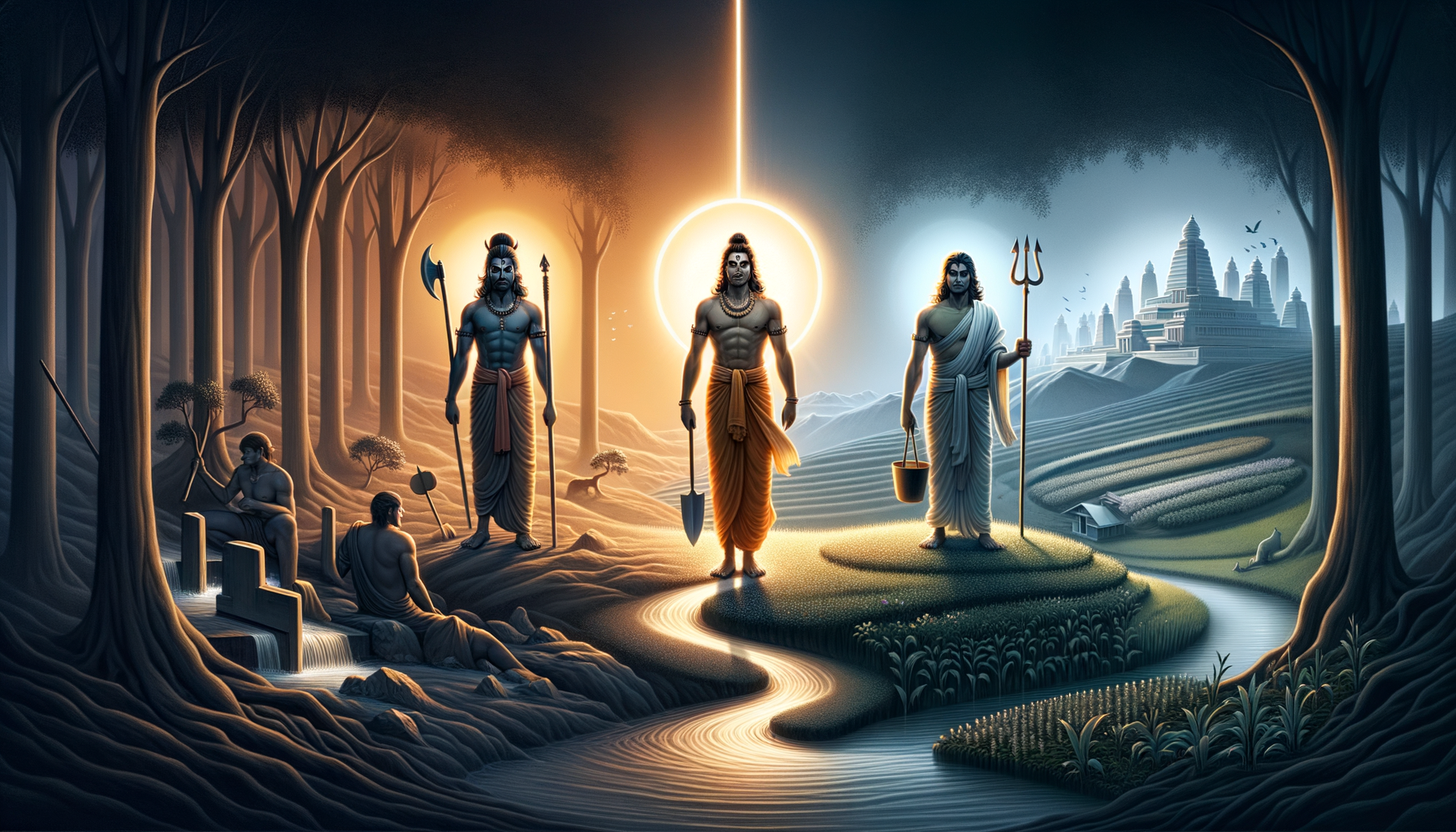
The Hindu scriptures outline a compelling arc of the evolution of consciousness through three interconnected avatars of Vishnu: Parashurama, Balarama, and Sri Rama. Read together across the Ramayana, the Mahabharata, and the Bhagavata Purana, these manifestations trace a movement from raw force to cultivated strength and, ultimately, to principled righteousnessan inner and civilizational journey from instinct to maryada (ethical order).
Parashurama represents the catalytic intensity of raudraan uncompromising energy that confronts entrenched adharma. In Puranic narratives, his axe symbolizes a necessary clearing of moral decay, the drastic correction that precedes renewal. Interpreted psychologically, Parashurama encodes a developmental moment in which anger and power are acknowledged, faced, and then disciplined. In the language of kshatra dharma, it is the courage to cut through falsehood when inertia protects it.
BalaramaHalayudha, wielder of the ploughshifts the locus of power from destruction to cultivation. Strength is yoked to agriculture, community, and fairness. His neutrality during the Kurukshetra conflict and his preference for pilgrimage over partisanship embody restraint, balance, and the ethics of sustenance. In human terms, this is the maturation of force into stability: the task of building institutions, honoring limits, and cultivating everyday dharma.
Sri Rama, Maryada Purushottam, completes the trajectory by rooting strength in rule-bound compassion and just governance. The Ramayana portrays an ideal where shaurya (valor) is inseparable from truthfulness, fidelity to vows, and humane leadership. Here, anger has been transmuted into clarity; authority is exercised as responsibility; and public order arises from inner discipline. This stage articulates a vision in which personal ethics and social harmony reinforce one anotherRama Rajya as a civilizational ideal.
Taken together, these avatars offer a coherent pedagogy of dharma: Parashurama awakens decisive moral energy, Balarama cultivates it into steady social strength, and Sri Rama sanctifies it through maryada and justice. The sequence is less a chronology than a contemplative map. It invites readers to recognize in themselves the same progressionfrom impulse, to discipline, to principled actionmirroring how societies evolve from survival to sustainability and then to ethical statecraft.
This triadic vision resonates across dharmic traditions. The moderation and rule-governed conduct of Sri Rama align with Buddhist kshanti (forbearance) and the Jain emphasis on ahiṁsā and samyak-charitra. The courage and restraint spanning Parashurama to Balarama find kinship with the Sikh sant-sipahi ideal, where moral clarity guides necessary strength. Read through this broader lens, the avatars encourage unity in diversity: distinct paths affirming a shared aspiration toward inner mastery and social harmony.
In practical life, the Parashurama phase appears whenever injustice must be named and confronted; the Balarama phase is present in daily disciplineswork, family, and community-building; and the Sri Rama phase emerges as steadiness under pressure, fidelity to commitments, and fairness in leadership. These are not abstract ideals but usable categories of experience that help organize action and introspection.
Viewed as an evolutionary grammar, the sequence cautions against two errors: wielding force without cultivation, and seeking moral order without the courage that underwrites it. The scriptures thus advocate integration: energy tempered by discipline, and discipline crowned by righteousness. Such integration is the essence of kshatra dharma when aligned to lokasangrahastrength in service of collective well-being.
The enduring relevance of Parashurama, Balarama, and Sri Rama lies in their composite teaching: boldness with boundaries, power with purpose, and authority with accountability. In times of social strain, this triad offers a rigorous, compassionate framework for renewalbeginning within and radiating out into institutions, culture, and public life.
Inspired by this post on Hindu Blog.










