-
From Axe to Bow: Parashurama and Rama’s Weapons across India’s Civilizational Evolution

Parashurama’s axe and Rama’s bow are more than weapons; they are precise metaphors for India’s civilizational evolution from corrective severity to codified restraint. Read together, they chart the passage from foundational pruning to lawful kingship, illuminating Kshatra Dharma and maryada in the Ramayana. The parashu symbolizes necessary removal of entrenched harm, while the Kodanda embodies…
-
The Parashu in Hindu Iconography: A Definitive Guide to Form, Theology, and Dharmic Unity

The parashu (paraśu), or sacred battle axe, condenses Hindu theology of force, restraint, and renewal into a single powerful ayudha. This long-form guide explains how to recognize the parashu in Hindu Sculptures, details its associations with Shiva, Ganesha, Durga, and Parashurama, and situates it within the ethics of Kshatra and dharma-yuddha. It connects scriptural narratives…
-
Bhagavan Parashurama: Warrior‑Sage Avatar of Vishnu Who Restored Dharma and Balance

Bhagavan Parashurama, the sixth avatar of Vishnu and a devoted worshipper of Shiva, embodies the Hari–Hara unity at the heart of Sanatana Dharma. Drawing on the Bhagavata Purana, Vishnu Purana, the Mahabharata, and the Ramayana, this comprehensive essay explains how Parashurama restored ethical order when royal power became predatory, then withdrew in penance to model…
-
Parashurama: The Saint-Warrior Avatar Who Reset Kshatra Dharma and Reclaimed the Land

Parashurama, the sixth avatar of Lord Vishnu and a devoted bhakta of Lord Shiva, embodies the union of spiritual austerity and disciplined strength to restore dharma. Scriptural accounts from the Bhagavata Purana, Vishnu Purana, Ramayana, and Mahabharata portray his mission as a principled reform of Kshatriya power when it strays into adharma. The narrative explores…
-
Parashurama Dwadashi 2026: Auspicious Date, Puja Vidhi, Fasting Rules, and Profound Significance

Parashurama Dwadashi 2026 falls on April 28, the Dwadashi tithi following Mohini Ekadashi in Vaishakh Shukla Paksha. This guide explains the date’s calendrical basis, clarifies how it differs from Parashurama Jayanti, and provides a careful, step-by-step Puja Vidhi suitable for home observance. Readers will find clear fasting and parana guidance aligned with traditional practice, along…
-
Parashurama Dwadashi 2026: Date, Puja Vidhi, Fasting Rules, and Deep Significance

Parashurama Dwadashi 2026 falls on 28 April (Vaishakh Shukla Paksha Dwadashi), the day after Mohini Ekadashi. This comprehensive guide explains the festival’s calendar context, theological meaning, and how to observe the vrata with clarity and confidence. Readers will find practical puja vidhi, fasting options in harmony with Mohini Ekadashi parana, and suggestions for mantra, stotra,…
-
Akshaya Tritiya 2026 (Akha Teej): Treta Yugadi, Timeless Auspiciousness, and Sacred Beginnings

Akshaya Tritiya (Akha Teej) in 2026 falls on April 19 and is revered as Treta Yugadi, the annual commemoration of Treta Yuga’s inception on Vaishakha Shukla Tritiya. The day’s auspiciousness, often linked to the Sun in Aries and the waxing Moon in Taurus, makes it one of the celebrated Sade-Teen Muhurat. Traditions emphasize Vishnu-Lakshmi worship,…
-
Wrath to Wisdom: Parashurama and Rama’s Timeless Ethics for Power, Justice, and Dharma

This long-form analysis interprets Parashurama and Rama as complementary modalities of Dharma: emergency correction and constitutional restraint. Drawing on the Ramayana, Puranas, and classical ideas of Dharma-Yuddha, it shows how the “axe” symbolizes decisive action against entrenched injustice while the “arrow” symbolizes calibrated governance under maryada. Readers gain a practical framework for leadership—when to act…
-
Mannarasala Nagaraja: Parashurama’s Penance and the Serpent King Who Made Kerala Bloom

Mannarasala Nagaraja Temple in Kerala is revered as the sacred grove where Parashurama’s penance and the serpent king’s grace transformed reclaimed coast into fertile land. Rooted in Treta Yuga tradition, the shrine venerates Sree Nagaraja and Sarpayakshi amid thousands of serpent stones. The Ayilyam festival in Kanni draws devotees seeking blessings for fertility, health, and…
-
Unveiling Cheruvugattu’s Sacred Legacy: Sthalapuranam of Jadala Ramalingeswara Temple

Sri Parvathi Jadala Ramalingeswara Swamy Devasthanam at Cheruvugattu stands as an ancient hill shrine whose sthalapuranam binds sacred geography with enduring ethical themes. Tradition attributes the installation of Lord Ramalingeswara Swamy to Lord Parusharama in Trethayugam, situating the site within an early sacred timeline. A pivotal episode recounts Karthikaya’s abduction of Kamadhenu and her calf…
-
Reclaiming Goa as Parshuram Bhoomi: A Sacred, Inclusive Vision Beyond Indulgence

At Shri Ram Temple in Vasco, Anand Jakhotia urged a shift in how Goa is understood—away from material indulgence and toward its civilizational identity as Parshuram Bhoomi. The address presented “Hindu Rashtra” as a dharmic, ethical-cultural horizon centered on unity and lawful pluralism, not exclusion. It connected Goa’s sacred geography, linked to Bhagwan Parshuram, with…
-
Parashurama and Rama Together? Demystifying Vishnu’s Avatars with Timeless Wisdom
The perceived paradox of Parashurama and Rama appearing at the same time dissolves when viewed through core Hindu principles. The avatar doctrine allows multiple divine manifestations to operate simultaneously, each restoring dharma in a distinct way. Parashurama’s status as a Chiranjivi explains his presence across yugas, while distinctions between shaktyāveśa (empowered) and pūrṇa (full) avatars…
-
Why Parashurama Stood Alone: The Profound Dharma Behind Vishnu’s Consortless Avatar

Parashurama’s consortless form is a purposeful feature of Vaishnava theology rather than an omission. Scriptural narratives emphasize his ascetic mission, where tapas, mobility, and disciplined detachment were essential to restoring kshatra-dharma. The diversity of Vishnu’s avatars reflects role-specific embodiments: Rama models household righteousness, Krishna social and relational dharma, and Parashurama corrective austerity. His status as…
-
Parashurama, Balarama, Sri Rama: Mapping Humanity’s Ascent from Force to Righteousness

Hindu scriptures present an integrated model of moral evolution through Parashurama, Balarama, and Sri Rama. Together, these avatars map a movement from raw force to cultivated strength and ultimately to principled righteousness. Parashurama encodes the courageous correction of entrenched adharma. Balarama anchors strength in restraint, agriculture, and social balance. Sri Rama perfects the arc through…
-
Parashurama Iconography Decoded: Powerful Symbols of Vishnu’s Warrior-Sage Avatar
This article decodes the iconography of Parashurama, Vishnu’s sixth avatar, to reveal how the warrior-sage form unites austerity (tapas) with protective strength (kshatra). Readers learn the meaning of the parashu (axe), bow and arrow, attire, and posture, and how these symbols teach disciplined action aligned with dharma-yuddha. The analysis situates regional motifs such as the…
-
Discover Kartavirya Arjuna: The Complete Guide to Sahasrabahu’s Boons, Valor, and Legacy

Karthaveerya Arjuna—also known as Sahasrabahu Arjuna—emerges in Ancient Hindu Texts as a Haihaya king whose thousand-armed prowess, granted by Dattatreya, symbolized both power and responsibility. His storied feats, including subduing the Narmada and capturing Ravana, illustrate the heights of kshatra while inviting reflection on ethical governance. Puranic narratives also chart a cautionary turn through his…
-
Discover Parashurama’s Proven Revolution: How Dharma Transformed Kingship and Society

Sri Parashurama’s narrative illustrates how Dharma disciplines power and protects society in Ancient India. Readers gain a clear, academic understanding of why sages traditionally guided rulers and how that counsel maintained justice and public welfare. The account highlights a Righteous War framed by restraint and responsibility, not conquest. Its ethical core aligns with shared values…
-
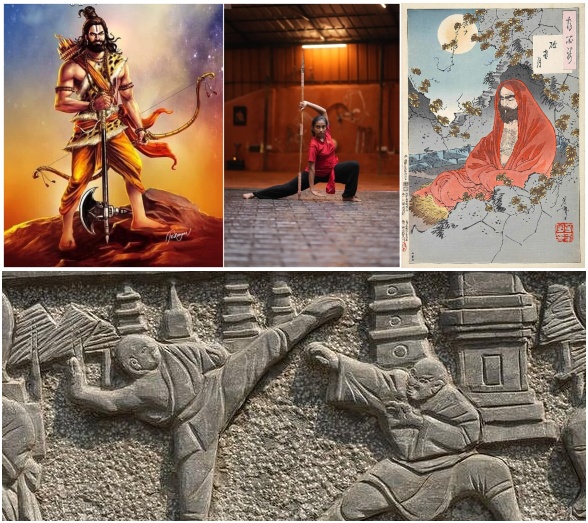
Lord Parashuram, Kalaripayattu, Bodhidharma and Kung-Fu

Kalaripayattu is an ancient martial art that originated in the southern Indian state of Kerala, and it is widely regarded as one of the oldest martial arts in the world. The art has been practiced and developed for over 3000 years, and its techniques have been used in warfare, self-defense, and physical fitness. Kalaripayattu is…
-
Parashuram Jayanthi – Tribute to the warrior god that fought for the common good

Parashuram Jayanthi is celebrated on the third day of the Hindu month of Vaishaka, which usually falls in late April or early May. This day is dedicated to Lord Parashuram, who is considered the sixth avatar of Lord Vishnu in Hinduism. Lord Parashuram is revered as a warrior god who fought for the common good…