
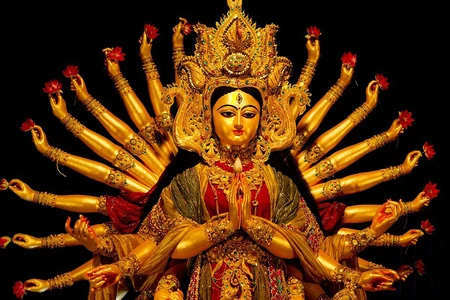
According to our ancient scriptures which are the Saptasudhi, the theory of the Navratri festival has been described. We are normally aware of two types of Navratri that are Chaitra Navratri and Shardiya Navratri. But, you will be amazed to hear that Navratri falls four times in a year.
The four types of Navratri and the time frame in which they fall in the year 2023 are mentioned below.
| Type of Navratri | Start Date | End Date |
| Shardiya Navratri | October 15, 2023 | October 24, 2023 |
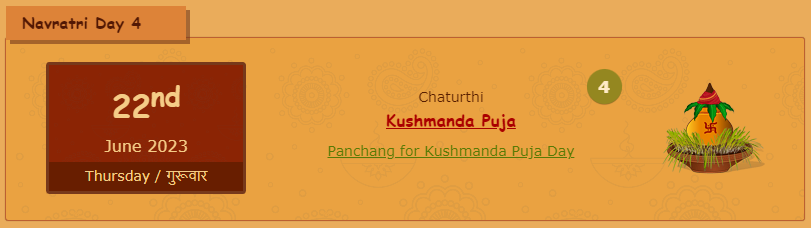
| Chaitra Navratri | March 22, 2023 | March 30, 2023 |
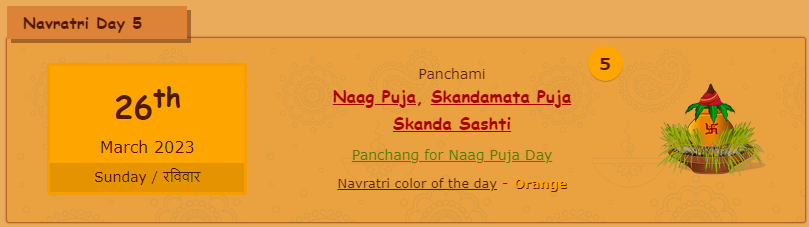
| Magha Gupt Navratri | January 22, 2023 | January 30, 2023 |
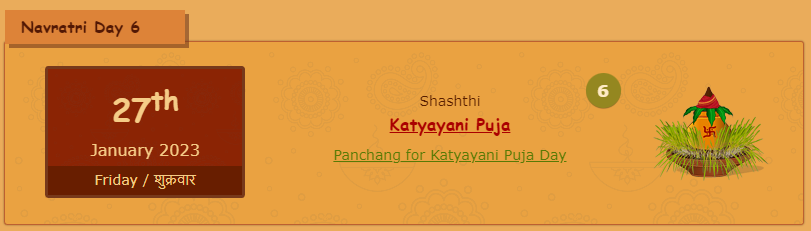
| Asadha Gupt Navratri | June 19, 2023 | June 28, 2023 |
Shardiya Navratri
Shardiya Navratri is the most popular and significant Navratri of all Navratris. That’s why Shardiya Navratri is also known as Maha Navratri.
It falls in lunar month Ashwin during Sharad Ritu around the onset of the fall/autumn season. The name Shardiya Navratri has been taken from Sharad Ritu. All nine days during Navratri are dedicated to nine forms of Goddess Shakti. Shardiya Navratri falls in the month of September or October. The nine days festivity culminates on tenth day with Dussehra or Vijaya Dashami.
Women adorn themselves with nine different colors which are allocated to each day of Navratri. Each day is ruled by one the planets or Navgrahas and accordingly colors are assigned to each day.
Each Avatar of Navdurga represents a distinct characteristic of Goddess Durga. Each day a specific Prasad is offered to Navdurga to get her blessings.


Chaitya Navratri
Chaitra Navratri is nine days festivity which starts on the first day of Hindu Luni-Solar calendar and falls in the month of March or April. Chaitra is the first month of Hindu lunar calendar and because of it this Navratri is known as Chaitra Navratri. Chaitra Navratri is also known as Vasanta Navratri and Rama Navami, as well because the birthday of Lord Rama usually falls on the ninth day during Navratri festivity.
All nine days during Navratri are dedicated to nine forms of Goddess Shakti. Most customs and rituals followed during Shardiya Navratri, which falls in the month of September or October, are also followed during Chaitra Navratri. Ghatasthapana Puja Vidhi for Shardiya Navratri and Chaitra Navratri is same.
Chaitra Navratri is more popular in northern India. In Maharashtra Chaitra Navratri begins with Gudi Padwa and in Andhra Pradesh it begins with Ugadi.




Magha Gupt Navratri
Magha Navratri, also known as Gupta Navratri, is nine days period dedicated to the nine forms of Shakti or mother Goddess. It falls in the month of Magh during January or February. Magh Navratri, which is less known in most places, is mainly observed in North Indian states like Punjab, Haryana, Himachal Pradesh, Uttar Pradesh and Uttarakhand.




Ashadha Gupta Navratri
Ashadha Navratri, also known as Gupt Navratri, is nine days period dedicated to the nine forms of Shakti or mother Goddess. It falls in the month of Ashadha during June or July. Gupta Navaratri is also known as Gayatri Navratri.


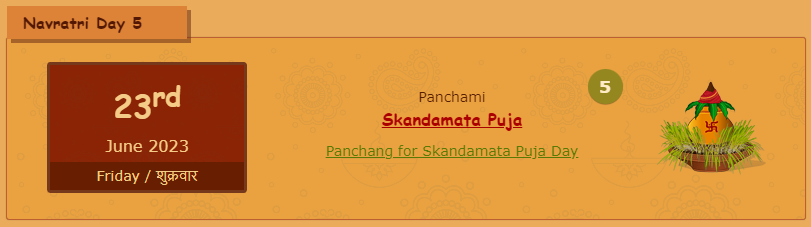


Source : https://www.drikpanchang.com/navratri/navratri-calendars.html
Dusserah
The 10th day of Shardiya Navratri is celebrated as Dusserah or Vijayadashmi. Vijayadashami is celebrated differently in various parts of Bharat. In the southern, eastern, northeastern, and some northern states of Bharat, Vijayadashami marks the end of Durga Puja, remembering goddess Durga’s victory against Mahishasura rakshasa to restore and protect dharma. In the northern, central and western states, the festival is also called Dussehra (also spelled Dasara, Dashahara). In these regions, it marks the end of Ramlila and commemorates god Ram’s victory over Ravana.
Alternatively, it also marks a reverence for one of the aspects of goddess Devi, such as Durga or Saraswati.
Vijayadashami celebrations include processions to a river or ocean front that involve carrying clay statues of Durga, Lakshmi, Saraswati, Ganesha and Kartikeya, accompanied by music and chants, after which the images are immersed in the water for dissolution and farewell. In other places, towering effigies of Ravana, symbolizing evil, are burnt with fireworks, marking evil’s destruction. The festival also starts the preparations for Diwali, the important festival of lights, which is celebrated twenty days after Vijayadashami.
Connection to Ramayana

The celebration of this festival is founded in Ramayana. It is the day Bhagwan Ram defeats Ravana. Ravana kidnaps Sita and takes her to his kingdom in Lanka (present day Sri Lanka). Ram asks Ravana to release her, but Ravana refuses; the situation escalates and leads to war. Prior to this, Ravana performed severe penance for ten thousand years and received a boon from the Brahma that he could not be killed by gods, demons, or spirits. However, Ram (a human and incarnate of Lord Vishnu) defeats and kills him, thus circumventing the boon given by Lord Brahma. A battle takes place between Ram and Ravana in which Ram kills Ravana and ends his evil rule. Finally, Dharma was established on the Earth because of Ram’s victory over Ravana. The festival commemorates the victory of Good over Evil.
Connection to Mahabharata
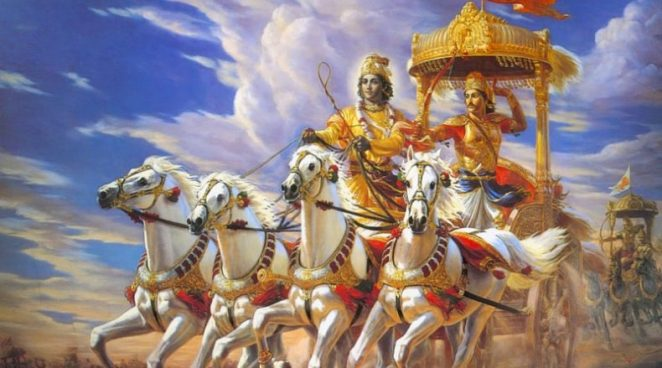
In the Mahabharata, Vijayadashami also marks the day that the Pandava warrior Arjuna defeats the Kauravas. The epic tells the story of the Pandava brothers who are known to have spent their thirteenth year of exile under concealed identity in Matsya, the kingdom of Virata. Before going to Virata, they are known to have hung their celestial weapons in a Shami tree for safekeeping for a year. It was during this time that Kauravas decided to attack the kingdom in which Arjuna retrieved the weapons from the Shami tree and defeated the entire Kaurava army.
Various Avataar of Devi Shakti
During the nine days of Navaratri, each day is celebrated as a unique form of Devi Shakti.
Day 1 (Shailaputri/Pārvatī)
On the 1st day of Navratri let’s explore the significance of Jaganmaatha (Divine Mother) and why she comes as a daughter to her devotees.

Many Devotees and Sages (Rishis) have worshiped and urged her to be born as their daughter, like Brughu Maharshi, King Daksha, Katyayana Maharshi, and many more because their devotion evolved to a state where they wished to express their affection to a physically manifested form of the Divine Mother and for the world to witness the divinity and so wished her to manifest as their daughter. Hence, to the mountain king Himavat, she came as Himavati or Shailaputri, to King Janaka as Sita/Janaki, so sloka “dharmeNa tanayA tava”: meaning, Sita emerged from Earth before King Janaka and by Ḍharma she can be considered as Tanaya or Daughter and hence was called Janaki, to King Samudra as Śrī Lakṣmī, to Bhishmaka as Rukmini, to Akasaraja as Padmavati, to Katyayana Maharshi as Katyayani, or Bhrughu Maharshi as Bhargavi and so on, but she always seeks to unite as the consort of īśvara as his Śakti (Viṣṇuin case of Lakṣmī, and Shiva in case of Parvathi, and Brahmā in case of Sarasvatī).
One important aspect of a father, which is very common in Sanatana Dharma, is to see one’s mother in his daughter, this is the reason for addressing one’s daughter as ‘ma’ or ‘talli’. It’s an inherent nature of a father to search for his mother’s qualities in one’s daughter because one’s mother is the pure embodiment of Soundarya(m) and Anunaya(m). Our very physical existence is a blessing and is a part of one’s mother. She becomes that nourished womb where every element of her body is shared to foster our growth. She goes through enormous pain while carrying us and giving birth. Even after birth, she wishes her health and life to be given to the child so that her children can grow and cherish the joy of this creation. One should foster such affection and wish for a privilege to be a parent to a daughter, and live with pride seeing their daughter grow in front of their eyes. This is the reason, she, the Divine Mother comes as a daughter to many.
Sloka from Śrīmad Bhagavātam composed by a scholar Bammera Pothana, said in the Veerabadhra Vijayam canto as follows:
“గిరిలలోన ఒకరి:గిరినైనా నా:పేరు వెలియచేసితివి ఇపుడు:ఇందువదనా
నీకు:తండ్రినైతి నా:కింత:చాలదే ఇది మహాద్భుతంబు ఇందువాదన”Girilaloona okari:girinaina naa:peru veliyachesitivi ipudu:Indhuvadana
Neeku:tandrinaiti naa:kintha:chalade idhi mah:adbhutambu indhuvaadanaThe mountain king Himavat to whom the Divine Mother came as His daughter, took the name Himavati or Parvathi or Shailaputri, since She is a Parvata Raja Putri (Daughter of the Himalayan Mountains) or Shailaputri. King Himavat told Her with joy that She has brought pride and glory to him, who is just but a mountain. Similarly, all fathers should expect their daughters to bring the same pride to one’s families.
~ Veerabadhra Vijayam
Devi Shailaputri Prarthana:
“वन्दे वाञ्छितलाभाय चन्द्रार्धकृतशेखराम्। वृषारूढां शूलधरां शैलपुत्रीं यशस्विनीम्॥”
Vande Vanchhitalabhaya Chandrardhakritashekharam।
Vrisharudham Shuladharam Shailaputrim Yashasvinim॥
Day 2 (Brahmācharini)
On the 2nd day of Navratri, let’s explore the beautiful story of Devi Pārvatī’s service to Shiva before their Vivah and the story of Manmada (Kamadev) who disrupted Shiva’s tapasya and was burnt by the third eye of Shiva.

After the destruction of Daksha Yagna for performing Nir:īśvara Yag (meaning a yagna without the īśvara), Devi Dakshayani walked into the Yogagni (Fire created by Yoga) to shed Her physical manifestation. She didn’t wish to continue as the Daughter of King Dhaksha who insulted Her husband (Shiva). This concept of dēha:tyag (sacrifice one’s body) in the fire of Yoga refusing the discrimination of one’s pathi:dev (husband by Dharma) is called Sathi or Sati. Hence, Devi Dakshayani was the first Sati who tried to protect Her Pati’s honor.
Shiva after the manifestation of Veerabhadra, dwelled alone in the absence of Devi (physically manifested form). He withdrew into Dakshina Murti state, a state of being a Guru, and became a full-time ascetic immersed in teaching.
At this time, an asura called Tarakasura performed vigorous austerity of tapasya, pleased by his tapasya Lord Brahmā manifested and asked for the reason and his wish. Tarakasura wanted eternal life in physicality. Lord Brahmā denied as everything in Prakṛti that manifests should one day dissolve back into Prakriti. Tarakasurar knew that Shiva was without his Śakti (in a physical manifestation), and also knew that Shiva will never wed any other, hence will never have a child. He also knew about Ganesh who was the Son of Gowri (another manifestation of Shiva:Śakti) and was not created out of Shiva Tejas, so He asked to be killed by a Son born out of Shiva Tejas or Shiva Veerya. Lord Brahmā agreed and disappeared.
Tarakasura went on a rampage of conquest and took over Deva:loka. Various lokas (dimensions of realities) fell under the rule of Tarakasura. Devatas in their haste and desperation reached out to Lord Brahmā for a solution since it was He who gave such a boon to Tarakasura. Lord Brahmā consoled the Devatas that Shiva:Śakti has born as Devi Pārvatī as a daughter to Menaka and Himavat and that She will wed Shiva soon. Knowing this Devatas waited.

Rishi Narada reached Himavat and explained to him that his daughter was none other than Shiva:Śakti. Himavat jumped in the joy that the Śakti has taken abode in his house for that he was just a mountain and was so fortunate. He also realized that he can never find a groom for Her, other than Shiva, because for eternity She is Shiva:Śakti. Devi Pārvatī blossomed into youth, bringing joy and prosperity to Himavat and his Kingdom. The mountain ranges of Himavat were a sanctuary for various Rishis, Sages, Munis, and more for their tapasya. He heard the news that Lord Shiva has reached Himavat mountains for tapasya. He immediately ran to His presence along with his daughter and various other amenities. He urged Lord Shiva to allow him to assist in His tapasya and asked that his daughter (Pārvatī) be by His side to provide all the necessary amenities needed for His time in the mountains.
Devi Pārvatī continued to serve Shiva with great devotion. A long time passed but neither did Lord Shiva expressed to Devi Pārvatī nor did She express to Shiva. There were immersed in their own activities which they undertook. This caused great dissatisfaction to the Devatas who were mistreated by Tarakasura. So King Indra of Devatas ordered Manmadha (Kamadeva) to spark a desire within Shiva as he (Manmadha) was the God of adoration and love by shooting an pushpa:ban (flower arrow of adoration) at Shiva.
Manmadha shook in fear and concern to such an act, but Indra forced him. Manmade reached home to his dharma:patni Ratidevi and expressed his concern, for which she took shook in fear and begged him not to perform such an action. She said, Lord Shiva is not something we can define, Akash (sky and space), Bhumi (Earth), Jalapura (water bodies), Agni (Fire), Vayu (wind), Soma, Surya (Sun) including Brahmā cannot comprehend Him, so how could Manmadha shoot an arrow of Kama at Him.

Manmadha went back to Indra in sorrow to express his refusal to such an act, he said that being a son of Pundarikaksha (Śrī Mahā Viṣṇu) such an act would belittle his father’s name. But devatas were desperate and so was Indra, so as a king he ordered him to do so. Now it became Manmadha’s kartavya (duty) to do so.
Devatas failed to realize that Shiva and Pārvatī were Prakṛti & Purusha and are the mother and father to all, and it was a disgrace to shoot an arrow of Kama towards their parents. In great dissatisfaction, Manmadha reached the Himavat mountains and with the help of Vasanta created a suitable atmosphere, but neither did Shiva nor Parvathi were affected by it.
Finally, he took an arrow (pushpa:ban) and shot it at Lord Shiva aiming at His chest, the arrow struck Shiva and He opened His eyes, the Kama from that arrow got burned by Shiva and couldn’t affect Him. The all tranquil, humble, and peaceful Shiva rose in displeasure and searched for the culprit who performed such disgraceful act, and noticed Manmadha in the bushes, He opened His third eye (a symbol of knowledge and the blaze of dissolution) at Manmadha which burned him to ashes. Rathidevi upon hearing the news rushed to the feet of Devi Pārvatī and begged for mercy and explained the disinterest of her husband and it was Indra who ordered him to do so. Hearing this Devi Parvati proclaimed that Shiva itself means mangalam (auspicious and pure) and the pinnacle of wealth, knowledge, strength, calmness, purity, and prosperity. It’s She (Pārvatī) alone that can make Him sit by Her side as She is Pāraśakti, that She is Adiśakti and She is the very Prakurti (which is our abode) and She is His Śakti and His very half as Ardhangini.
Now that all progeny had stopped because Manmadha disappeared, She took Kamadeva’s bow and arrows and sat next to Shiva as His Śakti. It’s She (Śakti) who can make Shiva to Rudhra when needed, and it’s She who can take him back to Shiva. She the Śakti is our abode, our mother, our divinity and our source, and the dispeller of māyā so that we can realize our father (Purusha) as the only pathi to all, hence the title Pashupathi. Devi Pārvatī, blessed Rathidevi that thought Manmadha lost his physical body, He will continue to exists without a body, hence the title ‘Ananga’ meaning without body parts, and only she (Rathidevi) can see him and no one else can. She also blessed that in the era of Dwapara:yupa he will be born in a physical form as Pradyumna as a son to Sri Krishna.

Sri Śankara gratified us with Shiva:nandha Lahiri and gave us the same tatva in its very first sloka:
” कलाभ्यां चूडालङ्कृतशशिकलाभ्यां निजतपः फलाभ्यां भक्तेषु प्रकटितफलाभ्यां भवतु मे ।शिवाभ्यामस्तोकत्रिभुवनशिवाभ्यां हृदि पुन- र्भवाभ्यामानन्दस्फुरदनुभवाभ्यां नतिरियम्”
“Kalabhyam choodalankrutha sasi kalabhyam nija thapa Phalabhyam bhaktheshu prakatitha phalabhyam bhavathu me Shivabham sthoka thri bhuvana shivabhyam hridhi punar Bhavaabhyam ananda sphura dhanubhavabhyam natheeriyam”
Meaning, Shiva, and Devi Parvathi are the fruit of one another’s tapasya and hence never to be prioritized over the other.
Devi Brahmācharini Prarthana:
“दधाना कर पद्माभ्यामक्षमाला कमण्डलू।देवी प्रसीदतु मयि ब्रह्मचारिण्यनुत्तमा॥”
Day 3 (Chandraghanta)
On the 3rdday of Navratri let’s explore the beautiful story of Devi Pārvatī’s tapasya to reunite with Shiva as His Śakti. And the magnificent Vivah (wedding) of Devi Pārvatī and Pāramesvara and the fascinating exploits in their wedding.

After the failed effort of Manmadha to spark Kama within Shiva, Devi Pārvatī returns home to Her father Himavat. Upon realizing the event Himavat reaches out to meet Lord Shiva, but by which time Shiva left the mountains and ceased His tapasya. Devatas become more desperate, since two new problems arose, one, Devi Pārvatī is not in the proximity of serving Shiva anymore, this limits the likelihood of them noticing each other. The second problem was, Manmadha (Kamadeva) is burnt to ashes, the progeny has stopped causing a decline of birth.
This setback caused deep resentment towards Indra for instigating such an approach. The one person who was joyous to this outcome was Tarakasura, whose odds of survival have increased giving him more time to rule and subjugate others. Devatas had no face to reach out to Shiva for a solution, and King Himavat would never allow his daughter to be involved in angering Shiva any further. For this devatas realized to humbly pray for the Divine Śakti in Devi Pārvatī to present a solution to their problems since She is their mother (Jaganmaatha). Both Shiva and Śakti realized the concern of the Devatas. Shiva He took the avataar of a female fortune-teller went to Himavat’s palace to meet Devi Pārvatī, and suggested Himavat, Menakadevi, and Devi Pārvatī perform tapasya to win over Lord Shiva. Devi Pārvatī agreed, at first both Menaka and Himavat were every concerned and anxious towards such a difficult endeavor, but later were convinced as it was the destiny of Śakti to reach Shiva. Himavat and Menaka send few other female companions to support Her tapasya.
Time passed and Devi Pārvatī continued to perform Her tapasya with integrity and reached a point where She just lived by eating few leaves, She became thin (hence the title ‘Aparna’), at this time Shiva took notice of her difficult tapasya and wanted to show the worlds (creation) the resolve and the devotion of Śakti (Devi Pārvatī).
He took avataar as a young handsome man and went to the location where Devi Pārvatī was performing Her tapasya. He went to Her and started talking to Her about Her efforts. He then started to convince Her that Her efforts were waste of time and that Shiva was just an ascetic who wears hide (animal skin), has no possessions, lives on arms, whose age is unknown to any, whose parents are unknown, has locks of hair, has snakes around His body, and uses ash instead of fragrance, stays mostly in funeral lands, rides on a bull, and is always surrounded by various ferocious bootha (beings). He asked Her to give up Her efforts and marry Him instead. Devi Pārvatī became angry and asked Her female companions to push this man out of this place, as He has no understanding of the magnificence of Shiva. At this Lord Shiva with a long smile and revealed Himself and expressed that He was very pleased with Her tapasya and proposed to wed Her at that very moment. Devi Pārvatī was gleeful and overjoyed to unite with Lord Shiva and be at His side. She is always Shiva:Shakti, but to tell us the importance of Shiva and to become an example for us to attain Pāramesvara, She the Divine Śakti manifests time and again to strives and attain Shiva.
In this way, She became ‘Swadhina Vallabha’ meaning the one who claimed the supreme and made Him Her own. He who burnt Kamadeva to ashes, She with Her splendid penance made Him desire Her, hence the title ‘Shiva:kama:sundari”. She took the same bow and flower arrows of Kamadeva and Her hands and sat next to Shiva as ‘Kamakshi’ and as ‘Tripura:Sundari’. Hence for Shiva, She is Shiva:kama:sundari, for us She is the Divine Mother (Jaganmaatha).


She urged Shiva that this time She wished to follow the rituals involved in Kanyadan and fulfill all the rituals defined by Shastra for Vivah and Panigraha. Pāramesvara agreed and asked the presence of Arundathi and the Sapta Rishis to reach out to Himavat for Devi Parvatis hand on His behalf. The wedding day was discussed and the procession started to come to Himavat mountains. Being from various lokas started towards Himavat mountains. Himavat as the father of the bride stood at the entrance to greet all the visitors. Menaka Devi had never seen Lord Shiva, she had only heard of his greatness but never witnessed his presence, so She stood at the balcony to see the various processions entering the mountains.
Sage Narada stood by her side narrating about the identity of the guests entering their house, many congregations of Yaksha, Gandarvas, Oceans, Mountains, Rivers, Sages, Rishi, and more entered, then came Devatas lead by Indira on his majestic white elephant (Iravatam), Menakadevi rose in anxiety assuming Indra was Shiva, Narada corrected her that it was Indira the king of Swarga:Loka. Then came beings from Brahmāloka on beautiful Swans lead by Four Headed Lord Brahmā, Sage Narada again corrected Menakadevi. A very beautiful and equally splendid as Devi Pārvatī, with bluish hue riding the majestic Garuda came to Śrī Mahā Viṣṇu, Menakadevi stood in joy for such magnificent beauty assuming it was Shiva, Sage Narada corrected Her again. Finally, from a remote side progressed a congregation with loud and eerie sounds and music, the congregation were full of ghostly beings and strange bootas, they were led by a Man wearing animal hide and long locks of hair riding a bull, with ash all over his body and skulls around His neck. To Menakadevi its was an abnormal sight, she wasn’t sure but ignored them, Sage Narada rose in joy and said, here comes your daughter’s groom, Menakadevi was confused and searched. To her shock, Sage Narada pointed out to the man on the bull. Menakadevi was bewildered and lost consciousness and fell.
After waking up she ran to Devi Pārvatī and objected to such a wedding. Devi Pārvatī, being the Pāraśakti knew the incomprehensible magnificence of Pāramesvara but realized Her mother’s anxiousness. Devi Pārvatī reached out to Lord Shiva and urged Him to show His magnificent true feature under His hair and outer dressing. Lord Shiva, agreed to Devi Pārvatī’s request and showed His spectacular form, He stood in front of her with beautiful hair, striking handsomeness beyond words, He stood tall and wide like a man never seen or never existed before, He stood brighter than thousand Suns, with calmness and coolness than the Moon, His glow was otherworldly. He stood with Sun as His umbrella, while Ganaga and Yamuna blew fans for cool air. Menakadevi was astonished and bloomed in joy.
The grand and one-of-a-kind wedding started, and when the time came to tell Shiva’s predecessors or parents, no one was able to tell who He was born to, or when He was born, or what world He belonged to. Śrī Mahā Viṣṇu and Lord Brahmā and the sages were unable to tell His lineage as he was īśvara. At this time, the worlds gathered in one place, all the worlds very empty as everyone was at the wedding, the creation, progression and destruction of nature, along with planet Earth went out of Balance, Viṣṇu reached out to Lord Shiva and expressed this imbalance as He (Viṣṇu) was the preserver of Creation, for this Lord Shiva understood the situation and called forth Rishi Agastya, and told him to walk to the other side of the world. Rishi Agastya was such a supreme Rishi that he alone can correct the balance of the world. Rishi Agastya with the divine grace of Lord Shiva was still able to witness the wedding even from the distance. In this way, Devi Pārvatī as His Śakti reached His side.
पिण्डज प्रवरारूढा चण्डकोपास्त्रकैर्युता। प्रसादं तनुते मह्यम् चन्द्रघण्टेति विश्रुता॥
Day 4 & Day 5 (Devi Skandamaatha & Devi Kushmanda)
On the 4th & 5th day of Navratri let’s explore the magnificent keli (केलि) of Shiva & Devi Pārvatī and the birth of Kartikeya.

Rishi Sanatkumara was an exalted sage, and during his days of Veda study (Vedabyasa) had a detest towards asuras for their atrocities towards Vedas and Rishis. This detest in him became a deep rooted trait, hence lay dormant in him as vasana (inherent traits carried over by jiva). Coming back to the story (In Navaratri Day-3), we experienced their wonderful wedding (Vivah) of Devi Pārvatī and Pāramesvara. After the vivah, they both reached Lord Shiva’s abode Kailash and withdrew into divine keli (केलि). Keli though considered as romance, means a divine play with each other through playful talk, dance, travel, perceiving each other in leisure, in isolation and to realize each other, and shaping each other on a very elemental level of physicality and consciousness.
Since Pārvatī is Śakti, She was the only one who can make Shiva sit beside her, in creation Śakti takes the foreground and Shiva takes the back seat. During dissolution, Shiva takes the foreground and Śakti takes a back seat and becomes a witness. Hence she is called Maha-pralaya-sakshini, meaning the only witness to Shiva’s dissolution. During this keli, Śakti is reshaping creation, and at the end of which two entities seize to exist and become one singular entity. During this process, Shiva and Pārvatī knew that they will have to bear a son. So, they reached out to Rishi Sanatkumara who was a Brahmā:gyani.
When Devi and Shiva manifested in front of him, he did not react. Because he was a Brahmāgyani, he saw Śakti in the entire Prakriti and Purusha within His Ātman, hence he did not react. Devi and Shiva expressed their desire to grant him a wish, for which Sanatkumara said he was not interested in anything, so rather wanted to grant a wish to them. This was a unique situation in creations where īśvara’s wish was granted. So, They asked Sanatkumara to be born as their son and he agreed but, he had one condition. He said, being in this physical body given by Prakriti as Sanatkumara for so long, hence in future, he has no intention to be born again from a womb, hence his condition was to be born to Purusha alone, meaning born to Shiva alone. Devi Pārvatī was surprised and wished that She would like to be his mother as well, for which Sanatkumara said, She can raise him as her own from birth but doesn’t wish to be born out of the womb.
Devi Pārvatī agreed to this condition. This keli continued for Shata:varsh (100 divine years, each loka has its time progression), and the devatas who were happy about the wedding were getting desperate day-by-day under the rule of Tarakasura. In this desperation and ignorance, a new concern arose in them. During Daksha:yagna:dwamsha (destruction of Daksha:yagna) all worlds witnessed the ferocity of Veerabadhra, who emerged from a strand of Sankara’s hair. They also realized that not even Lord Brahmā nor Śrī Mahā Viṣṇu could comprehend Pāramesvara. Based on this analysis they concluded that this boy born out of Sankara’s Tejas and Pāraśakti will be unimaginable. They were unable to comprehend or gauge such a being, and be able to keep up with Him. Hence, they reached out to Lord Brahmā, together they concluded that it’s better to be ruled by Tarakasura than experience this new being born out of Shiva.
With the fear of the unknown and with the lack of devotion towards their parents (Shiva & Pārvatī) they came to an ominous conclusion, to ask Lord Shiva to stop their Keli and to hold His Tejas back and for Devi Pārvatī not to bear a child. With this hubris idea, they all went to Kailash and called for Lord Shiva’s audience. Upon hearing the commotion, Lord Shiva came out and addressed the Devatas. Rather than expressing their agony, and ask for a solution, they presented their ominous and disgraceful idea. The great unconditional and selfless ascetic, and ever auspicious Shiva, who drank the halahala (anti-creation element/poison), smiled and calmly agreed to this request. But, Lord Shiva expressed a problem with their request, He said His veeryam (tejas) was already fully blossomed and is about to take physicality, so Shiva took His ‘Rejus’ (Agni from His third eye) and merged with His tejas which resulted in ‘Ojas’, which can only be held by an auspicious place (punya:kshetra) since such a divine and supreme brilliance cannot be just discarded recklessly.
He asked, “who among them would be willing to bear it” and be that kshetra (auspicious site). Devatas when into turmoil and argued among themselves as to who can hold this vibrant brilliance than the Sun and the fire. The only one entitled to receive Shiva tejas was Para:devata (Devi Pārvatī) but the devetas failed to realize this and asked Bhumi (Innate Śakti of Earth) to be the one suitable to receive this. So devatas urged Bhumi and Bhumi agreed. It’s to be noticed that another feminine aspect of Śakti other than the Pāraśakti agreed to receive Shiva tejas which was very demeaning towards Devi Pārvatī. Lord Shiva blessed them all to receive the comfort they were looking for and receded to brahmi:stiti (A state of pure Para:brahmam) into tapasya and left Devi Pārvatī in isolation. As soon as Bhumi received it, the brilliance spread and covered the entire Earth, Bhumi was unable to bear it and urged devatas to relieve her from this. So they considered Agni:deva to be pure enough to receive havis (offerings in yaga) hence can be its Kshetra. Agnideva agreed and came forward and received that brilliance in astonishment.
The very Pāraśakti, the mother of creation (Jaganmaatha) reached Her peek of anger for such a foolish act by the devatas. But, She is the mother of creation, She is our abode, She is the Śakti that runs this creation and its various realities, its She who makes Shiva to Rudhra when needed, to correct foolishness and ignorance, and it is She who can soothe Rudhra back to Shiva. She alone, the very Pāraśakti, the Ishwari can make the īśvara be by Her Side and make Him desire Her and allow creation to come to be. So, She stepped in and saw that it was time to punish this foolishness. So, Devi Pārvatī punished Bhumi by cursing her that She will endure multiple husbands at a time, and their children when grow up and becoming her husband’s too. This is the reason why multiple kings who own lands are called Bhu:pathi and when their children grow up and become kings they also become bhu:pathi’s over the same land.
The second curse Bhumi received was to have an uneven body and an uneven environment. This is the reason why Earth’s geography is different from place to place. Third, Bhumi was cursed to only have a girl as a child and never a Son to continue the progression of the family, hence Devi Sita was born of Bhumi as an Aionija. This is the reason why there is Surya Vamsha (Surya Ancestry) and Chandra Vamsha (Moon Ancestry) and never Bhu Vamsha. Devi Pārvatī then punished the devatas for steeling her rightful offspring, so She cursed that the devatas will never bear children, and because of the amrut (elixir of immortality) they drank their numbers will always remain the same irrespective of the progression of time, in a given creation. One has to take note that in all these events, Devi Pārvatī has never found fault in Lord Shiva for sacrificing their tejas, this was their depth of devotion towards each other.

Now, the situation with Tarakasura was not resolved and neither did Kartikeya come into being. So all the Devatas realized their faults and reached out to Lord Brahmā again and requested a solution towards the birth of Kartikeya because Agnideva was still in possession of Shiva Tejas. With this, they assumed someone else to give birth to this brilliance so they decided to request the elder daughter of Himavat, Devi Ganga (River Ganga) to accept the Tejas and give birth. This was not a usual situation to ask another female Śakti to bear a child for another person’s Tejas, so they asked Agnideva to reach and urge Ganga to accept this great burden.
Ganga manifested and accepted the request, so She grew and covered Agnideva with Her water and took the Tejas within Her. All sides of creation watched with curiosity if Ganga could bear a child. Then came the shocking news that even Ganga wouldn’t bear it urging devatas to find an alternative. Devatas were again in turmoil as to the solution to Shiva’s Tejas, then their intellect raised a good question, who in this creation is eligible to hold? they realized it to be none other than Pāraśakti. They didn’t have a face to go back to her, and so they asked Ganga to let the Tejas at the feet of the Himalayas. Once Shiva Tejas hit the ground a flash of huge lightning came forth and many rare and primary minerals were born from the Śakti of these Tejas like Gold, Silver, Copper, Iron, and more.
At the foot of those mountains was a lake known as Sarvana:tat(aka), which was the essence of Devi Pārvatī and this kshetra was one of the many forms of the Ishwari which born when an asura known as Basmasura took a boon from Lord Shiva and in return chased Him, to help this situation Devi Pārvatī manifested as a lake. That lake finally was able to bear that Tejas, and since the lake had six extensions the Tejas split into six giving birth to six baby boys. The babies needed a mother, so now with this excuse the Devatas asked Devi Pārvatī to take the children, and She with a beautiful smile took them made them into one single baby.
Since this baby was born in the lake called Sarvanatat, He was called Sarvanabhav, and since He had six faces, He was addressed as Shenmukha or Arumugha (meaning six faces). Since He was the son of Shiva, He was called Kumara (hence the title Kumara is given to all boys and Kumari to girls) and since He was fed and nourished by the six Krutikas (they also are a different manifestation of Ishwari), He was called Kartikeya. Since he was the reincarnation of Sanatkumara and since the Tejas slipped rather than entering a womb He was called Skanda. All celebrated in joy for the birth of Kartikeya.
This story was told by Rishi Vishwamitra to Sri Ram during Treta:yuga.

This boy grew up to be a magnificent warrior and was coronated as the chief of the devata, and then waged a war with Tarakasura. A great battle was fought that day among the devatas and the asuras, and as predicted Kartikeya eliminated Tarakasura and stopped his evil rein. All lokas rose in joy and celebrated their liberation in praise of Kartikeya.
Prarthana of Devi Skandhamaatha:
सिंहासनगता नित्यं पद्माञ्चित करद्वया।
शुभदास्तु सदा देवी स्कन्दमाता यशस्विनी॥
Simhasanagata Nityam Padmanchita Karadvaya।
Shubhadastu Sada Devi Skandamata Yashasvini॥
Prarthana of Devi Kushmanda:
सुरासम्पूर्ण कलशं रुधिराप्लुतमेव च।
दधाना हस्तपद्माभ्यां कूष्माण्डा शुभदास्तु मे॥
Surasampurna Kalasham Rudhiraplutameva Cha।
Dadhana Hastapadmabhyam Kushmanda Shubhadastu Me॥
Day 6 (Katyayani)
On the 6th day of Navratri let’s explore the role of Śakti in Creation (Śrusti), Preservation (Sthiti) and finally Dissolution (Pralaya). And also the role of Śakti as a Guru (teacher).
Pāraśakti comes as a daughter to her devotees, like Sati to Prajapati Daksha, as Uma to Himavat, and many more. Similarly, in order to bestow her grace for the devotion of Rishi Katyayana and to diminish the evil called Mahishasura, She (Pāraśakti) emerged like brilliance of thousand Suns, with three eyes just like Shiva, with black hair and eighteen arms. She is Shakti that supports all three aspects of reality: Creation, Preservation, and Dissolution.
It’s She through whom Trimurti (Brahmā, Viṣṇu, and Maheswara) operate. So, Devi Katyayani emerged with the Trident of Maheswara in one arm and the Chakra (Disk) of Viṣṇu in another and, the water-pot (kamaldala) of Brahmā in another. All divinities manifested into Her arms as various entities. With this magnificent form She diminished the evil Mahishasura and so was proclaimed the title Mahishasura:mardhini. It was Jagad Guru Adi Śankaracharya who used it in His magnificent stotram, Kanakadhārā, Sloka 10 said:
“गीर्देवतेति गरुडध्वजसुन्दरीति
शाकम्भरीति शशिशेखरवल्लभेति ।
सृष्टिस्थितिप्रलयकेलिषु संस्थितायै
तस्मै नमस्त्रिभुवनैकगुरोस्तरुण्यै ॥”“Giir-Devate[aa-I]ti Garudda-Dhvaja-Sundarii-[I]ti Shaakambharii-[I]ti Shashi-Shekhara-Vallabhe[a-I]ti | Srsstti-Sthiti-Pralaya-Kelissu Samsthitaayai Tasmai Namas-Tri-Bhuvanai[a-E]ka-Guros-Tarunnyai ||”
Jñana (spiritual wisdom) blooms when kama (desire) falls in-line with Ḍharma (an act towards the cumulative wellbeing) resulting in sat:karma (positive). Such a lifestyle opens doors for devotion, which when performed with śrāddha (sincere effort) results in the evolution of human consciousness. Sri Śankara hence is giving this last sloka for those who wish to take the next step towards jñana.
The sloka ‘Srsstti-Sthiti-Pralaya-Kelissu Samsthitaayai’ refers to Srusti as in the concept of creation, Sthiti = Preservation, and finally the concept of dissolution-of-creation back to its original state is called Pralaya. Since this sloka is about jñana, it is addressing īśvara as ‘Guroho’, meaning Guru. It’s under the light of a Guru that one realizes īśvara, without a Guru, īśvara becomes just a textbook subject and not a living experience. Hence, a Guru gives jñana, so expecting anything other than jñana from a Guru is an ill-thought.
In this phrase ‘Tri-Bhuvanaika–Guros-Tarunnyai’ Sri Śankara is addressing Shakti (Śakti) of the Divine Mother as a Ḍharmapathni (wife) of the Guru of triloka (three worlds). This can be seen in the sloka from Advaita Guru Paramparā:
“सदा शिव समारंभम शंकराचार्य माध्यमम अस्मत आचार्य पर्यन्थं वनडे गुरु परंपराम”
“Sada Shiva Samarambham Sankaracharya Madhyamam Asmat aacharya Paryantham Vande Guru Paramparaa”“नारायणा समारंभम व्यास शंकर माध्यमम असमद आचार्य पर्यंतं वनडे गुरु परंपराम”
“Nārāyaṇa samarambhamvyasa sankara madhyamam asmad aacarya paryantamvande guru paramparaam”Advaita Guru Paramparāīśvara can be comprehended by seeing through any of the three windows of this reality, which is through its creation, preservation, or its dissolution. īśvara is the supreme entity and supreme singular consciousness, which exists even in the absence of the creation, since īśvara is devoid of a host. He Himself manifests as a host to foster the creation and its various realities, and finally dissolute it to its original state. All this happens within Him, hence there is no secondary entity other than īśvara. In this sloka Sriman Nārāyaṇa/ Sada:Śiva is the first Guru in the legacy of Gurus, followed by Vyāsa in succession (also a manifestation of Viṣṇu, who compartmentalized the Veda, and composed various Puranas, Upanishad, the Itihaasa and more) in the middle is this hierarchy is Sri Śankara (who revitalized Sanatana Ḍharma at its brink of extinction) and this succession constitutes as the legacy Gurus to whom we perform our Vanday (salutation).
This reality can be preserved through any of the three windows or concepts, and so Sriman Nārāyaṇa is not limited to the concept of Preservation, He is none other than īśvara (Viṣṇu tatvam). This is one of the main reasons, Sri Śankara established a culture, wherein all the successors of the four matt (institutions) worship Sri:chakram (the disk held by Viṣṇu) and chant ‘Nārāyaṇa, Nārāyaṇa, Nārāyaṇa’ whenever someone bows down to them.
Since a sanyasi shouldn’t expect anything, including a namaskar, by chanting the title ‘Nārāyaṇa’ three times they forward or redirect our namaskaram to Nārāyaṇa instead. It’s widely misconstrued that Sri Śankara is a Shivait (one who follows the discipline of Shivam or a follower and a propagator of Shiva and family) mainly because He and His successors apply the three stripes of Vibhudi (ash) on their forehead. However, this very Kanakadhārā and the concept of one īśvara who operates in three different concepts shows us otherwise. A person can play different roles in a day, like an employee at work, father or a son at home and as a student in the presence of a Guru, similarly, īśvara simulates and gives us the experience of reality as three concepts that can be seen as one īśvara or one Guru, hence known as ‘Tribhuvanaika Guru’.

‘Giir-Devateati’ also addressed in many other version of Kanakadhārā as ‘Vaag Devateati’ which refers to Vakdevi or Devi Sarasvatī, the consort and the Śakti of the Creator Brahmā.

‘Garudda-Dhvaja-Sundariiti’ refers to Garudadvaja meaning the one who rides the great Garudha, which is Viṣṇu and Sundari meaning the embodiment of beauty, love, and compassion which is Śrī Lakṣmī (the consort and the Śakti of the Preserver).
Next should come the Śakti of dissolution, who Sri Śankara referred to as ‘Shaakambhariiti’.

Next, He said ‘Shashi-Shekhara-Vallabheti’ wherein Shashi Shekara means the one who wears the crescent moon on His head who is none other than Shiva/Pāramesvara. For this world, mainly Earth, the moon is the celestial body that represents both kālám (progression of time) and immortality. One can say it’s the Sun that represents time, which is also true in terms of determining the beginning and the end of a day along with the seasons. However, to compare one day from the next, and in gauging the progression of days, the moon phases in relation to the Sun’s Hoora (predominance of Sun on a given day) help us determine that. Also, the Sun in this solar system is stationary (but not in the flow of the expanding universe), whereas the moon revolves around the Earth depicting various phases helping us distinguish one day from another.
Moon goes through 14 phases of decrements and 14 phases of increment, along with a full moon and no moon day, uniquely defining the progression of time and the rate of change, this approach gave us the calendars and the ability to calculate future celestial occurrence. Hence ‘Shashi Shekara’ represents Shiva/Pāramesvara, who with the moon on His head symbolizes that He is devoid of time, hence the title kālántaka. kālá for us is a progression of events, but for īśvara this happens within Him through the concept of dissolution. Finally, ‘Vallabethi’ meaning beloved or dearest, referring to Devi Pārvatī/Pāraśakti.
Day 7 (Kalaratri)
On the 7th day of Navratri let’s explore two unique manifestations of Devi by the title Kalaratri and Shakambhari, and the story that shows how this concept goes beyond the three stages of Creation, Preservation, and Dissolution.
Kālá means time and Ratri means darkness, night and emptiness. Kāláratri is a ferocious aspect of Pāraśakti. The story goes as follows: Two evil beings by the names Shumbha and Nishumbha attacked the Deva:loka and overtook it. The Devas reached the abode of Pāramesvara (Shiva) and urged a solution to their troubles. Pāraśakti (Devi Parvati) was bathing so She created an alternate beings called Chandi who lead the fight against the evil. Chandi created another being Kāli, meaning the one of dark complexion. In this battle, the evil was purged. But soon after another evil emerged with the name Rakthabija, Raktha means blood and Bija means seed. As the name emphasizes, this evil possessed a power wherein his blood would become a seed for another evil being to emerge.
Each time Kāláratri attacked, his blood fell on the ground and new forms of evil emerged. Kāláratri went into a frenzy and cut the head of Rakthabija and collected his blood and drank it. In her frenzy She was unstoppable, She attached everything and anything in her way. The Devas again urged Pāramesvara as they couldn’t solace Her anger. Pāramesvara fell on the ground in front of Her and Her foot touched him, She immediately came to her consciousness and this stopped her frenzy.
Śakti operates in the stages of creation, preservation, and dissolution as explained by Jagath Guru Adi Śankaracharya in His stotram called Kanakadhārā.
गीर्देवतेति गरुडध्वजसुन्दरीति
शाकम्भरीति शशिशेखरवल्लभेति ।
सृष्टिस्थितिप्रलयकेलिषु संस्थितायै
तस्मै नमस्त्रिभुवनैकगुरोस्तरुण्यै ॥“Giir-Devate[aa-I]ti Garudda-Dhvaja-Sundarii-[I]ti Shaakambharii-[I]ti Shashi-Shekhara-Vallabhe[a-I]ti | Srsstti-Sthiti-Pralaya-Kelissu Samsthitaayai Tasmai Namas-Tri-Bhuvanai[a-E]ka-Guros-Tarunnyai ||”

Once in a time of severe drought, people, animals, and plant life were into deep suffering (when a person performs a:dharma, that man suffers, but if a king does a:dharma the entire kingdom suffers). The Divine Mother who couldn’t tolerate the suffering of the people, came forth and manifested, but instead of showering rain and riches, She manifested Herself into flora, or rather into edible vegetation. This vegetation was not just one particular tree but it bore many types of vegetables, fruits, and other edible flora. The people and the animals ran towards Her to quench their hunger and thirst.
While dwelling or reciting Kanakadhārā, one can always urge and make sure their primary necessities are met. One can always urge for more, like good Health, wealth, prosperity, children and more. Even if we don’t, like a mother, the Divine Mother Shakambhari will always keep an eye on us and will always make sure to suffice our necessities without we requesting them, so that we can continue to cherish dwelling in Kanakadhārā leading us in the path to jñana.

When one reaches content in life (note, this doesn’t mean to reject prosperity if presented itself as a part of karma:phala) and continue to explore Kanakadhārā, he or she will reach a point of pure joy of this Dhara. Sri Śankara hence incorporated this sloka into Kanakadhārā from Śrī Lakṣmī Astotara Shatanamavali. It’s in this stotram wherein a critical fact is hidden in plain sight, wherein Śrī Lakṣmī is addressed by the title ‘Brahmā Viṣṇu Shivatmikayi Namaha’ meaning it’s She the Pāraśakti is the Ātma swarupam as Vagdevi (to manifest as veda which is the breath of īśvara) to support creation alongside Brahmā, and as Śrī Lakṣmī to provider prosperity in order to support the preservation of creation alongside Viṣṇu and to provider jñana and witness dissolution (unification) alongside Rudhra as Rudhrani.
Day 8 (Mahagauri)
On the 8th day of Navratri let’s explore an unique secret of Devi’s role in creation and its dissolution hidden in the title ‘Mahapralaya Sakshini’.

Uma, Daughter of Himavata, said to Indra, “It is the Eternal. Of the Eternal is this victory in which ye shall grow to greatness.” Then alone Indra came to know that this was the Brahman. Among the Devas it is He who came closest in knowing/touching Brahman. Kenopanishad Chapter 4.1-4
As we can see above, beyond the 33 types of Vedic Koti Devas, lies a concepts that encompass creation, its realities, and the states beyond its dissolution. This is why the 8th day of Navaratri is vital to understand that, Uma/Parvati is none other than Brahman. Among the infinite realities, emulate a unique event between Pāraśakti (Uma) and Pāramesvara (Shiva). It so happened that Shiva at one moment opened his eyes from a deep transient state, looked at Devi Uma and addressed her as ‘Kali’. In this swarupa (appearance/ form) She was with a dark complexation, so Shiva in a single glance said “Kali” meaning “oh dark one”.
The creation & destruction of realities lies in the phenomenon of mahapralayam, which is the dissolution-of-creation and its many realities by Pāramesvara. It’s plural, because there are many universes with different realities which are explained in Sri Devi Puranam, Śrīmad Bhagavātam, and in Sri Lalitha Sahastranama Stotram. Pāramesvara in His Rudhra Trandavam (Cosmic dance of dissolution) devours creation into Himself, to which only Devi Parvathi (Call Her Gowri) bears witness (please note that Rudhra is not a destroyer, He is the concept of Dissolution and Change). She later sparks an event to foster a new creation through Pāramesvara. Countless such dissolution and creations have happened, and for all this, She stands witness, hence in Sri Lalitha Sahastranana Stotram, She is called ‘महा प्रलया शक्षिणी’ (Maha Pralaya Shakshini).

‘Maha:pralaya’ means the supreme dissolution of creation and ‘Shakshini’ meaning witness. Even in the state of preservation of creation, She is the one who triggers the transformation of Shiva to Rudhra. Daksha Yagna, an event from Mahabharata Itihasa is an excellent example to understand this concept of the Devine Mother, wherein She steps into the yoga-agni making Shiva become Rudhra. She Herself very rarely becomes Rudhrani, like the events where Pāraśakti as Devi Katyayani diminishes evil like Mahishasura. She again calms Rudhra back to Shiva allowing Creation to flourish, like when Halahalam an anti-creation element that emerged during Kshera:sagara Madanam, and all Devatas and Daityas ran to Pāramesvara for help. Lord Shiva consoled Devi Parvathi to allow Him to consume Halahalam in order to save creation and in return make Viṣṇu happy as it’s his role to preserve creation and its Dharma, for which She agreed.
It’s to be noted that, it’s īśvara, who both saves and also punishes, it’s He who both creates and later dissolutes, it’s He who shows both anger and also compassion, yet He, in His true essence of Pārabrahmā is devoid of these contradictions and concepts. Similarly, the Divine Mother both triggers and also consoles, She both witnesses the dissolution and instigates creations. Hence, the title in Pārvatī Astotarashatanamavali ‘Srisstiroopai namaha’ and ‘Srisstisamhara Karinai Namaha’. She is both vigilant but also witnesses everything with composure. She opens the path for us towards understanding our Father, but She can also toss us further into Her māyā (illusion) making us dwell in desires and into an ever ending cycle of Samsara. From Her creation manifests as Prakṛti can cover us with materials and imaginations in Her Prakṛti and make us forever loop the cycle of janma and karma, or She can open the path towards the Purusha by detaching our bonds to Prakṛti, so that we understand the supreme singular conscience who is our father. She makes us use His Prakṛti (call it the physical realm) as a bridge for a Jīva to both cherish its existence and walk towards the Purusha, hence, in Sri Lalitha Sahastranana Stotram, She is addressed as:
पुरुषार्थप्रदा पूर्णा भोगिनी भुवनेश्वरी ।
Purushardhaprada purna bhogini bhuvaneshvari
This is but a very tiny glimpse of the Divine Mother, so we in the interim of our momentary physical form can make an attempt to comprehend that the Divine Mother’s love is incomprehensible yet tranquil and comforting.
Laya (Dissolution of Atman and Prakriti):

Shiva (Pāramesvara) and Shivaa (Pāraśakti) are both Pralayakartha (Pralaya:kartha) (who dissolute) and Pralayashakshini (Pralaya:shakshini) (who witness the dissolution) and should never to be worshiped separately. One should never misinterpret Shiva as the destroyer, it would an insult to identify Him in this way. Everything that emerges, dissolves back into its source, even Ātman should one day become one with Pāramatma (supreme singular consciousness) and this happens through jñana. Jñana is a state wherein the self or Ātman realizes and recognizes itself, in other words, the self which associates itself to this physical body detaches itself from the physical realm, to unify with Pārabrahmā. This concept of Ātman unifying with Pāramatma is called as laya.
The dissolution of creation (with all its realities and countless universes), becomes a singularity when Prakṛti (both physical manifestation of energy and pure energy) are unified with Pāramesvara. In the same state, as per Viṣṇu tatvam (same tatva different perspective), Sri Viṣṇu is depicted as Vatapatra Sai. During this state, He alone as the supreme singular consciousness dwells in the absence of creation and all its realities, devoid of kālá (time). Its to be noted that īśvara is always alone since there is no secondary entity other than Him, however, in creation and its various realities, He manifests differently.
After maha:pralayam when He decides to restart creation, His Śakti drips out of Him as Prakṛti, or rather we should say, His Śakti emulates within Him to manifest as Prakṛti. Eventually Prakṛti unifies with Him through the concept known as mahapralayam. Countless such creations and dissolutions take place, or rather one should say taking place within īśvara because the time for us might be linear, but for īśvara, He is kāláthita (‘kālá’ = time and ‘athita’ =devoid) meaning devoid of time. This is the reason why Pāramesvara is depicted with a garland of skulls that belong to previous Brahmā (creators) who came and left, and out of respect to the creator of each srusti (creation), Shiva tags them to His garland.
A similar message of multiple creations and realities existing in parallel can be seen both in Śrīmad Bhagavād Gita and Sri Devi Bhagavatam (Sri Devi Bhagavata Puranam). In Viṣṇu tatva, Viṣṇu restarts creations, similar to the blossoming of a lotus flower. It’s Śrī Lakṣmī who blossoms in His hrudaya (as His Śakti) to become strusti (creation) and manifesting as Prakṛti. In a single word, Viṣṇu becomes Vishvam (entire creation and its realities) encompassed within Him. This is the reason Viṣṇu Sahastranama Strotram starts with the word ‘Vishnvam’ and every other name in this stotram is but analogies and subtitle to ‘Vishvam’.
Three forms of Laya (Dissolution):
Swalpakalika Laya (Swalpa:kalika:Laya) is a phenomenon of our consciousness momentarily detaching itself from the body/physicality, during a state of rest. The Ātman (Rudra) still exists but dwells in a different state, commonly known as a dream. This type of laya providers our body and mind with rest and rejuvenation to restructure itself to perform karma after being awake. The physical body and mind continue to function during this state but in the background.
Aatyantica Laya (Aatyan:tica) is to ignite jñana so that the Jīva recognizes Ātman, meaning itself to be the Pārabrahmā. We have read earlier that its the Divine Mother who has to bring us close to īśvara by fostering devotion leading to jñana.
Finally, pralaya(m) is a temporary reset of Bhumi (Earth) either through a calamity or by the beginning of a new era. Pralaya(m) has an extended version known as mahapralaya(m), which is the complete dissolution of creation and all its realities to unify creation with its source, which is Pārabrahmā unified with Śakti becoming a singularity.
Hence, Pāramesvari (the Śakti also Devi Pārvatī) is the only one to witness this dissolution, hence known by the title ‘Maha Parlaya Shakshini’. Pāramatma (the supreme singular consciousness) using its Śakti stores the information required to restate a new creation. His Śakti eventually oozes out of Him to form both the physical matter and also pure energy with which He (īśvara) as Brahmā structures and builds a reality, as Viṣṇu He strives towards its preservation and as Rudra propels creation forward towards change, rest, jñana.
Eventually, He takes back this Śakti. Many such realities exist in this creation, and so, many respective Brahmā and Viṣṇu and Rudra exist for these respective realities, who are but one īśvara. Through the process of pralaya(m) and mahapralaya(m), īśvara Himself seeks to unify the Jīvas who were unable to realize the Pārabrahmā.
Above are the three major forms of pralaya performed by the concept known as Pāramesvara and Pāraśakti. Based on this we should carefully contemplate that there is no anger involved in the phenomenon of mahapralaya. In fact, it is done out of Karunyam (empathy), because a Jīva hops through millions of lives dwelling in a never-ending loop of samsara. Jīva unable to realize Ātman eventually gets exhausted, at which point īśvara Himself reaches them and assimilates them with Himself, hence, this concept is not something to be feared, rather one must contemplate upon this, and when understood, life and its unanswered questions automatically fall in place.
Day 9 (Durga)
On the 9th day of Navrati let’s explore the story of Mohini.
Devi Pārvatī is Pāraśakti and from Her arises the essence and the concept of Prakṛti, and as discussed in our earlier articles, is the adobe for our existence. Creation is a vibration, and the same can be found in the book of Patanjali Yoga Sutras called Science of Yoga by I.K Taimni which beautifully expands as to how sound as resonance is what makes creation unfold into the taste, smell, and color and more. Hence, She assimilates the very nature of preservation and creation in this physicality. On the other hand (Viṣṇu tattva) Viṣṇu attains the nature of preservation, and hence is the concept of sustainability, and well-being of creation in His purview, especially the upliftment of Ḍharma. Hence, the sloka from Śrīmad Bhagavād Gita, part of Sri Maha:bharatham, composed by Rishi Veda Vyasa, said in chapter 4, sloka 8:
परित्राणाय साधूनां विनाशाय च दुष्कृताम्। धर्मसंस्थापनार्थाय संभवामि युगे युगे।।
I (Viṣṇu as Sri Krishna) will take care of those who are pious, rishis, humble and the eradicator of those who have performed wicked deeds and to establish Ḍharma

The same essence can be found in Devi Bhagavatam as well. It’s because of this very nature, both Śrī Mahā Viṣṇu and Pāraśakti manifest into different forms in different times in their own creation. Sri Viṣṇu takes birth mostly from a womb of Prakṛti (female) and Śakti as ayonija (meaning not born out of a womb). Śrī Mahā Viṣṇu manifests as Sri Rama, Sri Krishna, Vamana, Varaha and more. Similarly, Pāraśakti manifests as Himavati, Dakshayani, Katyayani, Bhargavi, and many more. Both manifest time and again, sometimes together (Sri Krishna and Yogamaya) and sometimes apart, to uphold Ḍharma and preserve creation.
Hence, they are siblings and bear the same color/hue, and so are addressed as Nārāyaṇa (Śrī Mahā Viṣṇu) and Narayani (Devi). Hence, the title ‘ViṣṇuSodariyai Namaha’. The gist is, Devi and Śrī Mahā Viṣṇu are mirror images of each other. They are the same tatva in two manifested aspects and it’s a deep secret why they do that. They both are one essence with two modes of presentation. If we compare Śrīmad Bhagavātam and Devi Bhagavātam we will see this resemblance very clearly. Their actions, their approaches, manifestation, their message, their role as a Guru, their role in the preservation of creations, their role in the establishment of Ḍharma, their role in the eradication of beings following a:dharma and more, are all the same.
Let’s discuss a little about Manmadha (Son of Viṣṇu and Śrī Lakṣmī) first. Sri Śankara referred to him as ‘Anangga’ meaning not to have a body or limbs. Sri Śankara’s sloka from Soundarya Lahari, Sloka 6, wherein He says:
“धनुः पौष्पं मौर्वी मधुकरमयी पंच विशिखाःवसंतः सामंतो मलयमरु-दायोधन-रथः ।
तथाप्येकः सर्वं हिमगिरिसुते कामपि कृपां अपांगात्ते लब्ध्वा जगदिद-मनंगो विजयते”“Dhanun paushpam maurvi madhu-kara-mayi pancha visikha Vasantaha samanto Malaya-marud ayodhana-rathah;
Tatha’py ekah sarvam Himagiri-suthe kam api kripaam Apangat te labdhva jagadidam Anango vijayate”‘Apangat te labdhva’ meaning the eyes of the Divine Mother when fell on Manamadha give him the power to win and cast his spell on us. As long as the Kama is entwined in the wheel of Ḍharma then it will not corrupt us. For example, the Kama or a desire towards reaching and understanding īśvara is a good desire, and so helps uplift us. When one realizes that, one can explore īśvara’s essence, learn a good stotram, read a good book, perform a pooja with devotion, and so on, then such a desire towards īśvara will uplift our consciousness.
Sri Śankara’s sloka from Soundarya Lahari, Sloka 5, wherein He says:
“हरिस्त्वामारध्य प्रणत-जन-सौभाग्य-जननीं पुरा नारी भूत्वा पुररिपुमपि क्षोभ मनयत् ।
स्मरोஉपि त्वां नत्वा रतिनयन-लेह्येन वपुषा मुनीनामप्यंतः प्रभवति हि मोहाय महताम्”“Haris tvam aradhya pranata-jana-saubhagya-jananim Pura nari bhutva Pura-ripum api ksobham anayat;
Smaro’pi tvam natva rati-nayana-lehyena vapusha Muninam apyantah prabhavati hi mohaya mahatam.”


Viṣṇu once through upāsanā (worship) of Pāraśakti attained Her beauty, for this Shiva, curiously (knowingly) asked Viṣṇu to show that form. Shiva reached Vikuntam (residence of Viṣṇu and Śrī Lakṣmī) and asked Viṣṇu to show His female form (the form of Mohini). Shiva who burnt the cities of Tripurasura, a sage (Adi Yogi) whose mind cannot be moved or disturbed by any desire, a sage who burnt Manmadha (the God of kama) whose arrows of love failed to flaw Him, however on that day His mind fluctuated by looking at His wife’s form in Viṣṇu.
Devi is the Mother of all worlds, created desire and love to fabricate Creation itself (which includes us) causing it to flourish by making a being strive for self-preservation. This further helps in the progression of one’s body and mind to continue in this creation as a son or daughter. Therefore, She is the only one who can pull Shiva into the notion of Desire. She is the only one who directed Shiva to move towards Viṣṇu by cloning Him into Herself. Since Shiva can only desire Devi, desired Mohini is a clone of Devi, which resulted in the remarkable birth of Ayyapa (Manikanta). Who is none other than the unified form of Shiva and Sri Hari (Technically Devi Parvathi posing as Viṣṇu)?
In this unified form, Ayyapa then abolished the evil Maheshe who was threatening the world with Her power. Maheshe took a boon from Brahmā, that only a unified form of Shiva and Sri Hari can diminish her, which she assumed would never be possible, hence proclaimed immortal. Maheshe assumed that the concepts of Preservation and Dissolution are two separate processes and failed to recognize that its one īśvara who operates in two modes, for creation to progress towards dissolution in a slower phase, hence with pride and ego failed to evolve in consciousness. We can now understand how Devi did such a unique and flavorful fabrication to save the worlds and safeguarding creation from various calamities that we and other beings of this creation bring upon ourselves through our own ignorance.
Hence, desire when in line with Ḍharma, uplifts us and gives this world many great things. For example, the great Rishi Vyāsa who compartmentalized the Veda and Upanishad, on a certain day drifted by a desire towards Gruthachi, and this resulted in the birth of Shukabrahmā who narrated Śrīmad Bhagavātam to King Parikskhit in seven days. If such a great personality was not born in this world, who else can take up the legacy of great Rishi like Vyasa.
In Devi Bhagavatam, King Janaka explains about Desires and the greatness of Gruhastu Ashram to Sage Shukabrahmā:
इंड्रीयनी भलिस्तानी ननियुक्तानी मानधहा
Indreyani Bhalistani Naniyuktani MaanadhaOne who forcefully suppresses one’s emotions that transpire from these desires, such desires will one day break loose and bite one back. Hence, these desires should be woven with Ḍharma, which then will result in our progress and upliftment, and eventually evolves to a state where one fully overcomes the desire and climbs up in one’s consciousness, such state is called as Vairagyam.
Another vital aspect of weaving desires with Ḍharma is its result, which is called Artha, meaning Kama in line with Ḍharma results in Artha (meaningful outcome), that Artha can be in the form of a Son or a Daughter, in other words, a specific kama (like attraction towards opposite sex) merged with Ḍharma (through vivaham/marriage) gives the potential to becoming a parent and hence releasing oneself from Pitru Runa, (‘Pitru’ = father and ‘Runam’ = debt). Every person has a debt towards one’s father to have received the opportunity to exist in this upaadi. This debt will get paid when one becomes a father oneself and performs ‘sa-chela snanam’ (holy bath performed upon becoming a father). Hence proving that such a kama results in the progression of one’s family and legacy.
It’s for those who act on their desires without consequence towards one’s Ḍharma, those who don’t gain the understanding of the significance of Ḍharma from exploring Shastra(m) and those who act devoid of faith in īśvara will face such blemish in life.
īśvara is sharing a crucial message on how a man can gain happiness, reach higher plains of consciousness, and have the final question emerge within. That question is to realize and ask if these desires and emotions are real, compared to The supreme bliss (Brahmānandam), in other words, to achieve Vairagya leading to Moksha. The important thing for a man is to cherish all the desires that are in line with the Vedic (Shastra) in respect to the Ḍharma of the ashramam, leading to happiness (like getting married, love, having children, prosperity, fame, serving one’s parents and Guru and receiving their constant blessings and more).
It’s a misconception that Shastra suppresses desire, it doesn’t, it only assimilates them based on time and in a fashion that will beneficial to us. Ultimately reaching a state where one realizes the flavor of the supreme bliss, that supreme bliss can only be found by worshiping the feet of the Divine Mother which is unprecedented compared to any other desires or emotions in life. A state also is known as ‘Punaravruthi Rahita Shiva Saahidhya’.
Ram Navami
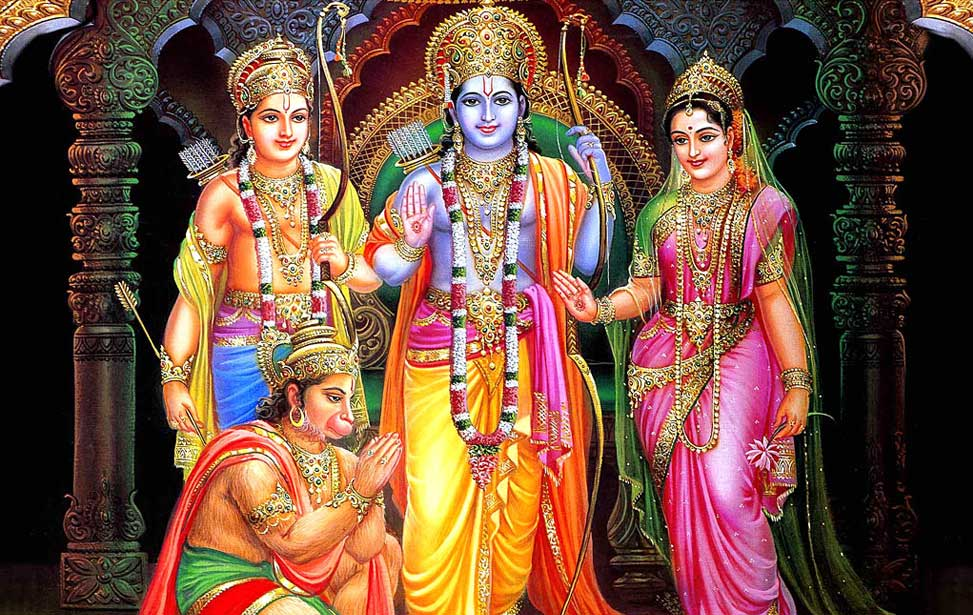
Ram Navami is a festival that celebrates the birthday of Lord Ram, the seventh avatar of the deity Vishnu. The festival celebrates the descent of Vishnu as the Rama avatar, through his birth to King Dasharatha and Queen Kausalya in Ayodhya, Kosala. This festival is a part of the Chaitra Navaratri in the spring, and falls on the ninth day of the bright half (Shukla Paksha) of Chaitra, the first month in the Hindu calendar. This typically occurs in the months of March or April by the Gregorian calendar.
Ram Navami is marked by the faithful with puja (devotional worship) such as bhajan and kirtan, by fasting and reading passages about Rama’s life. A number of cities mentioned in the Ramayana about Ram’s life observe major celebrations. These include Ayodhya (Uttar Pradesh), Rameswaram (Tamil Nadu), Bhadrachalam (Telangana) and Sitamarhi (Bihar). Some locations organize ratha yatras (chariot processions), while some celebrate it as the wedding anniversary festival (kalyanotsavam) of Ram and Sita.
While the festival is named after Ram, the festival typically includes reverence for Sita, Lakshmana, and Hanuman, given their importance in Ram’s life. Some Vaishnava Hindus observe the festival in Hindu temples, while others observe it within their homes. Surya, the Hindu sun god, is a part of the worship and ceremonies in some communities. Some communities observe all nine days of Chaitra (Vasanta) Navaratri by remembering Rama and reading the Ramayana, with some temples organizing special discussion sessions in the evening. Charitable events to help those in need and community meals are organized by temples and organizations, and for many Hindus, it is an occasion for moral reflection.
In Karnataka, Sri Ramanavami is celebrated by the local Mandalis (organizations) at some places, even on footpaths, by dispersing free panakam (a jaggery drink) and some food. Additionally, in Bengaluru, Karnataka, the Sree Ramaseva Mandali, R.C.T (R.) Chamrajpet, organizes India’s most prestigious, month-long classical music festival. The uniqueness of this 80 year old musical extravaganza is that celebrated Indian classical musicians, irrespective of their religion, from both genres – Carnatic (South Indian) and Hindustani (North Indian) – descend down to offer their musical rendition to Rama and the assembled audience.
Bhadrachalam temple in Telangana is one of the major Ram Navami celebration sites.
In eastern Indian states such as Odisha, Jharkhand, and West Bengal, the Jagannath temples and regional Vaishnava community observe Ram Navami, and treat it as the day when preparations begin for their annual Jagannath Ratha Yatra in summer.
Devotees associated with ISKCON fast through the daylight hours. A number of ISKCON temples introduced a more prominent celebration of the occasion of the holiday with the view of addressing needs of growing native Hindu congregation. It was however a notable calendar event on the traditional Gaurabda calendar with a specific additional requirement of fasting by devotees.
Further Reading
https://www.drikpanchang.com/navratri/navratri-calendars.html
https://en.wikipedia.org/wiki/Navaratri
https://en.wikipedia.org/wiki/Vijayadashami
https://sanatanadhara.com/navratri/
https://en.wikipedia.org/wiki/Rama_Navami