
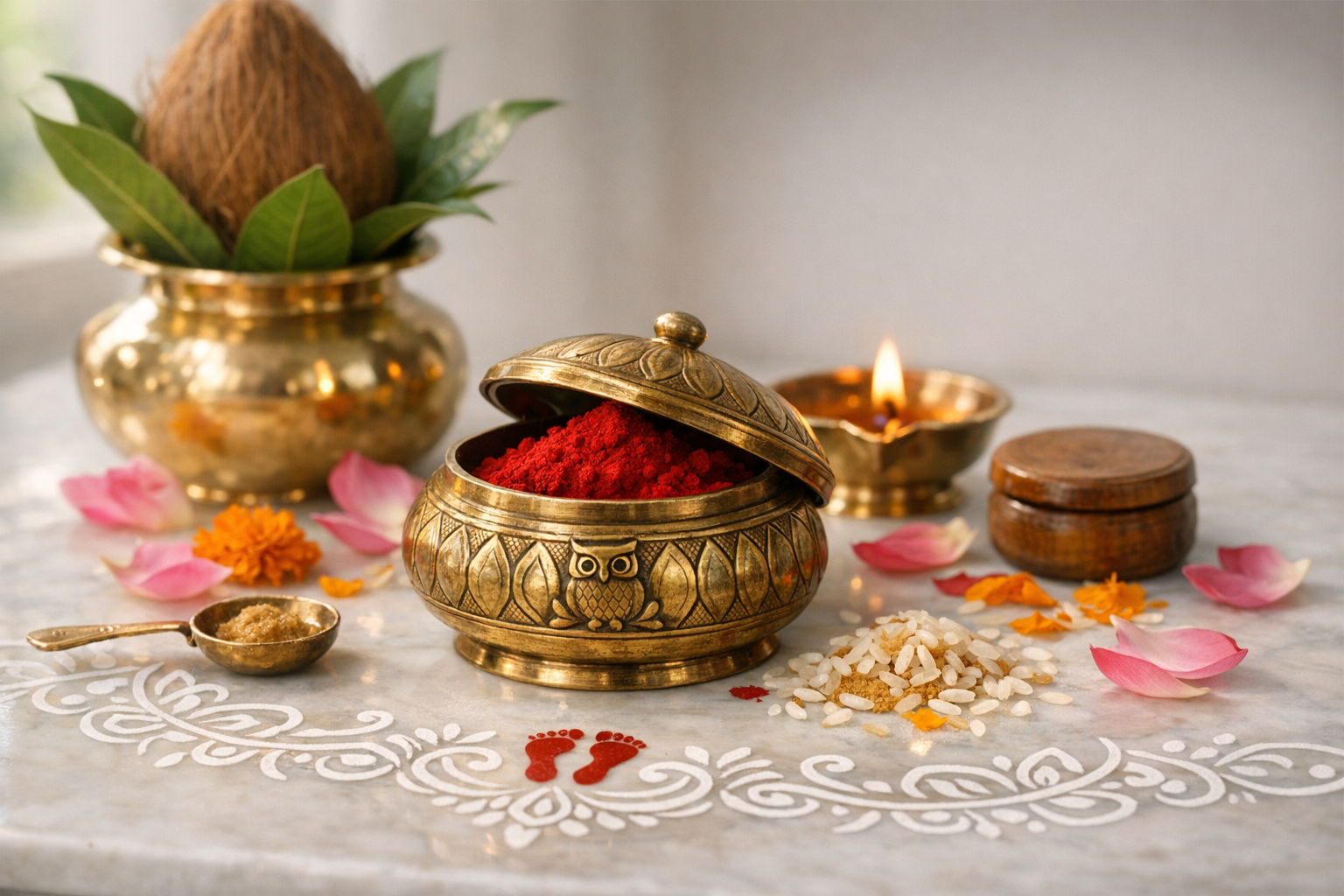
The vermilion box, known across Bengal and eastern India as the Sindoor Dabi, Sindoor Kouto, or Sindoor Box, is far more than a household ornament. In many Hindu homes it stands as a living symbol of Goddess Lakshmi, the embodiment of auspiciousness, prosperity, and purity, and it anchors daily worship at the ghar mandir or household shrine. Typically fashioned from brass, silver, bell metal, or terracotta, this compact vessel safeguards sindoor or kumkum, substances central to Lakshmi worship and to the broader visual language of the sacred feminine in Hindu traditions.
As a material object, the Sindoor Dabi binds ritual function to cultural memory. Its weight, patina, and artisan-imprinted motifs form part of a quiet, daily rhythm: elders lifting the lid at dawn, a gentle touch of red to the deity’s forehead or pedestal, and the closing gesture of gratitude that returns the powder to its sanctified container. The box thereby mediates between form and feeling—between craft and devotion—preserving collective heritage in a single, familiar act.
In the iconography of Lakshmi, red is a key chromatic code. It signals vitality, life-force, fecundity, and the auspicious activation of rajas channeled toward harmony and ethical prosperity. Placed beside images of Mahalakshmi, Gajalakshmi, or a kalasha invoked as her seat, the vermilion box becomes an indispensable emblem of presence: it affirms that auspicious wealth (śrī) is not mere accumulation, but ethically aligned abundance that nourishes family, community, and dharma.
Ritual manuals across regions—through the frameworks of Panchopachara and Shodashopachara—assign gandha (fragrant substances and coloring agents) a specific role in deity worship. Kumkum or sindoor, preserved within the Sindoor Dabi, is offered during alankara and archana, joining sandal paste, akshata (consecrated rice), flowers, and incense. In kumkumarchana traditions, especially popular in the worship of the Divine Mother, the repeated offering of kumkum syllabically praises the goddess while materially embodying devotion.
In daily Lakshmi puja at home, the sequence typically integrates the vermilion box with quiet precision. After invoking Lakshmi with dhyana and avahana, devotees apply kumkum to the deity’s image or pedestal, mark the kalasha or the lamp, and place small red tilaks upon key ritual vessels. This gentle choreography translates theological meaning into touch: the red mark visualizes an inner vow—may the home remain a seat of purity, right livelihood, and generosity.
Regional practices in Bengal offer distinctive textures. During Kojagori Lakshmi Puja, households adorn floors with alpana motifs and Lakshmi’s footprints leading inward, often highlighted with rice paste and red accents. The Sindoor Kouto is set near the deity, and married women may exchange kumkum as a blessing for saubhagya, reinforcing the link between Lakshmi’s grace and the well-being of the family. Even after Durga Puja, the residue of sindoor khela culturally underlines red’s association with auspicious continuity and communal warmth.
Beyond the shrine, the vermilion box participates in life-cycle rituals. In many parts of India, haldi-kumkum gatherings celebrate sisterhood and auspiciousness; the Sindoor Dabi becomes a locus for sharing blessings that honor sumangali ideals while increasingly being reinterpreted as a wish for holistic health, mutual respect, and dignity for all members of the household.
Design vocabularies for the Sindoor Dabi draw on regional craft lineages. In Bengal and adjoining regions, bell metal and brass workshops produce cylindrical, conical, or lotus-petal forms; terracotta ateliers mold lightweight, painted containers; and contemporary silversmiths chisel fine repoussé florals. Motifs frequently reference Lakshmi’s attributes—lotus petals, overflowing pots, and in Bengal, the owl (ulooka), her vahana—quietly teaching theology through object design.
The owl motif deserves special notice in eastern India. Far from common caricature, Lakshmi’s owl signifies alertness, discernment, and the vigilant stewardship of resources. When a Sindoor Dabi takes the shape of an owl or bears its incised outline, it conveys an ethical reminder integral to Lakshmi worship: prosperity is to be guarded with wisdom, distributed with compassion, and aligned with dharma.
Textual and ritual traditions reinforce these aesthetics. While specific paddhatis vary by region and lineage, the consistent thread is clear: kumkum or sindoor functions as a visible marker of sanctity. Applied to deities, vessels, or thresholds, it delineates sacred space and time, marking a transition from the ordinary to the auspicious. The Sindoor Dabi, by safeguarding this powder, preserves ritual integrity across daily, weekly, and festival observances.
Materials and composition have evolved alongside safety awareness. Historically, vermilion could be derived from cinnabar (mercuric sulfide), and premodern cosmetic repertoires referenced mineral reds and saffron-based hues. Today, many families prefer plant-based kumkum derived from turmeric and slaked lime, or certified lead-free formulations. From a health perspective, trusted, tested products—clearly labeled and free from heavy metals—best honor the satvik spirit of worship.
Choosing and maintaining a Sindoor Dabi blends reverence with hygiene. Clean, dry storage preserves the powder’s color and texture; periodic replenishment maintains freshness; and dedicating a small spoon or finger ring for application ensures both ritual and practical purity. When positioned on the altar, the box is commonly set to the deity’s right or near the lamp, aligning with domestic paddhatis that emphasize order, clarity, and devotion.
Viewed through a dharmic lens of unity, the cultural significance of sacred red extends across related traditions. In many Buddhist settings—particularly in the Himalayan and Nepali spheres—red powders serve as auspicious offerings and tika during festivals and shrine observances. Jain puja trays regularly include kumkum alongside chandan and akshata for devotional markings, even as Tirthankara images are kept unadorned to emphasize their transcendence. Sikh teachings center devotion on the Name and ethical action; within Punjabi cultural life, however, red marks can appear in familial or social ceremonies. Across these paths, a shared thread emerges: reverence for ethical prosperity, gratitude, and community well-being, reflecting the spirit of unity in spiritual diversity.
The vermilion box is thus both symbol and pedagogy. Its presence in the household consolidates a theology of prosperity that is consciously ethical; it trains attention toward mindful consumption, generosity, and gratitude; and it invites each generation to receive, refine, and relay traditions without coercion or exclusivity. When families gather at dusk, light the lamp, and open the Sindoor Dabi, they enact a small, daily covenant with Goddess Lakshmi—prosperity held within limits, wealth guided by wisdom.
In the diaspora, the Sindoor Dabi anchors memory and belonging. It is often among the first ritual objects unpacked in a new home, transforming unfamiliar rooms into sacred space. Whether crafted in Kolkata, Bankura, or a contemporary atelier abroad, the box bridges continents, reminding families that heritage is not a relic but a living practice—portable, renewable, and shared.
Ultimately, the Vermilion Box endures because it harmonizes form, feeling, and philosophy. It safeguards a simple substance that colors the threshold between the material and the sacred; it encodes centuries of craftsmanship; and it embodies the grace of Goddess Lakshmi as a daily invitation to live with dignity, discernment, and kindness. In that quiet, enduring role, the Sindoor Dabi remains a luminous icon of auspiciousness and a unifying symbol within the broader dharmic family.
Inspired by this post on Hindu Blog.










Leave a Reply
You must be logged in to post a comment.