Ruru Bhairava occupies a distinctive place within the sacred circle of the sixty-four manifestations of Bhairava, the fierce and protective aspect of Lord Shiva. Grouped within the Ashtashta Bhairavasthe structured set of eight clusters comprising the 64 BhairavasRuru presides over the second octet and is celebrated as the guru among these formidable guardians. While Bhairava is widely perceived as awe-inspiring and even terrifying, Ruru embodies the pedagogical, pacifying dimension of Śiva’s wisdom, harmonizing protection with instruction.
Traditional Shaiva sources organize Bhairava worship in protective circuits, with each Bhairava serving as a directional sentinel and spiritual functionary. In many paddhatis Ruru Bhairava is associated with the agneya (southeast) direction within the eightfold protective mandala. This spatial logic informs both ritual architecture and circumambulation routes in Hindu temples where Ashta Bhairava shrines ring the sacred core, enabling devotees to engage with a complete field of guardianship and grace.
The name “Ruru” holds multiple resonances in Sanskrit: it evokes the swift and alert ruru-deer and simultaneously suggests a call or sound that awakens attention. Iconologically, Ruru signifies the teacher’s roleguiding through clarity, discipline, and the arts of speech and music. In several regional traditions, Ruru Bhairava thus mediates between Śiva’s fear-dispelling ferocity and the serene insight of Dakṣiṇāmūrti, drawing worshippers from anxiety into understanding.
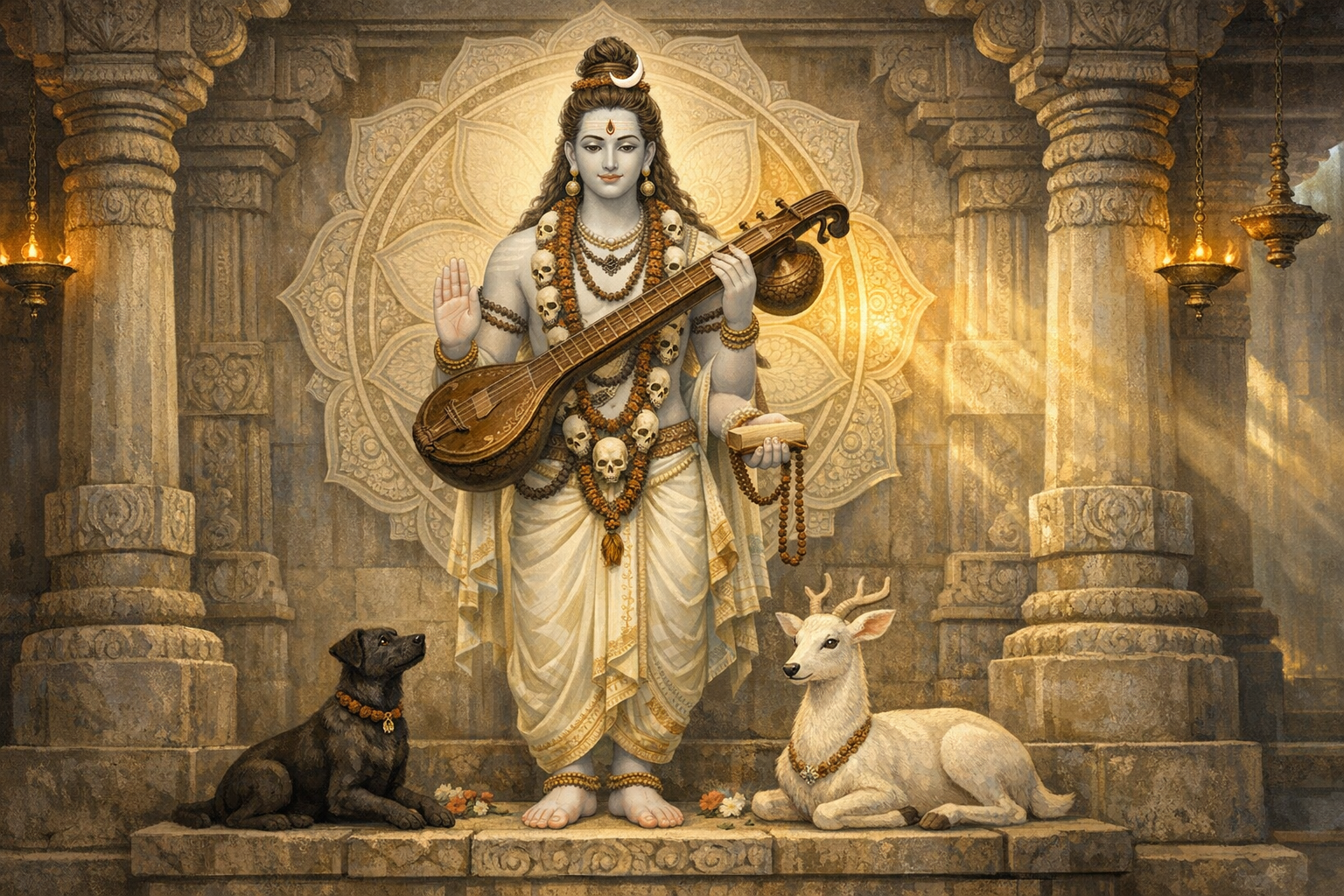
Across Agamic and Śilpa-Śāstra conventions, Bhairava images share core attributes: a third eye, jaṭā-mukuṭa (matted hair), serpentine ornaments, and sacred emblems of sovereignty and time. Ruru Bhairava, however, is rendered with a gentler facial expression than the more krodha (wrath) oriented forms. Sculptors often emphasize calm eyes, composed lips, and a poised bearing, communicating a pedagogy that subdues fear not by shock, but by instruction and refinement.
Arm counts and attributes vary by lineage and region. Two-armed, four-armed, and even multi-armed depictions are observed. In the teacherly idiom, Ruru frequently carries a vīṇā or pustaka (book), together with an akṣamālā (rosary), signaling mastery of śāstra, mantra, and the arts. In alternate renderings, trishūla, ḍamaru, pāśa, aṅkuśa, or kapāla may appear, integrating the standard Bhairava grammar of instruments and emblems. Abhaya and varada gestures are common, underscoring assurance and benediction alongside discipline.
Complexion and ornamentation reinforce this pedagogy. Many traditions describe Ruru’s hue as śveta (white) or crystal-like, aligning him with sattva and lucidity. White sandal paste, rudrākṣa garlands, and refined textile motifs are preferred in alankāra. Yet Ruru remains unmistakably Bhairava: the kapāla-mālā, serpent-yajñopavīta, and the crescent moon in the jaṭā keep his identity anchored in Śiva’s paradoxdeath-transcending power married to luminous wisdom.
Vāhana traditions for Ruru Bhairava exhibit regional pluralism. Several South Indian iconographic streams place him with a vṛṣabha (bull), harmonizing his role with Nandi’s steadfastness; others link him to the ruru-deer, highlighting alertness and gentleness; a few temples adopt alternate carriers preserved in local sthapati manuals. The ubiquitous dog, Bhairava’s companion across many forms, may also be present near the pedestal, signifying vigilance and liminality. Pairings with Śakti differ across texts; some sources associate Ruru with Maheshvarī or a śuddha-vidyā aspect, reflecting his knowledge-centered charisma.
Placement in temple architecture reflects both theology and urban-sacred geography. In Kashi (Varanasi), the Kashi Khanda of the Skanda Purana extols Bhairava’s protective office, with local traditions mapping Ashta Bhairavas around the city’s sacred core. In Tamil Nadu and elsewhere, Ashta Bhairava shrines are found along circumambulatory paths, where Ruru’s shrine often marks the southeast segment. These spatial cues help devotees and researchers identify Ruru by position, attributes, and altar iconography.
Ritual practice around Ruru Bhairava spans the spectrum from Tantric paddhatis to widely observed Dakṣiṇācāra (sattvic) worship. Regular upacāras, ghee lamps, white flowers, and recitations of Bhairava-nāma sequences are common. Devotee accounts frequently emphasize a distinctive calm felt before Ruru’s serene visage, as music or soft chanting suffuses the sanctuman affective testimony to the form’s educative and healing tenor.
Mantra lineages attest to diversity as well. Seed syllables commonly linked to Bhairava include “Hraum” and “Hum,” while simple invocations such as “Om Bhairavaya Namah” remain accessible and honored across sampradāyas. Ashtami tithis are widely favored for Bhairava worship; some lineages reserve particular weekdays for Ruru, reflecting local temple calendars and guru-paramparā guidance. The underlying principle is consistent: invoking Ruru to convert fear into discernment, and turbulence into study and steadiness.
From a sculptural standpoint, Ruru Bhairava is often depicted in sama-bhaṅga or light ālīḍha stance, with well-defined jaṭā, the śaśaṅka (crescent) adorning the hair, and the yājñopavīta rendered as a living serpenta reminder that knowledge is vital and dynamic. The waistcloth may hint at the wild freedom of the forest ascetic, while jewel-work and sacred threads affirm mastery over time, death, and the senses. Sthapati traditions keep these elements coherent yet flexible, allowing regional aesthetics to shape the idol form without obscuring core identifiers.
Texts and manuals frame this iconographic grammar. While puranic passages such as those in the Skanda Purana (Kashi Khanda) situate Bhairava in the sacred city and its guardianship, Agamic and regional śilpa paddhatis guide the artisan’s handdetailing proportions, hand attributes, vāhanas, and alankāra suited to Ruru’s role. Temple inscriptions and oral sthapati lineages further transmit nuances, explaining why images at Kashi, Tamil Nadu, Karnataka, or Nepal display shared DNA with regional signatures.
Philosophically, Ruru Bhairava fuses jñāna (insight) with kṣatra (protective discipline). The vīṇā and pustaka convey pedagogy and refinement; the trident and staff signal ethical firmness. Together they express a dharmic axiom: protection attains its highest form when anchored in knowledge, and knowledge attains efficacy when tempered by courage and care. Devotees describe this synthesis as the felt experience of standing before a fierce protector who teaches, consoles, and sets one resolutely on the path.
Ruru’s didactic and compassionate identity also offers a bridge across Dharmic traditions. In Buddhist contexts, the wrathful teacher-archetype appears in Vajrabhairava (Yamāntaka), a wisdom form that, like Ruru, wields fierceness to end ignorance. In several Jain spaces, Bhairava resonates as a kṣetrapāla or guardian, reflecting a shared ethos of sacred protection around tīrthas. While the Sikh tradition is non-iconic, the Guru’s fearless pedagogy and ethical guardianship map closely to Ruru’s values. Across these lineages, knowledge-led fearlessness emerges as a unifying current.
For pilgrims, art historians, and seekers, identifying Ruru Bhairava in a temple complex entails attending to three markers: the southeast orientation in an Ashta Bhairava circuit, the presence of vīṇā or book among the hand attributes, and the comparatively serene facial expression set within Bhairava’s standard emblems. Local archakas and sthapatis often preserve mnemonics and stotra traditions that clarify these cues, ensuring that worship, conservation, and scholarship remain aligned.
In contemporary practice, Ruru Bhairava encourages communities to cultivate learning circles, music-infused satsangas, and study of śāstra alongside regular pūjā. This integration of devotion and disciplined inquiry deepens personal resilience and collective harmony. By interpreting Ruru’s iconography as a living pedagogyan invitation to learn, listen, and live courageouslytemple culture stays vibrant while staying true to Agamic wisdom.
Ultimately, Ruru Bhairava stands as the gentle guru among the 64 fierce protectors, transforming existential anxiety into contemplative clarity. His idol form, grounded in Śilpa-Śāstra yet open to regional beauty, beckons devotees to embrace both vigilance and vision. In honoring Ruru, one honors a Dharmic unity that cherishes many paths yet converges on wisdom, compassion, and steadfast protection for all beings.
Inspired by this post on Hindu Blog.