
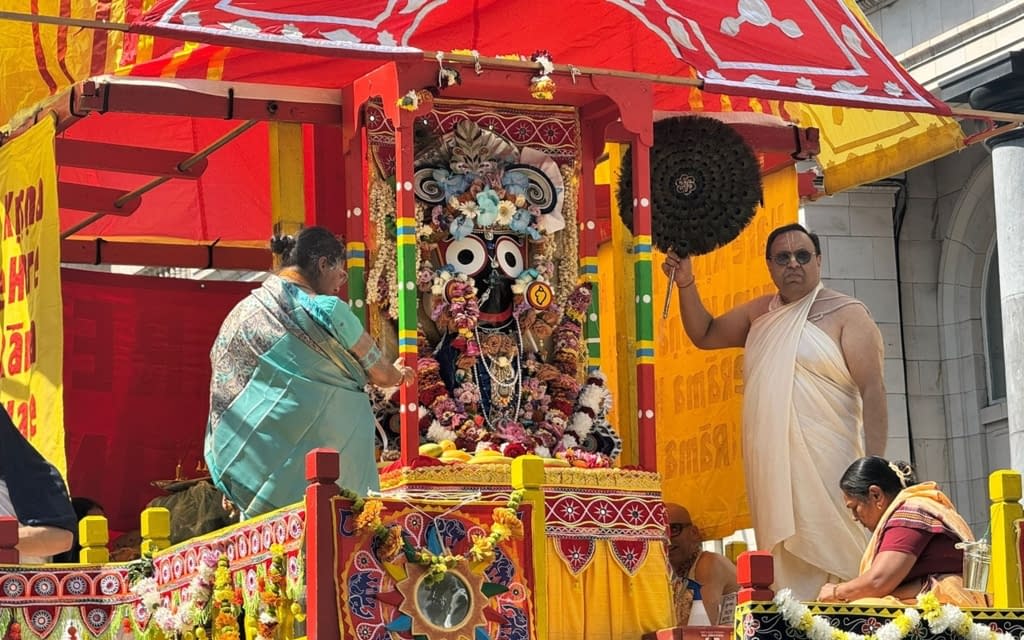
The celebrated Rathayatra, widely known as the Hare Krishna Festival of Chariots, returned to central London on Sunday, 24 May 2026, transforming Park Lane and the surrounding thoroughfares into a moving tapestry of devotion, music, and shared community. More than 10,000 participantsfamilies, pilgrims, well-wishers, and religious leadersassembled to accompany and pull three striking chariots, each rising to approximately 40 feet. The procession’s scale and serenity offered a vivid demonstration of how a historic Indian tradition flourishes in a contemporary, multicultural city.
This year marked 57 years of Rathayatra on London’s streets, a continuity that traces back to 1969 when the public chariot festival was first held in the city. Popularised worldwide by the Hare Krishna MovementISKCON (International Society For Krishna Consciousness)in the late 1960s, the Festival of Chariots has grown into one of London’s most anticipated Hindu festivals in the UK. Its endurance reflects the convergence of diasporic identity, civic cooperation, and a shared appreciation for living cultural heritage.
Rathayatra’s roots are ancient, originating in Jagannath Puri (Odisha, India), where Lord Jagannath, Lord Balabhadra, and Subhadra Devi are traditionally taken on majestic chariots to bless all who gather along the route. The London manifestation faithfully presents this essence: deities are placed upon ornately decorated chariotstraditionally known as Nandighosha (Jagannath), Taladhwaja (Balabhadra), and Darpadalana (Subhadra)which proceed through the city accompanied by devotional singing (kirtan), rhythmic drums (mridanga), and hand cymbals (kartals).
At the theological core is a simple yet profound idea: Jagannathliterally “Lord of the Universe”symbolises divine accessibility. The act of pulling the ropes is not merely ceremonial; it is interpreted in Gaudiya Vaishnavism as drawing the Lord into the heart and into public life. The imagery resonates well beyond denominational boundaries. Values such as compassion (karuna), service (seva), and nonviolence (ahimsa) are celebrated in a way that harmonises with the wider dharmic familyHinduism, Buddhism, Jainism, and Sikhismunderscoring the principle of Vasudhaiva Kutumbakam.
From an event-management perspective, the festival exemplifies mature urban coordination. The chariots comprise robust timber frames, multi-layered canopies, and secure drawgear. Multiple thick ropes distribute the load to large groups of participants for controlled, collective pulling. Trained stewards regulate pace and spacing, liaising closely with city officials and safety teams. Medical points, first-aid volunteers, wayfinding signage, and designated crossing corridors enable the wider public to move safely as the parade advances along Park Lane and onward through central London.
For many Londoners observing from the pavements, the sensation is both visual and auditory: cascading flower garlands, vibrant canopies, the steady pulse of kirtan, and the warmth of greetings from volunteers. The festival’s ambience encourages gentle participationsome take turns on the ropes, others clap along to the maha-mantra, while families explain to children the meaning behind the deities and the chariots. The procession’s methodical tempo, punctuated by devotional song, creates a shared emotional cadence that is at once public and deeply personal.
A hallmark of London Rathayatra is the inclusive cultural programme that follows the procession, typically in a major public square in the heart of the city. Classical dance forms such as Odissi and Bharatanatyam, congregational kirtan, and accessible introductions to the Bhagavad-Gita and Srimad-Bhagavatam complement the pageantry, making the festival as educational as it is celebratory. Stalls often provide orientation to bhakti-yoga, meditation practices, and the philosophical tenets of the Hare Krishna tradition in a manner designed for first-time visitors as well as regular practitioners.
Equally integral is the distribution of sanctified vegetarian food (prasadam), which expresses hospitality and equality in practice. Annadanathe sharing of food without discriminationreinforces a message of social harmony. Organisers continue to improve sustainability, increasingly adopting reusable or compostable serviceware, segregated waste streams, and volunteer-driven cleanup to ensure the festival’s environmental footprint aligns with its ethos of reverence for life and responsible stewardship.
Interfaith presence and dharmic unity are visible strengths of the London festival. Representatives and participants from Hindu, Buddhist, Jain, and Sikh communities frequently attend, recognising convergent principles such as truth-seeking, compassion, and service. The procession’s opennesswelcoming passersby to walk alongside or observe respectfullyencourages dialogue and strengthens interpersonal bonds across communities. In this sense, London Rathayatra doubles as a living classroom in unity in religious diversity.
The festival’s social impact extends to youth engagement and skills development. Each year, hundreds of volunteers coordinate logistics, safety, hospitality, stage programming, and crowd guidancegaining experience in event planning, public communication, and teamwork. Many report a heightened sense of belonging and well-being, illustrating how faith-driven cultural events can nurture civic competencies while enriching London’s multicultural fabric.
Accessibility and family-friendliness remain central planning priorities. Step-free areas near assembly points, staggered movement to prevent bottlenecks, and clear steward instructions at major crossings help ensure safe, inclusive participation. Families typically find vantage points along Park Lane before following the chariots at a comfortable pace, while visitors are advised to plan public transport in advance given the scale of road closures and footfall.
After 57 consecutive years in London, the Festival of Chariots demonstrates how an age-old tradition can adapt to a global city without losing spiritual depth or cultural integrity. It simultaneously embodies devotional intimacy and public celebration, offering an experience that is scholarly in its symbolism, communal in its hospitality, and transcendent in its aspiration. As participants disperse at day’s end, what lingers is the sense that a moving temple has passed through the heart of the cityleaving a quiet trace of unity, hope, and shared purpose.
Inspired by this post on Dandavats.










