-
Pradhanikarahasya on Mahalakshmi’s Supremacy: Unveiling the Primordial Shakti of Creation

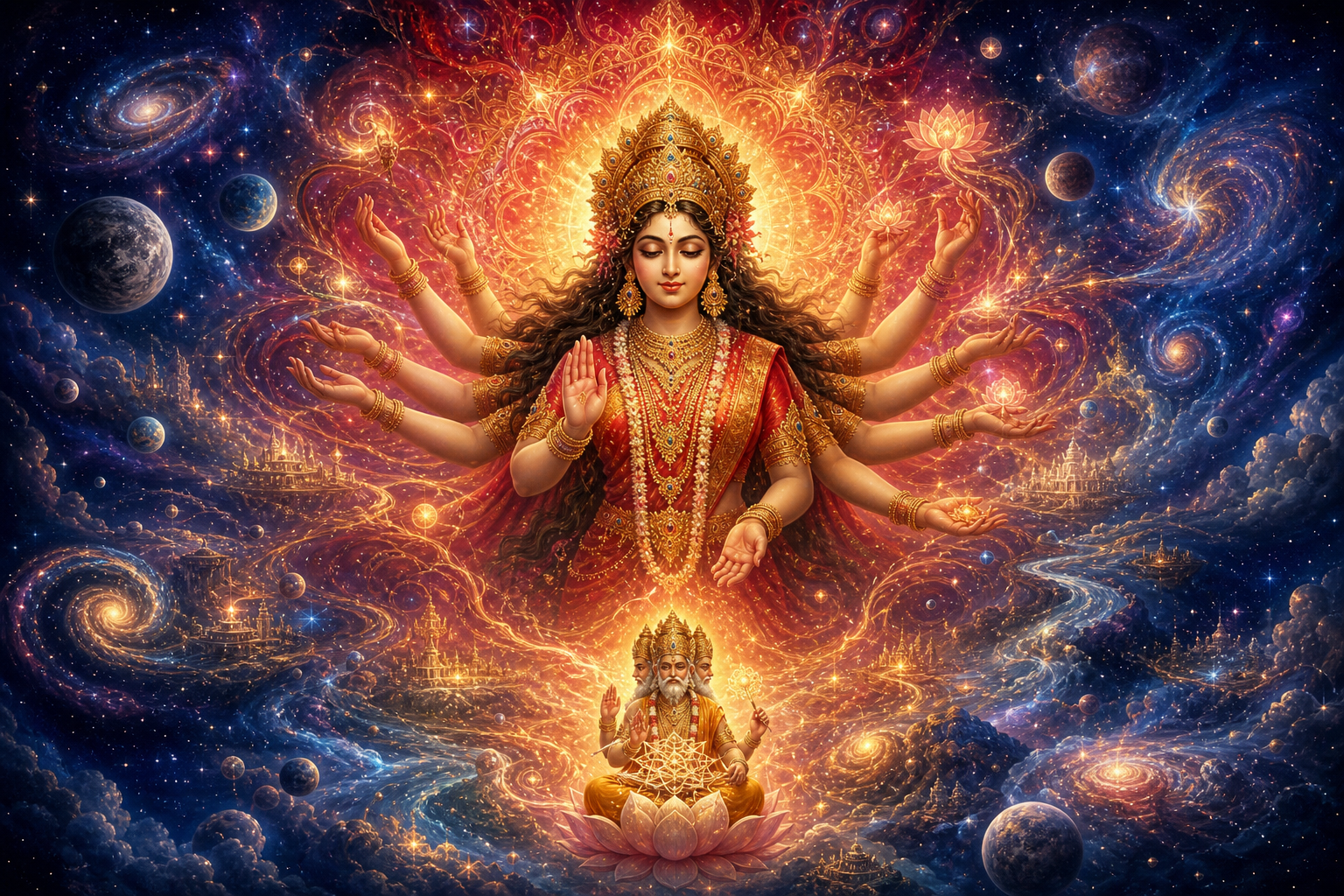
Pradhanikarahasya, an annex to the Devimahatmya (Durgasaptashati), presents a rigorous Shakta theology in which Mahalakshmi is the primordial source of creation. It integrates Vedic and Upanishadic insights to show how Shakti is both nirguna and saguna, aligning non-dual metaphysics with living devotion. The text decodes the Devimahatmya’s three episodes through the three gunas, offering a…
-
Unveiling Prishni: The Speckled Celestial Mother of the Maruts in Rigvedic Cosmology

Prishni, the “speckled” celestial mother of the Maruts in the Rigveda, illuminates how Hindu scriptures bind natural phenomena to sacred meaning. This analysis clarifies her etymology, traces her presence in Vedic hymnody, and examines her relationship to Indra, Rudra, and the storm-host. Readers gain a precise understanding of how “speckling” functions as Vedic symbolism for…
-
Dhumavati and Shiva Unveiled: Origin Myths, Smoke-Clad Symbolism, and Transformative Wisdom

Dhumavati, the smoke-clad Mahavidya, teaches how endings and absence become gateways to discernment across the Dharmic family. This in-depth essay clarifies her origin myths, including the Sati–Shiva narratives and the Daksha yajna smoke motif, and interprets their philosophical stakes. It decodes her iconography—crow, broom, winnowing basket, cremation ground—as a curriculum in viveka and vairagya. Readers…
-
Nemili Sri Bala Tripurasundari Peetam, Vellore: Sacred history, rituals, darshan tips, and travel guide

Nemili Sri Bala Tripurasundari Peetam in the Vellore region (Ranipet district) is a revered house-temple 20 km from Kaveripakkam, where devotees worship Sri Bala—the powerful child-form of Tripurasundari—with intimate, precise Sri Vidya rituals. The shrine’s strength lies in its homely sanctity, meticulous daily puja, and Navaratri celebrations that blend tenderness with theological depth. Pilgrims can…
-
At the Goddess’s Gate: Manidwipa’s Iron Enclosure and the Discipline of Sacred Choice

The Devi Bhagavatam describes Manidwipa’s Chintamani Griha encircled by progressively subtler enclosures. This essay examines the outermost Iron Enclosure (loha-prakara) as a Hindu symbol of sacred choice and disciplined detachment. It shows how the first threshold functions ethically (yamas–niyamas), psychologically (pratyahara and boundary hygiene), and ritually (temple prakara as didactic space). Readers learn to map…
-
Saranyū, Daughter of Tvaṣṭṛ: The Swift Vedic Goddess of Transformation and ṛta

Saranyū, the swift goddess of the Vedas, unites movement, light, and craftsmanship into a single principle: transformation governed by ṛta. Positioned as daughter of Tvaṣṭṛ and wife of the solar Vivasvat, her narrative encodes lawful speed and timely transition. The Aśvins embody her swiftness in service of healing, while the Chāyā motif distinguishes authentic presence…
-
Shukla Devi Puja 2026: Jyeshta Shukla Ashtami Date, Complete Vidhi, and Deeper Meaning

Shukla Devi Puja (Shukla Devi Aradhana) is observed on Jyeshta Shukla Ashtami, and in 2026 this sacred day falls on 22 June in most Indian almanacs. The vrata honors the sattvic radiance of Shukla Devi, integrating Panchopachara or Shodashopachara puja, mindful fasting, and the recitation of Devi stotras. Offerings typically emphasize the Shukla ethos—white flowers,…
-
Shukla Devi Puja 2026 on Jyeshta Shukla Ashtami: Sacred Timings, Kheer Bhavani, Complete Vidhi

Shukla Devi Puja (Shukla Devi Aradhana) in 2026 falls on 22 June, coinciding with Jyeshta Shukla Ashtami in the Hindu calendar. The day venerates the luminous, sattvika dimension of the Divine Mother and aligns with the Khir Bhavani Mela in Kashmir, where devotees traditionally offer kheer. The article explains how Ashtami tithi is computed, why…
-
Choosing a Mahavidya for Navratri: Scholarly, Horoscope‑Aligned, Ethical, Transformative Guide

This research‑informed guide shows how to choose a Mahavidya for Navratri using three converging lenses: present life needs, Jyotisha (Vedic astrology) indications, and spiritual readiness. It summarizes the core strengths, indications, and household‑friendly practices for all ten Mahavidyas, with clear ethical safeguards. Readers learn how to align sadhana with dasha cycles and graha conditions, how…
-
Dashamahavidya Jayanti 2026–2027: Accurate Tithi Guide, Deep Meanings, and Home Puja Methods

This comprehensive guide to Dashamahavidya Jayanti 2026–2027 explains how the ten Jayantis of Mahatara, Matangi, Bagalamukhi, Chinnamastika, Dhumavati, Mahakali, Bhuvaneshwari, Kamala, Tripurabhairavi & Lalita are determined by tithi, with clear notes on regional calendar differences. It summarises widely observed tithis for each Mahavidya, indicates likely 2026–2027 Gregorian windows, and offers practical home-puja methods aligned to…
-
Matangi Jayanti 2026: Unlock Vak-Siddhi and Prosperity on Akshaya Tritiya (April 19)

Matangi Jayanti 2026 falls on April 19, coinciding with Vaishakh Shukla Tritiya and Akshaya Tritiya, creating a highly auspicious window for worship. As Tantrik Saraswati, Matangi blesses devotees with vak-siddhi, cultured expression, and prosperity grounded in ethical values. The day is ideal for home puja, sattvic offerings, and mantra-japa aligned with one’s tradition and local…
-
Chinnamasta Jayanti 2026: Fierce Shakti Awakening—Date, Tithi, Rituals, Deep Meaning

Chinnamasta Jayanti 2026 falls on 29 April and is observed on Vaishakh Shukla Trayodashi according to the Hindu calendar. This comprehensive guide explains the festival’s date–tithi alignment, its profound Mahavidya symbolism, and how householders can perform a sattvic, family-friendly puja at home. It connects Chinnamasta’s fierce wisdom to yogic themes of manipura chakra, kundalini, and…
-
Matangi Jayanti 2026: Unlock Vak-Siddhi and Prosperity on Akshaya Tritiya (April 19)

Matangi Jayanti 2026 falls on April 19, coinciding with Vaishakh Shukla Tritiya and Akshaya Tritiya, creating a highly auspicious window for worship. As Tantrik Saraswati, Matangi blesses devotees with vak-siddhi, cultured expression, and prosperity grounded in ethical values. The day is ideal for home puja, sattvic offerings, and mantra-japa aligned with one’s tradition and local…
-
Chinnamasta Jayanti 2026: Fierce Shakti Awakening—Date, Tithi, Rituals, Deep Meaning

Chinnamasta Jayanti 2026 falls on 29 April and is observed on Vaishakh Shukla Trayodashi according to the Hindu calendar. This comprehensive guide explains the festival’s date–tithi alignment, its profound Mahavidya symbolism, and how householders can perform a sattvic, family-friendly puja at home. It connects Chinnamasta’s fierce wisdom to yogic themes of manipura chakra, kundalini, and…
-
Sita Navami 2026 (Apr 25): Auspicious Puja Vidhi, Vrat Guide, Panchang Rules & Significance

Sita Navami 2026 falls on April 25, aligning with Vaishakha Shukla Navami in the Hindu calendar. This comprehensive guide explains the festival’s scriptural foundations, cultural depth, and ecological symbolism, spotlighting Sita as an embodiment of dharma and a manifestation of Goddess Lakshmi. It clarifies Panchang-based tithi rules, the Udaya Tithi and Madhyahna approaches, and why…
-
Shakti Peeth vs Siddha Peeth: Origins, Rituals, and the Power of India’s Sacred Seats

Shakti Peeth and Siddha Peeth occupy central yet distinct roles in Hindu sacred geography. Shakti Peeth are mythically anchored in the Sati narrative and emphasize Devi–Bhairava worship, major festivals like Navaratri, and communal pilgrimage. Siddha Peeth are experientially anchored in the attainments of siddhas and in anushthanas that reliably catalyze inner transformation. Many renowned shrines,…
-
Sitalsasthi 2026: Sambalpur’s grand Shiva–Parvati wedding and Odisha’s living heritage

Sitalsasthi 2026, the ceremonial wedding of Lord Shiva and Goddess Pārvatī, will be celebrated on June 20 in Odisha, with Sambalpur hosting the most expansive and community-driven observances. Rooted in over four centuries of practice, the festival blends śāstra-guided rituals with a city-wide cultural carnival featuring processions, folk arts, and water-splashing motifs that welcome the…
-
Siddha Kali and the Science of Siddhis: Tantric Methods, Mantras, and Ethical Mastery

Siddha Kali is revered in Shakta traditions as the beneficent source of siddhis—spiritual capacities that ripen through disciplined mantra, meditation, and ethical living. This long-form exploration presents the iconography, mantric grammar, and ritual architecture that distinguish her worship, from nyasa and yantra to Panchopachara offerings. It situates siddhi within a pan-dharmic ethos shared by Hinduism,…
-
Matrisadbhava of Kerala: Authoritative Guide to Shakta Tantra and Bhadrakali (Rurujit)

Matrisadbhava stands out in Hindu scriptures as a Kerala-centered Shakta Tantra that systematically encodes the worship of Goddess Bhadrakali, also revered as Rurujit. It unites doctrinal depth with Kerala’s temple pragmatics—nyāsa, mantra, yantra, homa, and bali—while foregrounding an ethic of care and precision. The text’s maternal vision affirms unity in diversity across Dharmic traditions, highlighting…
-
Kalaratri Saptami 2026: 10 Powerful Navratri Day 7 Practices for March 25 and Oct 17

The seventh day of Navaratri (Saptami) honors Goddess Kalaratri as Shubankari, the fierce remover of darkness who grants auspicious outcomes. In 2026, Saptami falls on 25 March during Chaitra Navratri and on 17 October during Sharad Navratri, with local panchang variations possible. This guide details ten grounded practices—sankalpa and altar setup, mantra japa, night worship,…