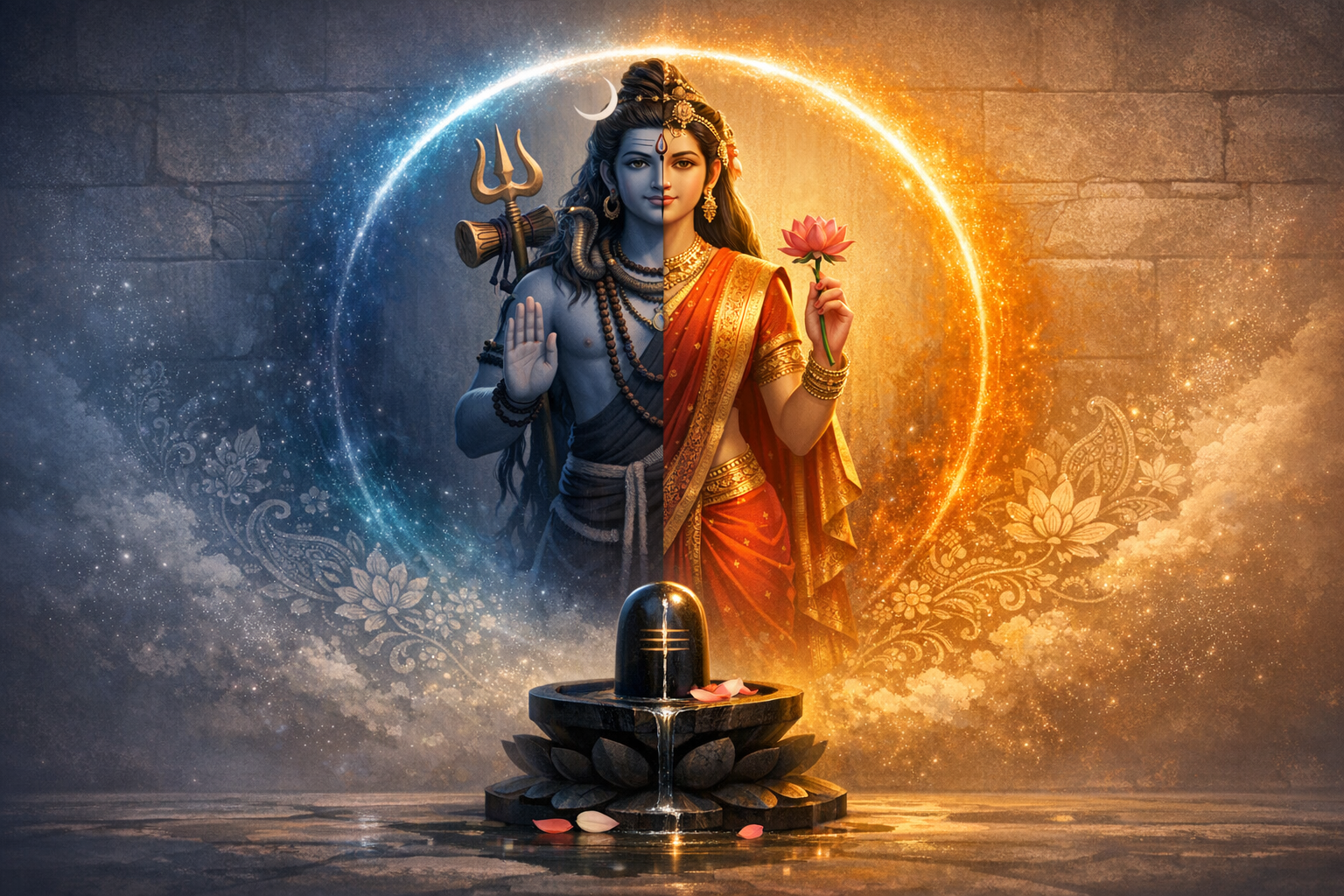
Across Hindu scriptures, few themes are as philosophically luminous as the union of Goddess Parvati and Lord Shiva. The Skanda Purana, among the largest and most intricate of the Mahapuranas, frames this union as an ontological truth: the formless ground of reality continuously expresses itself as form, and form, in turn, points back to the formless. In this vision, their relationship is not merely conjugal or mythic, but a precise map of consciousness (Shiva) and energy (Shakti) whose inseparability sustains the cosmos and illumines the inner life of the practitioner.
Skanda Purana passages that dwell on Uma–Maheshvara articulate a perennial axiom: the Absolute is both nirguna (without attributes) and saguna (with attributes). Parvati makes explicit what ritual, iconography, and meditation implyShiva as pure, unbounded awareness is ever-present yet ungraspable, while she, as Shakti, is the radiant dynamism that makes experience, devotion, and liberation possible. Their union is not a fusion of two separate entities, but a disclosure that the stillness of awareness and the dance of manifestation are one reality seen from complementary vantage points.
The Purana’s method is pedagogical as well as devotional. Through hymns, dialogues, and sacred narratives, it presents analogiesfire and heat, moon and moonlight, word and meaningto demonstrate inseparability. None of these pairs can be prised apart without dissolving the phenomenon itself. In the same way, Parvati’s revelation clarifies that to seek Shiva without Shakti is to chase an abstraction, and to adore Shakti without Shiva is to mistake surface for source. Both are ever together: the essence and its power.
Within the broader fabric of Hindu philosophy, this insight coheres with the Upanishadic horizon. The nirguna–saguna dialectic is neither contradiction nor compromise; it is epistemic humility before an infinite Reality that accommodates both transcendence and immanence. Rigvedic wisdomEkam sat viprā bahudhā vadantisanctions plurality of approach, while the Brihadaranyaka’s “neti, neti” underscores the transcendence of ultimate truth beyond all predicates. The Skanda Purana stands at this Vedic–Puranic confluence, translating high metaphysics into living, ritual, and contemplative practice.
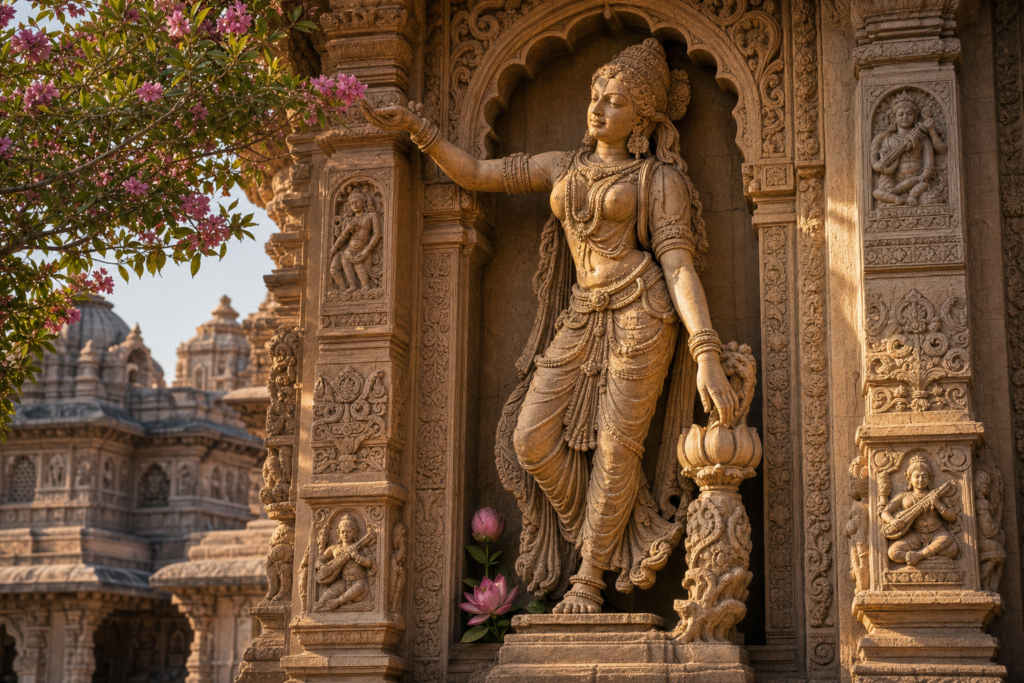
Shaiva iconography renders these metaphysical claims with startling precision. Ardhanarishvara, the composite form of Uma–Maheshvara, is not a statement about human gender, but a diagram of Reality’s two inseparable aspects: consciousness and creative potency. It testifies that wholeness precedes the play of difference, and that the many are meaningful because they arise from unity. This is why Parvati’s voice in the Purana is crucialit discloses the interior dynamism of the Absolute rather than presenting a second principle alongside it.
The aniconic Shivalinga likewise encodes philosophy in form. As a sign (liṅga) rather than a likeness, it points beyond image to the unmanifest. The pedestal (yoni) signifies Shakti, the matrix of manifestation. Rituals such as abhishekam and Panchopachara five offerings are, at their core, disciplines for aligning the practitioner’s mind with this truth: the formless light of awareness and the world’s living forms are not rival claims, but mutually disclosing faces of one Reality reverenced as Uma–Maheshvara.
Shiva Nataraja adds the dynamic dimension. Encircled by the arc of fire, the Lord’s dance communicates a cosmology of emergence, maintenance, concealment, revelation, and repose. In this grammar of movement, Parvati is implicit as the very power that choreographs the steps; the dance would not be without the dancer’s energy. Skanda Purana consistently points to this pulse of becoming, where Parvati’s Shakti is the cosmic throb that renders Shiva’s stillness perceptible as creation, cognition, and compassion.
A well-known dictum in the Shaiva tradition“Shiva without Shakti is shava”condenses this teaching into a single, arresting line. It does not diminish Shiva; it underscores that unmanifest awareness, without its power to express and know, is not available to experience. Parvati’s revelation therefore guards practice against arid abstraction on one side and mere ritualism on the other. The two belong together: wisdom and method, insight and embodiment, ground and gesture.
This unity is not only cosmic; it is yogic and interior. In the contemplative anatomies of Kundalini Yoga, Shakti is described as resting at the muladhara, ascending through chakras as practice matures, and uniting with Shiva at the sahasrara. Whether approached allegorically or literally, the map teaches integration: as breath refines, attention gathers, and mantra steadies, the practitioner intuits the still-bright field of awareness within which all experience arises and dissolves.
Practical pathways follow the classical triad of jnana, bhakti, and yoga, with Puranic inflection. Japa of “Om Namah Shivaya” attunes the mind to Shiva’s presence; meditative adoration of Uma–Maheshvara harmonizes compassion and clarity; silent contemplation in the wake of ritual abhishekam allows insight to settle. Each method speaks to a different temperament, yet all converge upon the same recognition: Parvati’s Shakti is the very power by which the seeker seeks and knows, and Shiva’s consciousness is the certainty that dawns when the search is at rest.
In domestic and temple life, this union is continuously re-enacted. Families observe Maha Shivaratri with vigil and meditation, offer Shivalinga Puja with devotion, and honor Gauri–Shankar as the sanctified household ideal where steadiness and warmth, discernment and care, abide side by side. Through these rites, Skanda Purana’s teaching becomes lived wisdom: philosophy moves from page to pulse, from discourse to daily life.
The Purana’s vision also clarifies contemporary questions about plurality and truth within the broader Dharmic world. Sikh scripture speaks of the One as both nirgun and sargunattributeless and with attributesan affirmation deeply resonant with the Shiva–Shakti paradigm. Jain Anekantavada (the “many-sided” nature of truth) counsels humility toward ultimate reality, recognizing that apparently divergent standpoints may illuminate one indivisible whole. Mahayana Buddhism’s insight that “form is emptiness and emptiness is form” similarly points to a non-dual relation between appearance and the unconditioned.
These convergences do not collapse distinctions; rather, they invite mutual recognition. Within Sanatana Dharma and its sister traditionsHinduism, Buddhism, Jainism, and Sikhismdiversity of practice and insight enriches a shared civilizational quest. The Skanda Purana’s teaching therefore strengthens unity in spiritual diversity: many approaches, one luminosity; many devotions, one dignity; many languages of the sacred, one listening heart.
The doctrine of Ishta (chosen form or emphasis) becomes a bridge rather than a barrier in this light. Parvati’s revelation validates the worship of form as a way to the formless and the contemplation of the formless as the heart of forms. Hence, differing liturgiesbe they elaborate Panchopachara offerings or silent meditationare not in rivalry; they are distinct doors to the same sanctum. Genuine pluralism is not a concession but an inference from metaphysics: if Reality is truly infinite, its compassionate disclosures will be manifold.
Ethically, the Uma–Maheshvara vision calls for complementarity in society. Just as Shakti and Shiva are coeval and coessential, social life is healthiest where qualities of care and clarity, initiative and equanimity, creativity and restraint, are honored in concert. The result is neither homogenization nor hierarchy, but balancean echo, in human terms, of the balance described by Skanda Purana at the roots of existence.
For students of scriptural studies, this teaching provides an interpretive key to Puranic literature: myth functions as a grammar for metaphysics. For contemplatives, it supplies a practical syllabus: stabilize attention, purify intention, and allow devotion to become insight. For householders, it offers a living symbol of partnership: dignify both steadiness and dynamism, both silence and speech, both contemplation and compassionate action.
Ultimately, when the formless takes form in temple, text, or inner stillness, the paradox dissolves into recognition. Parvati and Shiva are not two stories braided together but one truth told in two accents. As Skanda Purana intimates through Parvati’s own disclosure, the practitioner does not manufacture this unity; it is discoveredpresent prior to seeking, constant throughout seeking, and fully evident when seeking comes to rest.
Inspired by this post on Hindu Blog.