-
Hinduism and the Transformative Cosmos: Creation, Dharma, and Sacred Change

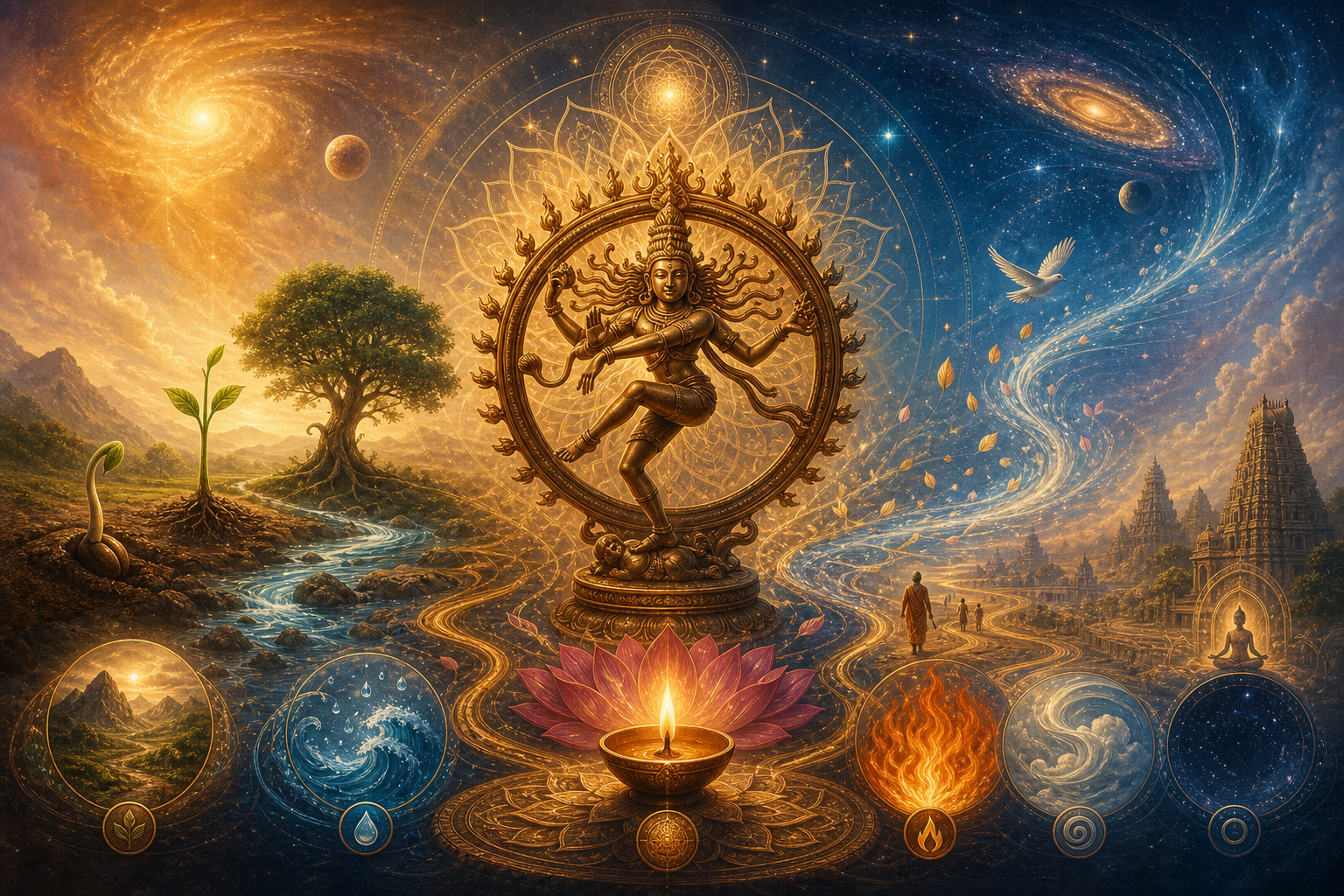
Hindu philosophy presents the universe as a continuous process of transformation rather than a simple story of creation and destruction. This article explains how Vedic, Upanishadic, Puranic, Vedantic, Sankhya, Yoga, and Bhagavad Gita traditions interpret manifestation, preservation, dissolution, karma, samsara, and moksha. It highlights Shiva Nataraja, the three gunas, pralaya, and cosmic time as key…
-
Panchabrahma & Panchakritya: Unveiling Shiva’s Five Faces and the Universe’s Five Acts

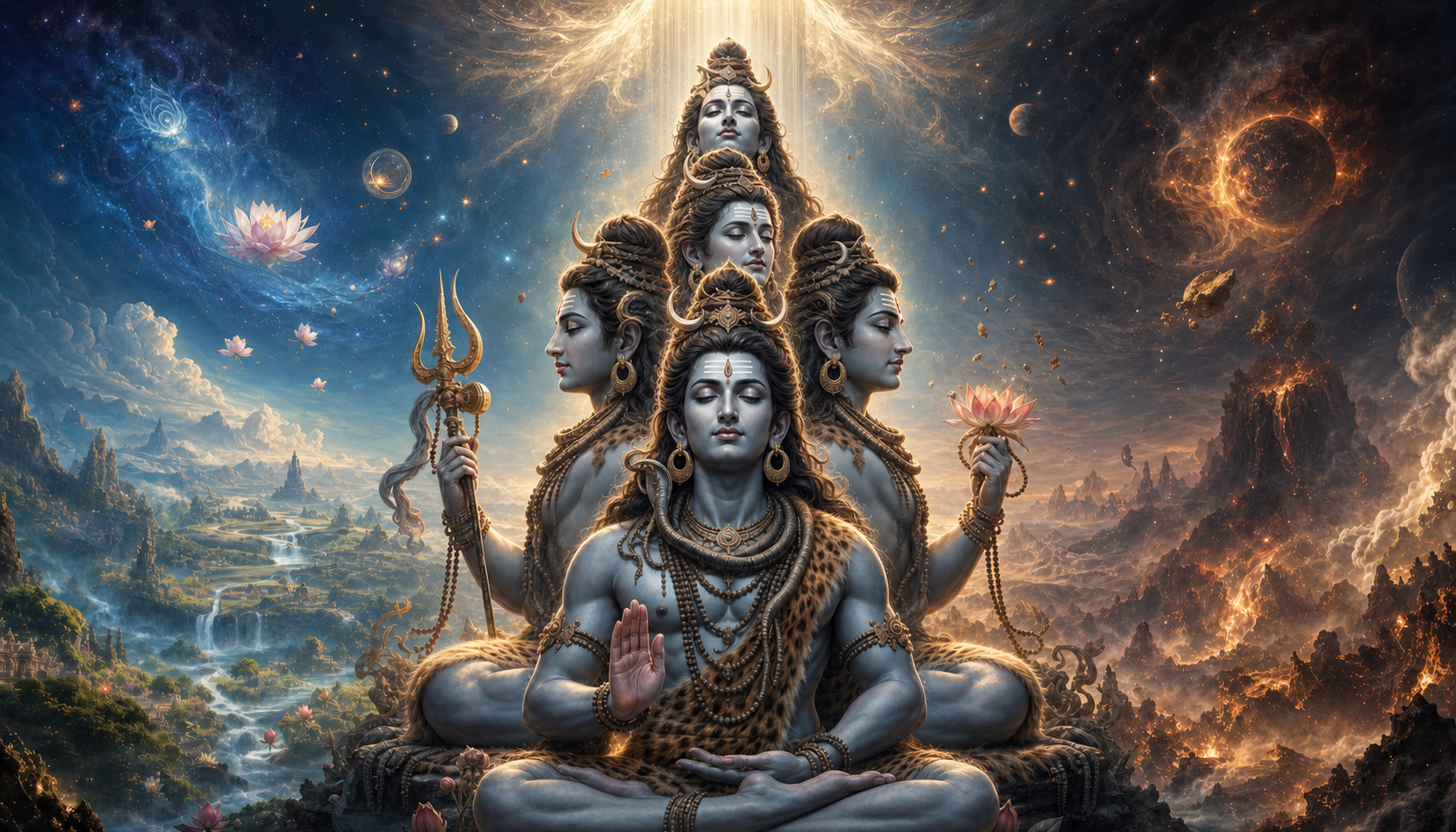
Shaiva philosophy teaches that the universe is not separate from Shiva but is Shiva in five continuous actscreation, preservation, dissolution, concealment, and grace. This article decodes Panchakritya and Panchabrahma, showing how the five acts and the five faces (Sadyojata, Vamadeva, Aghora, Tatpurusha, Ishana) structure both cosmic process and inner transformation. Drawing on Vedic, Upanishadic, Agamic,…
-
Master the Urdhva Tandava: Shiva’s Upward DanceIconography, Sacred Lore, and Inner Transformation

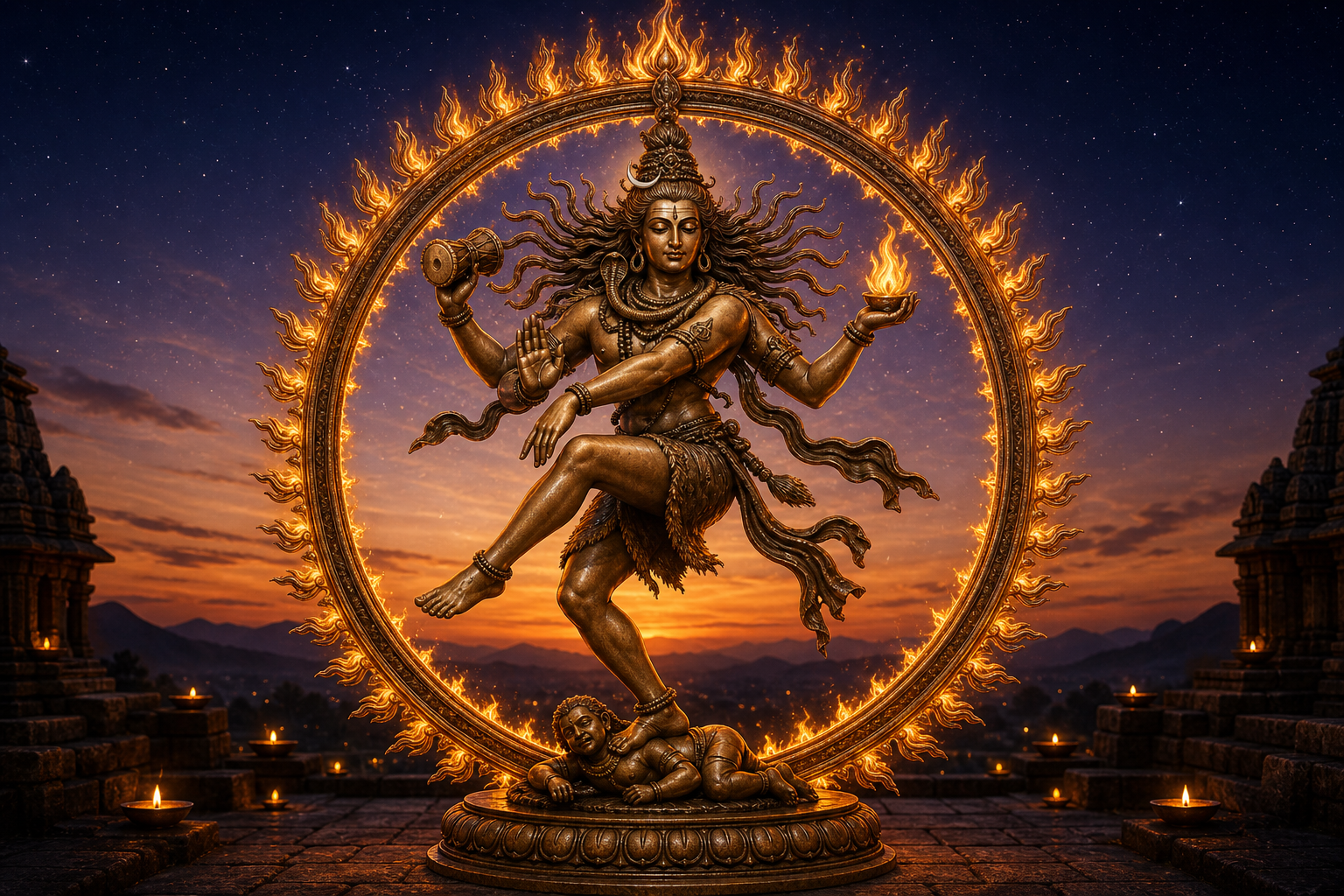
Urdhva Tandava, the Supreme Ascending Dance of Shiva, unites iconography, philosophy, and lived practice into a single upward current of grace. This article clarifies its etymology, situates the form within panchakritya and Shaiva thought, and reframes the Chidambaram lore with Kali as a non-dual harmony of Shiva–Shakti. It decodes the iconographyraised foot, damaru, agni, Apasmara,…
-
Alinga Mudra’s Sacred Embrace: Decoding Shiva–Shakti Union in Hindu Sacred Sculpture

Alinga Mudrathe sacred embraceunifies aesthetics, devotion, and philosophy in Hindu sculpture, especially in Uma–Maheshvara imagery. This long-form analysis decodes how the gesture functions within Agamic and shilpa canons, balancing intimacy with public beneficence through abhaya and varada. Regional case studies (Chola bronzes, Nepal Valley reliefs, Odisha’s Kalinga temples, and Hoysala sculpture) show diverse yet coherent…
-
Sattainathar, the Ascetic Bhairava: Tamil Iconography, Temple Rituals, and Transformative Meaning

This in-depth study presents Sattainathar as an ascetic, guardian form of Shiva aligned with Bhairava within Tamil Shaiva Siddhanta. It clarifies iconographytrident, skull-bowl, drum, dog vahanaand interprets each symbol through a rigorous philosophical lens. It situates Sattainathar historically in Tamil temple culture and Chola–Pandya art, while outlining Agamic and Purāṇic bases, including the Skanda Purana.…
-
Ekavali: Sacred Elegance of the Single Strand in Hindu Iconography and Temple Art

The Ekavaliliterally a single, unbroken strandanchors the visual and ritual logic of Hindu sacred art. Placed just below the throat, it defines the threshold of speech and mantra while harmonizing with longer hāras and garlands. From Gupta and Pāla–Sena stone to Chola bronzes, its form adapts to style yet preserves a consistent function: sacred simplicity…
-
Unveiling the Sacred Logic: Why Shiva’s Lilāmūrtis Adorn Temples Yet Rarely Receive Puja

Why do Shaivite temples display so many vivid forms of ShivaNataraja, Tripurantaka, Gajāsura-saṁhārayet focus daily worship on the Shiva-liṅga? This long-form, research-driven explainer shows how Shaiva Āgamas and Śilpa Śāstras place the aniconic liṅga at the contemplative center (garbhagṛha), while narrative lilāmūrtis teach theology through sight and participate in festivals as utsava-mūrtis. It clarifies the…
-
Shiva as the Tiger‑Slayer: Sardula Samhara Murti, Darukavana Myth and the Fall of Ritual Ego

Sardula Samhara Murti portrays Shiva as the Tiger‑Slayer of Darukavana, an image that dissolves ego and ritual pride rather than celebrating brute force. The narrative anchors a subtle theology: saṁhāra is the removal of inner obstructions, not annihilation of life. By reading the icon’s visual grammartiger skin, serpents, ḍamaru, and agnireaders gain a practical key…
-
Dashabhujeshwara Decoded: Five-Faced, Ten-Armed ShivaIconography, Mantras, Ritual Power

Shiva’s Dashabhujeshwara formfive-faced and ten-armedembodies the Pañcabrahma theology in which one Absolute performs five cosmic acts: creation, sustenance, dissolution, concealment, and grace. Drawing on the Śiva Purāṇa, Āgamas, and Śilpa-Śāstras, this explainer clarifies how each face (Tatpuruṣa, Aghora, Vāmadeva, Sadyojāta, Īśāna) aligns with directions, mantras, and meditative practice. It decodes the ten arms as sovereignty…
-
Gajasurasamhara: Shiva’s awe-inspiring conquest of ego – history, symbolism, style

Gajasurasamhara presents Shiva in a fierce, transformative dance that subdues the elephant demonan enduring visual lesson on conquering ego. This long-form, research-driven overview traces the form’s Purāṇic and Āgamic foundations and explains its technical iconography, from multi-armed attributes and the distinctive elephant-hide canopy to posture, ornaments, and attendant figures. It maps stylistic evolutions across Pallava,…
-
Revealing the Sacred Beauty of Imperfection: Why Authentic Hindu Bronzes Aren’t Flawless

Authentic Hindu bronze sculptures are often misjudged by a modern expectation of machine-like perfection. This essay explains, in academic yet accessible terms, how lost-wax casting and panchaloha metallurgy naturally produce subtle surface variations that signal authenticity. It decodes sprue scars, chasing marks, porosity pinholes, and asymmetry as the normal fingerprints of traditional workmanship rather than…
-
Samhara of Shiva: Unveiling the Compassionate Power of Dissolution and Renewal

Samhara, the dissolution aspect of Shiva, is not violent destruction but compassionate renewal that clears exhausted forms so truth can shine. Grounded in Vedic, Purāṇic, and Āgamic sources, this long-form analysis explains how Samhara interlocks with Shiva’s five acts to sustain cosmic and personal transformation. The iconography of Naṭarāja, Mahākāla, and Kālābhairava decodes dissolution as…
-
Shiva’s Damaru: Decoding the Cosmic Rhythm of Creation, Balance, and Transformation

This long-form exploration decodes Shiva’s Damaru as a compact, technical map of creation, balance, and transformation in Hindu philosophy. It explains Nāda-Brahma, the A-U-M schema, and the panchakritya while situating the drum’s meaning within linguistic tradition via the Maheshvara Sutras and Panini’s grammar. Readers gain an acoustical and yogic understanding of the instrument, including how…
-
Ananda Tandava Unveiled: Decoding Shiva Nataraja’s Blissful Cosmic Dance and Living Wisdom

Ananda Tandava, Shiva Nataraja’s blissful dance, is a complete grammar of Hindu philosophy translated into gesture, rhythm, and form. This comprehensive overview traces its roots in the Agamas, Puranas, and Bhakti hymns, and explains how the five divine acts (panchakritya) appear in Nataraja’s iconography. Readers learn how Chidambaram’s Chidambara Rahasya and the Pancha Sabhas embody…
-
Tripura Tandava of Shiva: Decoding the Sixteen-Armed Dance of Cosmic Dissolution

Tripura Tandava, often aligned with Shiva’s role as Tripurāntaka, encapsulates the precise instant of cosmic dissolution where triadic structures resolve into pure awareness. Grounded in the pañcakṛtya framework, it brings together saṁhāra (dissolution) and tirodhāna (concealment) to culminate in laya (absorption). The post examines Purāṇic narratives, āgamic iconographyincluding the striking sixteen-armed conventionand the dance grammar…
-
Bhujanga Lalita Tandava: Decoding Shiva’s Serpentine Grace and the Defeat of Avidya

Bhujanga Lalita Tandava unites Shiva’s dynamic tandava with the soft cadence of lalita, translating complex Shaiva metaphysics into a clear, embodied grammar of movement. The dance’s serpentine wave, read through kundalini symbolism, demonstrates how intelligence and grace transform raw force into awakened action. Iconography of Natarajaespecially the subduing of Apasmara (avidyā)grounds an ethics where clarity…
-
Kalika Tandava Decoded: Shiva’s Eight‑Armed Cosmic Dance of Renewal and Liberation

Kalika Tandava presents Shiva’s eight‑armed dance as a rigorous map of cosmic processes and inner transformation. The iconographyAbhaya and Varada mudras, damaru, agni, trishula, kapala, and moretranslates metaphysics into a readable visual grammar. Drawing on Shaiva Agamas, Shilpa‑Shastras, and the Natya Shastra, the form aligns creation and dissolution with a living rhythm practitioners can contemplate…
-
Sandhya Tandava at Dusk: Decoding Shiva Nataraja’s Twilight Dance and Its Living Wisdom

Sandhya Tandava is the twilight expression of Shiva Nataraja’s cosmic dance, performed before an illustrious assembly with Goddess Parvati as witness. It ritualizes the liminal hour when day turns to night, aligning personal worship with cosmic rhythm. Iconographydamaru, flame, abhaya mudra, and Apasmaramaps directly to the five divine acts and becomes especially evocative at dusk.…