Two namesGauranga and Nimaicondense a theology, a cultural memory, and a living devotional practice around Chaitanya Mahaprabhu (1486–1534). In the Bhakti Tradition of Bengal and beyond, these epithets function as symbols that describe an arc from intimate, protective domesticity to luminous, public compassion, mirroring the historical expansion of Gaudiya Vaishnavism and its emphasis on Nama Sankirtana (collective chanting of the holy names).
Chaitanya Mahaprabhu, widely honored within the Hare Krishna Movement as Sri Krishna himself appearing in a golden form, catalyzed a devotional renaissance in early sixteenth-century Bengal. Centered in Navadvipa (Nadia) and later radiating from Jagannath Puri, his movement emphasized accessible devotion, congregational chanting, and scripturally grounded love of God. The names “Nimai” and “Gauranga” capture distinctive facets of this life and message, and their symbolism continues to inform practice, aesthetics, and theology.
In South Asian religious cultures, names frequently serve as portable theology. They encode relationships, virtues, metaphysical assertions, and communal memories. For Gaudiya Vaishnavas, “name” (nama) and “form” (rupa) are inseparable in contemplative practice; uttering a sacred name is simultaneously an invocation of presence. Within this hermeneutic, “Gauranga” and “Nimai” are not mere biographical nicknames; they are interpretive keys to the inner meaning of Chaitanya’s life.
“Nimai” is the affectionate childhood name used by family and neighbors in Navadvipa. Gaudiya hagiographiesespecially the Chaitanya Bhagavata and the Chaitanya Charitamritarecord that he was born beneath a neem (Azadirachta indica) tree, a detail that generated the epithet “Nimai.” The neem association reflects widespread folk and Ayurvedic understandings of the tree’s protective and purifying qualities. In early modern Bengal, bestowing such a name signaled a maternal, domestic wish for safety and well-being.
This protective usage is culturally resonant. Neem leaves have long been hung at thresholds, woven into festival decor, and used in bathing and fumigations to ward off illness. In classical Ayurveda, nimba (neem) is documented for its tikta (bitter) rasa, purificatory action, and cleansing potency. Thus, the epithet “Nimai” is not incidental; it situates Chaitanya within a matrix of Bengal’s household piety, medicinal knowledge, and ritualized carewhere the sacred begins at home and radiates outward.
Symbolically, “Nimai” conveys the theme of purification. The “bitter” that cleanses becomes a theological metaphor: just as neem removes impurities, Chaitanya’s early lifeas a prodigious scholar named Vishvambharacleansed intellectual pride and social discord through a gentle, reforming presence. For many practitioners today, the name “Nimai” evokes intimacy, a mother’s hope, and the assurance that transformative grace begins with protection and inner clarity.
“Gauranga,” by contrast, belongs to a broader, public, and explicitly theological register. Etymologically, it derives from Sanskrit gaura (golden, fair, radiant) and anga (limb, body), yielding “the one with golden limbs” or “the golden-complexioned one.” Within Gaudiya Vaishnava theology, this golden radiance signifies Sri Krishna assuming the mood and the luminous hue associated with Sri Radhaan interpretation crystallized in the theological axiom “radha-bhava-dyuti-suvalita.”
Gaudiya sources repeatedly foreground this point. The Chaitanya Charitamrita presents Sri Chaitanya as Sri Krishna tasting the love of Radha and offering prema-bhakti as a universal gift in the Kali age. The “golden” (gaura) hue communicates both identity and mission: identity as Krishna enriched by Radha’s compassion, and mission as the radiant outpouring of divine love through Nama Sankirtana.
Aesthetically, “Gauranga” encodes an ideal Bhakti rasa. In literature attributed to Rupa Goswami and in the wider Gaudiya aesthetic discourse, sweetness (madhurya), grace, and gentleness permeate devotion. “Gauranga” names a theological beauty: arms uplifted in kirtana, countenance suffused with compassion, and a presence that dissolves estrangement. For communities across Bengal and Odisha, artistic depictions of Gauranga’s golden formoften with associatesserve as visual pedagogy, making theology tangible.
Philologically, gaura in classical Sanskrit connotes brightness, radiance, and in specific contexts, a golden or fair hue; as a theonymic epithet, it points to luminosity rather than any modern racialization of color. The compound “Gauranga” thus functions as a doctrinal précis: radiance as a sign of inward love, outward compassion, and a soteriological role as yuga-avatara (a redeemer for the present age) centered on chanting.
There is also a subtle sociolinguistic contrast. “Nimai” belongs to the domestic spherespoken by mother Śacī Devī, kin, and neighborsand registers protection and belonging. “Gauranga” belongs to the congregational sphereintoned in kirtana and samajaregistering shared aspiration and universal outreach. Together, they map a movement from home to world, from intimacy to inclusion, from neem’s protective shade to the golden radiance of public compassion.
Historically, this movement is legible in Chaitanya’s life course: prodigy and teacher in Navadvipa, renunciate in Katwa, and mystic exemplar in Jagannath Puri. The devotional program that followedNama Sankirtana, scriptural engagement with Bhagavata Purana, and a refined theology transmitted by the Goswamisplaced accessible chanting at the heart of communal transformation. The discovery and veneration of texts like the Brahma-samhita in the Gaudiya lineage further deepened the scriptural scaffolding of this practice.
From a scriptural standpoint, Bhagavata Purana’s emphasis on hari-kirtana in Kali Yuga sets a pan-Indic frame for Gaudiya practice. Within this horizon, “Gauranga” becomes an interpretive emblem of the gift of kirtanadevotees hold that the golden form manifests to make the highest love (prema) available through the simplest means, the chanting of divine names.
The ritual grammar of Gaudiya practice reflects the centrality of these names. The congregational invocation“sri-krsna-caitanya prabhu nityananda sri-advaita gadadhara srivasadi gaura-bhakta-vrinda”precedes kirtan in many traditions, honoring the Pancha Tattva and invoking a devotional mood characterized by humility, joy, and mutual uplift. Chants of “Gauranga” or combined invocations like “Nitai-Gaur” serve both as devotion and pedagogy, teaching doctrine through sound.
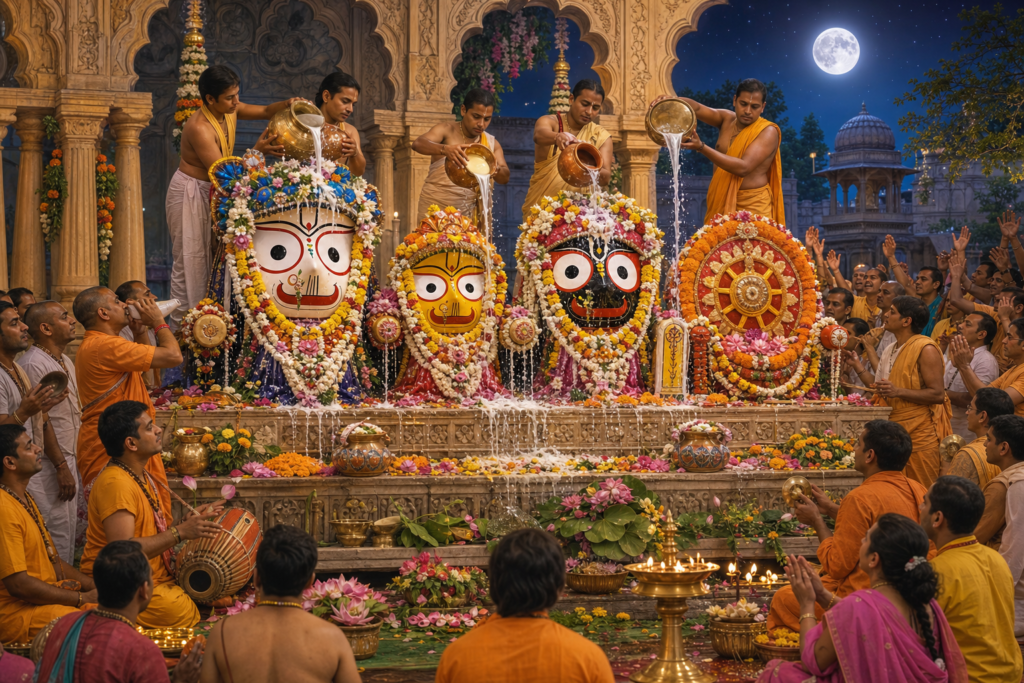
Culturally, Gaurapurnimacommemorating the appearance of Sri Chaitanyabecomes the liturgical culmination of this symbolism. Communities in Bengal, Odisha, and a global diaspora shaped by the Hare Krishna Movement (ISKCON) mark the day with fasting, kirtan, and recitations from Gaudiya texts. In these observances, “Nimai” animates the intimate memory of birth under a neem tree, while “Gauranga” animates the universal festival of light that followed.
Interpreted through the lens of shared Indic wisdom, the two names also resonate with broader dharmic values cherished across Hinduism, Buddhism, Jainism, and Sikhism: compassion, non-harm, interior purification, and the unifying power of remembrance of the divine. The deep ethic of inclusivity implicit in Nama Sankirtana finds parallels in practices such as naam-simran within Sikh tradition and in the wider Indic esteem for inner purification and compassionate living found across the dharmic spectrum. The symbolic pairing of neem’s purificatory care and golden radiance invites a vision of inter-traditional harmony.
From a comparative-religion perspective, the epithet-praxis seen here is not merely ornamental. Honorific names across dharmic traditions encode soteriological functions and ethical ideals. “Nimai” emphasizes the maternal and medicinalthe household’s responsibility to nurture and protect. “Gauranga” emphasizes the public and salvificthe community’s responsibility to gather, sing, and share compassion. Together, they articulate an ethic of personal transformation and social harmony.
Contemporary relevance is clear. For many practitioners worldwide, hearing “Gauranga” evokes warmth, belonging, and a shared moral horizon that crosses caste, region, and language. For Bengalis, “Nimai” still carries the tenderness of family memory and local sacred geography, linking Navadvipa’s lanes, neem groves, and scholastic culture with the global soundscape of kirtan.
As scholarship continues to explore Gaudiya historyits roots in Gauda-desha (Bengal), its interactions with Jagannath traditions in Puri, and its textual legacy through Goswami literaturethe symbolic clarity of these names offers a reliable compass. “Nimai” points to origin, protection, and purification; “Gauranga” points to mission, radiance, and universal embrace. Their complementarity keeps devotional discourse grounded, humane, and oriented toward unity.
In sum, the dual symbolism of “Nimai” and “Gauranga” provides a compact theology of Chaitanya Mahaprabhu: neem-born humility blossoming into golden grace; household affection widening into congregational uplift; inner cleansing unfolding as public compassion through Nama Sankirtana. These names remain living bridgesbetween home and temple, scholarship and song, and among the dharmic traditions that cherish compassion, wisdom, and unity.
Inspired by this post on Hindu Blog.