-
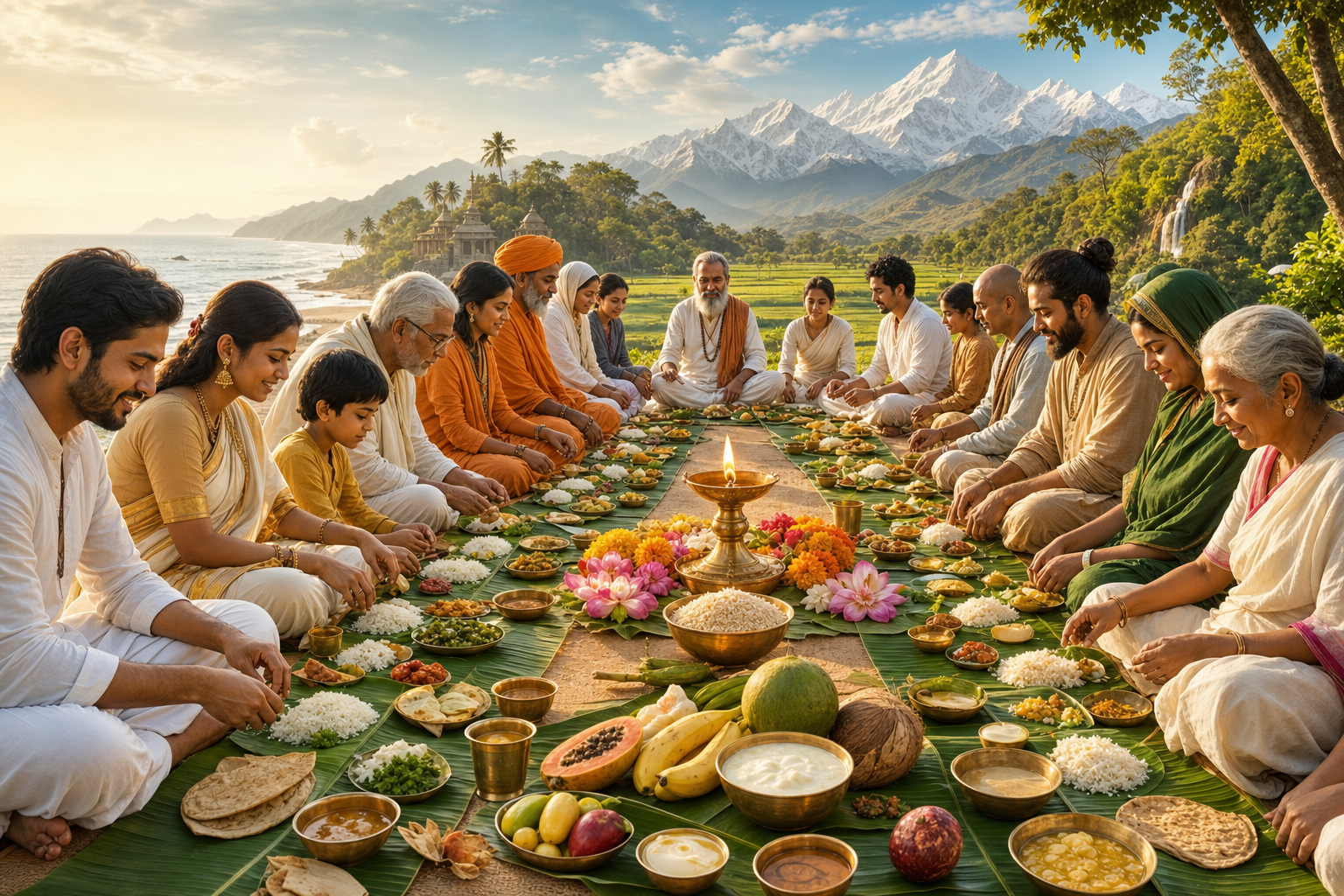
The Fragrance of Truth: Why Dharmic Spiritual Wisdom Must Never Be Bought or Sold

A flower does not sell its fragrance—this classical metaphor explains why authentic spirituality in Hinduism, Buddhism, Jainism, and Sikhism cannot be commodified. Drawing on the Upanishads, the Bhagavad Gita, and core dharmic values such as aparigraha, seva, and anekantavada, this analysis distinguishes stewardship from sale and gratitude from price. It shows how guru–shishya pedagogy, dhamma-dana,…
-
Nandagopa, Krishna’s Foster-Father: A Powerful Study in Dharma, Adoption, and Love Beyond Blood

Nandagopa—Nanda Maharaja of Vraja—embodies a dharmic model of fatherhood defined by nurture rather than blood. Drawing on the Bhagavata Purana and allied traditions, this analysis situates him as Krishna’s foster-father who performs samskaras, protects the child, and leads the Gopa community with ethical clarity. The study explores adoption and kinship in Dharmashastra, shows how bhakti…
-
Liberate the Self: Hindu, Buddhist, Jain, and Sikh Insights on Embracing True Nature

This long-form essay explores how Hinduism, Buddhism, Jainism, and Sikhism converge on a single, practical insight: suffering intensifies when one strives to become someone other than one’s true nature. Drawing on the Upanishads, Bhagavad Gita, Yoga Sutra, Sāṅkhya analysis, Buddhist teachings on craving and anatta, Jain doctrines of aparigraha and anekāntavāda, and Sikh wisdom on…
-
Shattering the Myth: Why Enlightenment Demands Action—Dharma, Karma Yoga, and Sacred Work

Many assume enlightenment frees a person from work; Hindu philosophy and its dharmic counterparts show the opposite. The Bhagavad Gītā teaches that action is unavoidable and must be transformed through Karma Yoga into selfless service. Dharma aligns individual role and aptitude with the common good, while prārabdha karma explains why even the realized remain outwardly…
-
Decoding Kamadeva’s Five Arrows: How the Senses Shape Desire, Dharma, and Creation

Kamadeva’s five flower-tipped arrows and sugarcane bow form a precise allegory for how the senses animate desire and sustain the cosmic cycle of life. Read as psychology, the allegory maps stimulus, attention, valuation, and pursuit; read as theology, it integrates kāma into the puruṣārthas alongside dharma, artha, and mokṣa. The Madana-dahana narrative shows desire sublimated…
-
Hindu Wisdom Beyond Pride: Shattering Ego’s Illusion to Reveal the Sacred in All Creation

This essay examines the illusion of worthlessness through Hindu philosophy and a classic teaching tale, The Search for the Void. It explains how ahaṃkāra (ego) and avidyā (misapprehension) distort judgment, while the Upaniṣadic vision—īśāvāsyam idaṁ sarvam and sarvaṁ khalvidaṁ brahma—reveals intrinsic, relational value. A detailed retelling of the Guru–Śiṣya narrative shows how “void” becomes a…
-
Already Enough: Dharmic Wisdom on Love, Self-Acceptance, and Living Authentically Today

The post argues that love and acceptance are not earned through perfection but revealed through authentic living, aligning with core insights of Hinduism, Buddhism, Jainism, and Sikhism. It explains Atman, anatta, anekantavada, and Ik Onkar as complementary lenses for intrinsic worth and compassionate action. Drawing on the Bhagavad Gita and Upanishads, it reframes perfectionism as…
-
Beyond the Frame: Why Hindu Deity Images Seem Incomplete—Revealing Infinity and Dharmic Unity

Many observers assume Hindu deity images are incomplete because they appear stylized, aniconic, or schematic. In classical Hindu thought, however, every sacred image is complete in essence (tattva) and intentionally incomplete in form (rupa), a design that honors the Upanishadic insight that the infinite cannot be fully pictured. Shilpa Shastras, temple architecture, and ritual consecration…
-
Are the Puranas Just Fiction? A Rigorous, Heart-Centered Guide to Finding God and Trusting Truth

Are the Puranas fiction or a reservoir of living wisdom? This analysis explains how Puranic narratives operate beyond a literal-versus-fable dichotomy by integrating mythic memory, ethics, ritual rationale, and contemplative instruction. Drawing on Indian epistemology (pramāṇa), it clarifies how śabda (trustworthy testimony), anumāna (inference), and yogic pratyakṣa (direct insight) jointly ground a rational, testable faith.…
-
Learning Without Chains: Hindu-Dharmic Wisdom to Turn Past Mistakes into Clarity and Power

This essay examines how Hinduism and allied dharmic traditions treat the past as a teacher rather than a burden. It integrates Hindu concepts such as karma, saṃskāra, smṛti, and karma-yoga with Yogic psychology (abhyāsa, vairāgya), Buddhist mindfulness (sati), Jain Anekantavada with Pratikraman, and Sikh teachings on hukam and Naam simran. Readers gain a clear, compassionate…
-
Why Nothing Is Ever Lost: Dharmic Wisdom to Transform Grief into Clarity and Peace

This long-form exploration explains why, across Hinduism, Buddhism, Jainism, and Sikhism, nothing is ever truly lost—forms change while meaning, memory, and value continue. It clarifies Vedanta’s two levels of truth, showing how the atman remains untouched even as prakriti transforms. It integrates Buddhist dependent origination, Jain Anekantavada, and Sikh Hukam to present a unified dharmic…
-
Beyond Pralaya and Kalpa: How Hinduism Envisions the Universe Folding Back into Itself

Hindu cosmology describes an immense, cyclical universe in which worlds arise, endure, and dissolve through patterned phases of creation and reabsorption. This article clarifies key terms—pralaya and kalpa—details their fourfold typology, and lays out precise time scales from yugas to Brahmā’s lifetime. It integrates Purāṇic, Vedāntic, Vaiṣṇava, Śaiva, and Śākta views, and relates them to…
-
Embracing Sukha and Dukha: Dharma’s Transformative Science of Resilience and Freedom

This essay explains why Sanatana Dharma views Sukha (happiness) and Dukha (distress) as complementary threads woven into the fabric of life. Drawing on the Bhagavad Gita, the Yoga Sutra, and convergent insights from Buddhism, Jainism, and Sikhism, it shows how Dharma transforms hardship into clarity and compassion. Readers learn practical methods—Karma Yoga, Bhakti, Jnana, Raja…
-
Jada Bharata vs. Kali Yuga: Unmasking Algorithmic Gurus and Reclaiming Timeless Dharma

Jada Bharata’s encounter with the modern attention economy offers a precise lens for navigating Kali Yuga’s spiritual noise. Grounded in the Bhagavata Purana, the sage’s teachings on vairagya, mauna, sakshi-bhava, and nishkama-karma map cleanly onto today’s influencer culture and consumer spirituality. Clear criteria from the Upanishads and the Gita help distinguish authentic guidance from spectacle…
-
Beyond Labels: Hindu, Buddhist, Jain, and Sikh Wisdom to Reclaim Identity and Inner Freedom

Modern society rewards borrowed identities built on titles, metrics, and public narratives, yet Hindu wisdom—and allied dharmic perspectives—offers a precise path to inner freedom. Drawing on the Upanishads, Bhagavad Gita, Yoga Sutras, and the Pancha Kosha model, this essay distinguishes social roles from the enduring Self. It explains how avidya, maya, and the kleshas distort…
-
Cut Through the Noise: Yoga Vasistha’s Radical Call for Direct Experience over Debate

Yoga Vasistha confronts the overload of modern discourse with a precise remedy: shift from argument to direct experience. Framed as a dialogue between Vasishta and Rama, this classical Hindu scripture privileges aparoksha-anubhuti—immediate realization—over conceptual accumulation. It maps a practical path through dispassion, inquiry, meditation, and ethical alignment, showing how transformation is verified in everyday equanimity…
-
Modern Education’s Illusion of Control: Dharmic Wisdom to Build Resilient, Purposeful Lives

Modern culture often trains people to believe life can be engineered into submission. Dharmic traditions—Hinduism, Buddhism, Jainism, and Sikhism—offer a corrective: disciplined agency paired with principled surrender. The Bhagavad Gita’s focus on action without attachment, the Yoga Sutra’s blend of practice and non-attachment, Buddhism’s insight into impermanence, Jainism’s many-sidedness, and Sikhism’s hukam together form a…
-
Ego’s Illusion of Difference: Dharmic Wisdom on Avidya, Unity in Diversity, and Healing

This essay examines why humans manufacture differences where none ultimately exist, using a dharmic framework drawn from the Upanishads, the Bhagavad Gita, Yoga Sutra, Anekantavada, Buddhist anatta, and Sikh teachings on Ik Onkar. It explains how avidya and ahankara harden provisional distinctions into identity, and how sama-darshana resists that process. It integrates classical Indian logic…