

A regional temple convention convened by the Karnataka Mandir Mahasangh in Bagalkot has issued an urgent appeal to the state government: allocate a structured, ring-fenced budget for the renovation, preventive maintenance, and professional management of Hindu temples across Karnataka. The deliberations emphasized that living places of worship are not only sacred sites for devotees but are also repositories of art, craft, music, social welfare traditions, and regional livelihoods, warranting sustained public attention and systematic care.
Bagalkot’s own cultural landscape—situated along the historic Badami–Aihole–Pattadakal corridor—illustrates the scale and significance of Karnataka’s temple heritage. From small village shrines to architecturally renowned complexes, the ecosystem of temples supports ritual continuity, community kitchens (annadanam), festivals, artisanal employment, and micro-enterprises. Participants at the convention underscored that deferred maintenance, fractured governance, and inadequate funding place this living heritage at risk, with consequences for safety, dignity of worship, and local economies.
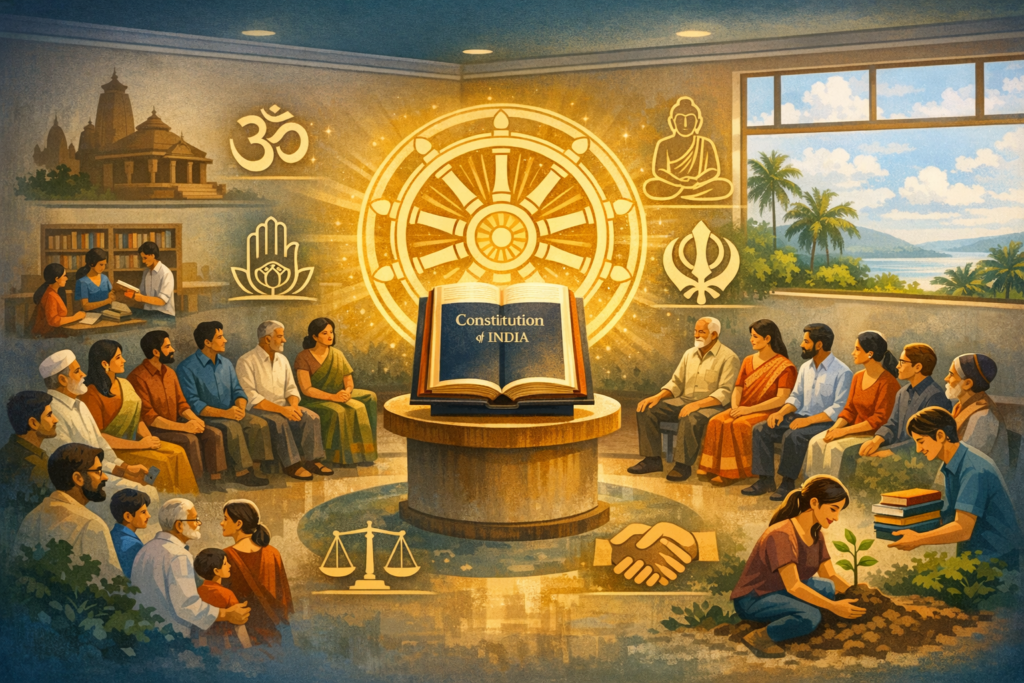
The convention’s call aligns with a broader, dharmic view of civilizational stewardship. While specific ritual codes and architectural idioms differ across Hinduism, Buddhism, Jainism, and Sikhism, their institutions share commitments to compassion, learning, service, and the safeguarding of sacred spaces. Strengthening conservation frameworks for temples can therefore be designed to foster unity among dharmic traditions, encourage knowledge exchange, and inspire inclusive, community-led care for heritage assets.
Current challenges are multidimensional. Many temples fall under the Department of Hindu Religious Institutions and Charitable Endowments (commonly known as the Muzrai Department), while others are managed by trustees, peethas, mathas, or community bodies; a subset of ancient monuments is protected by archaeological authorities. This administrative plurality—valuable for local autonomy—can nonetheless fragment technical standards and funding flows, resulting in uneven upkeep, ad hoc repairs, and overreliance on short-term fixes instead of preventive maintenance cycles.
The consequences are visible in structural deterioration (cracks, moisture ingress, joint failure), electrical and fire-safety gaps, inadequate sanitation and drainage around precincts, and limited barrier-free access for the elderly and persons with disabilities. Moreover, archaka welfare, archival documentation, and risk preparedness (for fire, floods, and crowd surges) remain under-prioritized in many places. The convention highlighted that a comprehensive budgetary response must couple conservation engineering with humane, dignified facilities for devotees and staff.
To address these gaps, speakers advocated a ring-fenced Temple Conservation and Community Services Fund within the state budget. Such a fund would prioritize life-safety and structural stability, provide predictable maintenance grants to smaller temples with low revenues, and support training, documentation, and digital oversight. Crucially, the fund should be outcome-driven, transparent, and structured to attract convergent resources from culture, tourism, rural infrastructure, renewable energy, and skill-development schemes—without compromising ritual integrity or local customs.
A technically grounded asset-management approach can organize works plans and budgets with clarity. This includes a state-wide baseline survey and condition assessment; GIS mapping of temple sites and precinct services; a five-year rolling conservation and maintenance plan with yearly milestones; and a preventive maintenance schedule (cleaning, drainage upkeep, termite control, lime-mortar pointing, and routine electrical safety checks) that reduces costly emergency interventions.
Structural and life-safety interventions should be guided by conservation principles that respect original materials and craftsmanship. Where technically feasible, compatible traditional materials—such as lime-based mortars and stone repair techniques—ought to be preferred, complemented by modern diagnostics (non-destructive testing, moisture mapping) to guide minimal, reversible interventions. Electrical retrofits, fire-detection and suppression, lightning protection, and emergency egress improvements can be sensitively integrated to protect both people and fabric.
Equally critical is comprehensive documentation. A digital inventory—photogrammetry, measured drawings, inscriptions registers, movable icons documentation, and condition photography—provides an authoritative baseline to manage change responsibly. Publicly accessible dashboards can track the status of works, tender timelines, budgets released and utilized, and post-completion audits, improving citizen trust and enabling informed oversight by community stakeholders.
Conservation ethics must be paired with ritual propriety. All planning and execution should be harmonized with Agama-shastra where applicable, and with the maryada of each temple’s sampradaya. This ensures sanctity of the garbhagriha and ritual sequences, appropriate materials in sacred zones, and careful sequencing of works to avoid festival disruptions. Consultation with peethas, acharyas, and hereditary functionaries can ensure that technical solutions reinforce the living traditions of worship.
Capacity building is indispensable. Karnataka’s storied tradition of sthapatis, shilpis, stone carvers, metalworkers, and conservators can be strengthened through structured apprenticeships, short courses, and certification jointly delivered by architecture schools, polytechnics, and heritage institutions. Field schools—on live conservation sites—can transmit tacit knowledge while training a new generation in safety, documentation, and ethical practice.
Community participation enhances both legitimacy and outcomes. Local oversight committees—comprising trustees, community representatives, women’s self-help groups, and technical advisors—can review project scopes, monitor procurement, and resolve grievances. Routine social audits, public display of scope and budgets at temple entrances, and open community briefings foster accountability and create shared ownership of the conservation journey.
Financing must be predictable and multi-sourced. Alongside state grants, guidelines can encourage responsible Corporate Social Responsibility (CSR) participation and philanthropic contributions toward public amenities (water, sanitation, queue systems, medical first-aid, waste management) and skills development. Clear boundaries are important: sacred architecture and ritual zones should be guided by tradition and qualified conservation professionals; donor visibility should emphasize public welfare infrastructure and transparency rather than intrusive branding.
When planned with sensitivity, conservation and improved amenities can boost inclusive local development without commodifying the sacred. Pilgrimage circuits, artisanal markets, cultural performances, and traditional food ecosystems benefit from clean, safe, and well-managed precincts. This multiplier effect supports dignified livelihoods while ensuring that devotees—especially the elderly and children—experience darshan with comfort and safety.
The unity of dharmic traditions offers a powerful template for policy design. A consultative Temple and Dharmic Heritage Council—featuring expertise from Hindu, Buddhist, Jain, and Sikh institutions—can codify shared standards on disaster risk reduction, documentation, artisans’ welfare, and community services. Such a forum would nurture mutual respect for each tradition’s maryada while aligning on technical excellence and public accountability.
Bagalkot’s context also underscores the value of integrated planning across heritage clusters. Well-documented conservation programs show that when urban services (drainage, waste, mobility), environmental management (water bodies, sacred groves), and heritage works are planned together, both the lived sacred experience and heritage integrity improve. Coordinating temple works with municipal and rural infrastructure upgrades prevents rework and protects investments.
Transparency safeguards must be systemic. E-tendering with standardized conservation bill-of-quantities, clear pre-qualification for specialized trades, independent technical review panels, third-party quality audits, and time-bound payments will improve delivery. Publishing all contracts, drawings, and completion reports (barring sensitive security details) sets a high bar of public trust consistent with the sanctity of temple governance.
A pragmatic roadmap can start with a 180-day statewide baseline survey and an initial allocation in the upcoming budget cycle. Priority Phase I works would focus on life-safety, structural stabilization, and sanitation at high-footfall temples and vulnerable rural shrines. Phase II would scale preventive maintenance, documentation, and training, while Phase III embeds continuous improvement through periodic audits, refresher trainings, and technology upgrades.
Measurable outcomes keep the effort focused. Suggested indicators include the percentage of temples with current condition assessments, number of sites with completed structural and fire-safety upgrades, reduction in incident reports, artisans trained and certified, volume of digital documentation completed, and devotee satisfaction metrics captured through anonymous kiosks and helplines. Publishing progress biannually normalizes accountability.
Equity must remain central. While prominent temples attract donations, smaller rural shrines—often the spiritual heart of agrarian communities—require targeted support. Predictable micro-grants for routine upkeep, emergency maintenance reserves during monsoons, and mobile technical teams for inspection ensure that sacred dignity and safety are not contingent on income levels.
Environmental stewardship belongs within sacred stewardship. Rainwater harvesting for abhishekam needs, greywater reuse for gardens, solar lighting in outer precincts, native-tree landscaping, and plastic-waste minimization can be implemented without intruding upon ritual zones. Such measures align spiritual values with sustainability and reduce operating costs over time.
Temples have historically extended care beyond their walls: feeding pilgrims, supporting learning, hosting arts, and offering refuge in times of distress. Formalizing community services—first-aid counters, quiet rooms for elders, child-friendly waiting areas, and safe drinking water—dignifies the devotee experience and expresses the ethos of seva that dharmic traditions collectively cherish.
The Karnataka Mandir Mahasangh’s appeal from Bagalkot is therefore not a narrow funding request but a civilizational policy proposition: protect living heritage through professional, inclusive, and accountable public investment that honors tradition while embracing modern safety and management standards. With a dedicated budget, clear technical protocols, and robust community oversight, Karnataka can set a national benchmark for temple conservation and dharmic unity in action.
Devotees and visitors often recall how a well-kept pradakshina path, the cool shade of sacred trees, and the unhurried rhythm of aarti transform a visit into a moment of inner quietude. Systematic care ensures that such experiences remain available to future generations—not as museum encounters, but as living, breathing acts of faith that bind families, neighborhoods, and the broader dharmic community in shared reverence and responsibility.
Inspired by this post on Hindu Jagruti Samiti.










Leave a Reply
You must be logged in to post a comment.