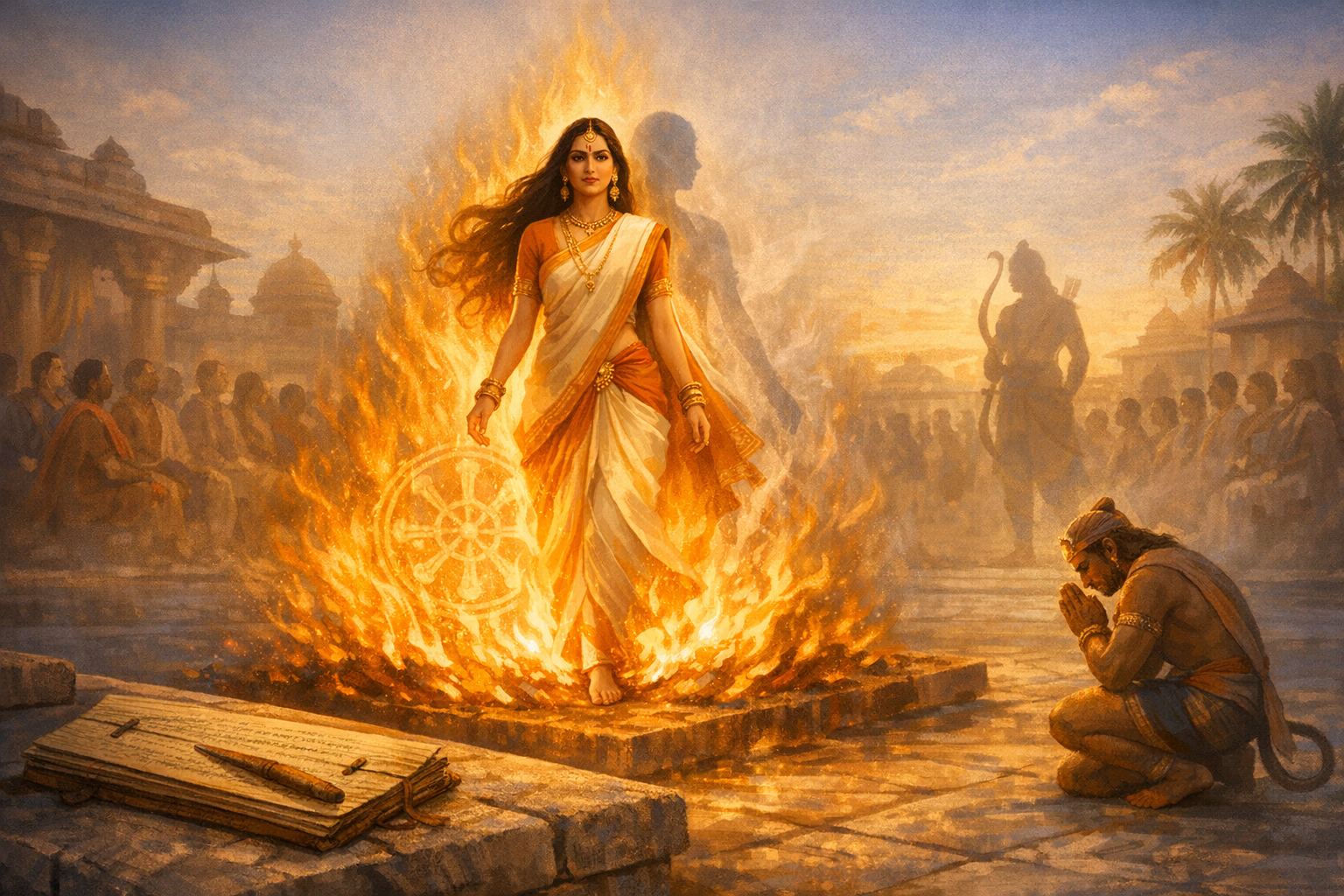
The idea of a Maya Sita—an illusory or chhaya (shadow) Sita substituted before Ravana’s abduction—has captured imaginations for centuries. Yet, within the Valmiki Ramayana as preserved in the critical scholarly tradition, this motif is absent. Understanding why it is missing illuminates both the narrative integrity of Valmiki’s epic and the theological evolution that later devotional texts embraced. It also reveals how the Ramayana tradition, across Hinduism and the broader dharmic family, holds space for multiple layers of meaning while honoring a common ethical core.
Maya Sita typically refers to a protective duplicate of Sita created by Agni or divine agency so that the “real” Sita never comes under Ravana’s touch. This variant appears in several medieval and early modern tellings and Puranic narratives, often to resolve the emotional and doctrinal discomfort some readers feel regarding Sita’s abduction and subsequent Agni-praveśa (commonly called Agni Pariksha). In these versions, the ordeal becomes the moment when the original Sita is returned to Rama and the Maya Sita is released back to Agni, thereby safeguarding Sita’s purity beyond question.
By contrast, the Valmiki Ramayana’s Yuddha Kāṇḍa presents a different narrative logic: Sita is rescued from Lanka and, before a gathered assembly, enters the fire as a public vindication of her integrity. Agni emerges as sakṣi (witness), affirming her spotless character. No prior exchange-of-Sita episode is narrated. This is not a mere omission; it is a conscious literary and ethical architecture that makes Sita’s voice, Rama’s role as maryādā puruṣottama, and the social gaze central to the story’s moral complexity.
Textual criticism strongly supports this reading. The critical edition of the Valmiki Ramayana—collating northern and southern manuscript families—does not attest to a Maya Sita substitution. While the Uttara Kāṇḍa itself is often debated for its relative lateness, even in that book the motif is not found. In other words, across the most conservative reconstructions of Valmiki’s text, the narrative consistently proceeds without the Maya Sita device.
This absence is significant for how the epic operates. If Sita had been safely with Agni throughout, several emotionally charged scenes that define the Valmiki Ramayana’s human drama would lose their urgency: Rama’s anguish in the forest, the relentless search guided by Hanuman, and the climactic weight of the public ordeal. The epic’s stakes depend on the presumption that Sita’s ordeal is real within the world of the poem, even as her inner purity is never in doubt.
Why then does the Maya Sita appear in later strata of the Ramayana tradition? The answer lies in the theological and devotional developments between the classical and medieval periods. As bhakti intensified and systematic Vedāntic reflection deepened, the concept of māyā broadened from “magical stratagem” (as with the māyā-mṛga) to a potent metaphysical principle. It became natural for some communities to frame Sita’s abduction as a divine līlā buffered by a protective illusion, thereby shielding both Sita’s sanctity as Śrī and Rama’s ideal kingship from any shadow of impropriety.
Influential later texts help trace this evolution. The Adhyātma Rāmāyaṇa (traditionally associated with the Brahmāṇḍa Purāṇa) explicitly introduces the Maya Sita device and strongly theologizes the narrative: Rama is fully identified with brahman, Sita with prakṛti/Śrī, and the entire storyline is presented as a pedagogical drama for the world. Other Puranic and regional Ramayana retellings, as well as temple and performance traditions, echo variants of this motif. These works are not “errors” but devout commentaries—creative, regionally rooted, and pedagogically motivated.
Valmiki’s project, however, is different. The poem’s center of gravity is rajadharma, the responsibility of rulership, and the cost of upholding social trust. Rama repeatedly acts within the constraints of maryādā, modeling the king as bound by public duty and appearances, even when those obligations are painful. Sita’s Agni-praveśa is thus less a “trial by fire” in a crude sense than a ritual vindication before society, with Agni as the cosmic witness restoring equilibrium between private truth and public faith.
It is helpful to note how the poem uses language. Terms like māyā in the Valmiki Ramayana typically point to tactical deception or sorcery in battle—indra-jāla, or the māyā of rākṣasas—rather than an ontological veil over reality in the later Vedānta sense. Reading back a fully developed metaphysical māyā into Valmiki’s usage can create anachronisms. The Maya Sita, as a theological artifact, belongs to a later exegetical moment that had grown comfortable converting narrative tension into metaphysical assurance.
At the same time, respect for those later tellings is essential. Bhakti-era communities sought not only to protect Sita’s fame but to present Rama and Sita as paradigms a devotee could safely adore without stumbling over morally fraught scenes. In this devotional pedagogy, the Maya Sita becomes a compassionate hermeneutic that resolves doubts by imagining divine foreknowledge and hidden protection. It is a way of saying: the world may see risk and slander, but the Goddess is inviolate and the Lord is beyond blemish.
The narrative integrity of the Valmiki Ramayana, however, gains power precisely by not smoothing the edges. Consider Sita’s own words in Yuddha Kāṇḍa when she challenges Rama’s stance; her speech crystallizes the epic’s willingness to put dharma to the test in public view. Agni’s testimony then vindicates her utterly. The sequence compels audiences to dwell in the tension between personal virtue and social perception, a tension that royal ethics (rāja-dharma) must navigate. The Maya Sita device would bypass that hard lesson; Valmiki’s text insists on it.
Comparative dharmic literature underscores this plurality of approaches. Jain retellings, such as the Paumacariya, recast episodes to highlight ahiṃsā, ethical restraint, and the karmic dimensions of choice. Buddhist sources like the Daśaratha Jātaka reframe the story to foreground renunciation and compassion. All these strands, together with Hindu Puranic amplifications, show a civilizational comfort with multiple windows onto the same moral horizon—truth, self-mastery, and duty.
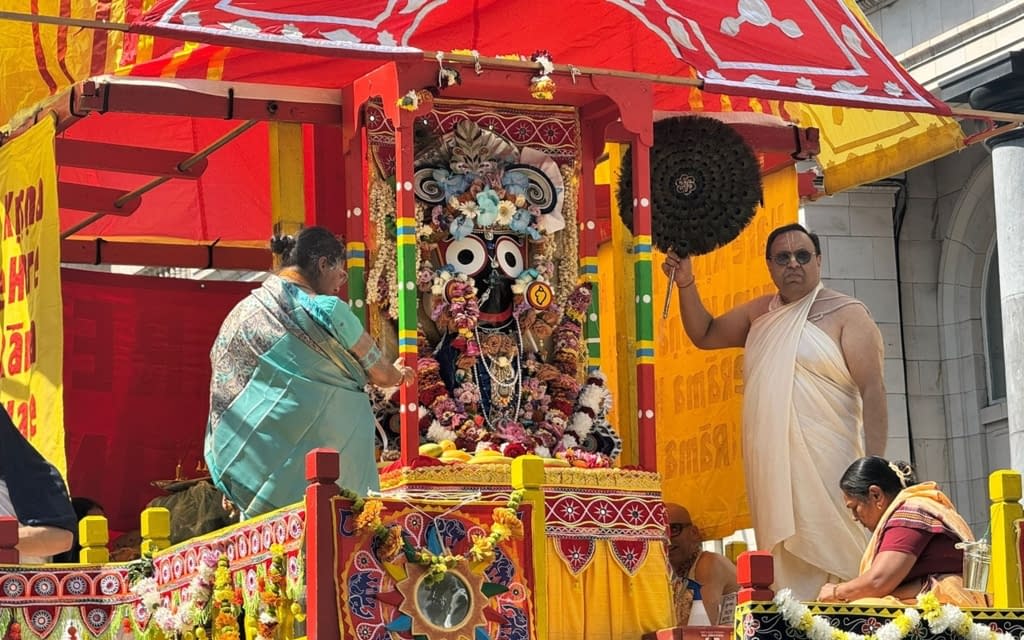
Performance traditions further shaped reception. Katha, kīrtana, Yakshagana, and regional Ramayanas often adopt interpretive flourishes to suit devotional audiences. In many such spaces, the Maya Sita functions as protective theology and as accessible instruction in bhakti. Meanwhile, exegetical schools—Vaiṣṇava and Śaiva alike—developed commentaries that lean into allegory, sometimes reading Agni-praveśa as a sacramental re-entry into divine protection rather than an ordeal alone.
From a philological perspective, the absence of Maya Sita in the Valmiki Ramayana is not a silence to be filled but a choice that guards the poem’s dramatic architecture. The rescue, the assembly, Sita’s speech, Agni’s testimony, and the restoration of honor comprise a carefully sequenced arc. The epic’s universality stems from the way it refuses to trivialize grief, doubt, and public duty—even for avatāras. Valmiki’s Rama embodies ideal conduct within human constraints, not a deus ex machina that forecloses struggle.
For many modern readers and devotees, the first exposure to the Maya Sita motif often comes through popular retellings or televised adaptations. Later, upon reading Valmiki, there can be surprise—even unease—at discovering that the canonical text does not narrate this substitution. That moment is valuable. It invites deeper study, compassion for diverse devotional needs, and a nuanced appreciation for how scripture and tradition interact over millennia.
One productive way to hold both perspectives is to distinguish between the “Valmiki Ramayana” as a specific textual composition and the “Ramayana tradition” as a living, expanding conversation. The former anchors literary and historical analysis; the latter includes Puranic, regional, and performative voices that teach, console, and inspire. In this view, the Maya Sita is a later, meaningful commentary—pastorally sensitive and theologically rich—while Valmiki’s narrative remains the ur-text whose human and ethical complexities continue to challenge and ennoble.
Attention to dharma across the Ramayana also bridges communities within the broader dharmic world. Hindus, Buddhists, Jains, and Sikhs may read the epic through distinct lenses, yet the shared esteem for truth (satya), self-restraint (dama), compassion (karuṇā), and service (seva) forms a unifying thread. Recognizing how later traditions developed motifs like the Maya Sita to emphasize these virtues strengthens—not fragments—civilizational unity.
In summary, the Valmiki Ramayana does not create a Maya Sita because its narrative power rests on confronting the problem of public accusation and private innocence head-on. Later theological developments, especially in Puranic and bhakti milieus, introduced the Maya Sita to offer an interpretive safeguard that lovingly protects Sita’s sanctity and Rama’s exemplariness. Both strands serve a higher educational aim: to refine conscience, expand empathy, and cultivate dharma in family and society.
Reading across these layers with care enables a balanced conclusion. Valmiki’s epic preserves a rigorous drama of ethics; the devotional tradition offers luminous assurances of divine protection. Together they demonstrate how the Ramayana tradition unites textual integrity with theological growth, allowing communities to seek meaning according to their temperament while remaining oriented toward the same moral North Star.
Holding both insights fosters harmony across dharmic traditions. It encourages humility in scholarship, generosity in devotion, and solidarity in culture, ensuring that the Ramayana continues to be a shared inheritance that uplifts and connects.
Inspired by this post on Hindu Blog.