-
Adhika Jyeshta Masam 2026 (Telugu Calendar): Sacred Dates, Rituals & Purushottama Vrata Guide

Adhika Jyeshta Masam 2026 in the Telugu Chandramana Panchangam runs from 17 May to 15 June during Parabhava Nama Samvatsaram. This intercalary month appears when no solar saṅkrānti occurs within a lunar cycle, ensuring long-term alignment of the lunisolar calendar. Revered as Purushottama Maas and dedicated to Lord Krishna, it emphasizes bhakti, ethical living, and…
-
Gifting the Shaligram Stone: Profound Punya and the Sacred Dharma Ban on Selling

Dāna—sacred giving—is celebrated across the dharmic traditions, and nowhere is its meaning more vivid than in gifting the Shaligram stone, the Śāligrāma-śilā revered as a svayambhū form of Viṣṇu. Puranic literature associates this act with boundless puṇya while insisting that a Shaligram must never be sold. The prohibition is not mere formality; it preserves the…
-
Shaligram, Shankha, and Tulsi: Unlocking Vishnu’s Living Presence and Timeless Grace

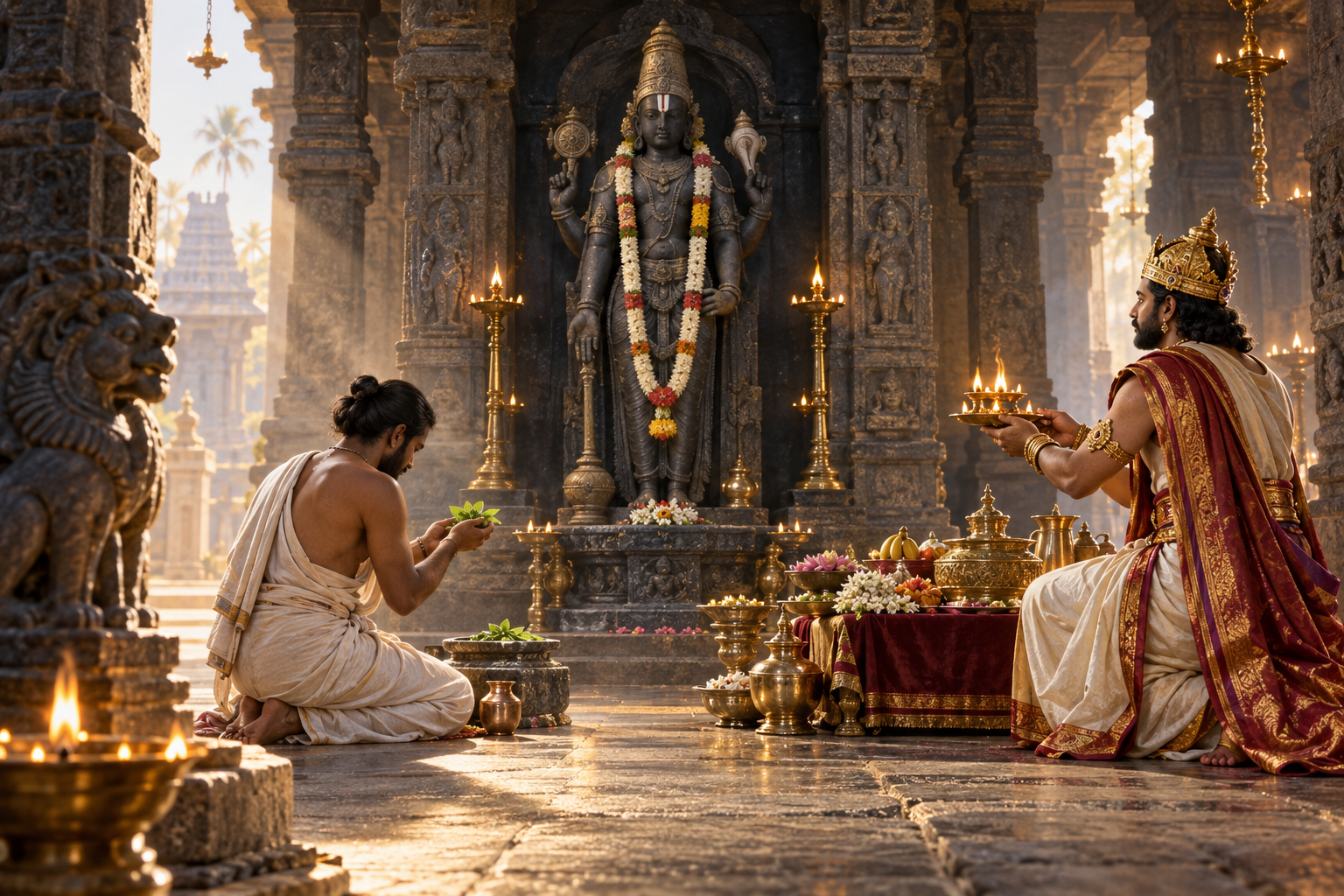
This comprehensive exploration presents the sacred triad of Shaligram, Shankha, and Tulsi as a living, scripturally grounded pathway to Vishnu worship. It clarifies the Shaligram’s geological identity as a natural ammonite fossil from the Kali Gandaki near Muktinath, honored as a svayambhū form of Vishnu requiring no prāṇa-pratiṣṭhā. It explains how the Shankha (Turbinella pyrum)…
-
Bilva Tree and Goddess Lakshmi: Timeless Symbolism, Prosperity Rituals, and Sacred Ecology

The Bilva tree (Aegle marmelos) is venerated in Hinduism not only as dear to Shiva but also as a sacred abode of Goddess Lakshmi, embodying durable, dharmic prosperity. This long-form exploration synthesizes scripture, ritual practice, Ayurveda, and temple ecology to show how Bilva bridges Śaiva and Vaiṣṇava devotion while nurturing household well-being. It explains the…
-
Akshaya Tritiya Unveiled: Definitive Mantras, Stotras, Puja Vidhi & Sacred Dāna for Prosperity

Akshaya Tritiya, observed on Vaishakh Shukla Tritiya, is extolled in the Skanda Purana and Padma Purana as a uniquely auspicious day when the fruits of worship, charity, and discipline become imperishable. This comprehensive guide details accurate, tradition-rooted mantras and stotras for Lakshmi Puja, Gauri Puja, Parashurama Jayanti, and Chandan Puja to Lord Krishna. It includes…
-
Akshaya Tritiya Dāna: The Definitive Guide to Inexhaustible Blessings and Scriptural Merits

Akshaya Tritiya, the sarva-siddhi day of Vaishakh, is celebrated across Dharmic traditions as an auspicious time for dāna (charitable giving) that yields inexhaustible merit. This guide explains the day’s scriptural footing in the Puranas and Dharmaśāstra, unifies perspectives from Hinduism, Jainism, Buddhism, and Sikhism, and details practical, ethical ways to give. It highlights Jala Daanam…
-
Ravana’s Doom Foretold: Dattatreya’s Disciples, a Vanara’s Kick, and Dharma’s Triumph

This long-form analysis examines a powerful Ramayana motif: a sage’s curse that Ravana, intoxicated by power and pride, would be humiliated—even kicked—by vanaras. It situates a regional strand that identifies the ascetics as disciples of Dattatreya alongside the canonical curse of Nandi in the Valmiki Ramayana’s Uttara Kanda. Readers gain a clear sense of how…
-
Date, Rituals, and Meaning of Sati Anasuya Jayanti 2026: A Devotional Guide to Vaishakh Chaturthi

Sati Anasuya Jayanti 2026 falls on Monday, 6 April, aligned with Krishna Paksha Chaturthi—Vaishakh (Purnimant) and Chaitra (Amavasyant). This guide explains the date and tithi clearly, helping readers plan according to their local panchang. It outlines an accessible home puja-vidhi centered on panchopachara, dhyana, and Puranic reading, with practical fasting and charity recommendations. The article…
-
Kokamukha Unveiled: The Jackal-Faced Mahakali in Texts, Temple Inscriptions, and Tantra

Kokamukha, remembered as the jackal-faced manifestation of Mahakali, emerges in the Shakta landscape at the intersection of Hindu scriptures, temple traditions, and Tantric iconography. The article clarifies the name’s philological roots and situates the form within cremation-ground theology, where fierce imagery communicates protection, fearlessness, and ethical clarity. It connects Kokamukha with Yogini traditions and early-medieval…
-
Decoding Lakshmi’s Lotus: Sacred Symbolism of Prosperity, Purity, and Dharmic Wealth

Goddess Lakshmi’s enduring association with the lotus is a precise theological and ethical statement, not a decorative habit. The lotus models purity-in-engagement—thriving in muddy waters yet remaining unstained—mirroring how dharmic wealth should arise and circulate without exploitation. Scriptural memory (Śrī Sūkta, samudra-manthana), iconographic conventions (padma-pīṭha, Gaja-Lakshmi), and temple arts all embed this meaning in public…
-
Shattering the Myth: Why Valmiki’s Ramayana Has No Maya Sita—Evidence and Dharma

The Maya Sita motif—an illusory duplicate of Sita—does not appear in Valmiki’s Ramayana. Textual criticism across northern and southern manuscript families confirms its absence, especially in the Yuddha Kanda where Sita’s Agni-praveśa serves as public vindication. Later Puranic and bhakti-era tellings, such as the Adhyātma Rāmāyaṇa, introduce Maya Sita to offer a theologically protective reading…
-
Ravana’s Abduction of Sita Revisited: Dharma, Curses, and a Deliberate Path to Moksha

Did Ravana kidnap Sita to be slain by Sri Rama and attain moksha? A careful, text-sensitive study shows that while Valmiki’s Ramayana emphasizes Ravana’s pride and desire, later Puranic and bhakti traditions interpret his fall within a cosmic design of grace. The Jaya–Vijaya doctrine, vaira-bhakti (absorption through enmity), karmic curses, and the Maya Sita motif…
-
Vṛtrāsura, Indra, and Ṛta: Timeless Dharmic Lessons on Leadership, Anarchy, and Renewal

This rigorous reading of the Vṛtrāsura cycle—spanning the Ṛg Veda, the Mahabharata and Ramayana, and the Purāṇas—unpacks how the myth encodes a timeless governance and ethics playbook. It clarifies Indra’s moral complexity (Brahmahatyā-dōṣa and Tapas), the leadership caution of Nahusha’s ascent and fall, and the systemic anatomy of anarchy when Ṛta is disturbed. Readers gain…
-
Chilling Symbolism of Asipatra: The Sword-Leaf Forest and Dharma’s Call to Compassion

The Asipatra or sword-leaf forest is a powerful Purāṇic symbol that dramatizes the consequences of harmful actions and the neglect of dharma. Rather than a literal geography of the afterlife, it functions as a moral pedagogy illustrating ethical cause and effect. Readers gain a clear understanding of how the image aligns with ahimsa, satya, and…
-
Vaikuntha Ekadashi Upavasam: The Purana Legend, Profound Fasting Benefits, and Dharmic Unity

Vaikuntha Ekadashi Upavasam is revered in the Puranas for its power to purify the heart and deepen devotion to Lord Vishnu. The classic legend of Murasura explains why this Ekadashi fast is considered uniquely transformative. Many devotees report lightness, clarity, and steadier meditation when observing the vrata with a sattvic approach. Temple practices such as…