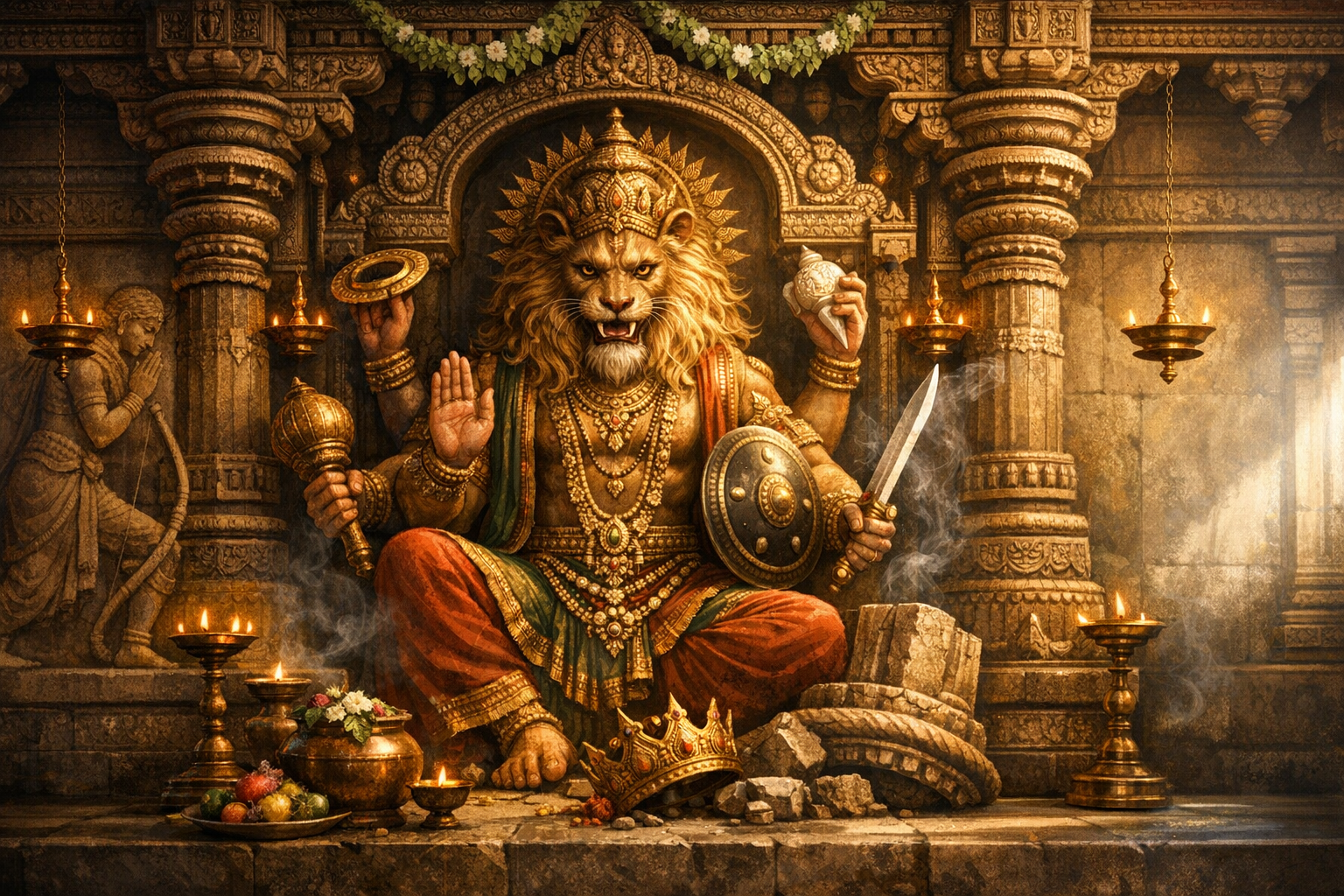
Between Bengaluru and Mysuru, at Maddur in Mandya district of Karnataka, stands an ancient shrine whose presiding image—Ugra Narasimha Murty—has long commanded awe and scholarship alike. The murti captures Vishnu’s leonine avatar in its most fearsome modality at the climactic instant of protecting Prahlada and ending Hiranyakashipu’s tyranny. For devotees and students of Indian art history, the temple offers a rare and compelling confluence of devotional power, mythic narrative, and South Indian iconographic finesse.
Maddur’s setting on the historic corridor linking Karnataka’s riverine heartland situates the temple within a long arc of sacred geography. Regional dynasties—the Gangas, Cholas, Hoysalas, and later the Vijayanagara Empire—shaped the broader cultural matrix in which Narasimha worship flourished. While precise construction phases at Maddur require epigraphic corroboration, stylistic observations suggest a palimpsest: an early core, periodic renovations, and ritual continuity that allowed Ugra Narasimha devotion to remain central in the region’s temple life.
The Ugra Narasimha Murty at Maddur is an arresting study in Vaishnava iconography. Depicted as half-man, half-lion at the very moment of hiranyaka-vadh (the slaying of Hiranyakashipu), the deity’s flared mane, gaping jaws, and intense gaze embody divine wrath deployed solely to restore dharma. Multiple arms emphasize superhuman agency; while two principal hands rend the asura’s torso, others typically display attributes such as chakra, shankha, gada, or weapons (e.g., sword and shield), reminding viewers that Narasimha is both metaphysical principle and martial protector.
A distinctive feature in several South Indian Ugra Narasimha images—attested in pan-Indic textual traditions—is the portrayal of the demon’s entrails as a gruesome garland. This is not gratuitous spectacle; it is a visual theology about cosmic reordering. By outwardly wearing the sign of unrighteous excess, Narasimha proclaims the limits of temporal power and the inviolability of dharma. The icon communicates a precise lesson: divine ferocity is never arbitrary; it is calibrated, purposeful, and ultimately protective.
The theological grammar of the image draws on the Puranas and temple Agamas. The Seventh Canto of the Bhagavata Purana and the Vishnu Purana provide narrative substrate, while Vaishnava Agamas—especially the Pancharatra tradition—prescribe iconometric canons (tala-mana), hand-gestures (mudra), and weapon iconography for Narasimha’s many forms. Texts recognize a family of manifestations—Ugra, Jvala, Vidarana, Vira, Yoga, and Lakshmi-Narasimha—each ritually distinct yet thematically united by the vow (pratijna) to protect seekers of refuge.
Within this typology, Maddur’s Ugra Narasimha occupies the high-intensity end of the spectrum, where iconography leans into the drama of the precise avatara-kala—emergence from the pillar, seizure of the asura, and the twilight-bound fulfillment of Vishnu’s promise. The deliberate choice to monumentalize this exact moment educates the devotee: dharma’s restoration sometimes requires fierce clarity, yet that ferocity is contained within—and returns to—cosmic serenity once justice is done.
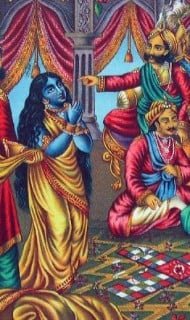
Local sthala-katha at Maddur preserves a compelling connection to Arjuna of the Mahabharata. According to oral tradition, Arjuna is said to have sought darshan of the fierce form—Ugra Narasimha—during a period of intense austerity, asking to behold and internalize fearless resolve before decisive battles. In this reading, the kshatra-ethos Arjuna embodies—valor under discipline, power yoked to ethics—finds archetypal reinforcement in Narasimha’s righteous ferocity. The legend endures in priestly retellings and community memory as a paradigm of courage anchored in dharma.
From a textual-critical standpoint, the critical edition of the Mahabharata does not locate this specific episode at Maddur; however, the broader motif—Arjuna seeking divine assurance and martial consecration (as in the Kirata episode with Shiva)—is well attested. Across peninsular India, Pandava circuits frequently localize epic memory into precise landscapes, creating a living atlas of dharmic exemplars. Maddur’s association with Arjuna thus aligns with a wider Indic practice of grounding epic virtues in place-based devotion.
Ritual practice at Maddur reflects the theological arc from fury to pacification. Ugra forms across Karnataka are often offered panakam (a jaggery drink) and tulasi, symbolically cooling righteous heat while celebrating the protective vow. Festival calendars place particular emphasis on Narasimha Jayanti (Vaishakha Shukla Chaturdashi), when recitation of the Prahlada narrative, alankara emphasizing protective majesty, and community seva integrate scriptural remembrance with present-time welfare.
Architecturally, the shrine presents a compact, devotee-facing plan centered on an east-facing garbhagriha that concentrates experiential intensity on the murti. A modest antarala and congregational hall (navaranga) frame darshan, while exterior surfaces—periodically renewed—indicate cumulative care rather than a single monumental campaign. Such pragmatic layering is emblematic of Karnataka’s temple history, where living worship often takes precedence over stylistic fixity.
In the larger artistic landscape, Maddur’s Ugra Narasimha converses with other iconic Karnataka images, from the monolithic Lakshmi-Narasimha at Hampi to the serene Yoga-Narasimha at Melkote. Juxtaposing these forms demonstrates Vaishnava iconography’s semantic range: the same deity communicates ferocity, serenity, and grace by calibrated shifts in posture, attributes, and facial expression—each choice mapping to a distinct theological and ritual purpose.
For many pilgrims, the first sight of Ugra Narasimha Murty is emotionally overwhelming: fear and consolation arrive together. The image insists that compassion can be fierce when it must be and tender when it can be. Devotees routinely articulate this encounter as a transformation—an inner shore is reached where courage ceases to be bluster and becomes responsibility. In this sense, the temple functions as an ethical schoolhouse as much as a sacred site.
The icon’s symbolism resonates across the wider dharmic family. Buddhism’s “simha-nada” (lion’s roar) connotes the fearless proclamation of truth; Jain traditions revere the lion (simha) as a marker of steadfast dharma; Sikh thought upholds the sant-sipahi (saint-soldier) ideal, integrating spiritual clarity with just action. Maddur’s Ugra Narasimha thus invites a unifying reflection: diverse dharmic paths converge on the insight that protection of the vulnerable and restraint of tyranny are sacred obligations.
From a historiographic angle, Ugra Narasimha imagery in Karnataka correlates with epochs of political consolidation, when royal patronage sought guardianship motifs in temple art. Yet the persistence of the form beyond dynastic cycles points to a deeper social ethic: community reliance on divine protection articulated through a visual language that is immediate, uncompromising, and legible across literacy divides.
Interpreting the Maddur image through Agamic canons clarifies several technical cues. The dynamic torsion (bhangima), expanded thorax, and leonine jawline correspond to raudra rasa (aesthetic of controlled wrath) as codified in classical aesthetics. The diagonal thrust of the upper limbs introduces narrative velocity, while the frontal stare arrests the viewer’s attention, collapsing mythic time into present experience. Such choices are deliberate, not decorative.
The Arjuna linkage, as preserved in oral tradition, gains further coherence when read alongside the Bhagavad-Gita’s ethics of action. If the Gita instructs on inner clarity amid conflict, Ugra Narasimha externalizes the principle that justice, once engaged, must be unswerving. In Karnataka’s cultural memory, then, Arjuna’s disciplined valor and Narasimha’s righteous ferocity become complementary mirrors reflecting the same dharmic imperative.
For visitors, Maddur offers both accessibility and depth. Situated just off the Bengaluru–Mysuru corridor, the temple is a convenient stop that rewards unhurried darshan. Observing customary etiquette—modest attire, silence within the garbhagriha, and patience during archana—enhances the contemplative encounter. Many find that returning at different times of day alters the visual impact, as natural light modulates the murti’s sculptural drama.
In sum, Ugra Narasimha at Maddur is a masterclass in Vaishnava iconography and a living locus of bhakti. Historically layered yet theologically coherent, it binds narrative, ritual, and ethics into a single, forceful statement: that dharma requires courage, that protection is sacred work, and that fierce compassion—like Arjuna’s disciplined aim—must be steady, precise, and just. The temple’s enduring vitality underscores a shared dharmic insight that continues to shape the cultural and spiritual life of Karnataka.
Inspired by this post on Hindu Blog.