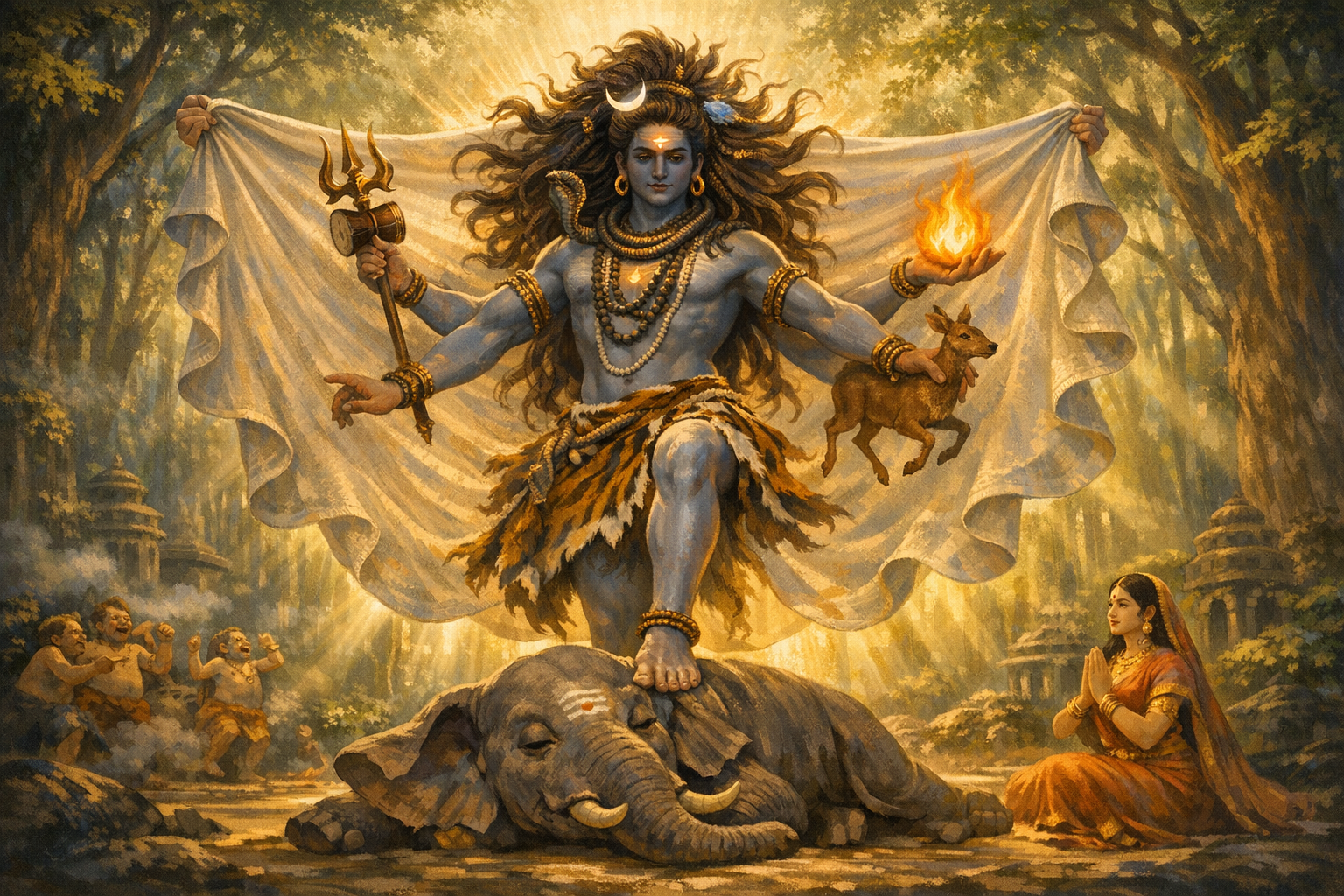
Gajasurasamhara stands among the most profound Shaiva forms, depicting Shiva’s dynamic slaying of Gajasura, the elephant demon, in the Daruka forest (Darukavana). Far beyond a dramatic episode, the scene embodies a rigorous spiritual grammar: the divine dance (Samhara Tandava) that annihilates ego (ahankara) and ignorance (avidya), reconstituting the cosmos and the practitioner’s inner world through fierce compassion. In Hindu symbolism and Shaivism, this form reveals how destruction, rightly understood, becomes the ground of clarity, freedom, and auspicious renewal.
Purana and Agama traditions recount how ascetics in Darukavana, self-assured in ritual mastery, confronted a wandering Shiva whose presence unsettled their assumptions. Through their ascetic powers they conjured forces to subdue himtiger, serpent, dwarf, and finally an elephant‑demon of immense ferocity. Shiva subdued each, tore asunder the elephant, and danced in sovereign stillness and motion, wearing the elephant’s hide as his mantle. The scene crystallizes a lesson central to Hindu spirituality: external ritual without inner surrender cannot replace realization; the ultimate authority is the Self that dispels delusion.
Within this hermeneutic frame, the elephant symbolizes dense tamasheaviness, inertia, intoxication of power, and collective pridewhile the forest itself represents the bewildering terrain of ritualism when it loses touch with insight (jnana) and devotion (bhakti). Gajasurasamhara therefore dramatizes the pivot from mere performance to transformation: when the divine will tears through thick coverings of ignorance, the practitioner rediscovers subtlety, humility, and luminous awareness.
Iconographically, Gajasurasamhara follows canons of the Agamas and Shilpa Shastra. Sculptors and sthapatis often craft Shiva in an emphatically dynamic posture, with matted locks (jata) flaring, the third eye aglow, and serpents ornamenting the body. Multiple arms extend in a sweeping arc; two hands typically stretch the elephant hide into a vast aureole, while others bear the trident (trishula), drum (damaru), fire (agni), or axe (parasu), and sometimes the deer (mriga) signifying the mind. The waistcloth of tiger skin and the living snake‑garlands underscore mastery over instinctive drives and vital energies (prana). The dance is both terrible and protective, terrifying to delusion yet liberating to seekers.
Variations in this murti across Hindu temples and Chola bronzes are instructive. In some panels, Shiva anchors one foot on the fallen elephant’s head or torso; in others, ganas cluster around, accentuating the cosmic spectacle. Parvati may be shown with a startled yet reverent poise, emphasizing that the terrible is enfolded by the auspicious (mangala). Across Tamil Nadu, stone reliefs and bronzesfrom the Kumbakonam region to the Airavatesvara Temple at Darasuramtestify to the form’s enduring prominence in Hindu art history and temple worship.
The attributes themselves encode a layered metaphysics. The damaru marks the pulse of creation (spanda), the primordial vibration from which sound (shabda) and form (rupa) arise. The trident conveys sovereignty over the triadsgunas (sattva, rajas, tamas), time (past, present, future), and states of consciousness (waking, dream, deep sleep). Fire purifies and dissolves hindrances; the deer, fleet and fickle, represents the mind’s restlessness brought under compassionate control. The elephant hide, stretched outward, visualizes the unveiling of truth when the thickest sheath of ignorance is removed.
Read through rasa theory, the scene projects raudra (fierce) yet transmutes it into karuna (compassion). What appears as destruction in Gajasurasamhara is not nihilism; it is the erasure of obstructions. In Shaivism, Shiva’s wrath targets not beings but the bondage that obscures their innermost freedom. Thus the same dance that terrifies delusion consoles the devotee, revealing anugraha (grace) as the final note of every cosmic cadence.
Philosophically, Gajasurasamhara complements Shiva Nataraja’s Ananda Tandava. Where Nataraja centers the play of manifestation and bliss, Gajasurasamhara emphasizes eradication of inner heaviness. The two images are not opposites but poles of one reality: joy and clarity arise when the coverings of ego and ignorance are sundered. In this sense, the darshan of the elephant‑demon dance functions as a mirror to practice: whenever pride hardens or knowledge turns brittle, the image reorients the heart‑mind toward surrender and lucidity.
Agamic manuals and Shilpa texts such as the Kamikagama, Suprabhedagama, and Shilparatna inform proportions, mudras, and movement in this murti. Chola‑period bronzes, refined through living foundry traditions in the Kumbakonam–Swamimalai corridor, intensify the kinetic line, making the bronze itself seem to breathe. In temple prakaras, stone panels condense narrative and teaching into a single visual grammar, guiding circumambulation as a pedagogical journey from outer ritual to inner realization.
For many practitioners, the imagery becomes most resonant in everyday thresholds: moments of wounded pride, heated conflicts, or spiritual fatigue. Contemplating Gajasurasamhara can feel like stepping beneath a sudden rainthe weight lifts, breath deepens, and what was personal affront or confusion is seen as a passing wave. The symbolism imparts experiential guidance: when the inner “elephant” of stubbornness rises, meet it not with suppression but with a fierce yet benevolent clarity that opens, illumines, and releases.
In a dharmic comparative lens, the message aligns across Hinduism, Buddhism, Jainism, and Sikhism. Buddhism names the roots of suffering as kleshasignorance, craving, aversionechoing the “demon” to be recognized and released. Jainism diagnoses kashayasanger, pride, deceit, greedas fetters to be conquered through right conduct and knowledge. Sikhism identifies haumai (ego) as the core obscuration, inviting remembrance (simran) and humility. Gajasurasamhara, without triumphalism, resonates as a shared map: inner bondage is the true adversary, and liberation the common horizon.
Historically, depictions of Gajasurasamhara inhabit a network of South Asian sacred geographies. Temple iconography from the Chola era onwardvisible in Tamil Nadu’s great complexes and across other regionspreserves a consistent semiotics while inviting regional idioms. In these settings, the murti is not merely aesthetic; it is pedagogical, liturgical, and therapeutic, shaping collective memory and personal practice through darshan, recitation, and circumambulation.
Psychologically, the elephant’s mass evokes the “thick skin” people develop to sustain self‑importance or resist change. The flaying in Gajasurasamhara is not cruelty, but unveiling: it strips away what prevents sensitivity, insight, and compassionate responsiveness. When the hide becomes a mantle, it signals transmutationwhat was an obstacle is integrated as strength, dignity, and shelter for others. Thus the narrative insists that even the hardest patterns can be re‑patterned through awakened awareness.
The forest setting, Darukavana, sharpens a second lesson: the sacred can be eclipsed by its own forms when means are mistaken for ends. Ritual, learning, and discipline remain vital; yet without inwardness and love, they risk hardening into self‑regard. Gajasurasamhara does not dismiss ritual; it renews purpose by restoring orientation toward moksha, the release that arrives when knowledge ripens into seeing and action aligns with truth.
In lived practice, many communities engage this form through hymns, stotras, and mantraoften centering Om Namah Shivayaalongside guided contemplation of the murti’s visual language. Breath awareness synchronized with the imagined beat of the damaru, or reflective focus on the trident’s triadic symbolism, helps relocate experience from reactivity to presence. As attention steadies, the inner choreography becomes tangible: contraction yields to spaciousness, and the need to dominate yields to the strength to understand.
Ethically, the form models radical responsibility. Shiva’s dance does not outsource the problem of suffering to an external enemy; it identifies delusion within as the site of transformation. This interiorization has social consequence: communities oriented by such insight tend toward humility, dialogue, and non‑domination, reinforcing unity across dharmic paths. The fierceness that breaks bondage within becomes gentleness that safeguards dignity without.
Art‑historical studies note how Chola bronzes of Gajasurasamhara achieve a paradoxical equilibrium: every muscle strains, every line swirls, yet the center remains still. This is not accidental. Shaiva theology repeatedly holds stillness and motion together; consciousness is both unmoved witness and creative power (Shakti). The form teaches that true freedom does not flee the world but dances through it, meeting each surge of life with grounded clarity.
A further iconographic nuance concerns Parvati’s presence in certain depictions. Her composed or gently startled gaze indicates that the terrible remains encompassed by auspiciousness; power is never severed from compassion. Devotees often read this as reassurance: even the most unsettling passages of practicewhen cherished certainties fall awayare held within a larger benevolence that ultimately heals and integrates.
Placed alongside Shiva Nataraja in temple circuits, Gajasurasamhara expands the pedagogy of dance: bliss without honesty about bondage becomes denial; dissolution without recognition of grace becomes despair. Together, the two forms school the practitioner in balancecelebrating joy while committing to the uncompromising work of clarity. This balance also supports unity among Hindu, Buddhist, Jain, and Sikh traditions by honoring a common ethic of humility, insight, and compassionate action.
In contemporary life, the “elephant” appears as collective certainty, ideological rigidity, or the heaviness of unresolved emotion. Gajasurasamhara suggests a method: not suppression or aggression, but a fierce, lucid seeing that reveals underlying fear and confusion, allowing them to be transformed. The result is practical: relationships soften, work becomes purposeful, and the mind, like a temple court after rain, grows clear and traversable.
Ultimately, the form’s enduring appeal arises from its honesty. It does not romanticize liberation; it shows the cost of truth as the surrender of self‑importance. Yet it also reveals the reward: when the hide of ignorance becomes a garment of wisdom, life itself is transfigured. In that light, Gajasurasamhara remains a master‑class in Hindu symbolism and Shaivisman image that educates the eye, steadies the breath, and clears a path to the freedom it depicts.
Inspired by this post on Hindu Blog.