Kuravi Veerabhadra Swamy Temple in the Kuravi mandal of the Mahabubabad district, Telangana State, India, is among the most prominent shrines dedicated to Veerabhadra, the formidable manifestation of Shiva. Revered across the Warangal region historically and now administered within Mahabubabad, the temple sustains an unbroken tradition of Shaivite worship in which Veerabhadra’s protective, restorative force is honored through precise rites, disciplined vows, and communal festivities.
The setting of Kuravinestled amid agrarian landscapes and connected to regional heritage corridors leading to Warangalcontributes to the temple’s living sanctity. Pilgrims traveling from Warangal, Khammam, and Hyderabad commonly treat the site as a day pilgrimage, with Mahabubabad serving as the nearest major railhead and node for local road connections. The temple’s approachable scale invites unhurried movement through its precincts and supports periods of quiet contemplation in addition to ritual participation.
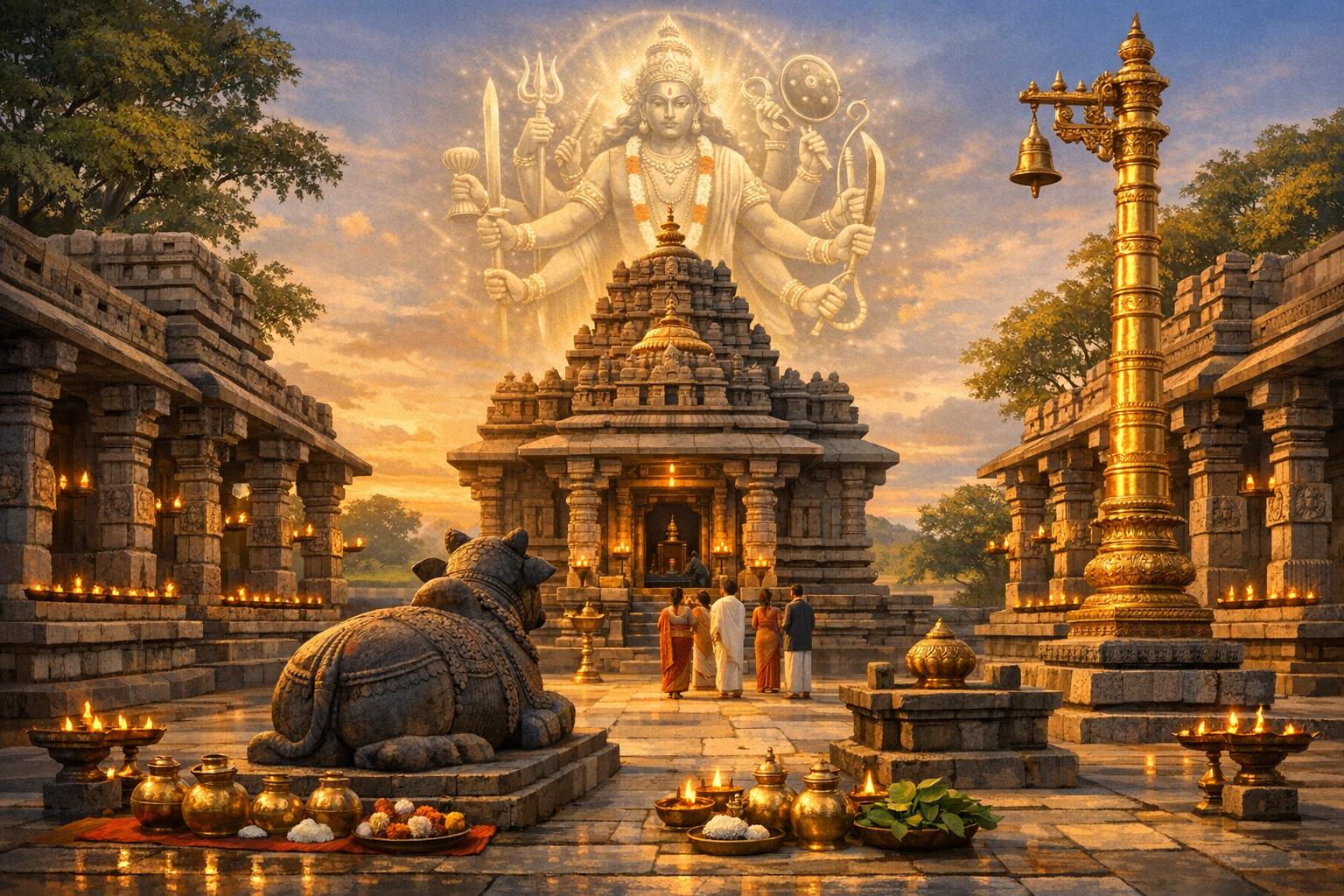
Iconographically, Veerabhadra Swamy here is worshiped in an ugra-roopa that tradition describes with three eyes and ten hands, a form emphasizing cosmic alertness and manifold agency. In classical Shaiva depictions, the deity bears a range of ayudhas such as khadga (sword), khetaka (shield), dhanus-bana (bow and arrows), trishula (trident), damaru (drum), and pasa (noose), among others, signaling the capacity to sever ignorance, uphold dharma, and protect devotees. The presence of Nandi aligned with the sanctum’s axis, a dhvajasthambha (flagstaff), and bali-pitha in the forecourt expresses the canonical Shaivite temple order.
The temple’s theological center of gravity rests in the Daksha-yajna narrative preserved in Puranic literature, notably the Shiva Purana and Skanda Purana. When Daksha’s sacrificial arrogance culminated in the exclusion of Shiva and the great sorrow of Sati, Veerabhadra emerged as Shiva’s righteous force to bring the ritual back into ethical alignment. The Kuravi sthala-purana reflects this wider tapestry: Veerabhadra’s ferocity is not a call to violence but a symbol of fierce compassionthe removal of adharma so that harmony, tapas, and truth may prevail.
Local tradition places the shrine’s antiquity in the early medieval period, with continued endowments and renovations over centuries. While epigraphic references specific to Kuravi are limited in popular circulation, the broader Warangal region’s Shaivite landscapeenergized under Kakatiya-era patronageis a reasonable comparative frame. Architectural vocabulary in and around Kuravi commonly exhibits the regional Dravida idiom, with sequences of mandapas, a vimana over the garbhagriha, and sculptural panels that reference both Shaiva mythology and local devotional motifs. Periodic restorations have ensured ritual continuity even as details of the superstructure have evolved.
Architecturally, the core sequence typically proceeds from a mukhamandapa through ardha-mandapa to the maha-mandapa and antarala, culminating in the garbhagriha. The sacred axis from the gopuram or entry to Nandi and onward to the sanctum encodes a progression from the social to the cosmic. Stone memberspillars, capitals, and beamsare composed with an eye to proportion and processional function. The resulting circulation pattern accommodates both individual darshan and collective utsava flow during peak festivals.
The vimana above the sanctum, capped by a kalasha, denotes the cosmic mountain. Within, the sanctum’s volume is deliberately compact, concentrating prana and facilitating dhyana even when the outer spaces are active. A circumambulatory path where present allows pradakshina, reinforcing the doctrine that truth is approached through humble, repeated remembrance rather than haste. Sculptural registers and subsidiary shrines commonly echo Shaiva themes and, in some cases, honor the Divine Motherreminding devotees that Veerabhadra’s energy is inseparable from Shakti.
Daily worship adheres to a disciplined cycle that centers on snana (sacred bathing) and abhishekam, with Panchamrita (milk, curd, ghee, honey, and sugar) as a principal medium. Vibhuti and bilva leaves are emblematic offerings to Shiva; naivedyam and deepa-aradhana complete the sequence. Devotees often undertake sankalpas seeking clarity, courage, and protectionespecially resonant vows in a kshetra of Veerabhadra, whose very name signifies heroic steadfastness aligned with dharma.
Rudrabhishekam is a distinguished rite at Shaivite kshetras such as Kuravi. Recitation of Sri Rudram with Chamakam, when performed with shraddha and correct intonation, is regarded in the Shaiva Agamic corpus as both purificatory and generative of inner equipoise. The rite connects individual supplication to a cosmology where speech (vac), meter (chandas), and devotion (bhakti) are harmonized.
Festival observances animate the temple’s ritual calendar. Maha Shivaratri, with its nocturnal vigil, japa of Om Namah Shivaya, and cyclical abhishekams, is a principal occasion that draws extensive regional participation. Karthika masam in Telangana is equally cherished, marked by deepotsava, pradakshina, and acts of dana; devotees often light rows of lamps that symbolically disperse inner darkness. Pradosham, observed bi-monthly, focuses on the dissolution of karmic accretions through Shiva’s grace and is meaningful in a Veerabhadra kshetra where ethical renewal is central.
Beyond calendrical rites, Kuravi sustains community bonds through annadanam, cultural recitations, and volunteer service. Many visitors describe a felt sense of solace in the mandapa’s filtered light and the sight of Nandi’s unwavering gaze. Families introduce children to seva here, affirming the continuity of dharmic values in simple, memorable actsqueue discipline, respectful silence before the sanctum, and heartfelt pranams.
For pilgrims, the experiential arc at Kuravi moves from environment to encountertree canopies shading the forecourt, the lingering fragrance of camphor, the rhythmic clang of the belland culminates in darshan that is both humbling and invigorating. People often report that the ugra aspect of Veerabhadra does not intimidate but rather clarifies: it separates essentials from distraction, advancing courage anchored in compassion.
Kuravi also serves as a useful lens for comparative study. Other famed Veerabhadra shrines, such as Lepakshi in neighboring Andhra Pradesh, highlight how regional crafts and royal patronages shaped iconographies of valor and guardianship. In the Telangana heartland, Kuravi’s continuity underscores a grassroots custodianshipdevotees and local administrators working in tandem to keep ritual knowledge living and accessible.
As a heritage asset, the temple benefits from sensitive maintenance practices: careful cleaning of stone surfaces; respectful management of offerings; and preservation of any inscriptions, wooden elements, or metalwork associated with the dhvajasthambha and utsava icons. Visitors can support this ethos by eschewing single-use plastics, following photography norms (typically restricted within the garbhagriha), and honoring dress codes that reflect the sanctity of the space.
Access is straightforward. Mahabubabad lies on the Kazipet–Vijayawada rail corridor, and frequent local transport connects the town to Kuravi. State highways from Warangal and Khammam facilitate road travel, with seasonal festival periods seeing additional services. As with most Telangana temples, darshan windows concentrate in the early morning and evening, with a midday recess; visitors are advised to check current timings and seva schedules locally before arrival.
The temple’s ritual economy is anchored in sevas such as abhishekam and archana, alongside prasadam distribution. These practices sustain artisans, priests, and allied vendors in a regional ecosystem that also includes handloom traditions and devotional crafts from the wider Warangal–Mahabubabad belt. In this sense, the temple is both a spiritual and socio-cultural anchor, binding faith to livelihoods.
Kuravi’s message resonates beyond sectarian boundaries. The virtues symbolized by Veerabhadracourage disciplined by wisdom, protection guided by compassion, and decisive action in the service of harmonyfind affirmation in the shared moral vocabularies of Hinduism, Buddhism, Jainism, and Sikhism. The temple’s ambience naturally invites reflection on ahiṁsa, satya, self-restraint, and seva as convergent ideals in the dharmic family.
In scholarly terms, Kuravi is instructive for understanding how sthala-purana, Agamic liturgy, and regional architectural idioms cohere within a living kshetra. It exemplifies the practical grammar of a Shaiva temple: spatial hierarchy from gopuram to sanctum, ritual progression from snana to deepa-aradhana, and seasonal intensification during Maha Shivaratri and Karthika masam. Equally, it illustrates how communities continually author their sacred spacesthrough patronage, volunteerism, and memory.
Standing before Veerabhadra Swamy at Kuravi, many visitors describe a consolidation of intentthe quiet conviction to live with integrity, to protect what is precious, and to serve without fear. That synthesis of devotion and ethical resolve is perhaps the temple’s greatest offering. Rooted in Telangana’s cultural soil and enriched by the historical aura of the wider Warangal region, Kuravi Veerabhadra Swamy Temple endures as a luminous node of Shaivite power, communal warmth, and dharmic unity.
Inspired by this post on Hindu Pad.