
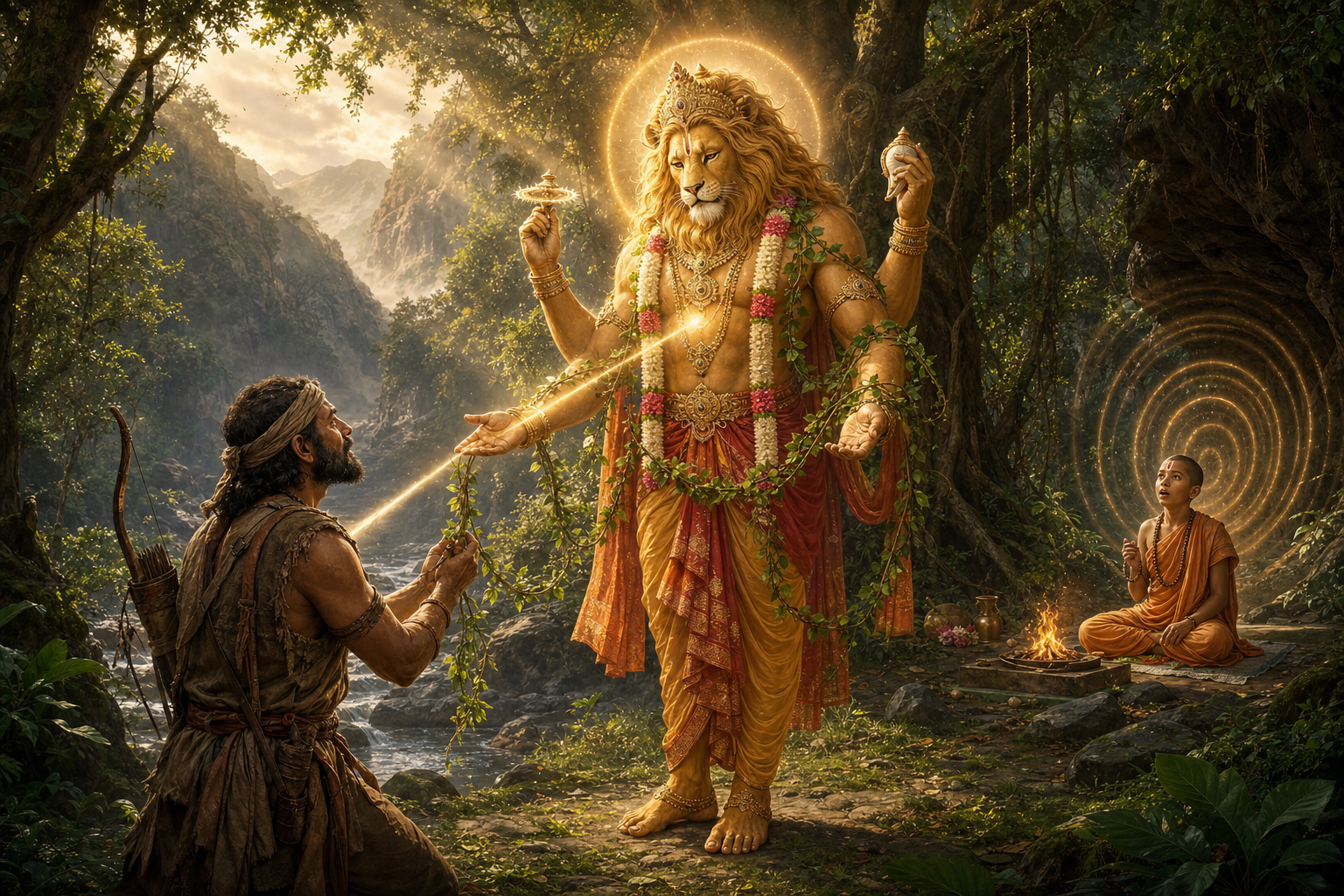
When a Hunter’s Bhakti Outshone a Saint’s Tapasya
The traditional account of Padmapadacharya and the forest hunter presents one of the most arresting paradoxes in Hindu spiritual literature. A disciplined seeker performs prolonged mantra practice in the hope of receiving darshan of Bhagavan Narasimha, yet the divine form remains hidden from him. An unlettered hunter then hears a simple description, searches with undivided attention, and returns with Narasimha bound in forest creepers. Beneath its miraculous imagery, the narrative examines a technically important question: what transforms religious activity into living devotion?
The story is best approached with both reverence and historical care. Padmapada was a major figure in the early Advaita Vedānta tradition and is traditionally remembered as a direct disciple of Adi Shankaracharya. The forest episode, however, belongs primarily to hagiographical and monastic memory rather than to independently verifiable biography. Traditional accounts preserve several versions, and their geographical details do not always agree. Some retellings place the austerity in the Sahyadri mountains, while the institutional account of the Sri Sringeri Sharada Peetham associates Padmapada’s Narasimha penance with the hills of Ahobila. Such variations are normal in sacred biography and need not obscure the central teaching.
Sanandana Before He Became Padmapada
Before receiving the name Padmapada, the young seeker was known as Sanandana. Traditional biographies describe him as a native of the Chola country near the Kaveri, learned from an early age and disinclined toward ordinary worldly ambitions. He later travelled to Kashi, encountered Adi Shankaracharya, and entered the guru-shishya relationship that would define his public identity. His scholarly significance is not limited to legend: the Pañcapādikā, traditionally attributed to him, became an influential commentary on the opening portion of Shankara’s Brahma-sūtra-bhāṣya and helped shape the later Vivaraṇa stream of Advaita interpretation.
Modern historical scholarship is more confident about Padmapada’s place in Advaita philosophy than about individual episodes in his life. Surendranath Dasgupta’s study of Padmapada, for example, accepts the traditional relationship between Padmapada and Shankara as historically plausible while observing that the miraculous stories cannot be tested by ordinary documentary evidence. This distinction matters. It permits the narrative to be studied as theology, moral psychology and sacred memory without forcing it into the category of modern historical reportage.
According to the traditional account, Sanandana received initiation into a Narasimha mantra from a venerable teacher while he was still living in the Kaveri region. Mantra initiation was not merely the communication of a sound formula. Within traditional practice, it established a disciplined relationship among mantra, deity, lineage, teacher and practitioner. Narasimha was therefore not an abstract object of curiosity for Sanandana. He was the chosen divine form toward whom the young seeker directed sustained worship.
Why Narasimha Is the Perfect Form for This Teaching
Narasimha, the man-lion manifestation of Vishnu, is most widely known through the account of Prahlada. He appears in a form that escapes the categories on which Hiranyakashipu’s apparent invulnerability depends: neither fully human nor fully animal, and therefore not confined by a simplistic division between the two. His manifestation proclaims that dharma cannot always be protected through predictable forms. Divine intelligence may operate at the boundary of categories, where pride and literalism have no adequate defence.
The form also unites qualities that appear contradictory. Narasimha is fierce toward oppression but protective toward the vulnerable; terrifying to Hiranyakashipu but compassionate toward Prahlada. His anger is not uncontrolled hostility. In Vaishnava theology it is a form of protective grace directed against adharma. This combination makes Narasimha especially appropriate to a story about spiritual perception. The same presence that overwhelms the ego becomes approachable through trust, sincerity and unwavering remembrance.
Sanandana desired more than intellectual knowledge of this form. He sought darshan, a reciprocal encounter in which the devotee beholds the deity and is also understood to be beheld by the deity. Darshan is therefore more than visual observation. It signifies relationship, recognition and grace. The longing for darshan sent Sanandana away from familiar surroundings and into the forest, a setting that traditionally represents both external danger and the uncharted interior of the mind.
The Technical Meaning of Purascharana
Sanandana is said to have undertaken a prolonged puraścaraṇa, often written as purascharana. In mantra traditions, this term refers to a structured observance undertaken to establish deep identification with a mantra and, according to the tradition, to bring its spiritual potency into full expression. Repeated japa is usually central, but a complete observance may also include prescribed worship, fire offerings, libations, ritual bathing or sprinkling, service and feeding. The exact disciplines, counts and auxiliary rites vary by mantra, lineage and textual authority.
Purascharana should consequently not be reduced to mechanical repetition. Its traditional architecture coordinates speech, breath, body, attention, ethical restraint, diet, time and intention. Repetition stabilizes the mind; ritual regularity reduces distraction; and devotion directs the resulting concentration toward the sacred. In an initiated practice, these components are supervised by a qualified guru because mantras and their associated disciplines are not interchangeable techniques assembled according to personal preference.
Sanandana possessed discipline, scriptural formation and a legitimate spiritual aspiration. Yet the expected vision did not occur. This delay is central to the narrative. The tradition does not deny the value of his tapas or imply that mantra practice was useless. Instead, it exposes the subtle distance that may remain between performing a discipline and being completely absorbed in its object. A practitioner can repeat a mantra while a portion of the mind continues to monitor progress, calculate achievement or anticipate reward.
That tension is recognizable beyond the world of formal ritual. A student may read while secretly watching the clock; an athlete may train while imagining applause; a meditator may sit in silence while measuring every session against an expected experience. The outward action can be correct while attention remains divided. Sanandana’s difficulty dramatizes this universal problem without dismissing the discipline that made him capable of recognizing it.
The Hunter Enters the Forest Clearing
During Sanandana’s austerity, a hunter encountered him in the forest and asked why he was living in such an inhospitable place. The hunter knew the terrain through experience rather than through scripture. He understood animal tracks, hidden paths, danger, hunger and the changing language of the forest. Sanandana, by contrast, had entered the wilderness for a spiritual purpose and carried the vocabulary of mantra, tapas and darshan.
Some traditional versions suggest that Sanandana assumed the hunter would not understand a theological explanation. He therefore described Narasimha as an extraordinary being with a human body and a lion’s face. This moment deserves careful attention because it reveals a limitation in the seeker as well as a feature of the plot. Sanandana possessed formal knowledge, but he underestimated the spiritual capacity of the person standing before him. The hunter lacked scholastic language, not intelligence, dignity or depth of commitment.
The hunter responded from within his own field of competence. Having traversed the forest for years, he declared that he had never seen such a creature. Nevertheless, he accepted the description as a real assignment. He vowed to search for the man-lion and return with him before the appointed time. In several retellings, he pledged his life on the truth of that promise.
Sanandana reportedly regarded the promise as impossible. The hunter, however, did not treat it as a metaphor or an occasion for debate. Once the form had been described, it occupied his whole field of awareness. He searched among trees, rocks, caves and streams. Hunger did not redirect him toward food, fatigue did not persuade him to sleep, and the absence of immediate evidence did not dissolve his resolve.
This is the turning point of the narrative. Sanandana knew the name, mantra and theological identity of Narasimha, but his attention still contained a distinction between the practitioner, the practice and the hoped-for result. The hunter knew almost none of the doctrine. Yet for the duration of the search, the described form became his sole concern. His concentration was not produced by conceptual sophistication; it arose from an uncompromising decision to keep his word.
A Vow Taken to the Edge
As the deadline approached and the search appeared to have failed, the hunter prepared to die rather than break his vow. In the logic of sacred biography, this extreme moment demonstrates that no competing intention remained in him. It should not be interpreted as an ethical endorsement of self-harm or as a recommendation that religious promises be enforced through violence against oneself. Hagiographical literature frequently uses life-and-death extremity to make an interior condition visible: the hunter’s attention had become total.
At that threshold, Narasimha appeared. The hunter examined the manifestation against Sanandana’s description: the form was human and leonine, precisely the mysterious being he had been asked to find. His response was practical rather than ceremonially refined. He cut or gathered forest creepers, bound Narasimha with them, and began leading the divine captive back through the forest.
The imagery is deliberately startling. The protector who defeated Hiranyakashipu could not be restrained by vegetation, yet he permitted himself to be led by a hunter. The binding therefore cannot signify physical conquest in an ordinary sense. It is a theology of voluntary self-disclosure: the unlimited accepts limitation out of affection for undivided devotion. Narasimha is not overpowered by the rope; he is said to be moved by the hunter’s sincerity.
This motif appears widely in bhakti literature. The divine, inaccessible to force and pride, becomes intimate through love. Sacred narratives may portray the deity as accepting food, serving a devotee, becoming a messenger or submitting to a bond. Such images do not diminish divine sovereignty. They redefine power by presenting responsiveness, compassion and relationship as higher expressions of sovereignty than remoteness.
The Seeker Who Could Hear but Not See
When the hunter returned, he announced that he had brought the being Sanandana sought. Sanandana saw the hunter and the creepers but, in important versions of the story, could not see Narasimha. The hunter perceived the divine form directly, while the trained practitioner perceived only signs that something extraordinary was present. Narasimha then roared, allowing Sanandana to hear what he still could not behold.
The asymmetry is spiritually precise. Sanandana is not portrayed as receiving nothing. Hearing the roar confirms that his practice has not been fruitless, but it also prevents him from claiming the encounter on his own terms. The partial revelation breaks spiritual complacency. It teaches that sacred knowledge does not confer ownership of the sacred and that practice cannot compel grace as though it were the predictable output of a transaction.
Overwhelmed, Sanandana asked why the hunter had been granted the vision that prolonged austerity had not secured for him. The response preserved in traditional retellings praises the hunter’s one-pointed concentration. The fullest versions state that he had remained absorbed without concern for hunger, thirst, sleep or personal safety, achieving in a short period an intensity that even long austerities might fail to produce. The numerical comparisons used in some versions are best understood as devotional hyperbole emphasizing immeasurable depth rather than as a literal formula for calculating spiritual merit.
A detailed version appears in the Balabodha Sangraham published through the Kanchi Kamakoti tradition. It relates that Sanandana could hear the roar and divine assurance but not initially see the form. The account adds that association with the hunter’s devotion benefited Sanandana and that Narasimha promised to come to his aid when the need arose. The Sringeri account preserves the same essential teaching: the hunter’s steadfast contemplation surpassed the seeker’s expectations.
One-Pointedness as a Spiritual Technology
The Sanskrit idea commonly expressed as ekāgratā describes the gathering of attention around one point. It is not mere stubbornness. Ordinary stubbornness can remain fragmented by resentment, fear, vanity and the need to defeat another person. Spiritual one-pointedness integrates thought, emotion, intention and action around a worthy object. The hunter’s search displays this integration: he believes the description, accepts responsibility, searches continuously and refuses to divide himself between the vow and competing comforts.
Concentration by itself is morally neutral. A thief, propagandist or tyrant may also act with sustained focus. The story therefore links attention with sincerity, fidelity and a sacred object. What makes the hunter’s absorption spiritually meaningful is not intensity alone but the conjunction of intensity with truthfulness and self-forgetting commitment. His one-pointedness is a technology of attention governed by dharmic intention.
The account also distinguishes sankalpa, a solemn and integrated resolve, from passing desire. Desire says that an outcome would be pleasant; sankalpa organizes conduct around it. Sanandana desired darshan and undertook serious practice, but the hunter’s vow concentrated his whole being into the search. This does not make impulsive vows inherently superior to disciplined sadhana. It illustrates how resolve supplies spiritual practice with direction and emotional force.
Bhakti Does Not Defeat Tapasya
The episode is often summarized by saying that the hunter’s bhakti outshone Sanandana’s tapasya. That formulation is memorable but can become misleading if it turns devotion and discipline into rivals. Sanandana’s austerity brought him to the forest, gave him the language through which Narasimha could be described, and prepared him to hear the divine roar. The hunter’s absorption then revealed what the discipline was meant to become. Bhakti supplied warmth and unity; tapas supplied endurance and structure.
In mature sadhana, these forces support one another. Tapas without devotion can harden into self-measurement, severity or pride. Devotion without discipline can remain emotionally powerful but unstable. Knowledge without humility can become a social boundary, while emotion without discernment can attach itself to harmful objects. The narrative therefore does not abolish study, ritual or austerity. It calls for their integration in a consciousness no longer preoccupied with its own spiritual status.
Sanandana’s response confirms this interpretation. He does not reject the hunter, denounce the vision or defend his superiority. He accepts correction. In some versions, he bows at the hunter’s feet. This act completes his tapas because the deepest austerity is often the surrender of the identity built around being learned, disciplined or advanced. Humility does not erase knowledge; it makes knowledge teachable again.
Learning, Literacy and the Dignity of the Hunter
The social dimension of the story is as significant as its mystical content. Older retellings sometimes emphasize that the hunter was unlettered or outside elite scholastic culture. A responsible contemporary reading should not convert that description into contempt for forest communities or manual occupations. The narrative overturns precisely such contempt. The person initially presumed incapable of understanding becomes the figure who demonstrates the meaning of concentration to the scholar.
The hunter possesses a different knowledge system. He reads tracks, terrain, animal movement and risk. He treats speech as binding and measures integrity through action. Sanandana possesses mantra, theology and disciplined ritual. The miracle occurs where these worlds meet. Neither body of knowledge is mocked, but the story refuses to let formal learning claim a monopoly on spiritual receptivity.
This reversal is characteristic of many bhakti narratives, in which devotion appears among people overlooked by established hierarchies. Its purpose is not to romanticize lack of education. Scholarship remains valuable, especially for preserving texts, clarifying doctrine and preventing misinterpretation. The sharper conclusion is that education becomes spiritually fruitful only when joined with humility, and that directness of heart may appear in any community.
Grace, Effort and the Limits of Spiritual Transaction
Theologically, the episode holds effort and grace in creative tension. Sanandana exerts effort through purascharana. The hunter exerts effort through an exhaustive search. Neither effort mechanically manufactures Narasimha. The manifestation remains an act of grace, but grace responds to a readiness expressed through total commitment. This avoids two extremes: the belief that divine experience can be purchased through a fixed quantity of ritual, and the belief that discipline is irrelevant because grace alone matters.
Practice prepares the vessel; it does not own what fills it. This principle helps explain why traditions prescribe repetition while also warning against pride in repetition. A count can discipline attention, but it can also nourish the thought that the practitioner has accumulated a claim upon the divine. The hunter keeps no count. His entire search becomes a single act of remembrance.
The narrative also complicates the idea of failure. Sanandana’s inability to see Narasimha initially appears to be a failed sadhana. Yet that very absence creates the encounter through which he learns humility, receives assurance and deepens his relationship with Narasimha. A delayed result may expose the hidden motive that an immediate result would have reinforced. In this sense, spiritual frustration becomes diagnostic rather than merely punitive.
The Promise Fulfilled Through Guru Seva
The later tradition connects the forest episode with Padmapada’s rescue of Adi Shankaracharya. A Kapalika ascetic is said to have sought Shankara’s head as a ritual offering. As danger approached, Narasimha manifested through Padmapada and destroyed the threat. The miraculous intervention was remembered as the fulfilment of the assurance given to Sanandana in the forest: Narasimha would come when he was truly needed.
As with the hunter episode, this account belongs to sacred biography and should not be confused with securely documented history. Within the narrative cycle, however, its function is clear. The spiritual power Sanandana sought for personal darshan reaches maturity when it becomes protection of the guru. Private attainment is transformed into service. The seeker does not display Narasimha for prestige; he becomes an instrument when another life is in danger.
This transition from experience to seva is one of the account’s most practical teachings. Spiritual insight is incomplete if it remains a private possession. Its ethical test appears in courage, responsibility and protection of others. The fierce energy of Narasimha is therefore disciplined by devotion and placed in the service of life rather than aggression.
From Sanandana to Padmapada
A separate traditional episode explains the name Padmapada, meaning “lotus-footed.” When Shankara called Sanandana from across the Ganga, the disciple stepped into the river without delaying to find a boat. Lotuses are said to have appeared beneath his feet, carrying him safely across. The image again celebrates one-pointed responsiveness, this time directed toward the guru’s call.
The two narratives illuminate one another. In the forest, Sanandana learns that wholehearted attention can appear in an unexpected person. At the Ganga, he embodies that same immediacy by responding without hesitation. Sacred biography thus portrays growth rather than a fixed hierarchy of saints and ordinary people. The scholar learns from the hunter, and the lesson later flowers beneath the scholar’s own feet.
Padmapada’s philosophical legacy gives this devotional portrait additional depth. The thinker associated with the Pañcapādikā was not remembered as choosing between reason and devotion. He belonged to a culture in which rigorous commentary, mantra practice, guru seva and devotion to a divine form could inhabit the same life. Advaita’s inquiry into non-dual reality did not necessarily erase devotional forms; those forms could discipline the mind, purify intention and prepare it for subtle philosophical discernment.
A Shared Dharmic Insight Without Erasing Differences
The value placed on collected attention is not confined to one Hindu lineage. Hindu yoga traditions analyze dhāraṇā, dhyāna and samādhi; Buddhist traditions develop forms of samādhi and mindful stabilization; Jain teachings place great importance on disciplined attention, tapas and dhyāna; and Sikh practice gives a central place to Naam remembrance and the orientation of consciousness toward the Divine. These concepts arise from distinct scriptures, metaphysical commitments and communities, so they should not be treated as interchangeable.
Nevertheless, a respectful comparison reveals a shared practical recognition: a scattered mind is easily governed by habit, while sustained remembrance can transform perception and conduct. Unity among Dharmic traditions is strengthened not by pretending that all doctrines are identical but by acknowledging resonances without erasing difference. The hunter’s concentrated search can therefore encourage conversation across Hindu, Buddhist, Jain and Sikh traditions while remaining firmly rooted in Narasimha bhakti and Advaita sacred memory.
What the Story Offers a Distracted Age
The contemporary relevance of the narrative is unusually direct. Modern attention is repeatedly divided by alerts, competing screens, unfinished conversations and the pressure to perform several tasks at once. Even spiritual activity can be consumed as one more stream of content. Mantras play in the background, sacred images are viewed for seconds, and teachings are collected faster than they can be contemplated.
The hunter represents the opposite condition. He receives one meaningful description and gives it sustained attention. He does not accumulate more descriptions to avoid acting on the first. His search suggests that depth often depends less on acquiring endless spiritual information than on faithfully inhabiting a worthy practice already received.
This does not require abandoning work, family or society for a forest. One-pointedness can be cultivated through modest disciplines: giving full attention during prayer, completing one responsibility before reaching for another distraction, listening to a person without preparing a reply, studying one passage carefully, or reserving a stable period for japa and contemplation. The outer scale may be small while the inner quality is exacting.
For mantra practice specifically, the account supports regularity, ethical preparation and guidance rather than experimentation driven by impatience. Advanced purascharana, intensive fasting and specialized Narasimha mantra disciplines traditionally belong under competent initiation and supervision. The transferable principle is not to imitate every external detail of a hagiographical austerity. It is to reduce divided intention and bring honesty, steadiness and reverence to an appropriate practice.
What the Narrative Does Not Teach
The story does not teach that literacy is spiritually harmful, that formal worship is unnecessary or that emotional intensity automatically proves truth. It does not authorize reckless vows, self-harm or contempt for ordinary responsibilities. Nor does it claim that every powerful inner image constitutes an objective divine manifestation. Hindu traditions commonly pair devotion with viveka, discernment, and place demanding practices within a lineage precisely to guard against confusion.
It also does not establish a competition in which one devotee’s grace requires another’s humiliation. Sanandana benefits from the hunter’s realization, and the hunter’s search begins with Sanandana’s description. Their roles are relational. The teacher becomes a learner, the apparent outsider becomes a spiritual exemplar, and both are drawn into the presence of Narasimha. Grace expands the circle rather than narrowing it.
The Enduring Lesson of the Bound Narasimha
The hunter captures Narasimha only in the poetic language of devotion. At the theological level, Narasimha freely allows himself to be bound because the hunter has already bound his own wandering attention to a single sacred purpose. The external creepers make visible an interior bond formed from trust, truthfulness and complete absorption.
Sanandana’s tapas is not discarded; it is purified of subtle entitlement. His learning is not condemned; it is opened by humility. The hunter’s simplicity is not praised as ignorance; it is honoured as an undivided alignment of thought, word and action. Narasimha’s grace does not reward social rank or spiritual self-image. It responds, within the logic of the narrative, to the quality of attention and the sincerity of the heart.
That is why the account has endured. It addresses the recurring distance between knowing a path and walking it, between repeating a sacred name and becoming absorbed in what it signifies, and between seeking a divine experience and becoming available for transformation. The hunter enters the forest intending to capture an unknown being. He emerges as the one whose devotion captures the meaning of sadhana itself.
Inspired by this post on Hindu Blog.
