Shiva’s sacred plurality is a defining feature of Shaiva tradition. Revered as Nataraja, ascetic, householder, and supreme yogi, he also appears as the forest-dwelling hunterKirata Murtiencapsulating the aphorism “The Lord Who Wears Every Form.” In this manifestation, the deity steps beyond courtly grandeur into the rugged wilderness, embodying skill, alertness, humility, and the testing of human resolve. Kiratamurti is thus both aesthetically striking and philosophically profound, a form that fuses the ascetic’s inner stillness with the archer’s precise outward action.
Kirata MurtiShiva the Divine Hunterfinds firm anchorage in scriptural narrative and temple art across the subcontinent. This study synthesizes textual sources from the Mahabharata and later Shaiva-Puranic traditions with iconographic canons of the Agamas and Shilpa-shastras, and then traces the motif through major sculptural programs from Kanchipuram to Ellora, from Hoysala sites to Himalayan Kirateshwar shrines. The result is a comprehensive, technical, and devotional panorama that illuminates how a single form powerfully bridges philosophy, aesthetics, and living temple practice.
Textually, the Kiratamurti narrative is among the most memorable episodes in the Mahabharata (Vana Parva). During exile, Arjuna undertakes intense tapas to obtain the Pashupatastra, the supreme weapon of Shiva. The deity appears disguised as a kiratahunter of the highlandsaccompanied by Pārvatī as Kirāti, to examine Arjuna’s concentration (ekagrata), humility, and kshatra-dharma. The test culminates in revelation and boon: Shiva discloses his true form and grants Arjuna the Pashupatastra.
The dramatic crux of the tale concerns the asura Muka, who takes the form of a wild boar. Both Arjuna and the Kirata strike the boar near-simultaneously, then dispute the rightful claim. A contest ensuesmartial, exacting, and symbolically chargeduntil Arjuna recognizes the divinity behind the hunter’s earthly guise. In many retellings, signs of Shiva’s sovereignty (such as an unfading garland or unmistakable divine presence) finally pierce the veil of disguise.
Later Sanskrit literature, notably Bharavi’s Kiratarjuniya, elaborates this encounter with rhetorical brilliance and philosophical density, shaping a classical template for subsequent poets, artists, and temple designers. Puranic strata, including the Shiva Purana and Skanda Purana, sustain the narrative’s liturgical memory and link it to the transmission of Pashupata knowledgeunderscoring Kiratamurti as an anugraha (grace-bestowing) form that perfects a seeker’s discipline.
The term kirata in classical Sanskrit commonly denotes mountain and forest communities of the Himalayan and northeastern regions. In the theological register, it signals liminality: the deity adopts the language, attire, and skill of the wild to reveal that the sacred is not confined to courts and cities. By inhabiting the liminal zone, Shiva sacralizes indigenous landscapes and lifeways, reminding devotees that wisdom and grace circulate in every stratum of Bharata’s cultural ecologies.
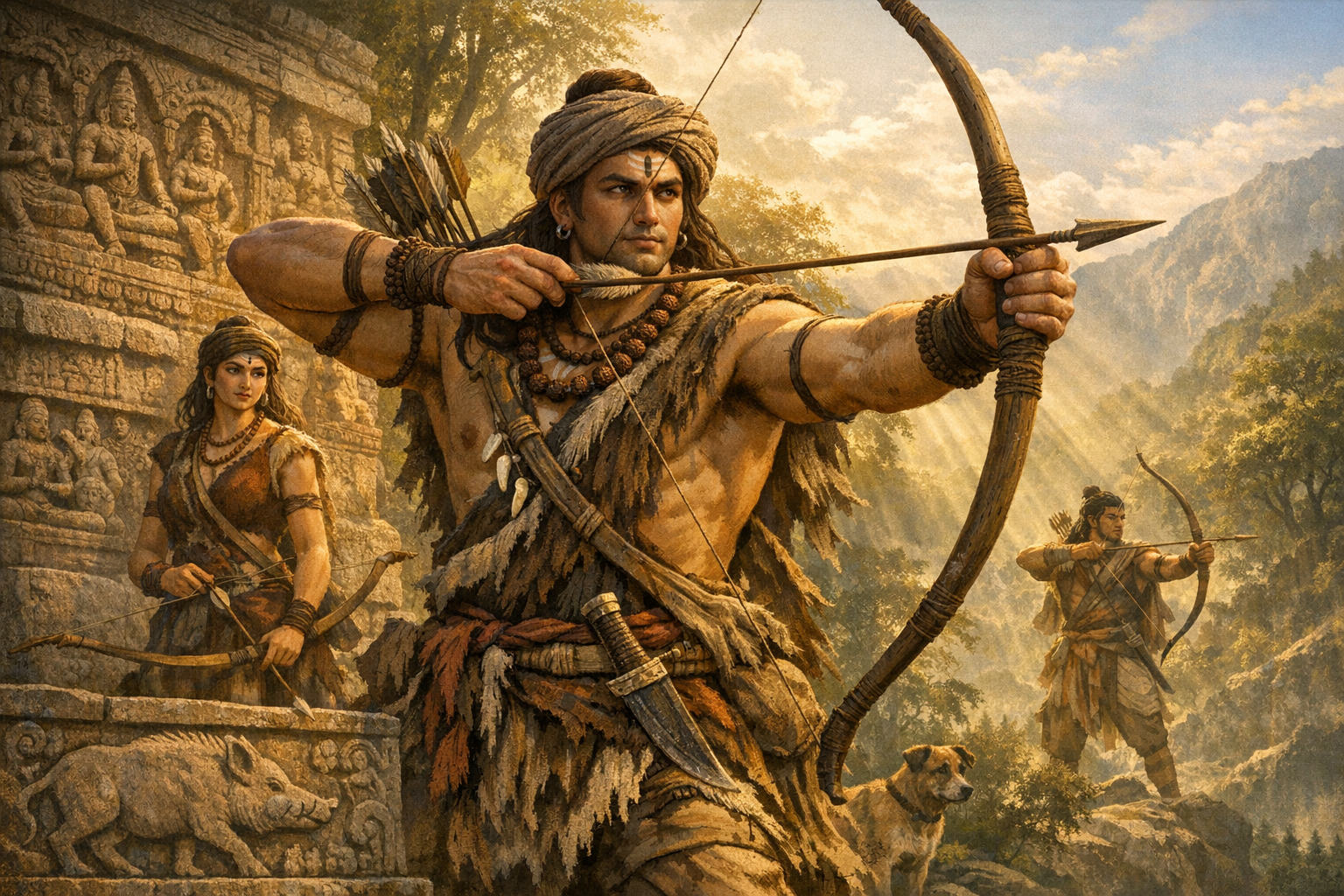
Iconographically, Agamic and Shilpa-shastra traditions present Kiratamurti with a distinct visual grammar. The form is typically shown as a robust hunter, bow in hand (often read as Shiva’s ajagava), quiver slung over the shoulder, and a hunting knife or short sword at the waist. Attire is forest-derivedbark-cloth, hide, or coarse textileswith ornaments of wood, bone, or simple metal, emphasizing functional mobility over royal opulence. A turban or wrapped headcloth frequently replaces the ascetic’s high jata-mukuta, and a moustache or beard may heighten the rustic verism favored by regional ateliers.
KirātiPārvatī as huntresssometimes appears alongside, bearing a bow or quiver, reinforcing the divine couple’s shared presence even within a test of solitary resolve. In narrative panels, an agitated hunting dog may be included, and the fallen boar (Muka) frequently anchors the lower register. The composition prioritizes diagonal tensionsdrawn bow, advancing figures, and the poised counterforce of Arjunaexpressing the dynamic energy (utsaha) that the theological arc ultimately sublates into serene recognition (prasāda).
Materially, Kiratamurti appears in stone, stucco, and, more rarely, in metal icons. Stone panels dominate temple architecture, where narrative cycles accommodate complex motion and interlocking gazes. Bronze or panchaloha utsava-murtis of Kiratamurti are comparatively scarce; where attested, they facilitate ritual processions emphasizing Shiva’s protective presence in forested or frontier geographies.
South Indian sculptural programs supply celebrated instances. At Kanchipuram’s Kailasanathar Temple, Mahabharata friezes incorporate scenes long associated with Arjuna’s penance, while the great relief at Mamallapuraminterpreted by many scholars as Arjuna’s tapas (alternatively as the Descent of the Ganga)captures the austerity that leads to Shiva’s bestowal. In the Deccan and Karnataka, Hoysala masterpieces at Halebidu (Hoysaleswara) and Belur (Chennakesava) render the Kiratarjuna episode with narrative intricacy, granular costume detail, and expressive naturalism.
Among rock-cut monuments, the Kailasa Temple at Ellora (Cave 16) includes a vigorous Kiratarjuna sequence, leveraging the cliff’s breadth to stage the contest’s momentum. These panels are technical studies in kinetic rhythm: taut bows, crossing glances, and the grounded mass of the boar form a sculptural dhvani (resonance) of disciplined force yielding to spiritual insight.
Himalayan and northeastern sacred geography offers another axis of importance. The Kirateshwar Mahadev Temple at Legship (West Sikkim) is venerated as a site where Shiva blessed Arjuna, and the Pashupatinath temple complex in Kathmandu includes a Kirateshwar Mahadev shrine. These spaces embody a living dialogue between Shaiva devotion and the ancestral traditions of Kirata communities, modeling the inclusive ethos of dharmic civilizationwhere local memory and pan-Indic theology converge without erasure.
Within temple practice, Kiratamurti functions as a pedagogic icon for ekagrata, dhairya (steadfastness), and kshatra-dharma integrated with ahimsa as ethical mastery rather than negation of strength. Priests and teachers often highlight how the hunter’s eye becomes a metaphor of one-pointed meditation; the arrow, a symbol of mantric focus; and the bow, the human frame held in poised equilibrium. For households and pilgrims alike, the form reinforces that spiritual illumination frequently follows rigorous inner testing.
Symbolically, the boar (Muka) embodies ungoverned impulsetamasic charge that surges without discrimination. The double-strike motifboth Kirata and Arjuna loosing arrowsconfronts the ambiguity of agency and merit: who truly “claims” the outcome of an act? The recognition scene resolves this paradox through anugraha; the devotee discovers that mastery lies not in domination of an external foe but in surrender to the immanent ground of consciousness that wields all bows and releases all arrows.
Read through a dharmic hermeneutic that values unity across Hinduism, Buddhism, Jainism, and Sikhism, Kiratamurti communicates a shared civilizational ethic: disciplined power yoked to compassion, skill harnessed to wisdom, and vigilance softened by humility. Parallels aboundthe Buddhist emphasis on taming the mind’s wild forces, the Jain call to subdue passions, and the Sikh ideal of the sant-sipahi (saint–soldier) who holds inner stillness and courageous action in balance. The hunter’s poise becomes a cross-traditional emblem of alert compassion.
From a technical iconographic standpoint, workshop idioms vary by region and period. Deccan and Hoysala ateliers often favor muscular torsos, knotted turbans, and emphasized moustaches; Tamil sculptors sometimes retain ascetic markers while translating them into frontier costume. The quiver strap frequently diagonals the torso like a yajnopavita, and forest ornaments echo the jewelry vocabulary in minimal, function-forward profiles. Dogs, attendants, and the Kirāti accompaniment modulate the scene’s rasa and narrative clarity.
Compositional analysis underscores how artists engineered visual tests mirroring Arjuna’s spiritual trial. Oblique lines (bows, limbs, sling of the quiver) create vectors of tension resolved around the hunter’s faceserene and unblinkingsuggesting that true aim originates from inner steadiness, not from muscular strain. The low-register mass of the boar counterweights the scene, grounding the mythic in tangible earth, even as the viewer’s gaze is drawn upward to recognition and grace.
Ritually, Kiratamurti images may be approached during vrata related to concentration and vow-keeping. Teachers sometimes invoke the story when instructing in japa and pranayama, comparing the continuity of breath to the continuous arc of the bow. Martial lineages and traditional archery (Dhanurveda) communities read the narrative as a charter for ethical strength: capacity developed for lokasangrahaupholding the worldrather than for self-aggrandizement.
For visitors, the encounter with Kiratamurti in sculpture can be unexpectedly moving. The rustic immediacy of the hunterfurrowed brow, weathered garments, a dog at heelcollapses the distance between the divine and the quotidian. Devotees often describe a felt recognition that grace appears in unanticipated forms, at the edge of forests and within the thickets of one’s own mind, precisely when resolve meets humility.
Conservation-wise, Kiratarjuna panels present instructive challenges: weather-exposed reliefs require preventive care; narrative legibility depends on preserving delicate low-relief textures around the boar, dog, and strapwork; and interpretive signage benefits from clarifying the relationship between Arjuna’s tapas and Shiva’s boon. Responsible heritage preservation thus sustains not only stone and metal but the civilizational memory encoded in this powerful form.
In contemporary spiritual life, Kiratamurti serves as a lucid mirror: the “hunt” is not for prey but for distraction, fear, and pridethe inner Muka. The form encourages practitioners to cultivate attentive strength and compassionate clarity, honoring the dharmic synthesis that welcomes diverse temperaments and paths. By venerating Shiva as the Divine Hunter, communities reaffirm a shared commitment to unity in diversity, where wisdom flows through every landscapemountain and temple, forest and city, warrior’s bow and ascetic’s heart.
In sum, Kiratamurti integrates textual authority, iconographic precision, and ritual relevance into a single, resonant theology of focus and grace. From Kanchipuram and Ellora to Halebidu and the Kirateshwar shrines of the Himalayas, this form reveals how Shaiva devotion encompasses the full spectrum of human experience. As an image, it is compelling; as a teaching, it is exacting; as a bridge across India’s dharmic traditions, it is profoundly unifying.
Inspired by this post on Hindu Blog.