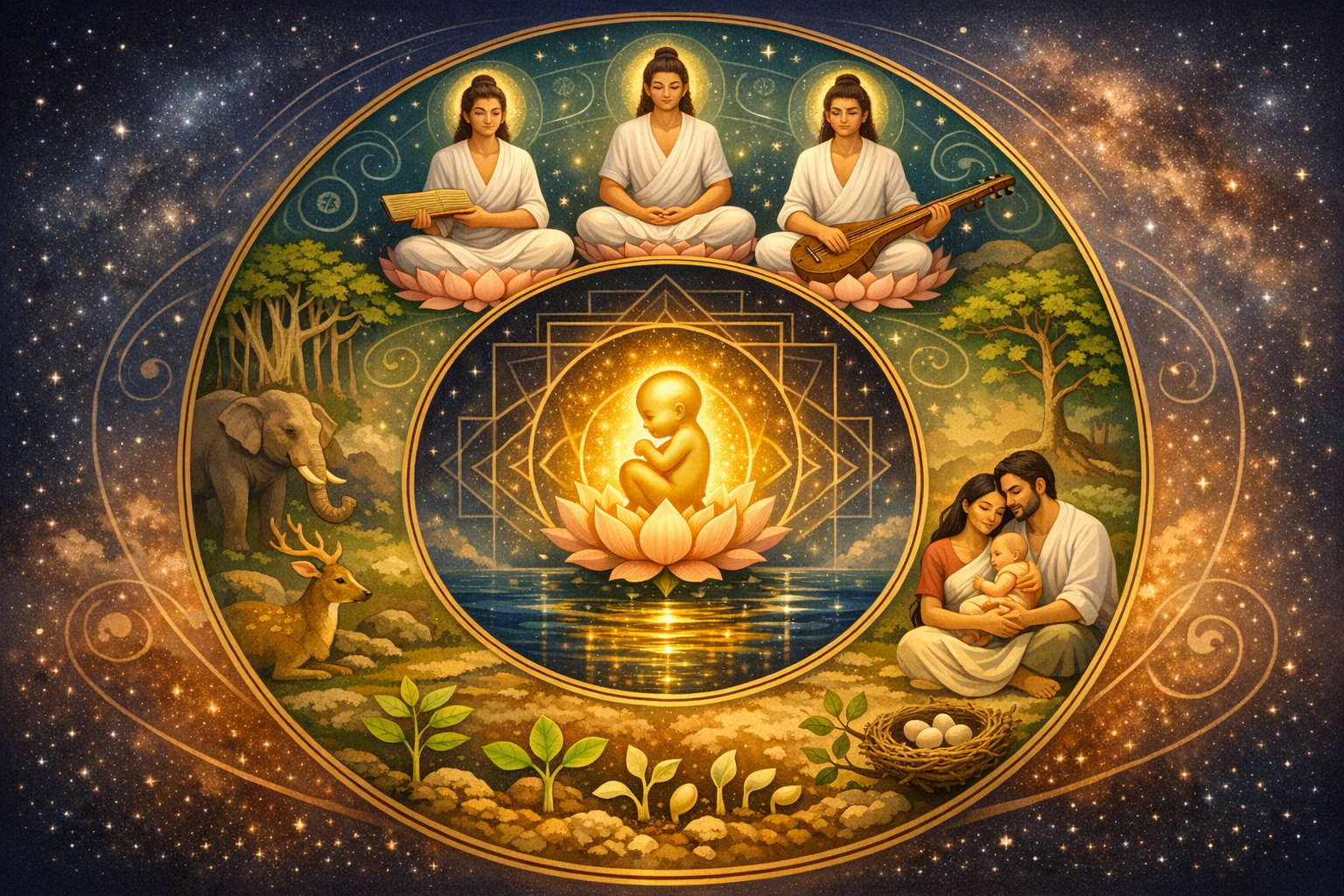
Hindu cosmology offers a layered, technically precise account of creation that moves from the subtle to the gross: from self-born (svayambhū) principles, to mind-born (mānasa) beings, and finally to womb-born (jarāyujā) life. This tripartite pattern appears across the Purāṇas and aligns with Vedic and Upanishadic insights into emergence, manifestation, and embodiment. Rather than a single linear story, these sources present a multi-modal frameworksarga (primary emanation) and visarga (secondary diversification)that accommodates metaphysical truths, psychological processes, and biological reproduction in a unified vision.
Classical scriptures such as the Viṣṇu Purāṇa, Śrīmad-Bhāgavatam (Srimad Bhagavatham), and passages echoed in the Manusmṛti describe how reality unfolds in phases. Primary creation (sarga) describes the emanation of principlestattvaswhile secondary creation (visarga) accounts for the structuring of worlds and species. Within this technical architecture, the categories self-born, mind-born, and womb-born function as a clear map of descent from pure consciousness to mental formation and finally to embodied life.
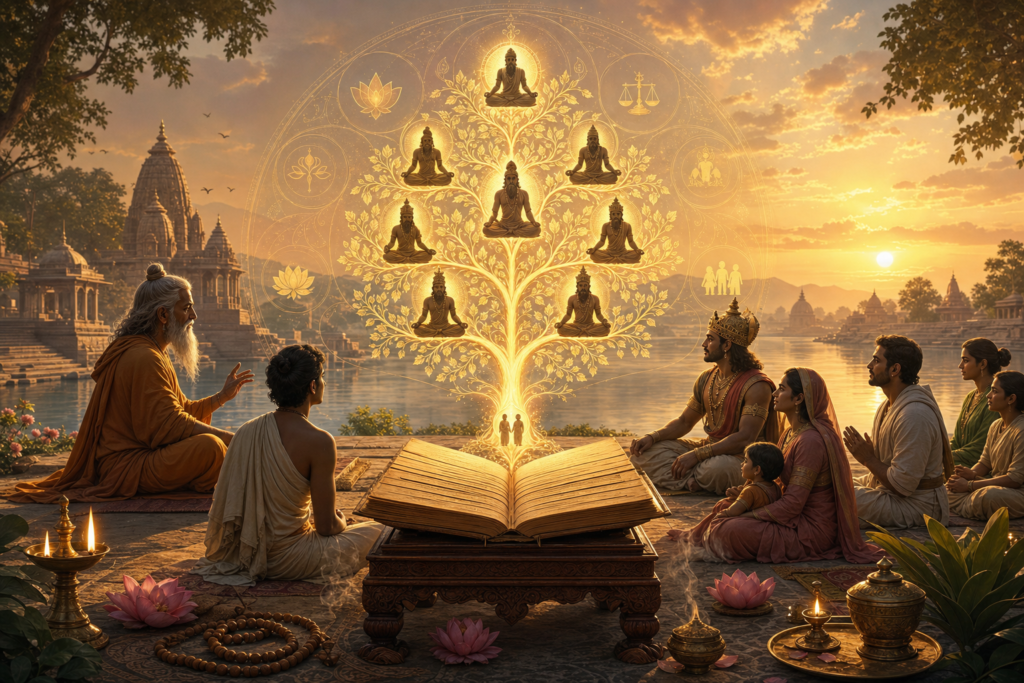
The “self-born” (svayambhū) level signals emergence without progenitors, pointing to the primordial fact of Being described in hymns like the Nāsadīya Sūkta (Ṛg Veda 10.129) and the Hiraṇyagarbha Sūkta (Ṛg Veda 10.121). Purāṇic narratives render this as Brahmā appearing on the lotus sprung from Viṣṇu’s navel or as Hiraṇyagarbha, the “golden embryo.” Upanishadic formulations, especially in Śvetāśvatara and related texts, preserve this insight as Brahman, the causeless cause. Self-born origin thus communicates an unconditioned, axiomatic beginning that is metaphysical rather than biological.
Sāṅkhya-influenced cosmology provides the technical scaffolding: from Prakṛti arise Mahat (cosmic intelligence), Ahaṅkāra (individuating principle), Tanmātras (subtle potentials), and then the Mahābhūtas (gross elements). “Self-born” corresponds to this uncaused emergence of principles. In the language of yogic psychology and Vedānta, creation proceeds from kāraṇa (causal, subtle) to sūkṣma (subtle-body scale) and finally to sthūla (gross embodiment)a movement often summarized as “gross to subtle” in reverse during contemplation, and subtle to gross in manifesting worlds.
The second stage, “mind-born” (mānasa), introduces beings who arise through will, thought, and austerity. The Purāṇas present Brahmā’s mānasa putraslists vary slightly across texts, but typically include the Four Kumāras (Sanaka, Sanandana, Sanātana, Sanatkumāra), as well as sages such as Nārada and Prajāpatis like Marīci, Atri, Aṅgiras, Pulastya, Pulaha, Kratu, Vasiṣṭha, Bhrigu, and Dakṣa. These mind-born progenitors structure cosmic order through knowledge, tapas, and dharma rather than through biological reproduction.
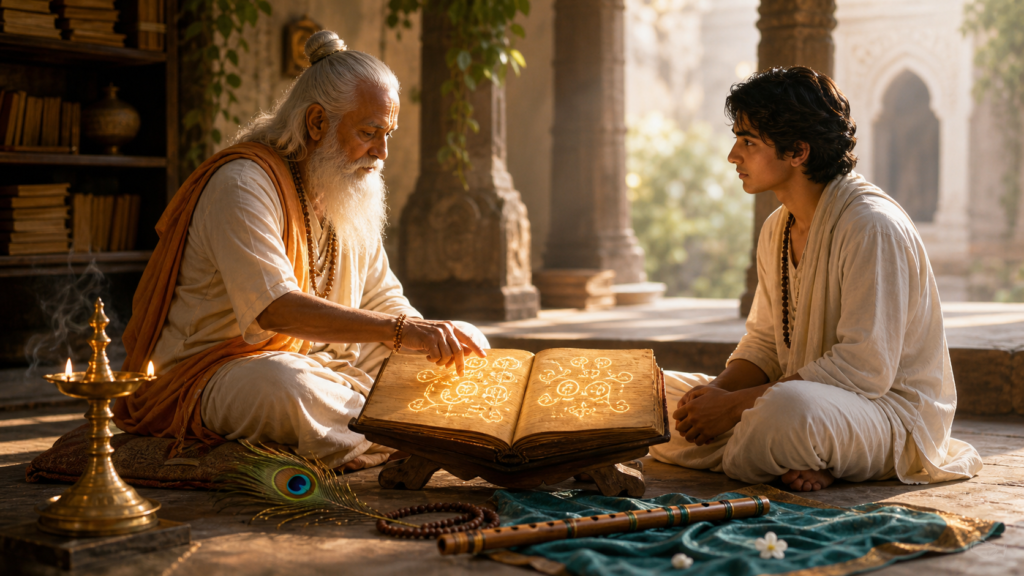
The Sanat Kumaras exemplify the philosophical depth of mind-born creation. Perpetual brahmacārins and paragons of jñāna, they appear throughout the Bhāgavata Purāṇa as teachers of nondual wisdom and devotion. In the counsel to King Pṛthu (Śrīmad-Bhāgavatam, Canto 4), they frame liberation as the fruit of steady contemplation, virtue, and experiential insight. As mānasa putras, the Sanat Kumaras symbolize how mindrefined through austerity and wisdomcan itself be a generative, ordering principle in the cosmos.
Nārada, another key mānasa figure, transmits bhakti and dharma across worlds, catalyzing transformation not by force but by song, story, and reasoned instruction. In the Purāṇic imagination, such sages seed civilizations and sacred lineages through teaching and initiation. The mānasa stage therefore encodes a civilizational insight: culture, ethics, and knowledge proliferate mind-to-mind before they take deep root in embodied society.
The third stage“womb-born” (jarāyujā)shifts into biological reproduction. Purāṇic and Smṛti texts recognize a sophisticated taxonomy of life-forms and modes of birth, often outlined as four: jarāyujā (viviparous, womb-born), aṇḍajā (oviparous, egg-born), svedajā (moisture-born, associated pre-scientifically with spontaneous emergence), and udbhijjā (sprouting, pertaining to plant life). Within the triplet of self-born, mind-born, and womb-born, jarāyujā highlights the fully embodied, relational, and parental mode of continuation that dominates human and animal life.
Classical discussions of asexual creation in this context refer both to mind-born sages and to svedajā and udbhijjā readings of life’s origins. Although pre-modern biology used the language of spontaneous generation, the philosophical point retained by the tradition is that life proliferates in ways that are subtle, mental, and physical. Hindu cosmology, therefore, provides a broad grammar of liferather than a single hypothesisaccommodating multiple forms of origination under an overarching metaphysical canopy.
This threefold sequenceself-born, mind-born, womb-borncan be read as a descent from sūkṣma to sthūla, from principle to idea to organism. It maps smoothly onto Vedāntic triads (kāraṇa–sūkṣma–sthūla śarīra), Sāṅkhya’s tattva cascade, and yogic accounts of manifestation. As a hermeneutic key, it encourages readers to recognize how metaphysical causes, cognitive-intentional processes, and biological mechanisms cooperate in the world’s unfolding.
Ethically, this model grounds reverence for all forms of life. If self-born reality underwrites existence, and mind-born sages preserve cosmic order through knowledge, then womb-born life inherits a dharma of care, ahiṃsā, and responsibility. The civilizational aspiration “Vasudhaiva Kutumbakam”the world as one familyemerges naturally from a cosmology that sees continuity across the causal, mental, and biological dimensions of being.
The framework also promotes unity across dharmic traditions. Buddhism’s expansive cycles of time (kalpas), Jainism’s Utsarpiṇī–Avasarpiṇī view of cosmic expansion and contraction, and Sikhism’s affirmation of Ik Onkar and Hukam resonate with the Hindu emphasis on an ultimate, self-born ground, the formative power of mind and moral law, and the sanctity of embodied life. Anekāntavāda (non-one-sidedness) in Jainism, the Middle Way in Buddhism, and the Sikh stress on living in harmony with Hukam converge with the plural, layered outlook of the Purāṇas and Upanishads.
Historically, Purāṇic lists of mānasa putras vary, signaling a tradition comfortable with complementary tellings rather than exclusive formulas. Scholars and practitioners can consult the Viṣṇu Purāṇa, Śrīmad-Bhāgavatam (for example, Srimad-Bhagavatam 3.20.3 for discussions of early creation), and cross-references in the Mahābhārata’s Śānti Parva for a technical sense of sarga and visarga. This textual plurality strengthens the core message: diverse descriptions illuminate a single, shared metaphysical horizon.
Symbolically, “self-born” can be seen as foundational truths; “mind-born,” as the generative function of insight, pedagogy, and culture; and “womb-born,” as the embodied institutions, families, and species that carry forward dharma in time. Such a reading preserves scriptural fidelity while showing contemporary relevancehow ideas become lineages, and lineages, societies.
The Sanat Kumaras are especially important for understanding the non-biological continuity of wisdom. Their lives emphasize brahmacarya, contemplation, and teaching as engines of cultural genesis. When set alongside Nārada’s mobile, dialogical method, the mānasa stage demonstrates how civilizational memory is preserved and renewed through insight and dialogue rather than compulsion.
A practical implication of this tripartite model is methodological. Inquiry into origins benefits from multiple lenses: metaphysical (self-born), psychological and pedagogical (mind-born), and empirical-biological (womb-born). Hinduism’s scriptural corpus encourages integrative reasoning, where science, ethics, and spirituality cooperate rather than competea stance that supports dialogue and mutual enrichment among Hindu, Buddhist, Jain, and Sikh communities.
The model also addresses common misconceptions. References to “many gods” in Purāṇic narratives serve symbolic, pedagogical, and devotional functions within a coherent metaphysics centered on Brahman. Deities and sages personify principles, processes, and paths that accommodate diverse dispositions (adhikāra-bheda), reflecting a civilizational commitment to plurality without losing philosophical clarity.
In summary, the movement from self-born to mind-born to womb-born provides a precise, testable hermeneutic for Hindu cosmology: a map tracking the descent of reality from causeless ground, through intentional cognition, into embodied continuity. By correlating sarga and visarga with Vedāntic and Sāṅkhya categories, and by highlighting figures such as the Sanat Kumaras and Nārada, the tradition articulates a sophisticated account of how universes, cultures, and species arise and endure.
Read as a shared dharmic inheritance, this vision nurtures unity in diversity. It affirms that ultimate reality (self-born) underlies all, that wisdom and compassion (mind-born) are the living agencies of renewal, and that embodied life (womb-born) is worthy of care and responsibility. Such a cosmology encourages dialogue, deepens ethical resolve, and sustains a culture of inquiry compatible with both ancient insight and contemporary knowledge.
Inspired by this post on Hindu Blog.