Tag: vedas

  • Equality of the Soul: A Powerful Interfaith Reading of Vedas and Jewish Wisdom

    Equality of the Soul: A Powerful Interfaith Reading of Vedas and Jewish Wisdom

    This rewritten study presents a rigorous, accessible exploration of the spiritual parallels between Vedic philosophy and Jewish mystical tradition. It focuses on equality based on the soul, showing how the Bhagavad-gita, Srimad-Bhagavatam, Torah, Zohar, Bahir, Talmud, and Sefer Yetzirah can be read in dialogue without erasing their differences. The article explains dharma, karma, reincarnation, guru-parampara,…

  • Powerful Equality in Sanātan Dharma: Varna, Women, and Compassion for All

    Powerful Equality in Sanātan Dharma: Varna, Women, and Compassion for All

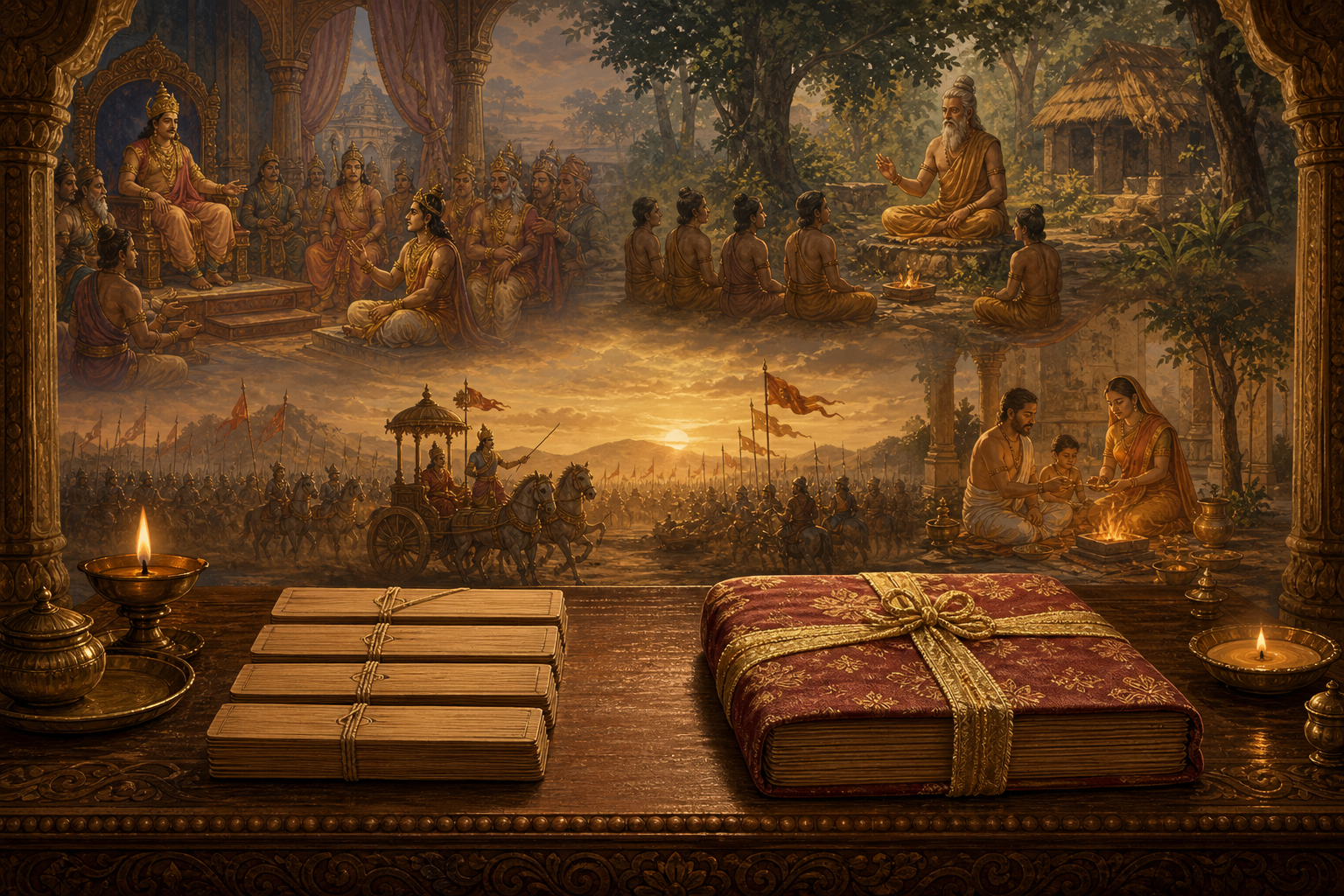
    Sanātan Dharma presents equality as a disciplined moral principle rooted in guṇa, karma, duty, and compassion. Its scriptural vision of varna emphasizes qualities and actions rather than birth-based arrogance or inherited privilege. The Vedas, Śrīmad Bhagavad-gītā, Rāmāyaṇa, Manusmṛti, and Mahābhārata also affirm the dignity of women, the need for social harmony, and responsibility toward animals…

  • Reading the Bhagavad Gita Seriously: A Powerful Call to Live Its Wisdom

    Reading the Bhagavad Gita Seriously: A Powerful Call to Live Its Wisdom

    The Bhagavad Gita remains one of the most influential scriptures of Sanatana Dharma, but its true value is realized only when its teachings are respected and practiced. This rewritten essay explains why shastra must guide decisions about duty and non-duty, rather than personal opinion alone. It also examines the Gita’s own acknowledgment of the Vedas…

  • Ami Ganatra’s Powerful Guide to Hindu Shastras and Living Knowledge Systems

    Ami Ganatra’s Powerful Guide to Hindu Shastras and Living Knowledge Systems

    Ami Ganatra’s Why are We This Way offers a serious and accessible guide to Hindu Shastras, Indian Knowledge Systems, and the living continuity of Sanatana Dharma. The book explains Shruti, Smriti, Vedas, Upanishads, Itihasas, Puranas, Darshanas, and related traditions without reducing them to a mere catalogue of texts. Its strongest contribution is showing how Hindu…

  • Powerful Vedic Insight: How One Reality Sustains Many Sacred Truths

    Powerful Vedic Insight: How One Reality Sustains Many Sacred Truths

    This article offers a careful, accessible exploration of the Vedic phrase ekaṁ sad viprā bahudhā vadanti and its relevance for religious pluralism. It clarifies why popular renderings such as “Truth is one. Paths are many.” are meaningful but not literal translations. The discussion explains key Sanskrit terms, including ekaṁ, sat, viprā, bahudhā, and vadanti. It…

  • Amsha Deva in the Vedas: Powerful Lessons on Balance, Dharma, and Sacred Share

    Amsha Deva in the Vedas: Powerful Lessons on Balance, Dharma, and Sacred Share

    Amsha Deva is a lesser-known but meaningful Vedic deity associated with the Adityas, the divine powers connected with cosmic order, moral law, and righteous balance. His name carries the sense of a share, portion, or allotted part, making him an important symbol of fair distribution in ritual, society, and spiritual life. This article explains how…

  • Sanatana Dharma as Living Wisdom: Pluralism, Practice, and Purpose in a Complex World

    Sanatana Dharma as Living Wisdom: Pluralism, Practice, and Purpose in a Complex World

    Sanatana Dharma is presented as a living wisdom traditioncivilizational in scope and practical in methodrather than a narrow, prescriptive religion. The discussion explains how pluralism, exemplified by Ishta and enriched by Jain Anekantavada, Buddhist upaya, and Sikh Ik Onkar, establishes unity in spiritual diversity across Dharmic traditions. It surveys layered scriptures, the six darshanas, and…

  • Panchabrahma & Panchakritya: Unveiling Shiva’s Five Faces and the Universe’s Five Acts

    Panchabrahma & Panchakritya: Unveiling Shiva’s Five Faces and the Universe’s Five Acts

    Shaiva philosophy teaches that the universe is not separate from Shiva but is Shiva in five continuous actscreation, preservation, dissolution, concealment, and grace. This article decodes Panchakritya and Panchabrahma, showing how the five acts and the five faces (Sadyojata, Vamadeva, Aghora, Tatpurusha, Ishana) structure both cosmic process and inner transformation. Drawing on Vedic, Upanishadic, Agamic,…

  • Why Ghee Fuels the Sacred Fire: Timeless Vedic Science, Symbolism, and Practice of Yajna

    Why Ghee Fuels the Sacred Fire: Timeless Vedic Science, Symbolism, and Practice of Yajna

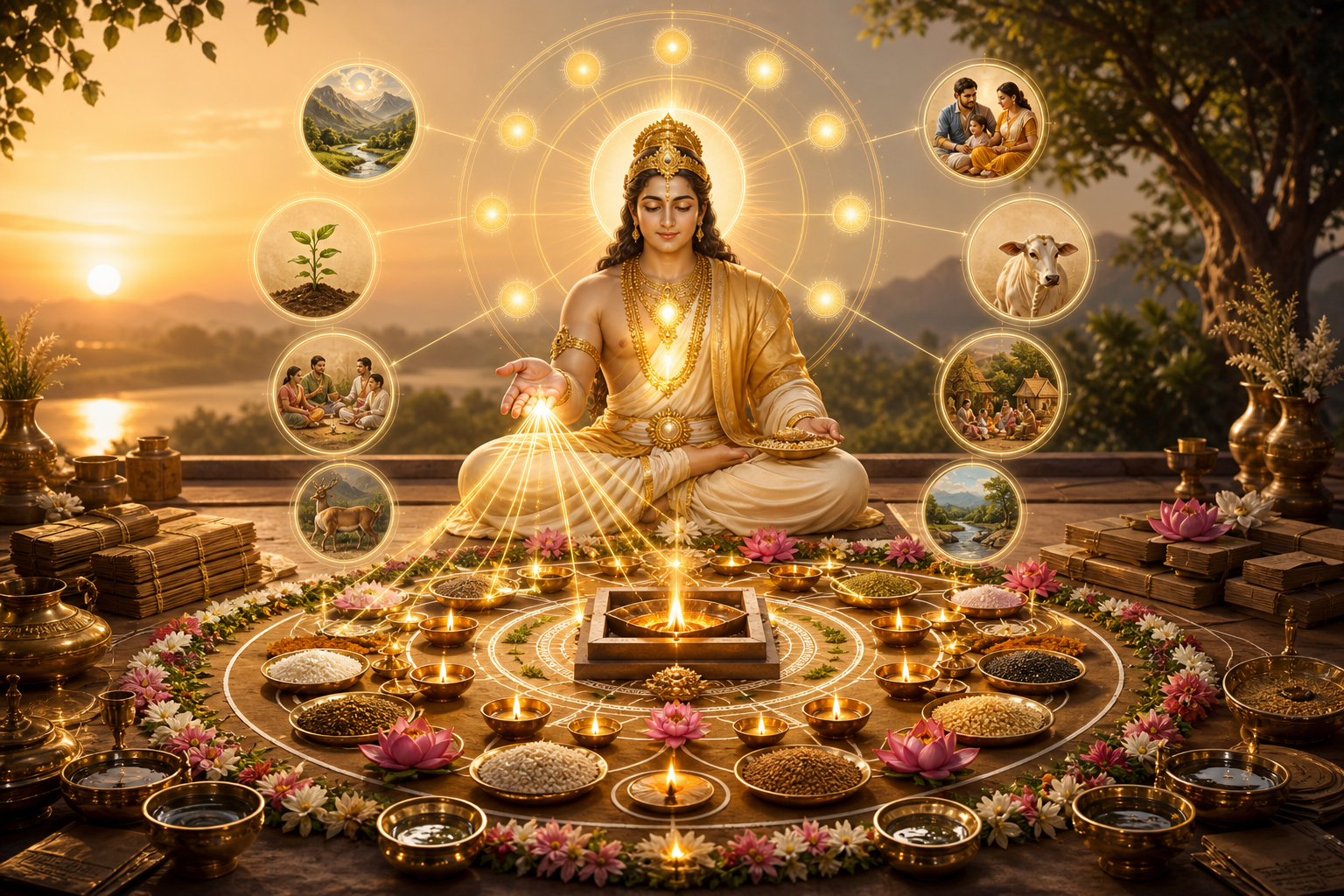
    Why does yajna (yagna) call specifically for ghee? This in-depth exploration connects scriptural injunctions, symbolism, and combustion science to show how ghee uniquely sustains a clean, bright flame, efficiently volatilizes herbal samagri, and embodies the sattvic nourishment central to Vedic ritual. It explains the ājya role of ghee in Śrauta and Gṛhya rites, clarifies why…

  • Mrityunjaya Murti of Shiva: Timeless, Death-Conquering Iconography, Vedic Mantra, and Rituals

    Mrityunjaya Murti of Shiva: Timeless, Death-Conquering Iconography, Vedic Mantra, and Rituals

    Mrityunjaya Murtithe death-conquering form of Shivaunites Vedic mantra, Purāṇic narrative, and precise iconography into a living theology of courage and immortality. This article decodes the Mahamrityunjaya (Tryambaka) mantra from Rig Veda 7.59.12 and related Yajurveda sources while explaining how shilpa-śāstra and Āgamas shape the image’s attributestrinetra, jata-makuṭa, serpent ornaments, triśūla, ḍamaru, and the amṛta-kalaśa. It…

  • Agni Idol Iconography Decoded: Vedic Fire, Sacred Geometry, and Unity Across Dharmic Traditions

    Agni Idol Iconography Decoded: Vedic Fire, Sacred Geometry, and Unity Across Dharmic Traditions

    This in-depth guide decodes the idol form of Agnitwin heads, seven tongues, ram mount, and ritual implementsso readers can reliably identify him in temples and museums. It explains why the Rig Veda opens with “Agnim ile purohitam yajnasya devam ritvijam” and shows how that verse is visualized in sculpture. It connects iconography to living practice…

  • Sanskrit Across Millennia: Unraveling Vedic vs Classical, Hidden Variants, and Lineages

    Sanskrit Across Millennia: Unraveling Vedic vs Classical, Hidden Variants, and Lineages

    Sanskrit’s evolution from Vedic to Classical illuminates how a single language sustained multiple dharmic traditions while accommodating regional identities and scholarly innovation. The article explains, in technical yet readable terms, the core differences between Vedic and Classical Sanskrit in accent, morphology, and style. It then maps internal variation within bothacross śākhās, genres, and historical periodsso…

  • Unraveling the Soul in Mimamsa: Ritual Power, Karma Mechanics, and Liberation in Classical Hinduism

    Unraveling the Soul in Mimamsa: Ritual Power, Karma Mechanics, and Liberation in Classical Hinduism

    Mimamsa develops a precise account of the soul (ātman) by grounding ethics in Vedic authority, ritual grammar, and the law of karma. It explains how apūrva (the unseen potency) links present actions to future results, safeguarding karmic justice across rebirths without requiring a discretionary deity. The soul is eternal, responsible, and known through robust pramāṇa…

  • Sri Suktam–Purusha Suktam Samputikarana: A Profound Vedic Rite for Abundance and Cosmic Harmony

    Sri Suktam–Purusha Suktam Samputikarana: A Profound Vedic Rite for Abundance and Cosmic Harmony

    Sri Suktam–Purusha Suktam Samputikarana unites two seminal Vedic hymns into a single, integrated practice that harmonizes prosperity with cosmic order. Purusha Suktam establishes the metaphysical axis of rta, while Sri Suktam invites Mahalakshmi’s auspicious abundance to descend in service of dharma. Through samputikaranathe interleaving methodthe rite makes their complementarity audible and transformative. The practice refines…

  • Beyond Dates and Dynasties: Why Dharmic India Chose Timeless Truth over History

    Beyond Dates and Dynasties: Why Dharmic India Chose Timeless Truth over History

    Ancient India developed a distinct historiography that privileged timeless truth over exhaustive chronologies. Rather than ignoring the past, Hinduism, Buddhism, Jainism, and Sikhism embedded history in genres like Itihāsa, Purāṇa, and Śāstra to illuminate Dharma and guide conduct. Epigraphy, coins, and temple records demonstrate rigorous documentation when it served justice, patronage, and community welfare. Examples…

  • Madhyandina Shakha of the Shukla Yajurveda: Yajnavalkya’s timeless legacy, texts, rituals, and reach

    Madhyandina Shakha of the Shukla Yajurveda: Yajnavalkya’s timeless legacy, texts, rituals, and reach

    Madhyandina Shakha is a principal recension of the Shukla Yajurveda, tracing its lineage to Yajnavalkya and preserving a carefully ordered ritual and philosophical corpus. Its core textsthe Vājasaneyi Madhyandina Saṁhitā and the Śatapatha Brāhmaṇa (Madhyandina)transmit the Isha and Brihadaranyaka Upanishads, uniting precise liturgy with deep inquiry into the Self. Auxiliary works such as the Kātyāyana…

  • Ashadha Purnima (Guru Purnima) 2026: Date, Rituals, Vyasa Puja Guide & Dharmic Unity

    Ashadha Purnima (Guru Purnima) 2026: Date, Rituals, Vyasa Puja Guide & Dharmic Unity

    Ashadha Purnimaalso known as Guru Purnima or Veda Vyasa Purnimafalls on 29 July 2026 and honors the Guru-Shishya Tradition across the dharmic family. The festival venerates Bhagavan Veda Vyasa and the transpersonal Guru principle that links knowledge with ethical living. This long-form guide explains the lunar calendar basis of the observance, regional variations, and the…

  • Neither Sat Nor Asat: Rigveda’s Nasadiya Sukta, Vedic Cosmology, and Sacred Paradox Explained

    Neither Sat Nor Asat: Rigveda’s Nasadiya Sukta, Vedic Cosmology, and Sacred Paradox Explained

    Rigveda’s Nasadiya Sukta opens with the paradox “neither sat nor asat,” a precise philosophical strategy rather than a rhetorical flourish. Read in concert with the Upanishads, the hymn marks a pre-categorical horizon where ordinary predicates fail, complementing later Vedantic distinctions between ultimate and conventional truth. Classical schools clarify its logic: Sāṅkhya’s causal latency, Nyāya’s theory…

  • Does Time Flow or Does Space Evolve? A Profound Reconciliation of Relativity and Dharmic Wisdom

    Does Time Flow or Does Space Evolve? A Profound Reconciliation of Relativity and Dharmic Wisdom

    This comprehensive analysis reconciles a popular paradox: modern physics is said to claim that time changes while space is constant, whereas ancient dharmic texts appear to say the opposite. Clarifying the science, general relativity treats spacetime as dynamic, with evolving spatial geometry and observer-dependent time. Clarifying the traditions, Hindu, Buddhist, Jain, and Sikh sources distinguish…

  • Is Any Indian Scripture Equal to the Quran or Bible? A Definitive Guide to Dharmic Canons

    Is Any Indian Scripture Equal to the Quran or Bible? A Definitive Guide to Dharmic Canons

    Is any Indian scripture equal to the Quran or Bible? In the dharmic world, authority is polycentric rather than centralized in one book. Hinduism distinguishes Sruti (the Vedas, as apex authority) from Smriti (Itihāsa, Purāṇa, Dharmashastras, and Agamas), with the Bhagavad Gita serving as the most accessible synthesis for general readers. Sikhism centers on a…