
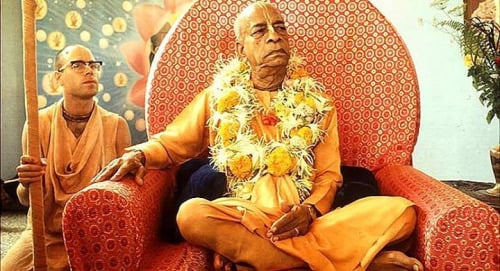
“I want you to go to China.” In the history of ISKCON and the Hare Krishna movement, this brief instruction to Tamal Krishna Goswami stands as more than a dramatic moment between guru and disciple. It reveals a sophisticated model of spiritual leadership, institutional correction, and devotional redirection. The episode took place in the atmosphere of Mayapur, at a time when the Radha Damodar party had become one of the most energetic and financially successful preaching units connected with Srila Prabhupada’s mission.
The account centers on a period of extraordinary momentum. The Radha Damodar party, under Tamal Krishna Goswami’s leadership, had become a major force in book distribution and public outreach. Within a year, its contribution reportedly reached forty percent of the total BBT proceeds. In practical terms, this meant that a mobile preaching party, driven by austerity, discipline, and zeal, had become one of the most productive instruments for spreading Krishna consciousness in the 1970s.
That success, however, also created institutional strain. Some brahmacharis were leaving their temples to join traveling sannyasis, while tensions grew between different models of service: the temple-based system led by grihastha temple presidents and the mobile sankirtana parties led by renounced preachers. This tension was not merely administrative. It raised deeper questions about authority, attachment, service identity, and the balance between missionary expansion and organizational harmony.
By the time the party arrived in India, it had brought around ninety brahmacharis. The Radha Damodar party occupied the entire third floor of the lotus building in Mayapur and appeared, from an external point of view, to be riding a wave of success. Such moments are often intoxicating in religious institutions. A service may be genuinely effective, yet the very energy that makes it effective can become disruptive if it begins to weaken shared discipline or collective trust.
The 1975 Christmas marathon illustrates the intensity of that period. The competition between Jayatirtha in California and the Radha Damodar party had become serious and highly charged. Ramesvara repeatedly asked Tamal Krishna Goswami how much the party would contribute to the book fund. The response was characteristically bold: a blank check could be placed in the safe, and whatever amount Jayatirtha gave, ten thousand dollars more could be added. It was a statement of fierce determination, confidence, and competitive devotional ambition.
By the end of that marathon, the Radha Damodar party had given one hundred ninety-five thousand dollars to the book fund, distributed a quarter of a million Back to Godhead magazines, and moved sixty thousand big books. These numbers are historically significant because book distribution was central to Srila Prabhupada’s vision. The BBT was not only a publishing house; it was a theological and educational engine for transmitting Vedic knowledge, Bhagavad Gita philosophy, and devotional practice across cultures.
Yet the deeper lesson of the event is not numerical success. The story shows that even successful service can require correction when it produces agitation. In Mayapur, temple presidents brought their concerns before Srila Prabhupada. Tamal Krishna Goswami remained in the room after the others left, sensing that a direct conversation with Prabhupada was necessary. This instinct itself reveals an important principle of the guru-shishya tradition: real discipleship does not hide from correction. It seeks clarity at the feet of authority.
When Prabhupada looked at him, Tamal Krishna Goswami expressed uncertainty: “I don’t know what to do. Maybe I should go to China or something.” At that time, going to China felt as improbable as going to the moon. It was not a casual travel suggestion. It represented the far edge of missionary imagination, a place that seemed remote, politically difficult, culturally complex, and spiritually challenging for an expanding Vaishnava movement based largely in India, Europe, and North America.
The next morning, during arati, Prabhupada’s servant called Tamal Krishna Goswami to see him. The initial response was resistance: “I’m not going.” The statement carried two meanings. He did not want to go upstairs, and he did not want to go to China. This moment is psychologically revealing. A disciple may be strong in preaching, fundraising, organization, and public mission, yet still find surrender difficult when the instruction touches the center of personal identity.
When he finally came before Prabhupada, the instruction was direct: “I want you to go to China.” Tamal Krishna Goswami immediately raised the practical concern: the Radha Damodar party needed him. Prabhupada repeated the instruction and briefly left to prepare for his walk. When he returned, he again said, “I want you to go to China.” The repetition was significant. It removed ambiguity and transformed an offhand remark into a formal directive from the spiritual master.
Tamal Krishna Goswami then began to offer reasons why the assignment would be difficult. What would happen to the party? Who would maintain its momentum? Was this not an important service? Prabhupada’s answer was both compassionate and uncompromising: “Don’t worry about the Party.” The account notes that Prabhupada’s bottom lip quivered and his hand shook. The emotional intensity of the moment suggests that this was not a cold administrative reassignment. It was a deeply personal act of spiritual care and institutional guardianship.
Prabhupada then gave the decisive instruction: “Then I take that service away from you. You have no other service to do now. Either you go to China, or you sit in Mayapur and chant Hare Krishna. There’s nothing else for you to do.” This statement reveals a core principle of Krishna consciousness: service is not owned by the servant. A role may be performed with intensity and excellence, but it remains an offering. If the guru redirects it, the disciple’s test is not efficiency but surrender.
Gurukripa, who was sitting behind Tamal Krishna Goswami, offered to go to China. Prabhupada refused: “No, he must go to China.” This response confirms that the instruction was not merely about finding a volunteer for a foreign mission. It was specifically directed toward Tamal Krishna Goswami. The assignment addressed his service, his attachment, his leadership, and his future contribution to the mission. In Vaishnava pedagogy, the instruction of the guru is often exact, even when its full purpose is not immediately visible.
The turning point came through a sudden inner recognition. The Radha Damodar party existed for Prabhupada’s pleasure. If Prabhupada would be pleased by his going to China, then the meaning of the service was fulfilled. This realization transformed resistance into acceptance. Tamal Krishna Goswami responded, “Okay, I’m ready to go.” Prabhupada beamed. The emotional weight of the room changed. What had begun as a difficult correction became a moment of devotional clarity.
Afterward, Prabhupada went to the roof, where he would walk, and announced: “Tamal Krishna Maharaj is going to China.” The devotees responded, “Jai, hari bol!” This public announcement is central to understanding Prabhupada’s leadership. He did not humiliate the disciple. He did not publicly frame the change as punishment or failure. Instead, he converted a tense institutional problem into a glorious new opportunity for Krishna’s service.
This is one of the most instructive dimensions of the episode. Prabhupada did not say, “People are complaining about you,” nor did he dwell on blame. He saw the disturbance, addressed the root attachment, protected the institution, and opened a new field of preaching. In modern leadership theory, this would be called reframing conflict into mission. In the language of dharma, it was the art of transforming adharma-leaning friction into renewed service.
The episode also illustrates the complexity of spiritual authority. Prabhupada’s instruction was not authoritarian in the shallow sense of merely imposing control. It was grounded in a larger vision: the welfare of the disciple, the stability of the movement, and the expansion of Krishna consciousness. Such authority requires moral clarity and detachment. It does not flatter success when success becomes entangled with ego, nor does it discard the servant when correction is required.
For readers shaped by contemporary institutional life, the story remains highly relatable. Many people know the experience of becoming identified with a project, team, title, or achievement. A person may begin with sincere intention, yet gradually feel indispensable. The fear of stepping away can appear as responsibility, but it may also conceal attachment. The Radha Damodar party was important, but Prabhupada’s intervention clarified that no single servant is the proprietor of service.
In dharmic traditions, this principle appears in many forms. Hinduism, Buddhism, Jainism, and Sikhism each warn against egoic identification with action, status, or possession. The Bhagavad Gita teaches disciplined action without possessiveness over results. Buddhist thought analyzes attachment as a cause of suffering. Jain ethics emphasizes restraint and non-possessiveness through aparigraha. Sikh tradition places service, seva, and humility at the center of spiritual life. Though their theological frameworks differ, these traditions converge in the insight that service becomes purified when it is freed from self-ownership.
Seen through that broader dharmic lens, the China instruction becomes more than an ISKCON anecdote. It becomes a case study in how spiritual discipline reorders ambition. Tamal Krishna Goswami’s drive was not condemned. His energy, determination, and organizational capacity were real assets. What required refinement was the subtle shift from serving through a mission to clinging to a mission as personal territory. Prabhupada’s correction preserved the energy while redirecting the attachment.
The historical setting is also important. In the 1970s, China was not an easy or obvious field for religious outreach. The country had undergone immense political and ideological upheaval, and public religious activity was heavily constrained. To send a leading disciple toward China required strategic imagination. Prabhupada was thinking beyond the visible boundaries of immediate success. He saw the global destiny of Krishna consciousness and the need to carry Vedic knowledge into difficult cultural spaces.
This strategic dimension deepens the story. A leader dealing only with internal complaints might have removed a person from responsibility and left the matter there. Prabhupada instead converted removal into expansion. The disciple was not diminished; he was given a frontier. The community was not burdened with prolonged factional tension; it was invited to celebrate a new mission. This combination of correction and empowerment is rare and deserves careful study.
The account also helps explain why Srila Prabhupada’s disciples often remembered him as both exacting and deeply affectionate. He could be stern when service required it, but his sternness was not driven by resentment. His concern was whether Krishna’s service was being advanced in purity. When he said, “Don’t worry about the Party,” he was not dismissing the party’s value. He was placing it back under divine ownership.
There is also a subtle theology of surrender embedded in the episode. Surrender does not mean passivity, weakness, or lack of intelligence. Tamal Krishna Goswami was not a passive figure; he was a strong organizer and preacher. His surrender mattered precisely because he had capacity, influence, and success. To give up failure is easy. To give up a thriving service when instructed by the guru is a deeper test of spiritual maturity.
The narrative further shows that correction, when administered with wisdom, can preserve dignity. Prabhupada did not use public shame as a tool. He did not allow the complaints to define the disciple. Instead, he made the disciple’s next act meaningful. That approach offers a practical lesson for spiritual communities, educational institutions, and mission-driven organizations: correction should be truthful, but it should also be oriented toward restoration and future service.
In a wider study of ISKCON history, the Radha Damodar party represents the power of concentrated sankirtana culture. Its results were extraordinary, and its influence on book distribution remains memorable. At the same time, the Mayapur episode demonstrates the need for alignment between charisma and institutional discipline. Movements built on spiritual enthusiasm must also cultivate humility, accountability, and respect for diverse forms of service.
The tension between brahmacharis, sannyasis, and grihastha temple presidents should therefore be read carefully. It need not be framed as one ashram against another. A dharmic community functions best when renunciation, household leadership, scholarship, worship, outreach, and administration are all respected as parts of a larger whole. Prabhupada’s intervention helped prevent a service culture from becoming polarized around status or lifestyle.
This point is especially relevant for readers interested in unity among dharmic traditions. Religious communities often experience tension between contemplatives and organizers, renunciants and householders, scholars and activists, ritual specialists and public teachers. The healthiest traditions do not erase these distinctions; they harmonize them around dharma, humility, and service. The China instruction was one such harmonizing act.
The emotional force of the story lies in its honesty. Tamal Krishna Goswami did not initially want to go. He resisted, argued, and worried about the future of his work. This makes the final acceptance more meaningful. It was not a theatrical obedience without inner struggle. It was the movement from self-protection to trust. Many sincere practitioners recognize this pattern: the heart first clings, then reasons, then slowly understands that surrender may be the doorway to a larger service.
Prabhupada’s final handling of the matter shows why spiritual leadership cannot be reduced to management technique. Management could have redistributed personnel. Leadership gave the moment meaning. Management could have issued an order. Leadership transformed the order into a shared celebration. Management could have solved a complaint. Leadership opened China as a field of devotional aspiration.
For contemporary readers, the practical lesson is clear. When success begins to create agitation, the solution is not always to abandon the work. Sometimes the solution is to examine attachment, adjust leadership, and expand the horizon. A service that belongs to Krishna can continue without one person’s control. A mission that is truly spiritual does not end when a leader is reassigned; it matures when leadership becomes obedient to principle.
The phrase “I want you to go to China” therefore carries multiple meanings. Historically, it was a direct instruction from Srila Prabhupada to Tamal Krishna Goswami. Institutionally, it resolved a conflict around the Radha Damodar party. Spiritually, it exposed the difference between attachment to service and surrender in service. Emotionally, it showed how a painful redirection can become a moment of grace.
The story remains powerful because it refuses simplification. Tamal Krishna Goswami’s success was real. The concerns of the temple presidents were real. Prabhupada’s correction was real. The new opportunity was also real. In that complexity, the episode offers a mature vision of Krishna consciousness: action must be vigorous, results must be offered, authority must be respected, and service must remain larger than the servant.
Adapted from the recollection of Tamal Krishna Goswami in “Memories-Anecdotes of a Modern-Day Saint” by Siddhanta das.
Inspired by this post on Dandavats.






Leave a Reply
You must be logged in to post a comment.